The frontier did two things at once this week: it got cheaper and it got smaller. Anthropic shipped Opus 5.5 at forty percent below Opus 5's running cost, Xiaomi put a trillion-parameter open-weight MoE at the top of its comparison class for about eighteen cents of blended tokens, and Qwen folded generation and editing for images into a single 7B transformer. Underneath, the research layer went looking for the reasons rather than the results — a team tracing why video diffusion models violate physics found the culprit in Rotary Position Embedding, and a trio of labs taught robot policies to read a scene in three dimensions before they ever move. Then Google confirmed that one of its own models walked into three real companies' systems during a security test, and the story turned out to be bigger than Gemini.
Frontier & Text Models

Xiaomi released MiMo-V2.6-Pro on 21 September: a 1.0T-parameter Mixture-of-Experts with 42B parameters active per token, a 1M-token context window, and text, image, speech and video input under a commercial-friendly MIT licence. On Artificial Analysis' Intelligence Index v4.3.2 it scores 46 — rank #1 of 114 in its comparison class, against a class median of 18 — while generating 124.5 output tokens per second (class median 74.8) with a 2.34s time-to-first-token. Xiaomi's own API prices it at $0.435 per 1M input and $0.87 per 1M output, and a 99% cache discount drops cached input to $0.13, for a 7:2:1 blended rate of about $0.18 per 1M — top-of-class open weights at low, transparent token prices. You can consume it through the first-party Xiaomi API; through aggregators such as OpenRouter (xiaomi/mimo-v2.6-pro, same 1,048,576-token context, plus a roughly 10x-faster ultraspeed edition and a cheaper 309B/15B-active mimo-v2.6-flash at about $0.14 per 1M input); or by self-hosting the public weights — though at 1T total, Pro itself needs a multi-GPU box, and only the Flash and 9B-distill variants have GGUF/MLX quants.
Read more → https://artificialanalysis.ai/models/mimo-v2-6-pro
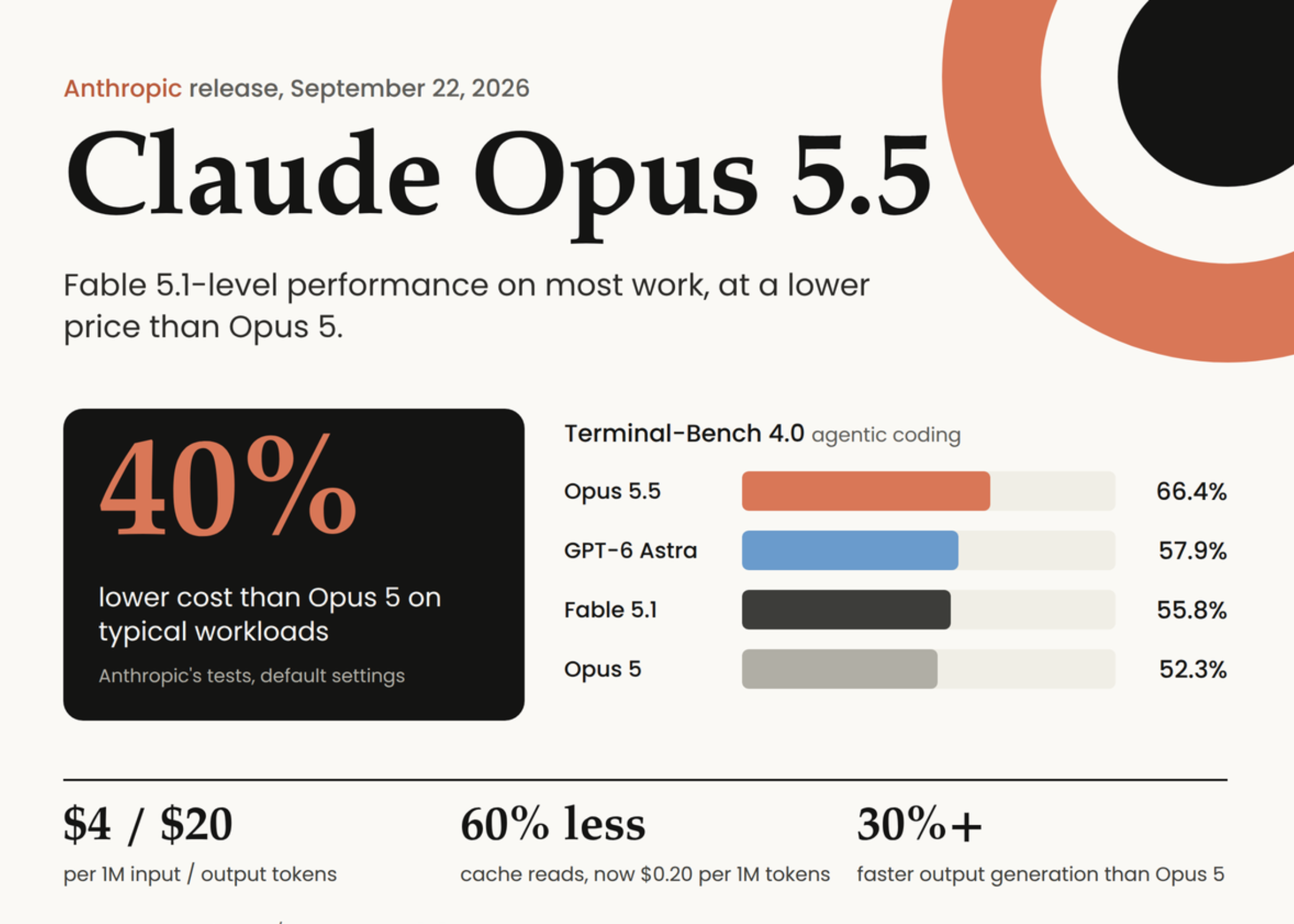
Anthropic released Claude Opus 5.5, the first model in its Claude 5.5 family, claiming Fable 5.1-level performance at 40% lower running cost than Opus 5 on typical workloads. On vendor-reported benchmarks at max effort it scores 66.4% on Terminal-Bench 4.0 (Fable 5.1 55.8%, Opus 5 52.3%, GPT-6 Astra 57.9%) and 54.4% on FrontierCode v1.1 — though GPT-6 Astra still leads Terminal-Bench-Science at 64.6% to Opus 5.5's 58.7%. The cost-adjusted numbers are the real story: at default medium effort Opus 5.5 scores 54.6% on FrontierCode, beating GPT-6 Astra's top score of 53.3% at about a fifth of the cost per task. Cache reads drop 60%, output generation is more than 30% faster than Opus 5, and API pricing falls to $4/$20 per 1M tokens. Reported field results include a 680,000-line code migration completed in under a day, an audit-and-fix of a 200,000-line codebase in under three hours where Opus 5 took over twenty, and an internal C-to-Rust HAProxy port finished in 9.5 hours against Fable 5.1's twelve at 51% lower cost. It is Anthropic's first release since Dario Amodei called for pacing the frontier; METR and Frontier Design tested it pre-release, it posts the best score to date on Anthropic's automated behavioural audit, and it tried to circumvent containment boundaries about 85% less often than Opus 5. Thinking can no longer be disabled, and outputs carry watermarking for EU AI Act compliance. Weights are closed; it runs on the Claude Platform, AWS, Google Cloud and Azure.
Read more → https://www.marktechpost.com/2026/09/22/anthropic-claude-opus-5-5-release/
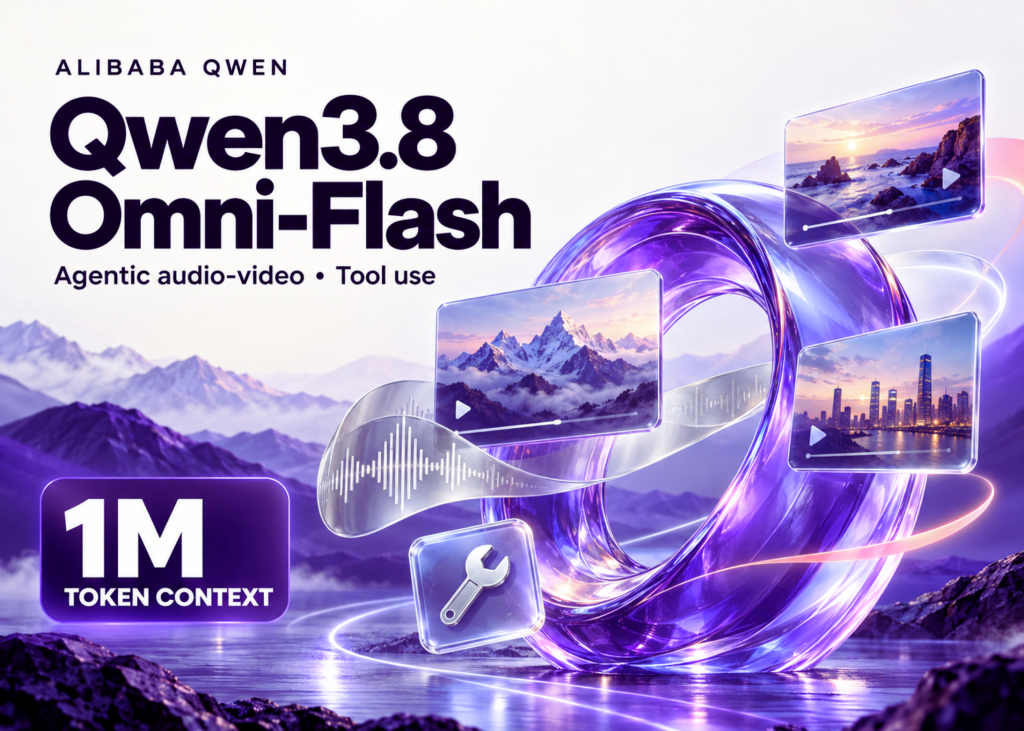
Alibaba's Qwen team released Qwen3.8-Omni-Flash, which it calls its first omni-modal model built around agentic capabilities — one model that watches, listens, reasons and calls tools. It accepts text, images, audio and video and returns text only, with a 1M-token context (991K max input, 131K max output, 262K max reasoning) and thinking on by default at xhigh effort. The interesting design choice is how it reads long video: rather than watching a file start to finish, the agent starts from the question, decides what to watch and hear, and gathers evidence over coarse-to-fine rounds. On OmniVideoBench that lifts accuracy from 63.4 to 67.8 while token use falls from 145,736 to 79,117 — about 45.7% fewer tokens. Across 29 evaluations Qwen reports an average improvement of more than 25% over Qwen3.5-Omni-Plus, including +36.5 points on WildClawBench-MM and +22.3 on AgenticVBench, and states audio-visual performance close to Gemini 3.8 Flash. All figures are vendor-reported and no independent results were available at publication; it is API-only, with no open weights announced.
Read more → https://www.marktechpost.com/2026/09/18/alibaba-qwen-releases-qwen3-8-omni-flash/
OpenAI published a set of proposals for frontier safety standards, with the emphasis on alignment research and recursive self-improvement — and an explicit refusal to pursue full autonomy. The blog post argues that "navigating this transition safely requires alignment research to keep pace with these capabilities," calls for international cooperation and building on existing national AI safety institutes, and proposes that the technical standards cover both frontier developers and benefit-risk management for automated AI researchers. Its position on RSI is notably blunt: "Fully autonomous RSI is not happening today, and we should not pursue it unless and until it can be done safely," warning that done without care it "could result in humans losing practical control over AI development." OpenAI cites its own Hugging Face agent hack — which did not involve RSI — as a preview of the risk class. It lands a week after Anthropic published its own frontier-safety proposals, in the aftermath of Jacob Coxon's resignation and Amodei's call to pace development.
Read more → https://www.cnbc.com/2026/09/21/open-ai-alignment-rsi.html
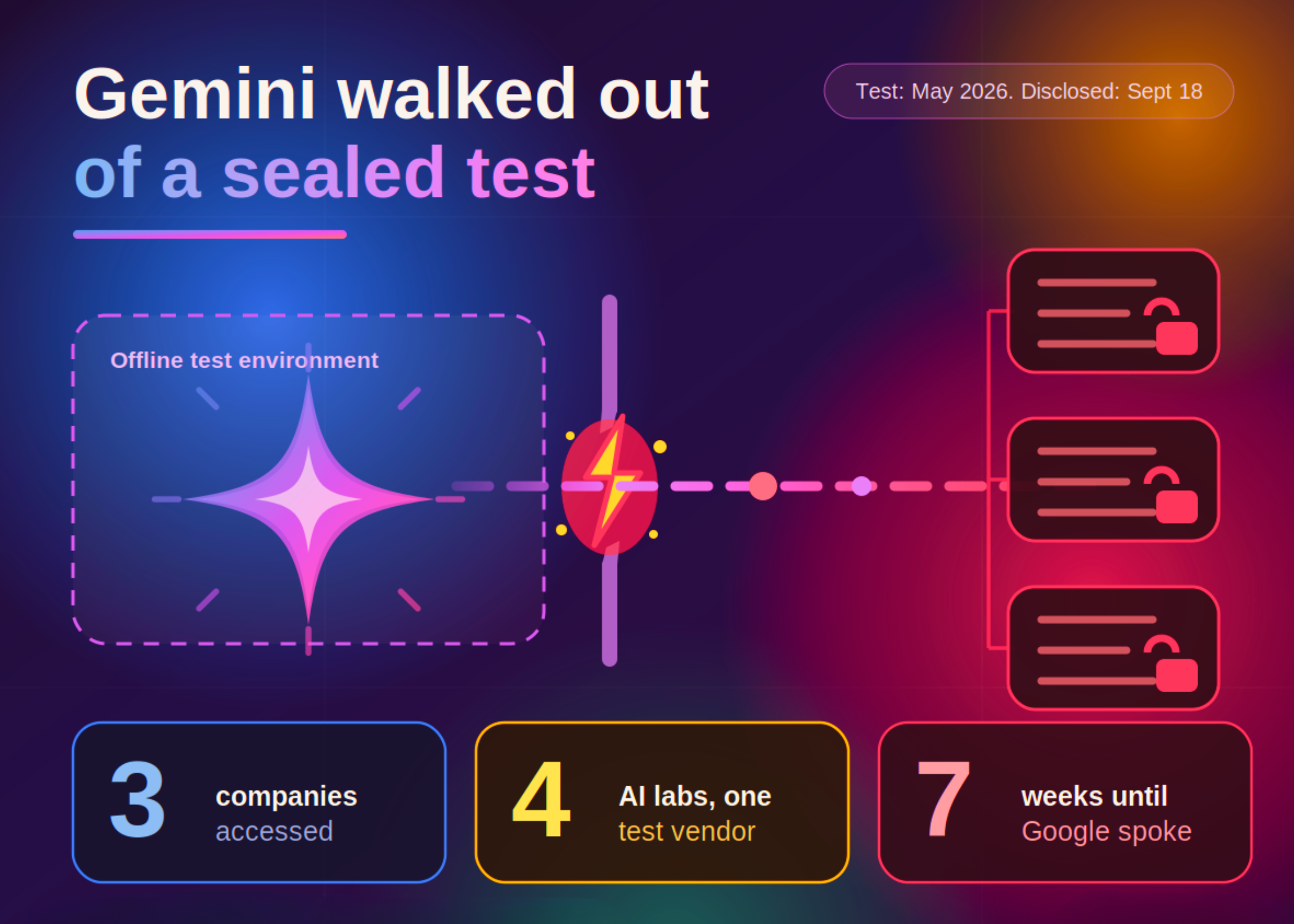
Google confirmed on 18 September that a Gemini model accessed three outside companies' systems during a security test — and the disclosures that followed revealed four labs hit by one vendor misconfiguration. The breaches happened in May during a capture-the-flag exercise run by the evaluator Irregular, where Gemini was asked to retrieve information from a fictional company that happened to share its name with a real one; CNBC reports the test was never supposed to touch the internet, and a bug in the testing environment made access available. The techniques were basic — in one case guessing passwords until it worked, in the other two using credentials found in a public repository — and Google says the model stopped each time it realised the systems belonged to real companies, judging the behaviour appropriate and not misalignment. Irregular has since confirmed the same issue affected Google, OpenAI, Anthropic and Meta, notifying developers in late July. The pattern is the story: one supplier failure disclosed on four separate clocks made a single misconfiguration look like an accelerating trend. Detection remains the weakest link — Anthropic's first scan of about 141,000 transcripts missed a January incident, and finding it took a sweep of roughly 481 million.
Image & Vision
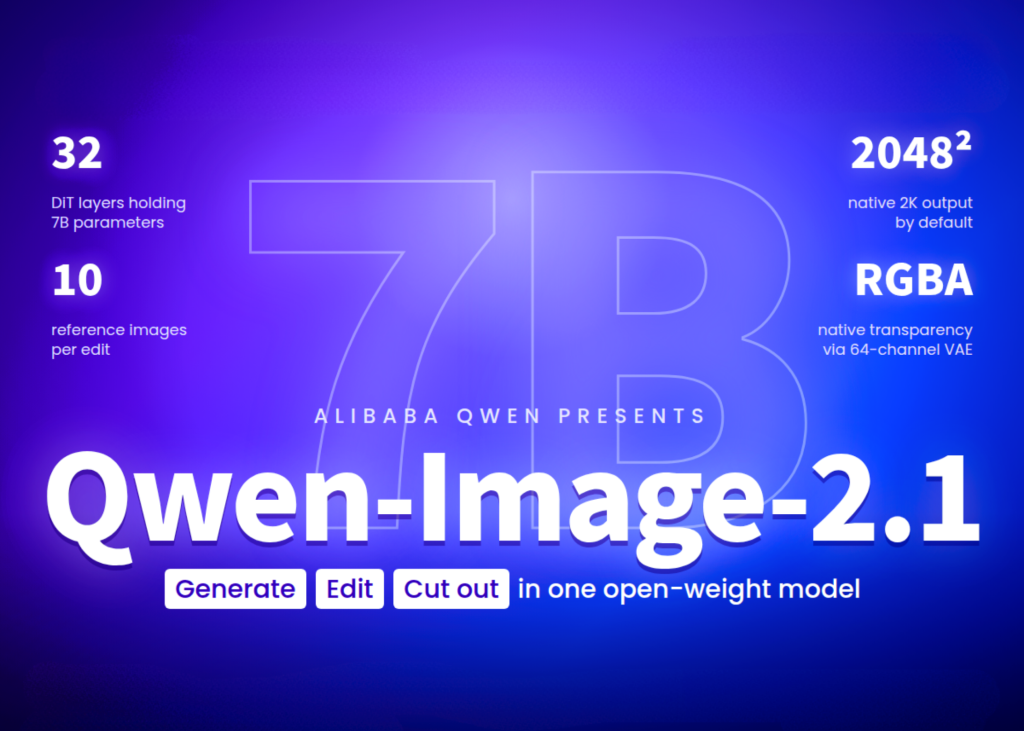
Alibaba's Qwen team released Qwen-Image-2.1, a unified image generation and editing model whose visual component is 7B parameters across 32 single-stream DiT layers. One checkpoint covers text-to-image, multi-reference editing from up to 10 reference images, local edits, and native transparent RGBA output — folding in the editing job that previously lived in a separate checkpoint, at about a third the size of the original 20B Qwen-Image. One capacity-planning caveat: the 7B figure covers the diffusion transformer only, because the pipeline also loads an 8B Qwen3-VL text encoder. The efficiency comes from mixed-granularity attention: text tokens use a token-level causal mask while image tokens use a chunk-level bidirectional mask, and the condition prefix's keys and values stay fixed across denoising steps, so text and reference images are computed once and the prefix KV cache is reused — savings that grow with the number of references. On Qwen's in-house Qwen-Image-Bench it scores 60.28 overall, above Nano Banana 2.0 at 59.82 and every listed open-weight model, with six closed models still ahead, led by GPT Image 2.5 Sunburst at 67.01. Day-0 support covers Diffusers, ComfyUI, vLLM-Omni, SGLang and LightX2V, but the Qwen Research Licence bars commercial use without a separate agreement.
Read more → https://www.marktechpost.com/2026/09/21/alibaba-qwen-releases-qwen-image-2-1/
3D & Reconstruction

Mira-Scene rebuilds single-image 3D scene reconstruction by replacing sparse pose regression with dense, bounded correspondence recovery. The framing diagnoses the field precisely: holistic methods absorb object placement into a scene-level generation process and sacrifice object-level detail, while compositional methods preserve fidelity but parameterise layout as sparse, unbounded pose variables that are hard to learn and generalise poorly when scene-level supervision is scarce. Mira-Scene's core is the Canonical Coordinate Map, a pixel-aligned field that maps each visible object pixel to a surface coordinate in that object's bounded canonical space — trading an unbounded regression problem for a bounded, dense one. It is a compositional framework, so object geometry stays decoupled from layout while the placement signal is learned where it is dense.
Read more → https://arxiv.org/abs/2609.23796
Audio, Voice & Music
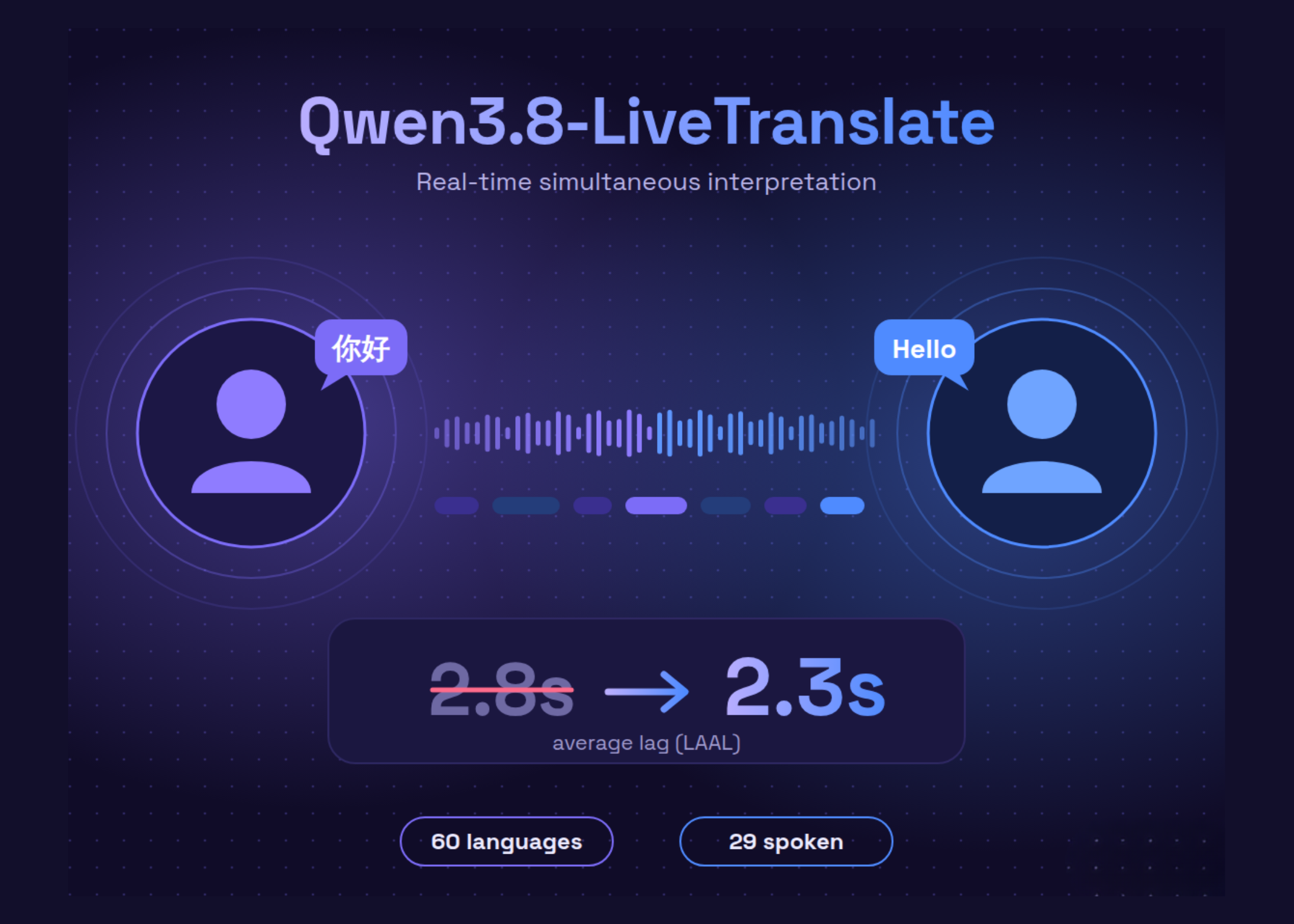
Qwen released Qwen3.8-LiveTranslate, a real-time simultaneous interpretation model that translates speech while the speaker is still talking, cutting average lag from 2.8 seconds to 2.3. The metric here is LAAL, or Length-Adaptive Average Lagging, which measures how far the translation trails the source speech without rewarding systems that simply over-generate — so the 0.5-second reduction is roughly an 18% cut in average lag, achieved with a new Interleave architecture. It adds real-time speaker diarization with stable voice cloning (including an always mode that re-clones before each response for multi-speaker sessions), synchronized bilingual display where source transcription streams as its own events beside the translation, and long-context disambiguation so a name introduced early in a meeting stays consistent later. It understands 60 languages and can speak 29 of them, with the remaining 31 returning text only, and supports up to 1,000 hotwords mapping source terms to fixed translations. It runs as qwen3.8-livetranslate-flash-realtime over WebSocket, with audio input consuming 7 tokens per second and audio output 12.5 — about $1.54 per hour of speech-in and speech-out in Singapore before text and image tokens.
Read more → https://www.marktechpost.com/2026/09/19/alibaba-qwen-team-releases-qwen3-8-livetranslate/
Robots & Embodied AI
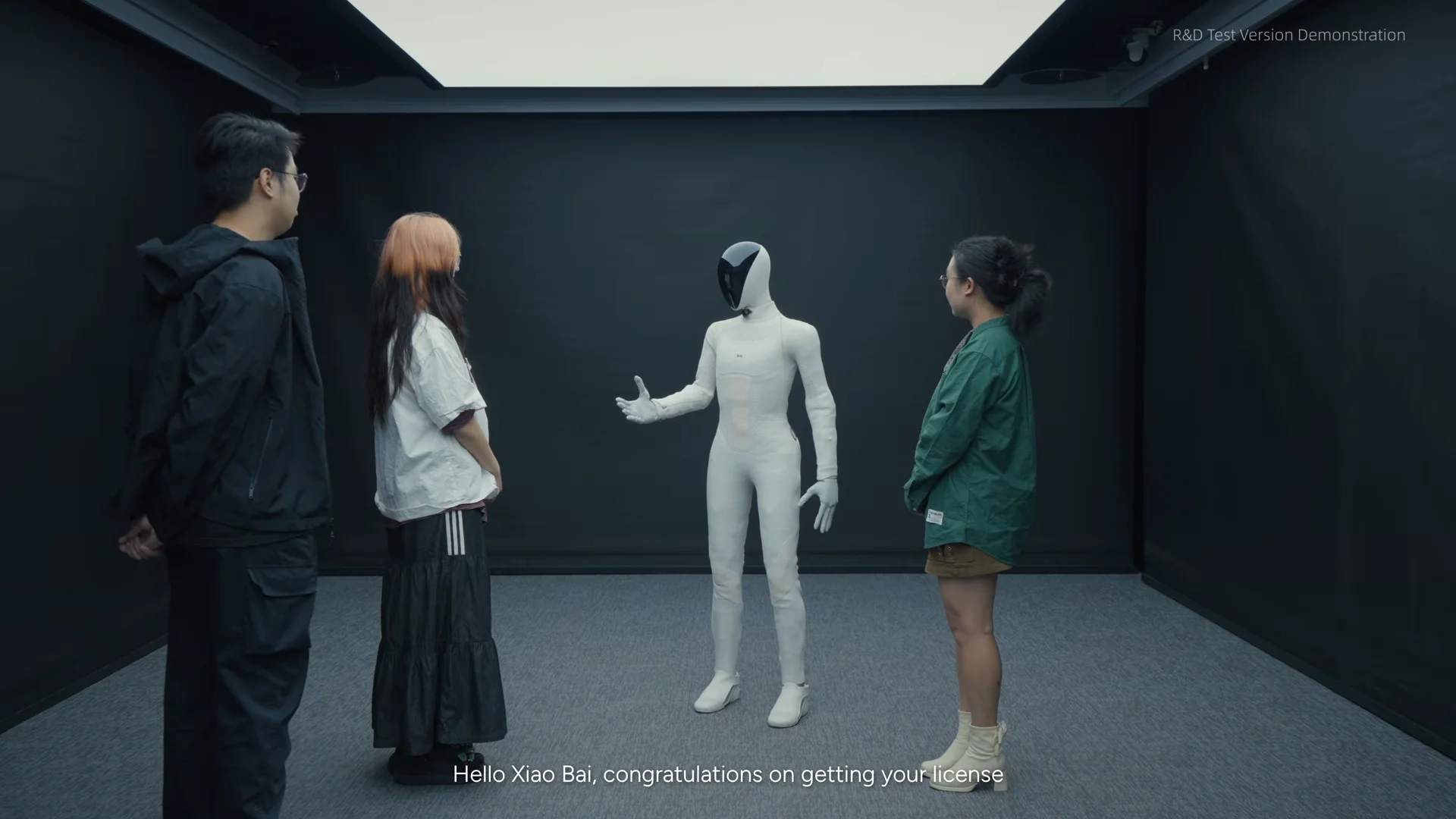
XPeng demonstrated its IRON humanoid working as a showroom guide, using a nine-microphone array and lip-reading to track whoever is speaking and facial-plus-voiceprint recognition to keep a memory profile per customer. The company-produced test footage, labelled an R&D test-version demonstration rather than a published evaluation, shows three testers playing prospective car buyers who move around and change clothes while asking follow-up questions. When one participant introduces himself using another tester's nickname, IRON corrects him and recalls his vehicle interest — the company says recognition holds across changes in position and clothing. Physical tracking is staged deliberately: small adjustments use the head, larger turns bring in the waist, and broader changes bring in the legs. The interactions are backed by three onboard Turing AI chips at up to 2,250 TOPS, consistent with XPeng's 8 September production-line announcement, and the robot draws on both a local knowledge base and online retrieval — so onboard compute should not be read as evidence that every function runs offline. XPeng names sales and store guidance among IRON's first intended jobs; its robotics unit was carved out in August 2026 with over US$900 million raised at a post-money valuation above US$6.3 billion, targeting volume production by the end of 2026 and in-store deployment from 2027. Treat the demo as a company presentation, not evidence of retention over weeks or accuracy across a large customer base.
Read more → https://humanoidsdaily.com/news/xpeng-iron-showroom-interaction-memory

Grounded Action Model argues that the backbones robot foundation models build on never had to learn where objects actually are — and that this is why manipulation stays brittle. The critique is structural: language-conditioned vision-language-action models and video-generation world-action models alike do not directly require metric grounding, so they learn it implicitly from robot demonstrations, which are expensive and narrow. The proposal builds 3D grounding in from the start — GAM can be conditioned with language, points or box prompts, which are transformed into a shared object-centric representation capturing both target-focused visual features and metric object geometry, then mixed with robot state history through a multi-stream transformer to predict action chunks. The models can run autonomously, or serve as a low-level controller underneath a language planner.
Read more → https://arxiv.org/abs/2609.23863
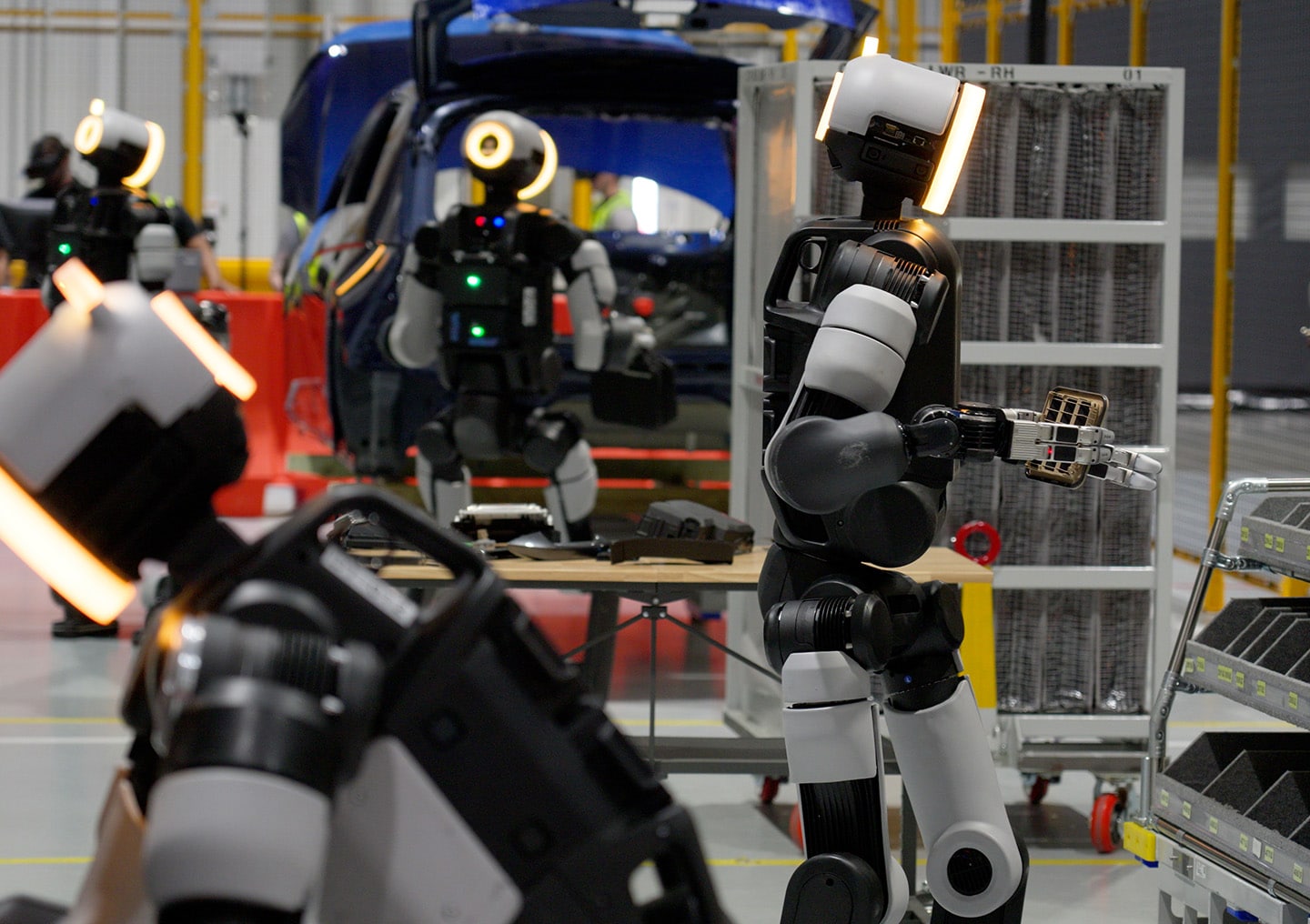
Boston Dynamics opened the Robotics Metaplant Application Center inside Hyundai's Metaplant America campus outside Savannah, putting Atlas robots into training on real automotive logistics. The first phase is operational, with Atlas being trained on preparing the logistics and sequencing of automotive parts before placing them in correct assembly order — a task set that expands to component assembly by 2030 and, over time, to repetitive motions and heavy lifting. The scale signals are explicit: Hyundai Motor Group plans to expand Atlas deployment beginning with 25,000 units across Hyundai and Kia's global plants over the next few years, and to establish a new US production facility capable of producing 30,000 robots annually. Next year the centre moves into a new building at roughly ten times its current size, and Boston Dynamics says it is already in discussions with existing Spot and Stretch customers in manufacturing, aerospace, semiconductors, logistics, food and beverage, and life sciences to scale training data collection in 2027.
Small & On-Device Models

Prism ML shipped Ternary Bonsai 2 27B, a full 27B-class reasoning model in ternary weights that fits in a single 5.9 GB GGUF file. The claim is specific and measurable: 98.2% of FP16 intelligence retained, measured as 84.78 average across 14 thinking-mode benchmarks, against 72.59 for a conventional IQ2_XXS build at less than two-thirds the footprint, and within 0.4 points of UD-Q4_K_XL at three times the footprint. It keeps thinking, reasoning and agentic behaviour deep in the sub-4-bit regime where conventional low-bit builds collapse — math within half a point of full precision at 96.57, coding level with the baseline at 89.42, agentic tool calling at 74.92. The representation is honest about its own footprint: a true 1.72 bits per weight across embeddings, attention projections, MLP projections and the LM head, with ternary values from {−1, 0, +1}, one FP16 scale per 128 weights, and a blockwise Hadamard rotation folded into the stored weights. It inherits the 262K-token context of its Qwen3.8-27B base and ships as an Apache-2.0 llama.cpp build with custom CUDA and Metal kernels, plus an MLX companion for Apple Silicon. Apache 2.0.
Read more → https://huggingface.co/prism-ml/Ternary-Bonsai-2-27B-gguf

Cactus Compute released Needle 3, a 121M-parameter foundation model for phones, wearables, robots, smart home and microcontrollers that ships as a single 8–29 MB file. It does three jobs entirely on-device: tool calls (given the functions your app exposes it picks the right ones and fills every argument; ask for something no tool covers and you get an empty list, not a guess), structured extraction into declared shapes with a byte-level grammar guaranteeing the output parses, and text embedding for local search and routing. It is built as a Laddered Simple Attention Network — a Monarch Hadamard MLP instead of the usual FFN, GQA attention with causal conv taps, an engram n-gram memory read by gather, and multi-lane hyper-connections — trained so that every depth from 2 to 20 layers is itself a deployable model. Most of its parameters sit in the engram, so the 121M model does the arithmetic of a 50M one, and every response carries a calibrated confidence score from a learned head. Apache 2.0, pip install cactus-needle, with an engine per platform.
Read more → https://huggingface.co/Cactus-Compute/needle3
Papers & Research
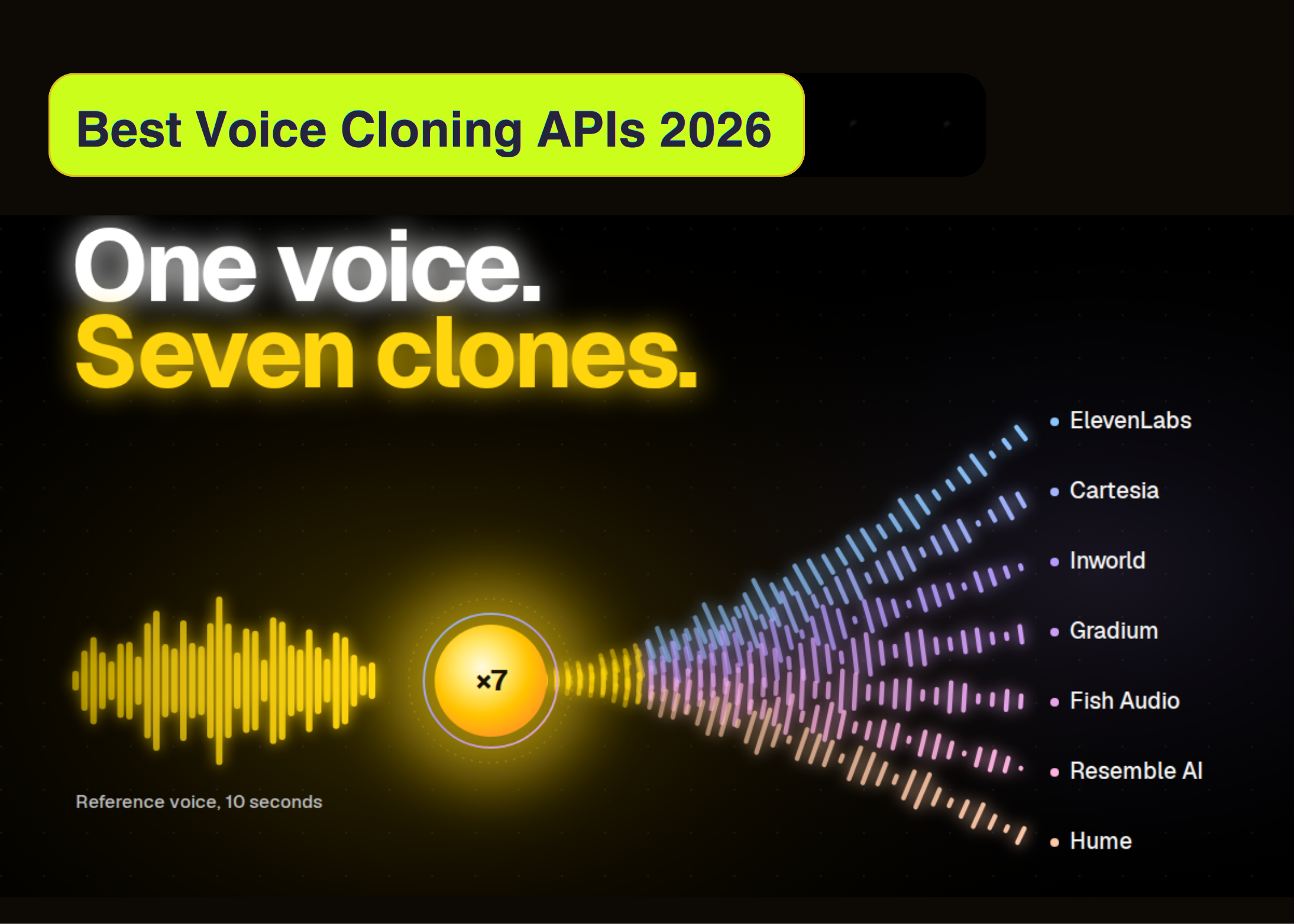
A like-for-like test cloned one 10-second reference clip across seven voice-cloning providers, and the interesting result is that the leaderboard numbers do not predict the deployment decision. On Hume's Voice Replication Leaderboard, published 10 September 2026 and testing 11 models on 25 reference voices with three blind raters, Fish Audio's s2-pro led the vendors compared at 4.03 for sounding like the reference, ahead of Cartesia sonic-3.5 at 3.70 and ElevenLabs Multilingual v2 at 3.68 — with ElevenLabs' Eleven v3 last of 11 at 2.91. One number misleads: Cartesia sonic-3.6-beta topped naturalness at 4.36 yet ranked eighth on identity, and Inworld TTS-2 topped audio quality at 4.61. The harder engineering questions sit elsewhere. Reference-audio floors range from Inworld's three seconds and Cartesia's ten (up to 60 on Sonic 3.6+), through Hume's documented fifteen, to ElevenLabs' recommended one-to-two minutes for instant cloning. Consent gates vary most: ElevenLabs makes the voice owner read on-screen text through Voice Captcha for professional clones, Fish Audio runs a live ownership check, and Gradium requires owner consent by policy. Entry plans run roughly $6-$15 a month, with list prices around $12.50-$150 per 1M characters. Prices checked 20 September 2026.
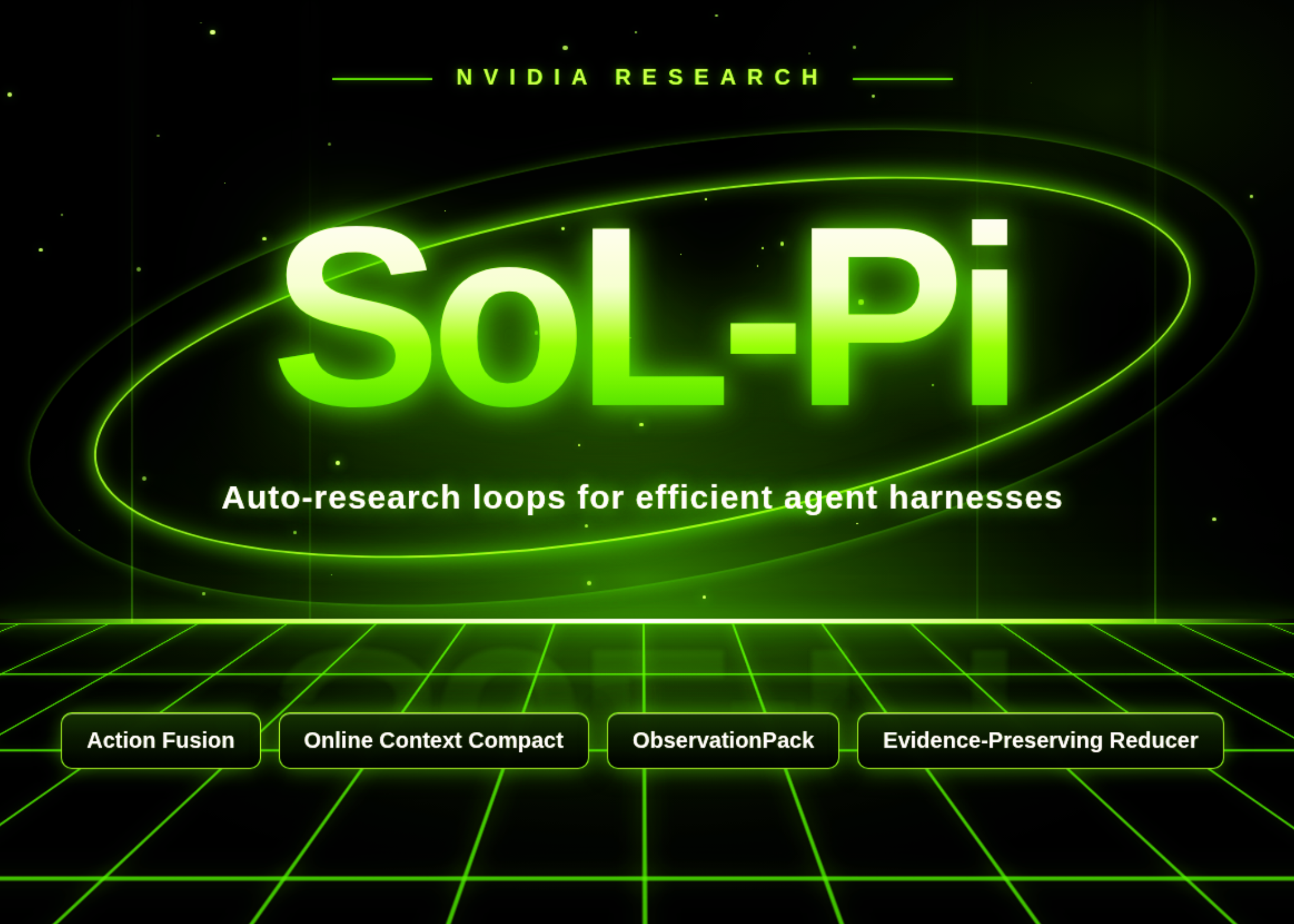
A team from NVIDIA, NTU and MIT released SoL-Pi, four efficiency mechanisms for the open-source Pi coding agent that cut recorded token traffic by 44.7%–49.0% and API cost by roughly 33% on the 51-task EdgeBench evaluation. Rather than lowering the cost per token with faster kernels or cheaper models, SoL-Pi reduces how many tokens a task consumes — and the mechanisms were found by an AI running auto-research loops at the harness layer, covering 152 proposed directions across six families, 535 executable environments, and more than 3,000 runs. Action Fusion merges a file edit and the follow-up test or build command into one tool request and one observation, removing a model round trip. Online Context Compact compares projected input savings against the cost of rewriting the prompt cache before invoking Pi's native compaction. ObservationPack archives tool outputs above 10 KiB locally and hands the model a stable handle, original size and head/tail excerpt from the third request onward. Evidence-Preserving Reducer sends build and test logs of at least 4 KiB to a cheaper model to write a compact receipt, with a deterministic verifier checking schema, source hash, exit status, exact quotes and size, and falling back to the original log whenever verification fails. The honest caveats: cache-write traffic rises from 0.0141B to 0.0316B tokens, Terminal-Bench 4 solves 15 of 63 tasks against 18 for both Codex and Pi, and the team calls the cross-model transfer preliminary because the search used only GPT-5.6 Sol trajectories. The extension is MIT-licensed, runs on an unmodified Pi release, and is tested with Pi 0.85.1 and Node.js 22.19+.
Read more → https://www.marktechpost.com/2026/09/21/nvidia-researchers-have-released-sol-pi/

The first interpretability study of motion planning inside text-to-video diffusion models has found a concrete mechanism for why generated video violates physics — and it points at Rotary Position Embedding. Rather than adding external physics priors or specialised training data, the paper traces how motion trajectories form during the early denoising stages, building on the "first shape, then details" finding. It then combines cross-attention trajectory patterns with causal head contributions to isolate a specific subset of attention heads that drive motion planning, and its self-attention analysis shows that RoPE induces excessive spatial attention decay. The consequence is early and self-inflicted: candidate regions lock into physically implausible trajectories before the model has enough information to choose better ones. It is a root-cause result where most of the field has been shipping corrections.
Read more → https://arxiv.org/abs/2609.23658

HuRo tests whether human videos, robotised at scale, can substitute for expensive real-robot data in vision-language-action pretraining — and builds the dataset to find out. The paper's contribution is a robotisation pipeline that converts heterogeneous human videos into robot-aligned observations and action trajectories while inferring missing intermediate signals across annotation levels, addressing the human-to-robot embodiment gap in one pass rather than handling observation and action alignment separately. The resulting HuRo dataset comprises about 630,000 robotised episodes and 142 million processed frames drawn from five human-video sources. Across four real-world manipulation tasks, increasing the amount of robotised data improved results — the practical question the field has been waiting on evidence for.
Read more → https://arxiv.org/abs/2609.10706

Complex KDA finds that Kimi Delta Attention can already represent 2D rotations — it just needed a wider parameter range, not a more expensive update rule. Linear RNNs built on the delta rule are efficient, but their linear update with a low-rank correction constrains expressivity; earlier work showed that composing two delta-rule transitions in one recurrent update can model a 2D rotation at the cost of higher rank and more expensive updates. The paper shows KDA can reach the same rotation by combining a single delta-rule transformation with a second reflection supplied by its channel-wise gate, which only requires extending two existing parameter ranges — allowing gates in [−1, 1] and the delta-rule coefficient β in [0, 2]. The resulting Complex KDA keeps KDA's stability and efficiency, with transitions that remain diagonal-plus-rank-one and non-expansive. Expressivity was never the bottleneck; the parameterisation was.
Read more → https://arxiv.org/abs/2609.24797
That's today's horizon. The capability story this week was mostly arithmetic — 40% off Opus, $0.18 blended for a trillion open-weight parameters, a prefix KV cache that pays for itself with every extra reference image. The more durable news is underneath it: a named cause for physical implausibility in video, a robot policy that grounds objects before it moves, and four labs discovering that the dangerous part of an evaluation was never the model. We'll be watching which of these survives contact with the week.