No new frontier model shipped this week — the news was everything built around them. Recurrence schedules that carry decoder state across token boundaries, an inbox for agents that work while you are not watching, context harnesses that fight overflow and goal loss, a $435M land grab in agent governance, and one clean negative result where a fruit fly connectome lost to a random control. The frontier moved sideways, not forward.
Frontier & Text Models
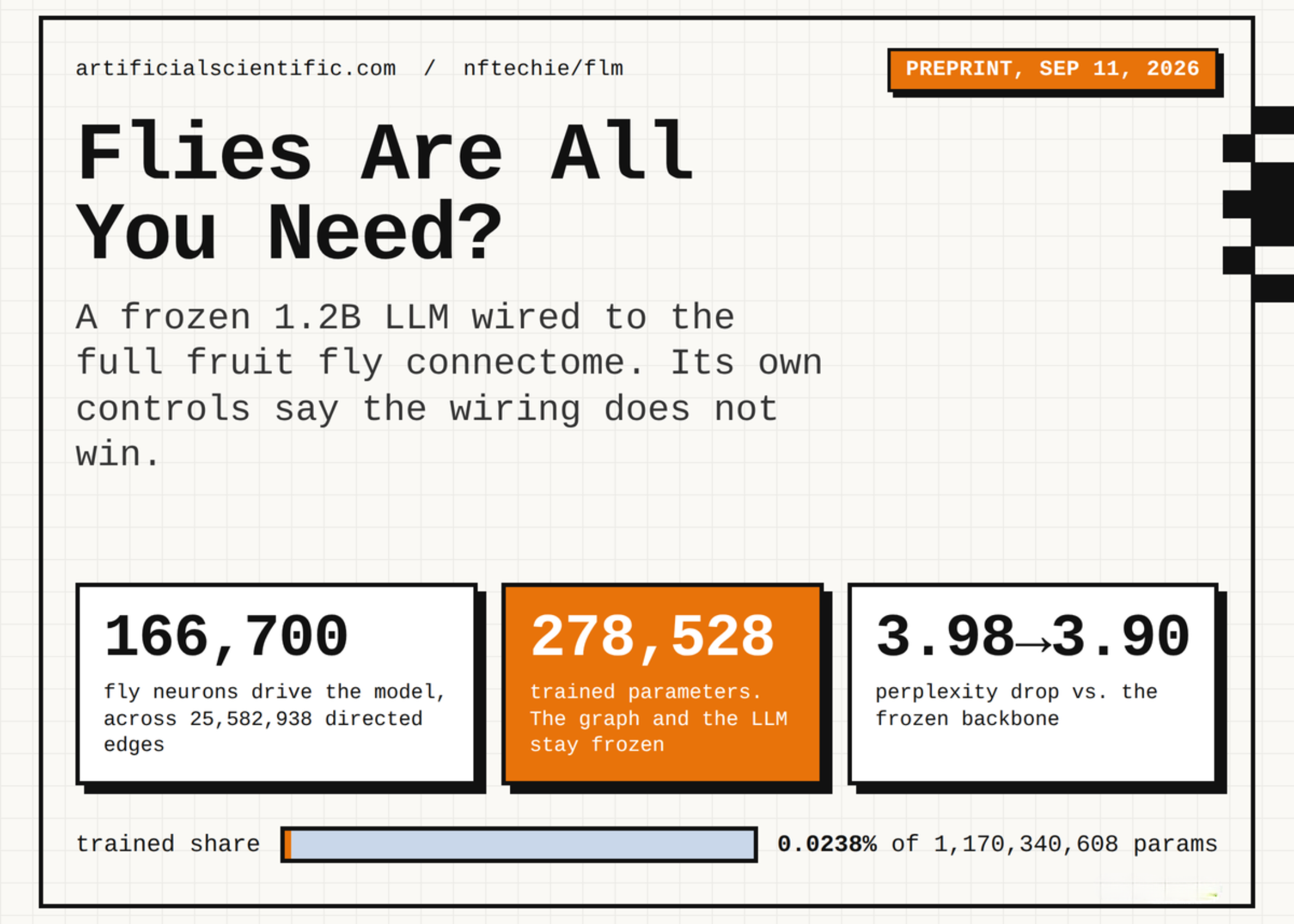
The most interesting result of the week is a negative one: a complete fruit fly connectome did not help a language model — and its own author's controls proved it. The Fly Language Model couples the full retained MaleCNS v1.0 connectome (166,700 nodes, 25,582,938 directed edges) to a frozen LiquidAI LFM2.5-1.2B-Instruct backbone. It is a reservoir computer bolted onto an LLM: the graph, the backbone, and the random input and output projections are all fixed, and only a 278,528-parameter readout is trained — roughly 0.0238% of the 1,170,340,608 backbone parameters. On 32 freshly frozen SmolTalk conversation dialogues (1,236 target tokens), the fly readout cut loss to 1.359816 nats/token against the frozen backbone's 1.381995 — but a parameter-matched control with no fly graph did slightly better, at 1.359328, in every seed. The biology did not beat arbitrary wiring, and the developer publishes that finding rather than burying it. It is the same lesson as the rest of this edition, arriving from the opposite direction: the structure you bolt onto a model has to earn its place.
Read more → https://github.com/nftechie/flm
Papers & Research

A Princeton researcher's September 12 technical report is a design specification, not a results paper — it reports no measured efficiency, reasoning-quality, or scaling numbers. In standard decoder-only LLMs, nothing computed at the last layer of token t feeds the first layer of token t+1; positions communicate only through attention over cached keys and values. Recurrent Looped Transformer (RLT) closes that loop, carrying the decoder's final hidden state and its layerwise sliding-window-attention cache into the next token across both prompt and response, with no reset at the boundary. The reference configuration ties 48 encoder and 48 decoder layers with shared attention and FFN weights, so each token executes 96 logical blocks — author Yifan Zhang calls this parameter reuse, not activation copying. After t tokens the state path traverses t·L_D decoder blocks, or 48t in the reference config, so structural depth grows with the sequence while per-token work stays fixed. "Infinite depth" means an extensible temporal computation path as the sequence grows, not infinite computation within one token — and the report is explicit that gates and contraction may suppress long paths, so structural depth is not a reasoning guarantee.
Read more → https://github.com/yifanzhang-pro/recurrent-looped-tranformer
News & Business
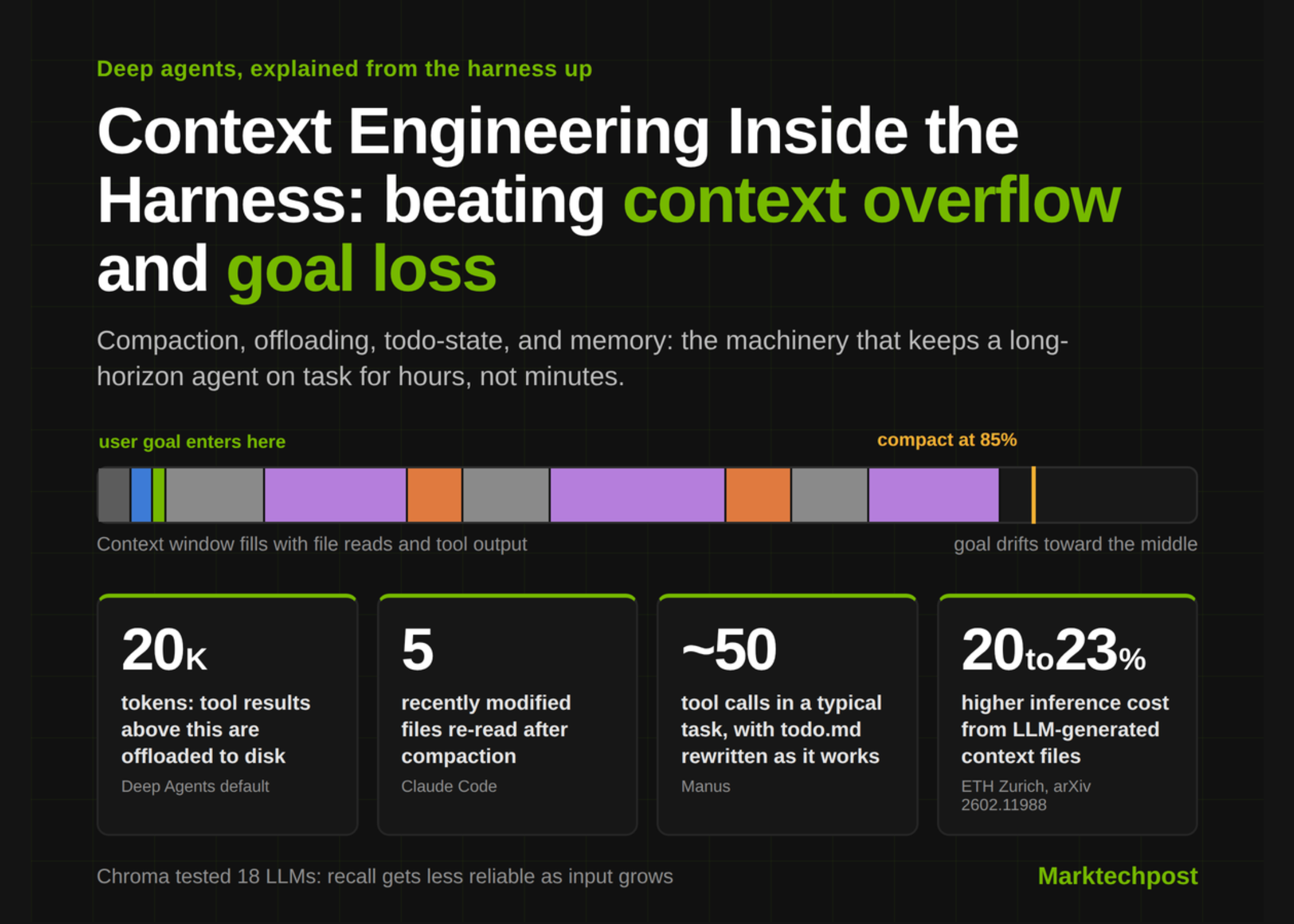
Shallow agents fail from context overflow and goal loss, and the fix lives in the harness — not the model. Four mechanisms do the work: budgeting and offloading, compaction, todo recitation, and persistent memory. Budget first: Deep Agents offloads tool results over 20,000 tokens and evicts old edits at 85% of the window. Compaction has to name what it keeps — Deep Agents adds session-intent and next-steps fields, while Claude Code re-reads its 5 most recent files. Todo recitation keeps the goal parked at the end of context, but Deep Agents v0.7 evaluations show it is not a free win. And persistent memory is not free either: ETH Zurich measured 20 to 23% higher inference cost from LLM-generated context files. The pattern across all four is the same one running through this edition — the model is a component, and the schedule around it is where the engineering lives.
AWS open-sourced Pizza Bot on September 10 — an email-style inbox for AI agents that run in the background, on the premise that background work is invisible in a chat window. It surfaces that work as three queues you already know how to read: All (thread history), Unread (completed work you have not looked at), and Action (work paused, waiting on your approval or answer), with an Activity panel showing what the main agent handed to a specialist, including that specialist's own transcript. Four requirements drove the design: inspect several sources, prepare a result in the background, ask before a consequential action, and come find the person who asked once it is done. The interface assumes you are not watching, pauses outlast the session that created them, and it plugs into Model Context Protocol servers for tools and Anthropic's Agent Skills convention so existing tooling carries over. A server owns the state and answers over HTTP; any client — Electron, browser, or terminal — reconnects and catches up, so a run keeps going when you close the thread or switch devices. The New Stack reported roughly 2,000 people inside Amazon used early versions before it was rebuilt as a standalone community project.

Between April and September 2026, investors poured $435 million into 12 financings for enterprise AI agent security and governance companies — nine of them aimed squarely at making agents safe enough to actually run inside businesses. The gap is real: IDC and Lenovo research finds 88% of enterprises with agent initiatives never ship to production, and Gartner predicts more than 40% of agentic AI projects will be cancelled by the end of 2027 over escalating costs, unclear value, and inadequate risk controls. The capital is flowing into the guardrails. AIR raised $50 million in early September — two rounds of $10 million led by Sequoia and $40 million led by Greenoaks — as an inline firewall that discovers and vets the skills, plugins, and MCP servers agents use, and already filters out about 27% of the add-ons it finds online as potentially risky; CEO Yair Saban compares it to driver signing in an operating system. Zenity secured $125 million in an August Series C led by Norwest, with SoftBank Vision Fund 2, Hitachi Ventures, and LG Technology Ventures participating, to monitor agent actions in real time and block deviations — revenues have tripled annually for two years. Alice raised $140 million led by Apax Digital Funds, is approaching $100 million in annual recurring revenue with 500% growth in its AI business over two years, and counts eight of the ten leading model labs as customers. Together Alice and Zenity account for $265 million — 61% of the five-month total. As Zenity CEO Ben Kliger puts it: "AI experimentation is long over." The bottleneck is no longer capability; it is governance.
Read more → https://forkast.news/enterprise-ai-agent-funding-surges-to-435m-in-five-months-security-and-governance-lead/
That's this week's horizon. Nothing new at the frontier — just five different groups discovering, from architecture, engineering, product, capital, and biology, that the model is no longer the interesting part. The scaffolding is.