The frontier kept splitting in two directions this week. One half pushed RL scaling and omnimodality to their limits — Xiaomi's MiMo-V2.6-Pro-RL runs one mixed reinforcement-learning pass across coding, agents, vision and security, while StepFun's 600B-total Step 5 Preview quietly re-opens the question of whether agentic long-horizon work needs a smaller brain. The other half went smaller and stranger: a 149M sparse retriever, a 421M classifier that refuses to generate text at all, a LoRA that cuts video diffusion from 49 forwards to 8, and a robot policy that learned from humans watching, not robots doing. And in British Columbia, the abstract argument about what a model owes the public became a lawsuit with a named defendant.
Frontier & Text Models
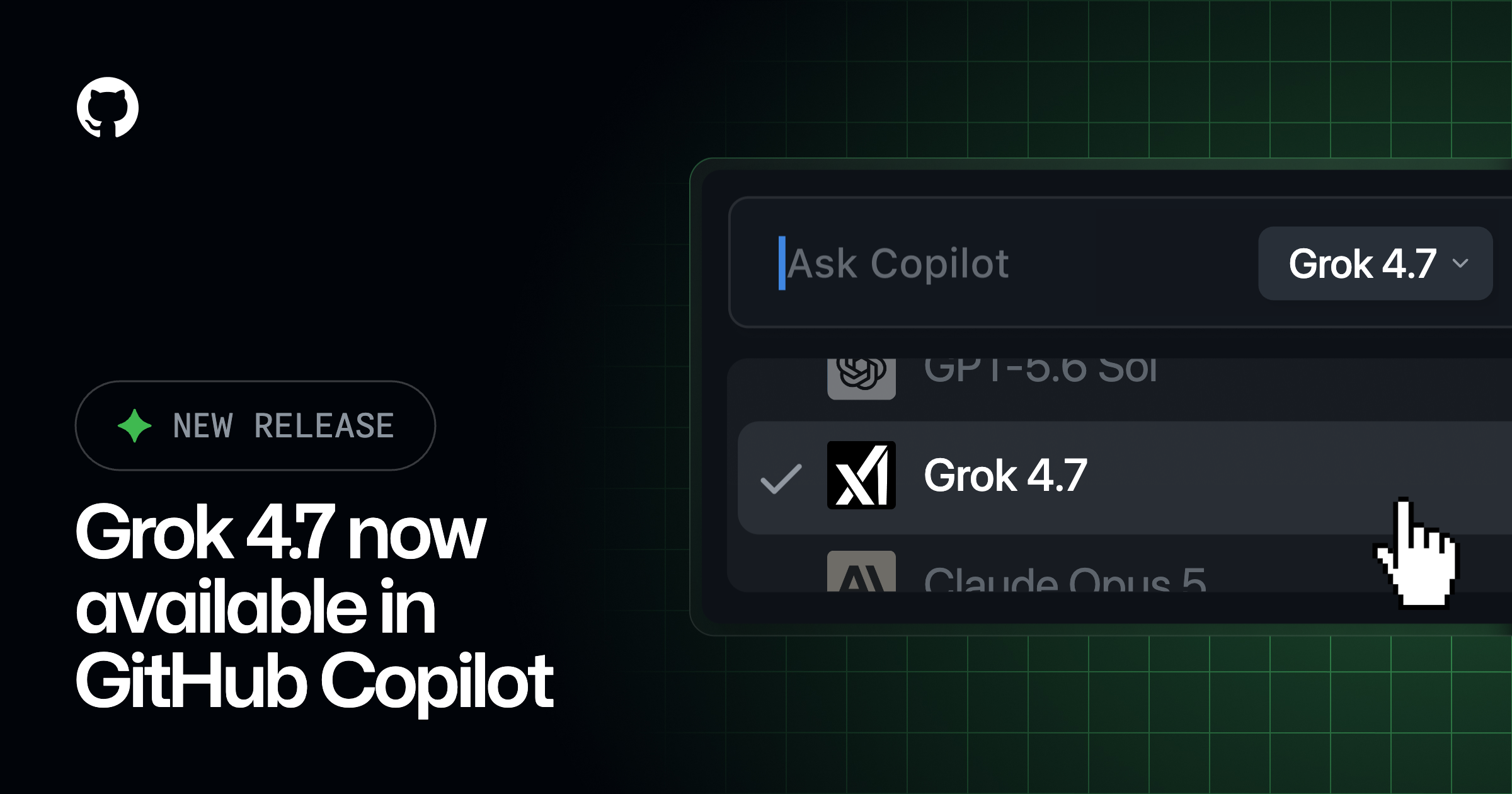
Grok 4.7 is now available inside GitHub Copilot, rolling out to Pro, Pro+, Max, Business and Enterprise plans across VS Code, Visual Studio, Copilot CLI, the cloud agent, the GitHub app, JetBrains, Xcode and Eclipse. Access is enabled per-account rather than switched on globally, the rollout is gradual, and usage draws on the existing usage-based billing model. For teams already standardized on Copilot, this is the first xAI model sitting beside the Claude and GPT options in the same picker.
Read more → https://github.blog/changelog/2026-09-21-grok-4-7-is-now-available-in-github-copilot/
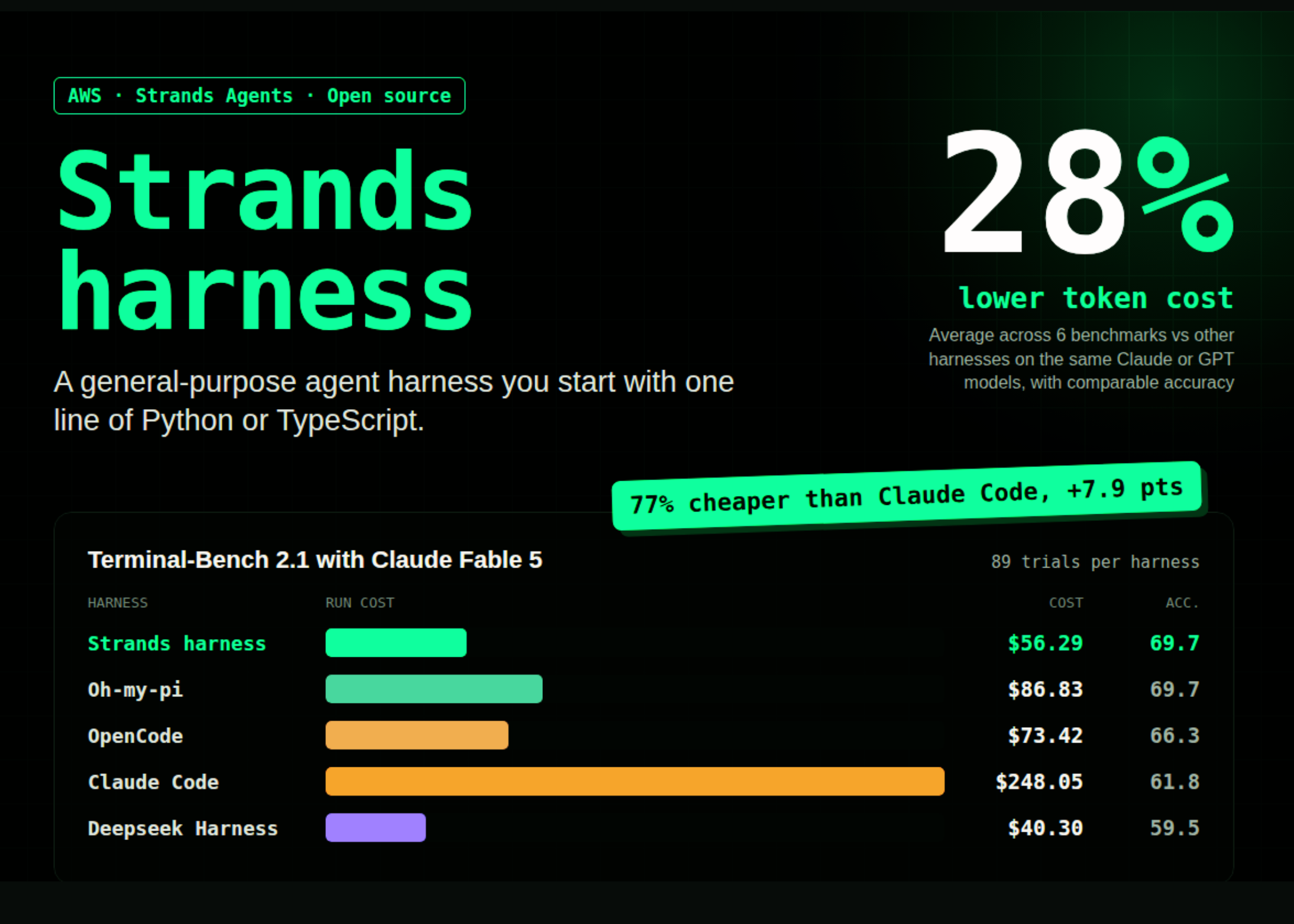
The Strands Agents team at AWS released Strands Harness, a fully assembled general-purpose agent harness that ships for Python and TypeScript under Apache 2.0 and starts with one line of code. A harness is the system around the model — loop, tools, context handling, memory, recovery — and the pitch is that you get a working one instead of rebuilding your own loop, which is where most teams lose the tuning. It runs locally or deploys to a cloud provider, and a bundled skills file lets your coding agent generate deployment config for AWS, GCP, Azure, Cloudflare and Modal. The team reports 28% lower token cost than other harnesses running the same Claude or GPT models across six benchmarks, at near-equal accuracy.
Read more → https://www.marktechpost.com/2026/09/21/aws-strands-agents-team-releases-strands-harness/

Altworld released Hemmingway-1, a 27B Apache-2.0 open-weights model with a narrow, unfashionable goal: writing the everyday message you actually need, without the preamble, the three options and the closing note about the options. Built on Qwen3.8-27B, it was tested on eighty real requests in head-to-head matchups with the answer order shuffled so the judge could not tell which model produced which. The company says it beats Fable 5.1 and beats GPT-6 Astra by fifty points on its CommunicationBench, with Kimi K3, GLM-5.3, Grok 4.6 and DeepSeek V4 Pro behind it — a 27B model. On the human-likeness axis it finished twenty-six points clear of the next model, and on hard asks it reports 72% against 9% for GPT-6 Astra. It loses on hostile storytelling and long story turns. Treat the benchmark table as the vendor's own; the EQ-Bench 4 placement — third, past GPT-5.5, Opus 4.7 and Opus 4.8 — ran through that benchmark's independent harness, which is the more load-bearing number.
Read more → https://huggingface.co/Altworld/Hemmingway-1

British Columbia sued OpenAI and CEO Sam Altman on 21 September over ChatGPT's role in the Tumbler Ridge school shooting, alleging the company failed to notify law enforcement of threats made on its platform before the attack. Attorney General Niki Sharma announced the provincial government's action, framing the case around OpenAI's failure to report what its systems had seen, and the suit demands safety overhauls alongside damages. This is the first time a government has taken a model provider to court over a mass-casualty event and the pre-attack signals its platform held — which makes it a different kind of case from the copyright and training-data litigation that has dominated the last two years. Whatever the outcome, it establishes the argument that a model provider's duty runs to the public and not only to its users.
Image & Vision

Paint-Anything learns a shared hex-prompt interface for any-color control in both image generation and editing, letting you name an object's target color as any 24-bit hex value. Rather than inventing dedicated color representations or special inference procedures, it leans on the fact that even compact language models already associate hex values with color semantics. The team built Paint-500K through object grounding, perceptual color labeling and editing-pair synthesis on real images, then handled the shadow problem — real-image color labels are only approximate — by adding pure-color anchors whose pixels exactly match their paired hex values, applied only at high-noise timesteps so low-noise training stays on natural images. They also introduce ACBench, split into text-to-image and editing halves.
Read more → https://arxiv.org/abs/2609.20816

RoboDawn asks whether the intelligence of a vision-language model transfers from the digital world to the physical one, and answers it with a deliberately thin interface: a compact set of discrete translation, rotation and gripper commands. Acting through that interface, the VLM controls a robot in a closed loop — observe the visual state, reason about the next action, execute it, then adapt to the result — with no task-specific robot training. An in-context learning scheme grounds the model in both interface usage and task-solving strategy from a handful of demonstrations. Experiments on RoboTwin 2.0 C2R and RoboDojo report strong performance, which is the interesting part: the interface, not a new policy network, is doing the generalization work.
Read more → https://arxiv.org/abs/2609.22966
Audio, Voice & Music

inclusionAI released Realtime-Venus, a 9B full-duplex audio-visual interaction model that continuously watches and listens, decides whether and when to respond, and generates text and speech on a shared causal timeline. Two checkpoints ship in one repo: Realtime-Venus-Omni for video, images, audio and text, and Realtime-Venus-Audio on the same streaming backbone for audio-driven conversation. It is adapted from MiniCPM-o 4.5 / Omni-Flow with a SigLIP2 visual encoder, Whisper-Medium audio encoder and a Qwen3-8B language backbone, generating discrete S3 speech tokens through a streaming flow-matching decoder. The features that matter: proactive interaction, semantic interruption handling so being talked over doesn't derail it, asynchronous delegation via a streaming protocol, and training-free long-video memory that reassembles non-redundant audio-visual evidence on the fly. Apache-2.0.
Read more → https://huggingface.co/inclusionAI/Realtime-Venus
Robots & Embodied AI
Reward AI published OM-1, a robot policy trained on human demonstrations only — no teleoperation, no on-robot data — and it controls any body. The premise is deliberately contrarian: the argument runs that reaching, grasping and adjusting on contact with human fluency will not come from more data or more compute, nor from running today's systems faster. The work cites Anderson's "More Is Different" to frame the target as a shift in the structure of the problem rather than a scaling exercise. The release pairs an Omnibody Hand with an Omnibody Model 1 and a data interface, under the framing "One Model, Any Body." It is an early and unverified claim in a field full of them — but the no-teleoperation constraint is the kind of bet that reframes a whole data-collection pipeline if it holds.
Read more → https://rewardai.com/blog/OM-1/
Papers & Research

WorldCrafter attacks the weakest link in video world models — forgetting where you've already been — by learning a camera-queryable implicit 3D-aware memory instead of explicit depth correspondences. The insight is that the requested viewpoint should shape how multi-view evidence gets compressed into the generator's limited token budget. A memory encoder and pose-conditioned readout module train jointly with the video generator, folding historical observations into a fixed set of target view-specific tokens before denoising. Combined with recent temporal context and few-step distillation, it supports streaming scene exploration from a single image or text prompt, with reported gains in long-horizon consistency and camera-control accuracy while holding visual quality across minute-scale exploration.
Read more → https://arxiv.org/abs/2609.24984

CodeMidas scales agentic coding RL by turning implemented functionality in existing codebases into executable environments, using source code as the only task-specific input. That matters because prior methods lean on development artifacts such as issues and commits, which caps the range of tasks you can extract. CodeMidas spends agentic compute at every stage: agents explore functionality to formulate behavioral specifications, build tests grounded in execution of the original code, then validate and filter candidates through execution checks and repeated solution rollouts. The resulting dataset is 5,545 training tasks drawn from 3,185 open-source codebases across 23 languages and 15 technical domains. Training MiMo-V2.5 on it with GRPO improved performance on all five benchmarks evaluated.
Read more → https://arxiv.org/abs/2609.22068

IntBMoE is a clean piece of architecture thinking: it separates three quantities that existing mixture-of-experts designs cannot set independently. For a single token, participation is how many experts contribute knowledge to its output, execution is how many are actually computed (the compute cost), and materialization is how many expert-sized parameter sets must be built and stored (the memory cost). Sparse routing keeps execution and materialization low but shrinks participation to a few experts; dense output-mixing restores full participation but its execution grows with the expert count; parameter-merging holds execution at one expert while materialization grows with the number of routing decisions. IntBMoE decouples all three by pairing dense expert composition with sparse block execution, with blocks drawn from a small learned codebook. The framing alone is worth the read.
Read more → https://arxiv.org/abs/2609.21346
News & Business

Xiaomi released MiMo-V2.6-Pro-RL, a flagship checkpoint built around a single thesis: scale reinforcement learning toward self-improvement rather than training separate specialists for each domain. The model handles text, image, video and audio natively with a 1M-token context for long repositories, tool traces and multi-session agent runs. The training recipe is the interesting part — one mixed RL run across coding, general agents, visual work and cybersecurity, with tasks and multiple harnesses shuffled into the same batch so capabilities reinforce each other and transfer to harnesses never seen in training. It uses fully asynchronous GRPO on batches of 1,568 prompts × 16 rollouts per step, billions of tokens per update, plus an agentic grader that ranks passing solutions rather than collapsing them to binary pass/fail. Released under MIT.
Read more → https://huggingface.co/XiaomiMiMo/MiMo-V2.6-Pro-RL
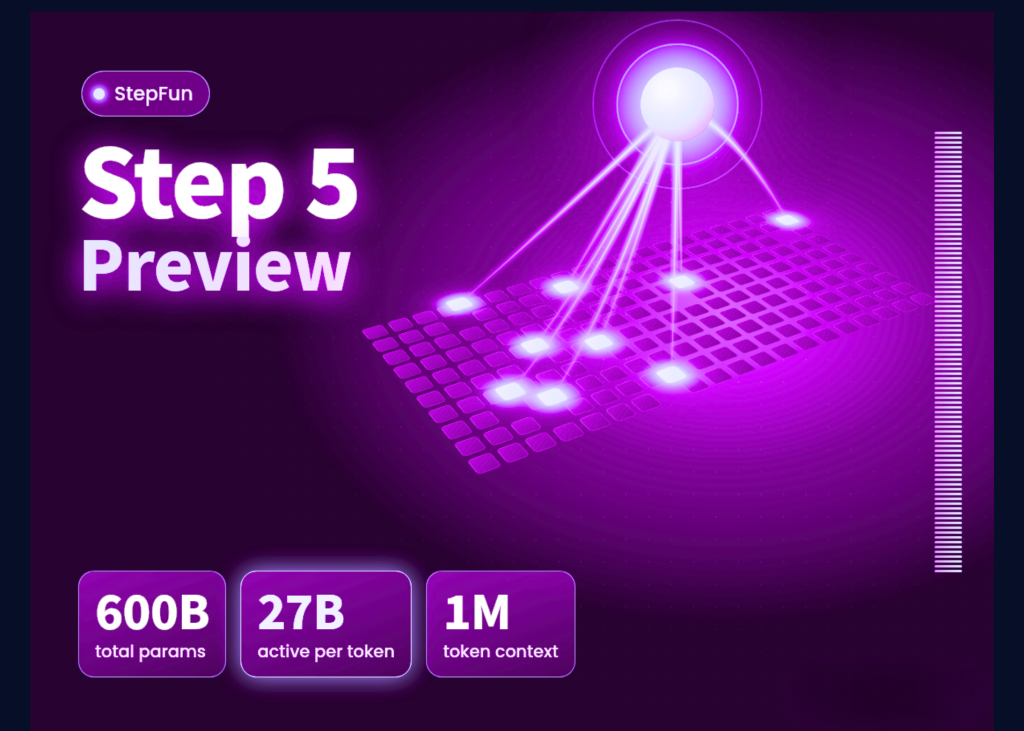
StepFun launched Step 5 Preview, a 600B-total / 27B-active MoE aimed squarely at long-horizon agentic work, with a 1M-token context and open weights promised for 15 October 2026. It reads text, images and video, supports low/medium/high reasoning effort, and stacks MTP-3 with FP8 MoE and KV-cache offload across 92 narrow-and-deep layers. The company-reported numbers, run at High effort while rivals ran at Max, put it behind Claude Opus 5 and GPT-6 Astra — FrontierFinance 66.4 against 69.7 and 55, DRACO 83.3 against 87.6 and 76.8 — but the two 24-hour agent experiments are the real hook: it tuned an H100 kernel to 508 TFLOPS against 493 for Opus 5, and lifted Qwen3-30B-A3B on AIME24 from 53.3% to 60%. Treat the benchmark table as a vendor claim; treat the day-long runs as the direction of travel.
Read more → https://www.marktechpost.com/2026/09/20/stepfun-launches-step-5-preview/

China Telecom's AI arm released Xing4.0-29B-A4B, a 29B-parameter model with only 4B activated per token, a native 256K context extensible to 512K, and a claim worth noticing: it is the first model of this scale trained entirely on Ascend NPU hardware under the MindSpore framework. The architecture is mHC + MLA + MTP, built for multi-step planning, tool calling and long reasoning chains, and the training-efficiency section reports roughly 96% higher throughput over out-of-the-box performance through MoE communication optimization, selective recomputation, automatic graph-operator fusion and fused mHC operators. It ships Apache-2.0 with adapters for LLaMA-Factory, SGLang, vLLM and KTransformers, plus format alignment for agent frameworks including OpenCode, Claude Code and Hermes.
Read more → https://huggingface.co/XingChen-AGI/Xing4.0-29B-A4B

Video Rebirth released HyperFlow, an 8-step LoRA for MiniMax-H3 obtained by data-free flow self-distillation, cutting inference from 49 model forwards to 8 — about a 3x end-to-end speedup, roughly 60 seconds per clip instead of 175 on 4× H200. The adapter is a rank-256 / alpha-256 PEFT LoRA on attention, feed-forward and both time embedders (316 modules), totaling 2.8 GB, and it samples on a fixed sigma grid stored in the file itself. Base weights, VAEs, conditioner and workflows stay official, so the same LoRA drives text-to-audio-video, first-last-frame-to-audio-video and reference-to-audio-video without swapping checkpoints. Optional Ulysses context parallelism, FlashAttention-3 and NVIDIA Sol-Attn sparse attention are supported. Note the license: MiniMax's H3 Community License excludes the EU, UK, South Korea and the US without separate authorization, and this is not an official MiniMax product.
Read more → https://huggingface.co/videorebirth/hyperflow

Bespoke Labs released Bespoke-Nimble-9B, a Qwen3.5-9B LoRA adapter for context-grounded choices, booleans and rubric score levels that scores the allowed answer tokens directly instead of generating reasoning or free-form text. The repo holds the adapter — about 165 MiB — plus tokenizer, exact prompt builder, reference inference code and aggregate evaluation results; it requires the Qwen3.5-9B base checkpoint rather than duplicating weights. Fields support at most 26 choices, rubric scores come back as the selected integer plus a probability-weighted expected score, and prompts over 2,048 tokens are rejected rather than silently truncated. Apache-2.0. For structured extraction and guardrail-style decisions, skipping generation entirely is the point.
Read more → https://huggingface.co/bespokelabs/Bespoke-Nimble-9B
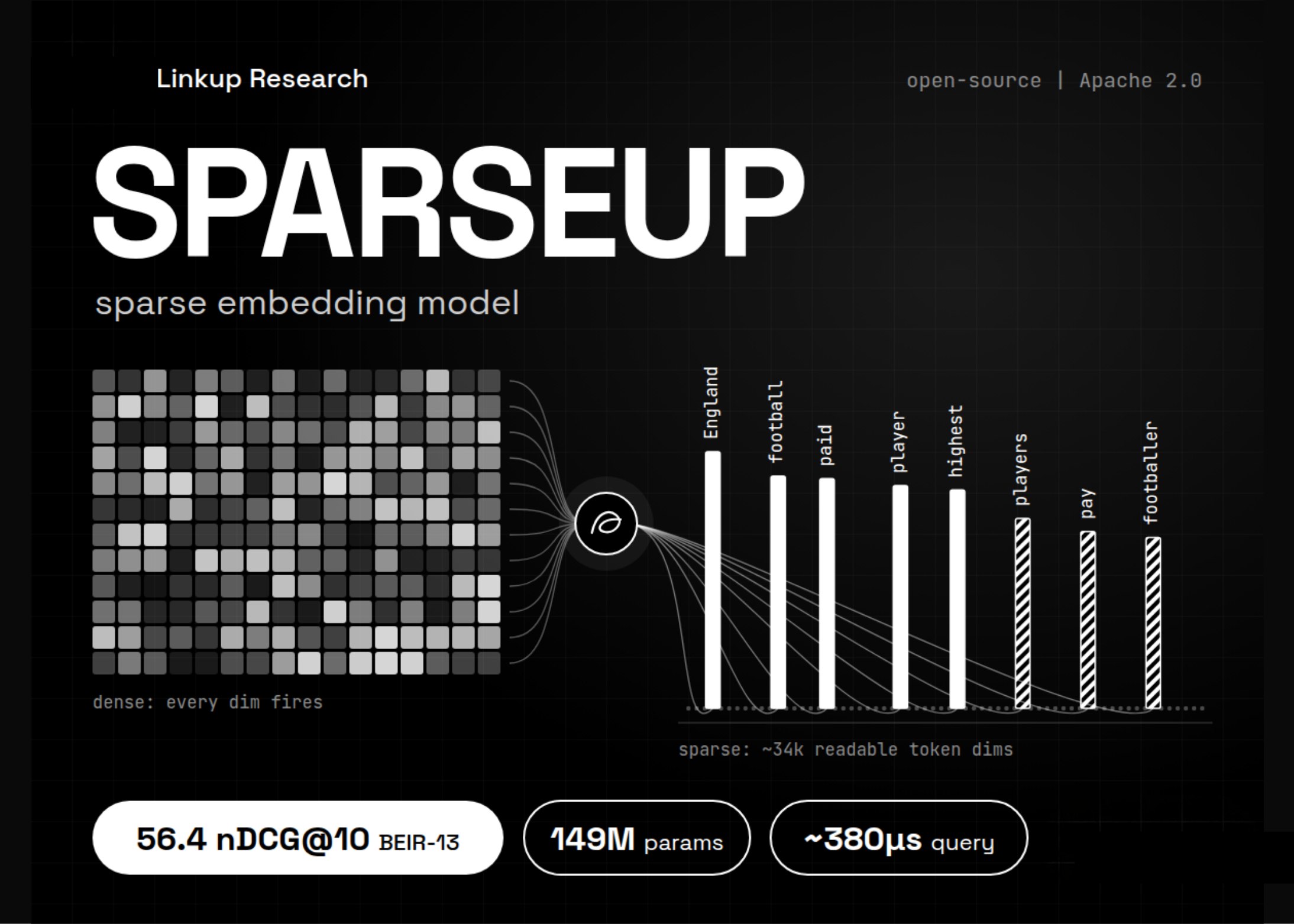
Linkup Research released SPARSEUP, a learned sparse embedding model on a 149M-parameter ModernBERT backbone under Apache 2.0, reporting 56.4 average nDCG@10 on BEIR-13. The claim is that it is the strongest public vocabulary-based sparse encoder under 150M parameters. Instead of one vector per text, it outputs weights over a vocabulary, and the training detail worth keeping is the logit transformation log(1 + ReLU(x − 15)) with a per-position top-k of 12 — fine-tuned on a single H100. Weights load through Transformers or Sentence Transformers with trust_remote_code=True. Most open retrieval work is dense; a small sparse encoder that still competes is useful precisely because lexical matching stays inspectable.
Read more → https://www.marktechpost.com/2026/09/19/linkup-research-releases-sparseup/
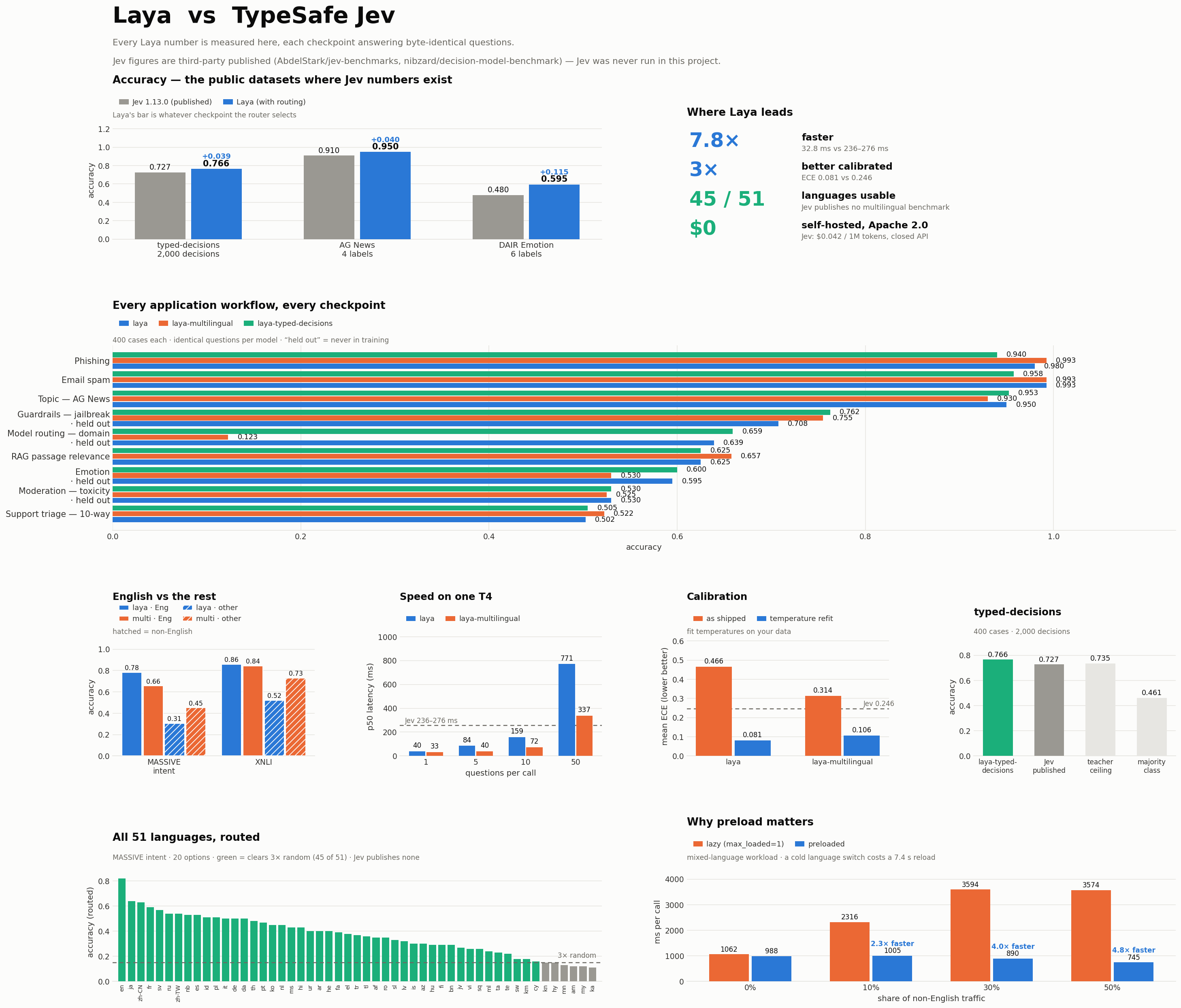
convaiinnovations released laya, a multilingual non-autoregressive System 1 decision model that never generates text at all — you hand it a state and typed questions, and it returns typed answers with calibrated probabilities in a single forward pass of about 33 milliseconds across 100+ languages. It is trained with reinforcement learning against strictly proper scoring rules (RLCD), which means reporting honest probabilities is the only way to maximize reward. There is nothing to parse and nothing to hallucinate, because there is no text output. The hub repo carries three checkpoints: the English ModernBERT-large encoder at root for guardrails and email triage, a smaller mmBERT multilingual variant covering 100+ languages at roughly 2.2x the speed with 1024 context, and a typed-decisions variant. A built-in Router detects scripts and languages in sub-milliseconds and dispatches to the right checkpoint.
Read more → https://huggingface.co/convaiinnovations/laya
That's today's horizon. The frontier is still shipping capability, but the more interesting movement is sideways and downward — a 149M retriever, a 421M classifier that won't speak, an 8-step video LoRA, a robot policy that watched humans instead of robots. And in British Columbia, "we should have told someone" stopped being a policy discussion and became a statement of claim. We'll be watching which of these survives contact with the week.