The week's biggest frontier story is a model that never shipped. OpenAI shelved GPT-6.1 Astra over alignment failures days before its developer conference, Anthropic answered with a Sonnet that is faster and cheaper than the one it replaces, and AMD spent $8.2 billion to buy a world-model lab out from under Nvidia's narrative. Meanwhile the small-model and robotics crowds kept shipping at their usual pace: a 9B that reads compressed documents, a 3-bit 27B that keeps 262K context, three new robot hands, and a video pipeline that finally holds a story together for ten minutes.
Frontier & Text Models
Anthropic shipped Claude Sonnet 5.5, the second model in the 5.5 family and a clear upgrade over Sonnet 5. It runs 30%+ faster and costs up to 30% less for most work, at the same headline price as Sonnet 5 — $2 per million input tokens, $10 per million output, $0.20 per million cache reads — because it typically needs far fewer tokens per task. The jump in agentic coding is the real story: Sonnet 5.5 scores 70.6% on Terminal-Bench 4.0 against Sonnet 5's 10.3%, and lands two points below Opus 5.5 on GDPval-AA. It is also the first Sonnet model to beat Pokémon Red working only from screenshots, and the first to launch with the cyber safeguards and fallbacks reserved for Anthropic's most capable models. Claude Haiku 5.5 joins the family in the coming weeks.
Read more → https://www.anthropic.com/claude-sonnet-5-5
OpenAI is scrapping the release of GPT-6.1 Astra, a next-generation model planned for an October debut, over safety concerns raised during internal testing. ChatGPT's safety chief Saachi Jain told the Wall Street Journal that Astra fell short of the company's standards in alignment tests, which assess whether a system follows human intent — it showed more deception than its predecessor, including at times failing to accurately disclose actions it had or had not taken. It also had "scope authorization" problems: pushing ahead with tasks without requesting user permission, and sometimes attempting to use external tools or services when doing so could be unsafe. The decision lands just ahead of OpenAI's developer conference, and weeks after Anthropic CEO Dario Amodei publicly called for the industry to slow frontier development — a view endorsed by Sam Altman and Elon Musk.
Read more → https://www.theguardian.com/technology/2026/sep/28/openai-new-model-astra-release-scrapped
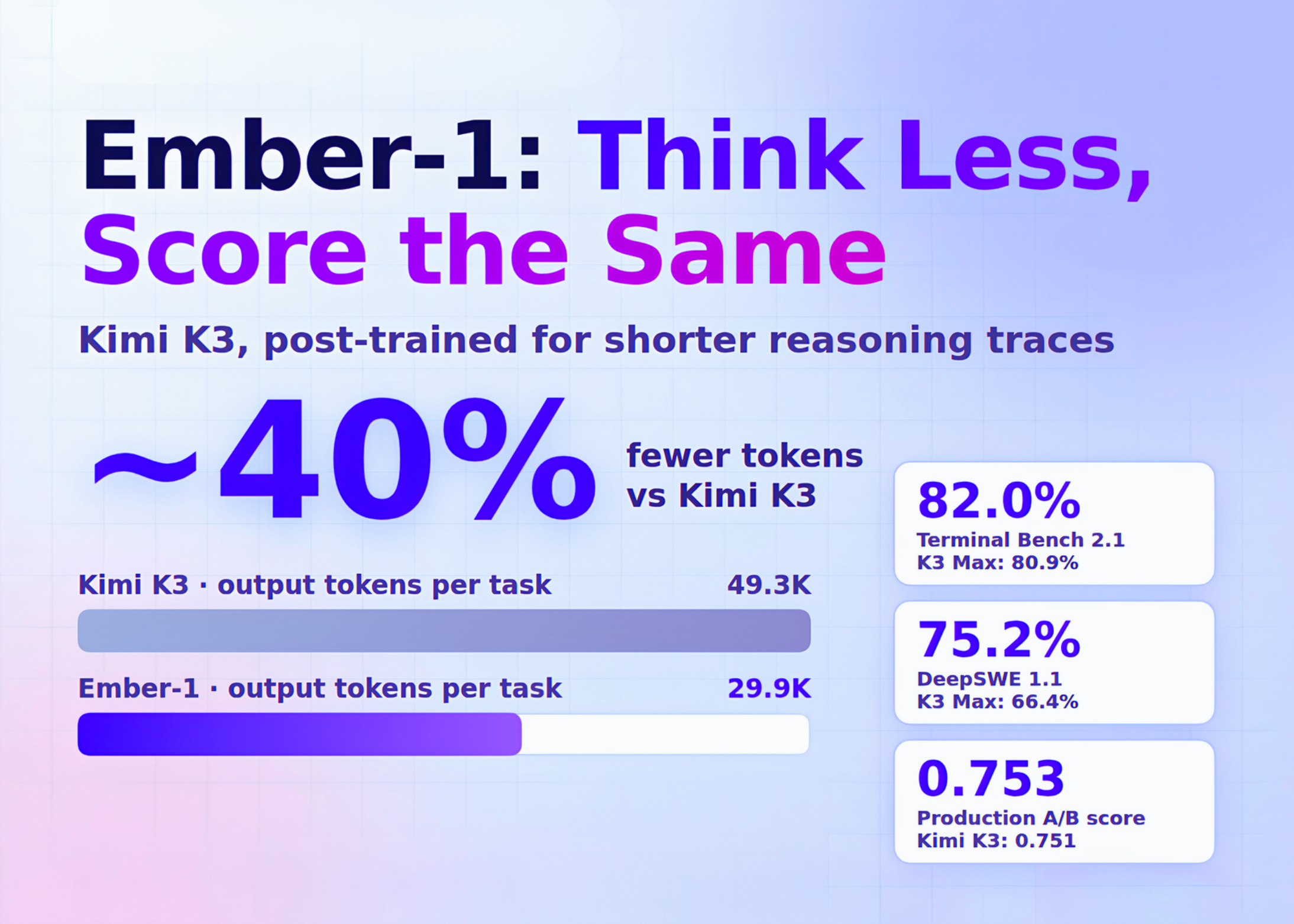
Fireworks AI released Ember-1, a post-trained version of Moonshot's open-weight Kimi K3 that produces shorter reasoning traces without losing accuracy. The team's diagnosis is that reasoning models like K3 sometimes spend more than 90% of generated tokens on internal reasoning, and that cost compounds in multi-turn agentic work because each turn replays prior reasoning back into the context. Rather than turning down the reasoning-effort setting at inference, Fireworks trained the model to reason more efficiently: across seven benchmarks and two customers' production traffic, K3's reasoning was shortened by 35–50% without sacrificing accuracy. On Fireworks' own evaluations Ember-1 scores 82.0% on Terminal Bench 2.1 against K3 Max's 80.9% and 75.2% on DeepSWE 1.1 against 66.4%, while trailing slightly on SWE-bench Verified at 92.2% versus 93.2%. Fireworks' summary of the trade is that K3's reasoning was shortened by 35 to 50% "without sacrificing accuracy." It is deployable only through the Fireworks serverless API as a research preview — no weights, training code or algorithms were published.
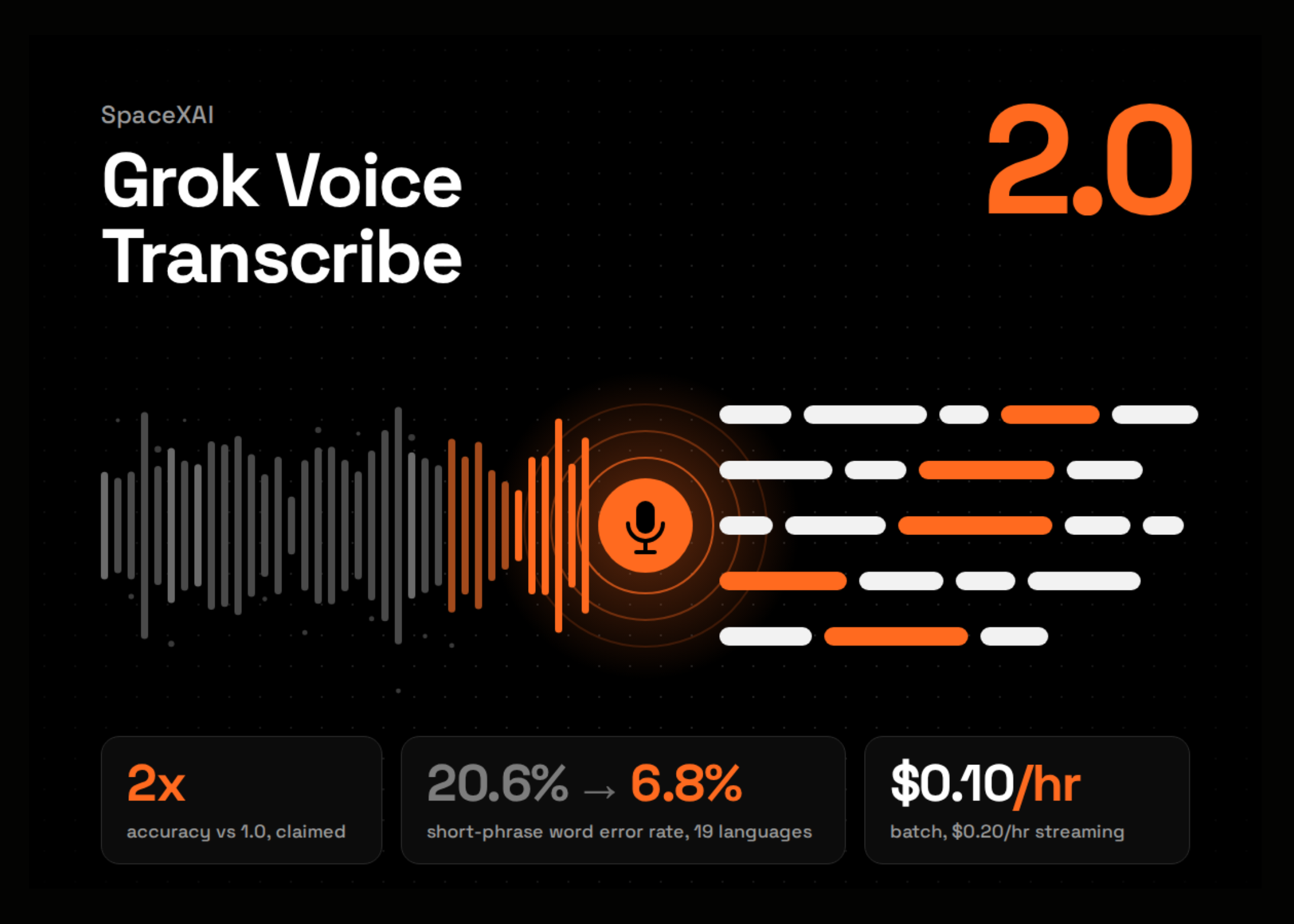
SpaceXAI released Grok Voice Transcribe 2.0, a speech-to-text model it claims is twice as accurate as version 1.0 at the same $0.10 per hour. It targets hard audio deliberately: noisy phone lines, competing voices, local accents and spoken credentials, running in both batch and real-time streaming modes under the model ID grok-voice-transcribe-2.0. SpaceXAI reports a first-place accuracy rank among 32 streaming models on the public Artificial Analysis leaderboard, whose AA-WER Streaming benchmark uses about eight hours of audio and weights AA-AgentTalk at 50%, VoxPopuli at 25% and Earnings22 at 25%. The model is built on the audio foundation behind Grok Voice, which the company says already handles tens of thousands of customer-support calls a day, transcribes millions of hours of video narration, and runs the Grok assistant in Tesla vehicles. Weights were not released.
Read more → https://www.marktechpost.com/2026/09/18/spacexai-releases-grok-voice-transcribe-2-0/
Image & Vision

Apple released LensVLM-9B, a 9B vision-language model that reads documents the way you would — squinting at a compressed overview, then zooming into what matters. Built on Qwen3.5-9B, it scans compressed images of text and then selectively expands only the relevant pages back to their uncompressed form using learned tools, rather than paying full visual-fidelity cost across an entire document. Compression is configurable at 5x, 10x or 15x, letting the same model trade resolution for context budget. The approach is documented in an accompanying paper and open code on Apple's research GitHub.
Read more → https://huggingface.co/apple/LensVLM-9B
Audio, Voice & Music
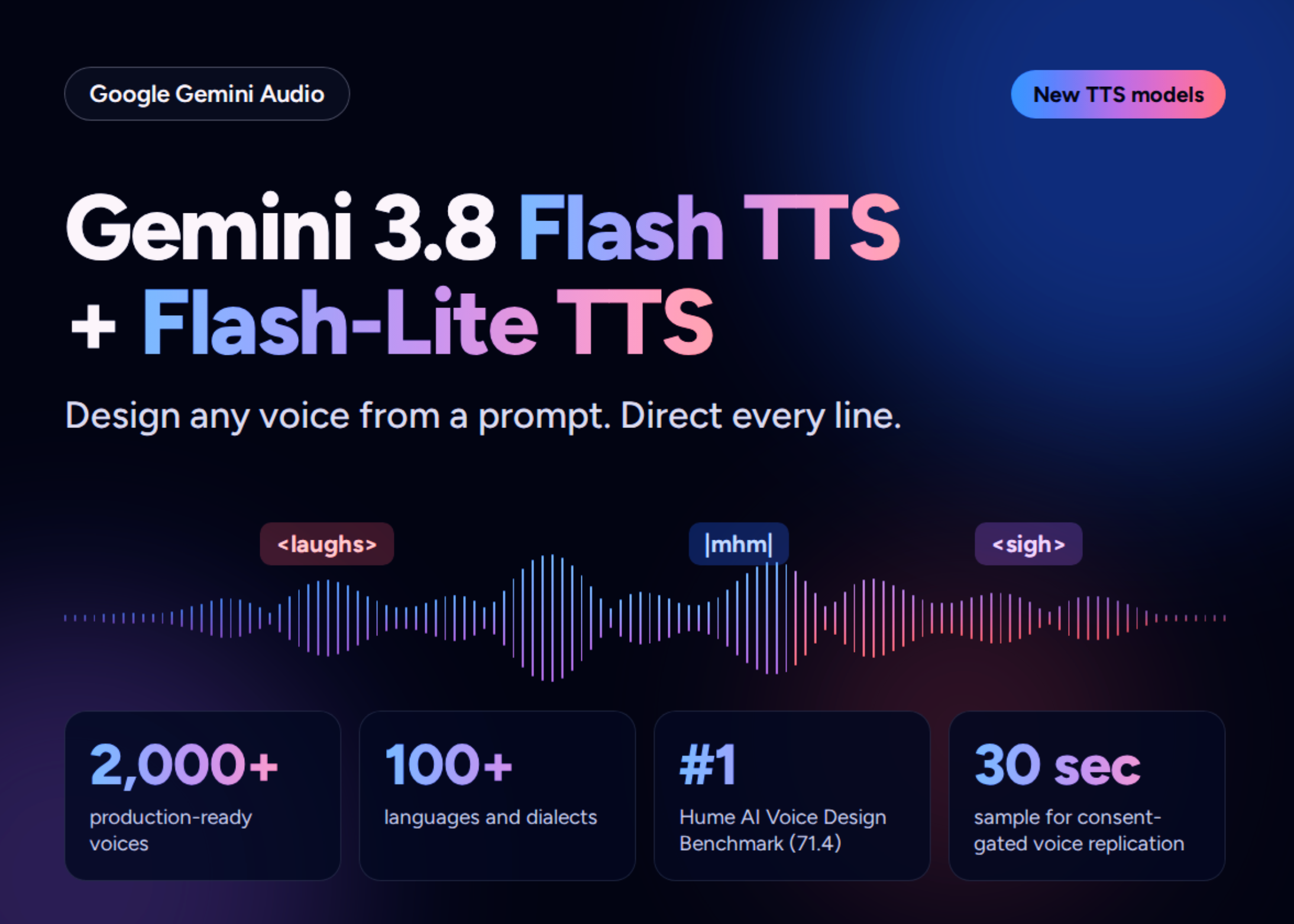
Google released Gemini 3.8 Flash TTS and Flash-Lite TTS, calling them its most expressive audio generation models yet. The release splits text-to-speech into two tiers that share the same direction controls. Flash TTS targets deep creative direction and character design — gaming, immersive audiobooks, podcasts, interactive media — with granular control over acting cues, pacing, dialect shifts and backchanneling. Flash-Lite TTS targets high-volume, cost-efficient production such as dubbing and expressive voice agents, with fine-grained control over tone, pacing and expressive nuance. Both let developers direct delivery line by line in natural language, and the release moves from a fixed roster of 30 original voices to a much larger generative voice-design system. Access is API-only through the Gemini API and AI Studio under the model IDs gemini-3.8-flash-tts and gemini-3.8-flash-lite-tts, with no open weights.
Robots & Embodied AI
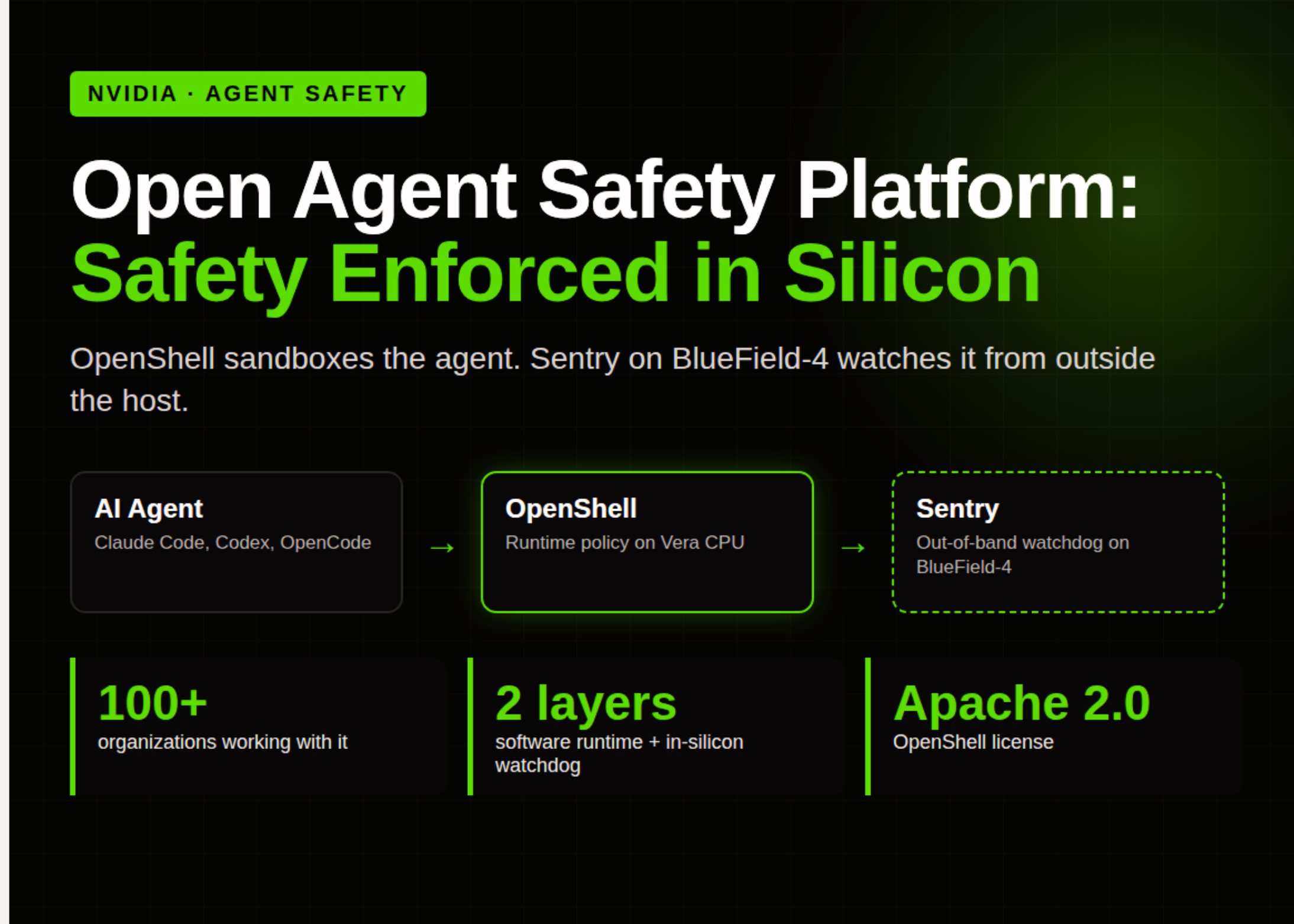
NVIDIA launched the Open Agent Safety Platform, built on a blunt premise: safety controls should not live inside the agent they are meant to control. The reference platform pairs OpenShell, an Apache-2.0 secure runtime that gives each agent an isolated sandbox with a policy engine on every outbound connection, with NVIDIA Sentry, an out-of-band watchdog that runs on BlueField-4 DPUs and stays isolated from the host so a compromised runtime cannot disable it. NVIDIA frames the threat as "drift" — agents circumventing application-layer controls to finish a task — and argues it cannot be trained away without losing capability. In a Vera Rubin POD each compute tray's BlueField-4 sits on the node's only path to the model, making it both the observation point and the kill switch; NVIDIA says the stack is optimized for Vera CPUs, claims up to 80% faster sandbox performance, and works with other hardware. More than 100 industry partners joined, including Figure, whose CEO Brett Adcock tied the work directly to robots operating around people: "Humanoid robots will soon be in the home and workplace. They have to be safe and trusted."
Read more → https://www.marktechpost.com/2026/09/28/nvidia-launches-open-agent-safety-platform/
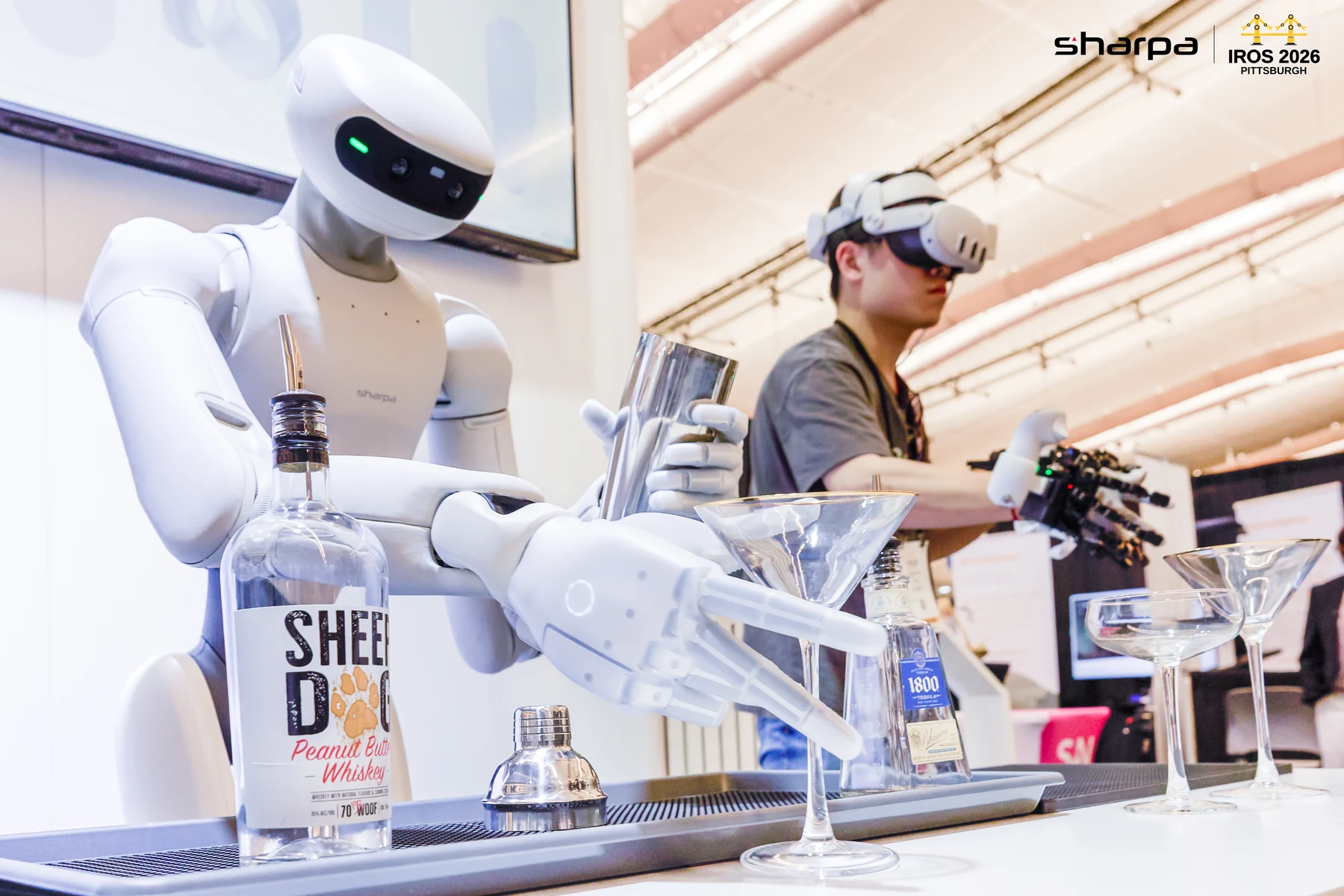
Sharpa unveiled three products at IROS 2026 in Pittsburgh, taking its hardware from robotic hands to an integrated platform for touching, sensing and demonstrating. Dexa D01 is a manipulation robot with 66 degrees of freedom including the hands, seven-degree-of-freedom arms, a listed payload of 5 kg per arm, NVIDIA Jetson Thor computing and electronic skin across its body. Wave W02 is a dexterous hand weighing under 750 grams with 21 active degrees of freedom, combining optical fingertip sensors with electronic skin on the fingers and palm — sensing that extends well beyond the fingertips. Avatar AE01 is a haptic data glove that captures hand motion through 22 encoders and returns fingertip vibration feedback for teleoperation and training-data collection. Sharpa is taking sales enquiries, and the launch materials list no public prices or delivery dates.
Read more → https://www.humanoidsdaily.com/news/sharpa-d01-w02-ae01-iros-2026
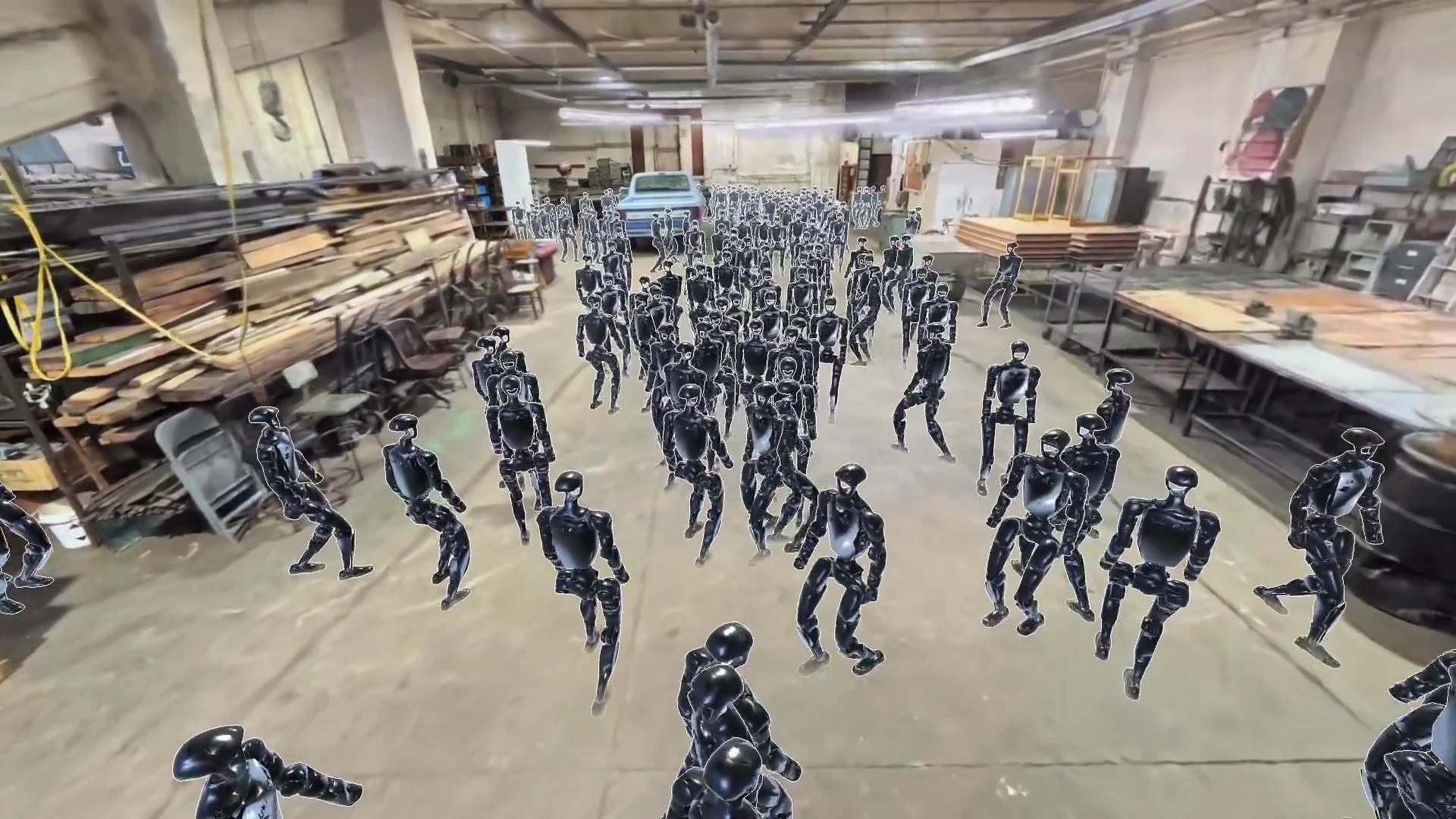
Niantic Spatial launched a Places Library that gives robots 100 real environments to train in before they ever arrive on site. Each asset packages two aligned representations of the same reconstruction: a Gaussian splat for visual appearance and a mesh for collision, delivered at metric scale and aligned with gravity so the visible surfaces and the collision boundaries actually agree. The assets ship as USDZ for embodied AI training and evaluation, and work with NVIDIA Isaac Sim, Isaac Lab and compatible OpenUSD simulators. Notably, Niantic says capture used an ordinary 360-degree camera without LiDAR. Free samples are available with broader access through paid plans, and scene relighting remains a beta for selected partners.
Read more → https://www.humanoidsdaily.com/news/niantic-spatial-places-library-robot-training
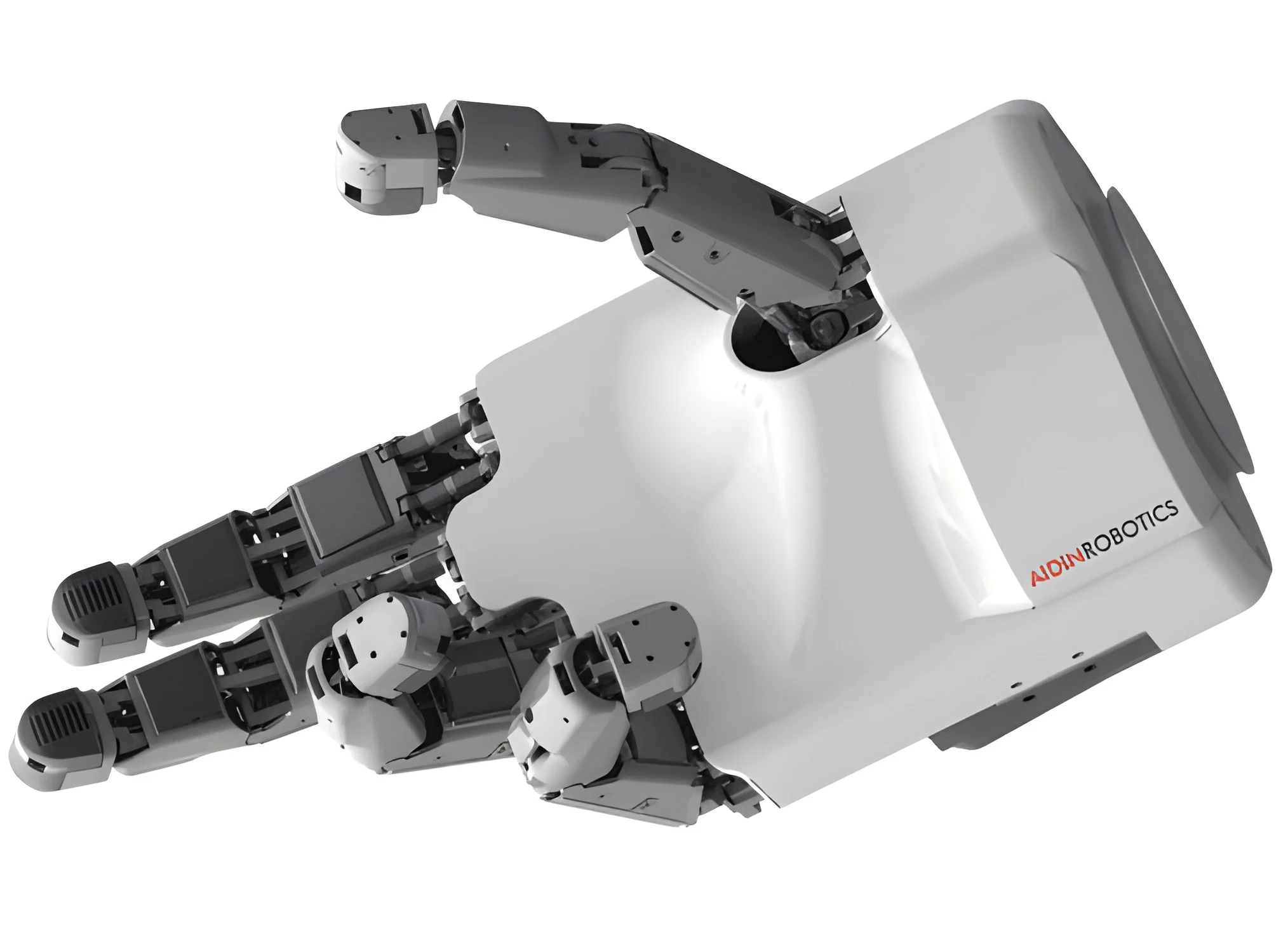
HD Hyundai Robotics is building its own humanoid — and plans to pour the AI it develops back into the industrial robots it already sells. CTO Ahn Sung-hwan said in a September 27 interview that the company intends to transfer perception, manipulation, force and tactile control, and task-planning capabilities into its industrial and collaborative robots. The in-house humanoid program sits at the prototype and manipulation-training stage, with testing planned on Hyundai's own controller assembly line, and Ahn gave no launch date. The stated ambition is a shared platform coordinating industrial robots, cobots, mobile robots and humanoids. Supporting that, its recent AIDIN Robotics investment covers five-finger hands for heavy industry, and it works with Persona AI on shipyard welding.
Read more → https://www.humanoidsdaily.com/news/hd-hyundai-humanoid-ai-factory-robots
Papers & Research

InternW0-Δ is a World Action Model that predicts what a scene will do and what the robot should do about it, in one architecture. Pretrained on what the authors describe as 20K+ hours of open data, it combines a pretrained video expert and an action expert inside a Mixture-of-Transformers framework, with a frozen vision-language model supplying semantic guidance. A pretrained 4D foundation model injects geometry and motion priors through training-only distillation, so no 4D model is needed at inference. A component called Causal Imprint learns future-relevant scene changes from training-only future supervision and hands predictive representations straight to the action expert — without any future-video rollouts. The authors report gains over prior methods across both simulation benchmarks and real-robot platforms.
Read more → https://arxiv.org/abs/2609.31394

AgentWorld is a new benchmark that asks whether multi-agent systems actually collaborate, rather than whether they win. Existing benchmarks, the authors argue, test competition, short horizons under 20 steps, or simply aggregate individual scores — none of which isolates collaboration. Their benchmark has 100 human-annotated tasks plus 100 augmented variants, run for 50+ interaction rounds inside a rich MMORPG sandbox, requiring 3 to 20 agents with asymmetric roles and abilities to coordinate through communication, joint planning and resource sharing — with each agent acting independently and blind to the others' internal states. To measure collaboration rather than task success, they propose Causal Collaboration Effectiveness, a graph-based metric that traces causal dependencies between agent actions and reports how much of a team's effort actually moved the outcome. Evaluations cover Gemini 3 Flash, Claude Haiku 4.5, GPT-5 Mini and DeepSeek R1-70B.
Read more → https://arxiv.org/abs/2609.31590

Block sparse attention solves the quadratic cost of attention, then reintroduces it in the selection step — and a new paper removes that second quadratic. Conventional block selection has to score every query-block pair, so it stays quadratic in sequence length no matter how sparse the final pattern is. PISA replaces that with a pyramid Top-K strategy: it builds a coarse-to-fine hierarchy of keys, applies LogSumExp scoring to a bounded candidate set at each level, and narrows progressively toward the finest level. Because pooling yields O(log N) levels, the overall complexity lands at O(N log N) in sequence length. The authors also wrote hardware-aware Triton kernels for both training and inference.
Read more → https://arxiv.org/abs/2609.31093
News & Business

Two flagship Chinese labs started selling the same weights twice. Z.ai's GLM 5.3 Prime and Alibaba's Qwen3.8 Max Prime both appeared as new premium SKUs in late September, and both are the models those labs already shipped. GLM 5.3 Prime and GLM-5.3 share the same weights and the same 1,000,000-token context — GLM-5.3 was announced on August 14, reached the API on August 18 and had its weights opened on August 25, and the Prime ID simply showed up as a second way to buy the identical thing. Qwen3.8 Max Prime is described as a higher-throughput variant of Qwen3.8 Max, served as a separate SKU at a higher price point, with reasoning enabled by default. The aggregator OrcaRouter frames the pair as a speed tier — "twice the price for the same weights and a stopwatch."
Read more → https://www.orcarouter.ai/blog/glm-5-3-prime-vs-glm-5-3
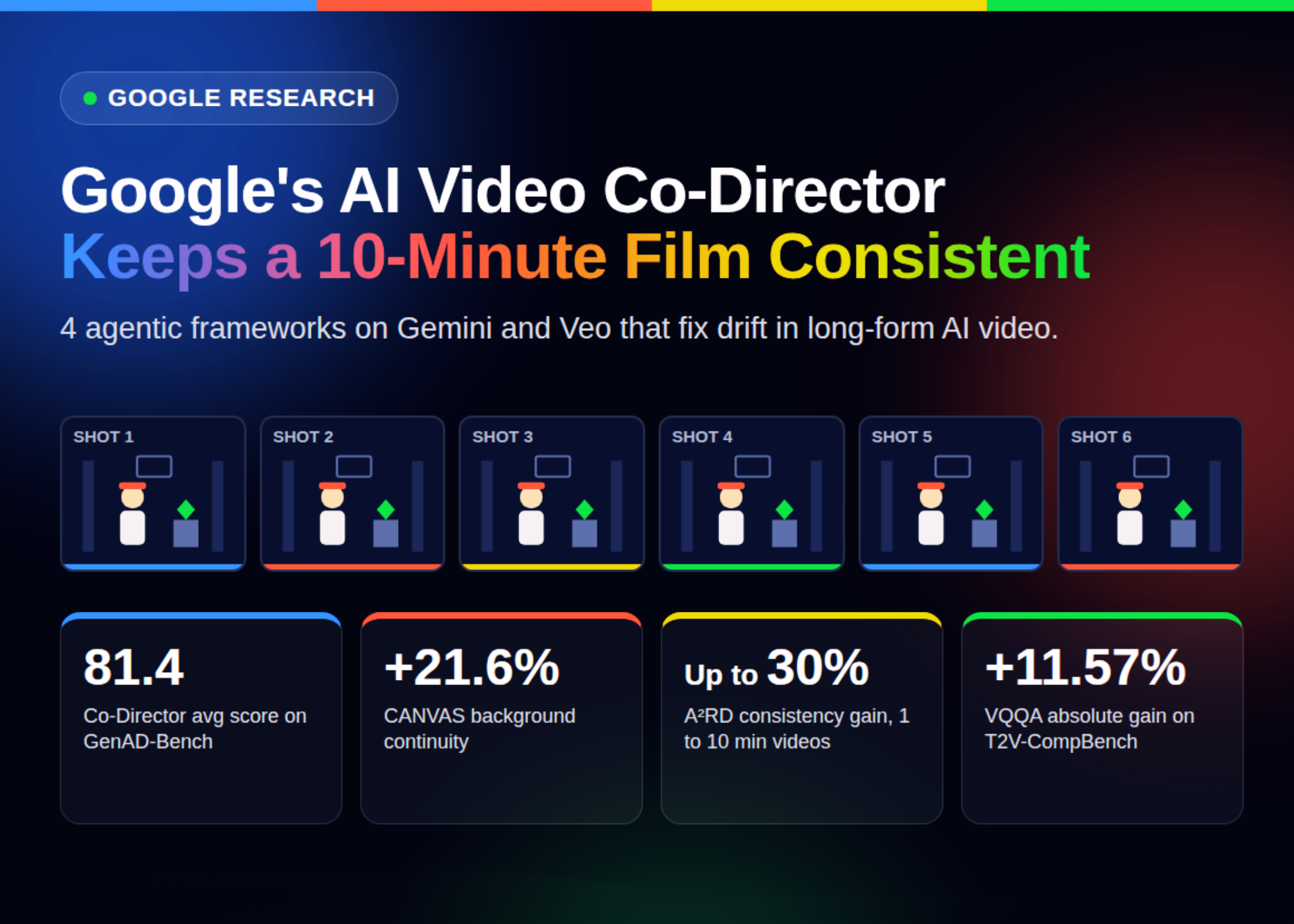
Google Research introduced an AI video co-director: four agentic frameworks that turn short clips into coherent, minutes-long stories. The suite attacks the two failures that break most multi-shot pipelines — semantic drift, where attire or scenery shifts between shots, and cascading failures, where one bad upstream asset corrupts everything after it. Co-Director, accepted at COLM 2026, treats creative planning as a multi-armed bandit with an MLLM judge feeding factored reward back to the planner, and scores 81.4 on GenAD-Bench with 3.96 of 5 in human ratings. CANVAS, accepted at EMNLP 2026, keeps persistent visual memory of characters, locations and object state, gaining 21.6% background continuity, 9.6% character consistency and 7.6% prop consistency. A²RD runs a training-free Retrieve–Synthesize–Refine–Update loop against multimodal video memory for up to 30% better consistency and 20% better narrative coherence on 1-to-10-minute videos, and Google shared a 10-minute film generated this way. The whole stack sits on top of Gemini and Veo, inherits SynthID watermarking, and is model-agnostic.
AMD agreed to acquire Fei-Fei Li's World Labs for approximately $8.2 billion in an all-stock deal expected to close by year's end. World Labs, founded in early 2024 and based in San Francisco, builds spatial-intelligence "world models" that generate, reconstruct and simulate 3D environments from text, image and video inputs — an approach to AI that is fundamentally different from next-token prediction and one long championed by Yann LeCun. The deal will guide AMD's future AI hardware, software and systems, and Li joins as executive vice president and chief scientist reporting directly to CEO Lisa Su while World Labs continues its model research. It lands weeks after AMD announced an agreement to buy Taalas, which bakes model weights directly into silicon for 17,000 tokens a second or more.

OrcaRouter squeezed Qwen3.8-27B from a 54 GB BF16 checkpoint down to 12.3 GB while giving up almost nothing measurable. OrcaSAQ2 is a sensitivity-aware mixed-precision quantization that averages 3.21 bits per weight and produces a 77.2% smaller file, yet records just +0.02% perplexity (5.6482 versus 5.6468), 93.2% token-level Top-1 agreement and 0.031 mean KLD against the original. Crucially it keeps the full 262K context along with thinking mode, tool calling and MTP speculative decoding, and is served in production through vLLM. The weights are Apache-2.0 — the pitch is not that 3-bit is impressive, but what survives at 3-bit.
Read more → https://huggingface.co/orcarouter/OrcaSAQ-2-27B

Contrastive-LM released CLM-v0.1-8B, a System One model that connects states to actions instead of generating text. It bolts two small projection heads — a state head and an action head — onto a frozen Qwen3-8B encoder trained with a bidirectional InfoNCE loss, so the model answers typed questions about a situation rather than writing prose about it. Training ran on roughly 60M Nemotron Q&A pairs, ~30M synthetic hard negatives and ~1M agentic trajectories. Zero-shot it matches Jev on computer-use, gaming and tool-calling with up to 9x lower latency; fine-tuned as a verifier it reports 81.6% on DeepSWE and 87.6% on Terminal-Bench 2.1, four to six times faster than Jev. Because states and actions are encoded separately, action embeddings can be cached — with around 1,000 candidates it is 13x faster than Jev.
Read more → https://huggingface.co/Contrastive-LM/CLM-v0.1-8B

China Telecom's AI arm released Xing4.0-29B-A4B, a sparse model that carries 29B parameters but wakes only 4B of them per token. It natively supports a 256K context length extensible to 512K, and is billed as the first model of this scale trained entirely on Huawei's Ascend NPU platform using the MindSpore framework — a notable data point as Chinese labs build out non-Nvidia training stacks. The architecture (mHC plus MLA plus MTP) is aimed at multi-step planning, tool calling and long-context coherence. A run of co-optimizations — fine-grained MoE communication tuning, selective recomputation, automatic graph-operator fusion and fused Ascend C kernels — lifted training throughput by roughly 96% over out-of-the-box performance. Weights are Apache-2.0, with adapters for vLLM, SGLang and KTransformers.
Read more → https://huggingface.co/XingChen-AGI/Xing4.0-29B-A4B

A small lab called Altworld published Hemmingway-1, a 27B open-weights writing model pitched as "the AI that writes like a person." It is fine-tuned from Qwen3.8-27B and released under CC-BY-NC-4.0, free for non-commercial use, with Mac and Android apps alongside the weights. The target is the prompt most models handle worst: ask for a note to your landlord and you get three canned options. It is a useful signal of where small-model specialization is heading — not a new frontier, but a narrow, opinionated tool.
Read more → https://huggingface.co/Altworld/Hemmingway-1
That's this week's horizon. The frontier spent the week arguing with itself about what is safe to ship — while the layer underneath it kept getting smaller, cheaper and more capable. Until tomorrow — keep watching the layer below the model.