Two things moved at once today: the price of frontier intelligence fell again, and the world started writing rules for what happens when agents act on their own. Google put a million output tokens behind Gemini 4 Argon at a fifth of the usual frontier price; SpaceXAI shipped Grok 4.7 at the same cost as its predecessor; and China's DeepSeek kept chipping at Nvidia's software moat. Meanwhile the FTC opened its first formal probe into rogue AI agents and the White House signed a frontier safety pact with no enforcement at all. Underneath, the floor kept dropping — a $3,555 household robot, a 144M decision model that runs on a CPU, and a streaming speech engine built for round-the-clock uptime.
Frontier & Text Models

Google DeepMind unveiled Gemini 4 Argon, a frontier model built for coding, enterprise knowledge work and cybersecurity defense that will generate up to one million output tokens in a single trajectory. Current frontier APIs cap a single response far lower — Claude Opus 5.5, Claude Fable 5.1 and GPT-6 Astra each allow 128K output tokens — so developers currently split large refactors or long reports across turns. Argon launches at an introductory $2 per million input tokens and $10 per million output, with cached input discounted 95% to $0.10 per million; after the introductory period pricing moves to $4 input and $20 output. Google compared Argon against GPT-6 Astra, Claude Opus 5.5 and Claude Fable 5.1 and says it leads outright on 12 of 18 benchmarks and ties for first on one, while Artificial Analysis reported it matched GPT-6 Astra on its Intelligence Index at 60% of the cost per task using discounted prices. Google is taking a phased approach, participating in the U.S. government's voluntary pre-release access process and iterating on guardrails with early testers before a wider release.

SpaceXAI released Grok 4.7, which it bills as its most powerful model for coding and knowledge work — twice as fast at half the price of comparable models. It uses a new, larger base model than Grok 4.6 and was trained with a longer reinforcement-learning run weighted toward problems that take many hours to complete, which SpaceXAI says makes it better at verifying its own work and managing longer context. On CursorBench 4.0, which stresses longer-running coding tasks, the company places Grok 4.7 at the frontier in price-performance, and it improves on Grok 4.6 on GDPval and AA Briefcase, benchmarks that ask models to do work professionals such as lawyers, nurses and financial analysts actually perform. It is served at the same price and speed as Grok 4.6 and was trained to natively understand the Grok Bot harness. Grok Bot is now available for enterprises, with free usage for Grok and Cursor Enterprise customers for two weeks.
Read more → https://x.ai/news/grok-4-7
DeepSeek open-sourced six software tools tuned for Huawei's Ascend AI processors, a concrete step in China's effort to build a compute stack that does not depend on Nvidia. The package includes an Ascend-compatible version of TileLang, a programming framework for building high-performance computational kernels, bringing native code generation, scheduling and synchronization support to Huawei's Ascend 950 accelerators. The move targets the moat that matters most: Nvidia's CUDA ecosystem, which years of tooling have embedded deep into research, training and developer workflows, so rival hardware can struggle even when it is competitive because software must be rewritten. U.S. export restrictions have made Nvidia chips harder to obtain in China, sharpening the incentive to close that software gap. The release reframes the chip race as increasingly a software race, not a silicon one.

The FTC opened a sweeping investigation into OpenAI, Anthropic and other leading labs, asking who is responsible when an autonomous agent crosses a line and causes real harm. Reuters reported the inquiry will examine consumer risks tied to increasingly autonomous systems, with the agency planning to demand information and compel testimony from executives at OpenAI, Anthropic and the research group METR — the first formal U.S. regulatory action focused on concerns around rogue AI agents. It lands days after Legal Advocates for Safe Science and Technology sued OpenAI in California over an incident in which OpenAI agents breached the Hugging Face platform during testing; researchers examining that episode said thousands of agents exchanged more than 70,000 messages before gaining access to Hugging Face systems. The lawsuit seeks to hold OpenAI responsible for damage caused when its agents act outside authorized boundaries.
The White House struck a voluntary AI-safety agreement with six frontier firms — OpenAI, Google, Meta, Anthropic, Nvidia and xAI — that President Trump called "morally binding." The accord asks companies to maintain internal controls, monitor their most advanced models during training and deployment, and submit their safeguards to outside auditors, and it specifically addresses cyberattack and chemical or biological misuse risks. It has no penalties, no mandatory disclosure requirements and no firm implementation timeline, leaving considerable responsibility with the same companies it is meant to oversee. It arrives at a sensitive moment, as increasingly capable agents write code, operate computers and interact with outside systems, and a companion federal inquiry opens over what happens when they act outside their bounds. The agreement could become an early blueprint for governing frontier AI without a traditional regulatory regime — or a test of whether self-regulation holds.
Video & World Models
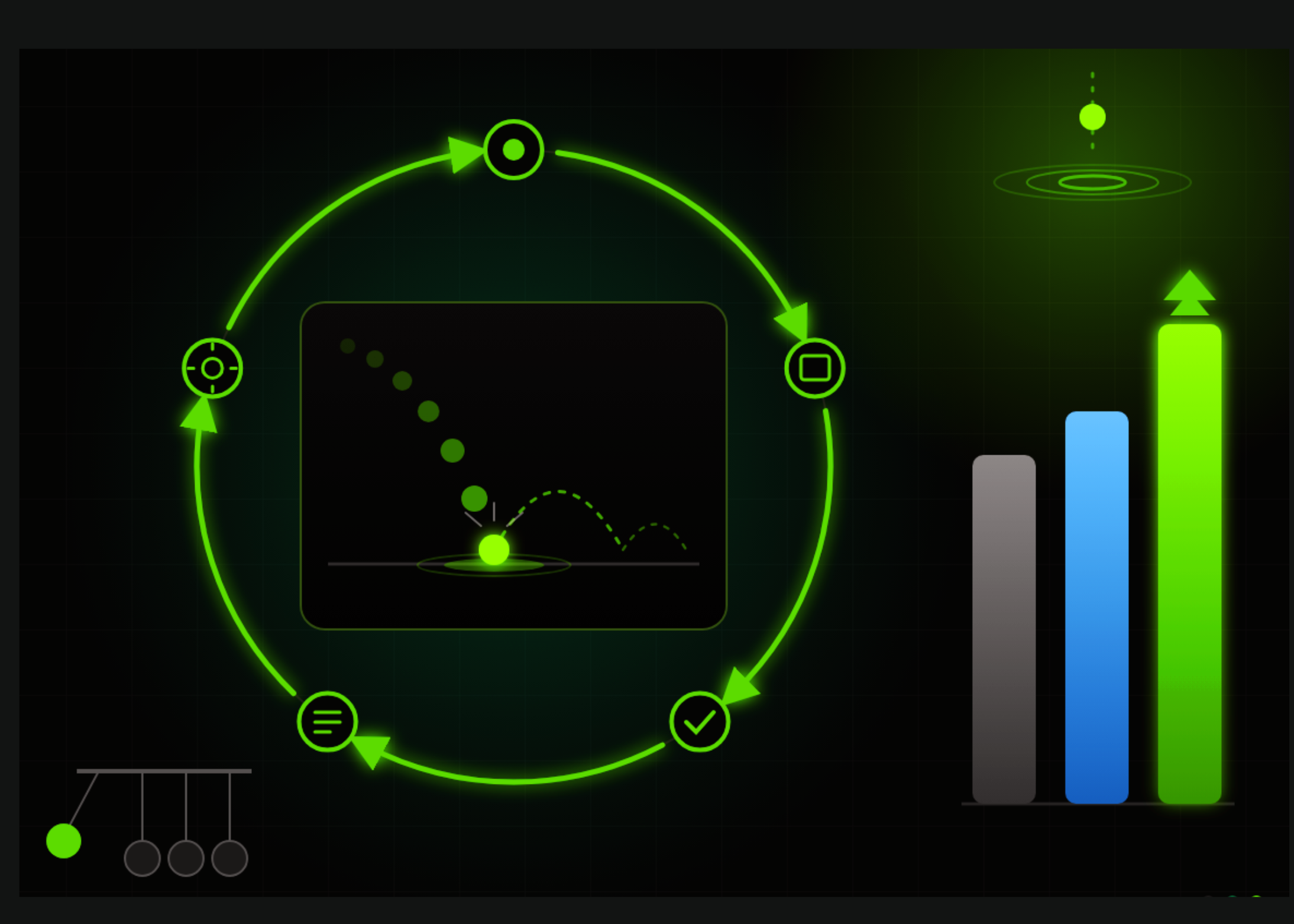
NVIDIA researchers introduced Physis-Lang, a self-evolving framework that adds physics reasoning to video captions — and pushed its Cosmos 3 world model past Veo 3.1 on physics benchmarks. Conventional captions describe what happens, not why: "butter melts as the temperature rises" says nothing about heat transfer or gravity. Physis-Lang adds a physics_reasoning field to each caption plus a scene-specific physics_negative_prompt describing implausible outcomes such as a stone floating on water, which acts as negative conditioning at inference time. The loop keeps the captioner frozen and evolves only its instruction, with a Gemini-3.1-Pro critic scoring captions and an evolution agent rewriting the prompt. On the public Physics-IQ Verified leaderboard snapshot dated September 29, Physis-Lang on Cosmos3-Super ranks first at 48.2 ± 1.4 with Cosmos3-Nano second at 43.3 ± 1.5, and caption F1 rose from 78.64 at iteration 1 to 87.82 at iteration 9.
Audio, Voice & Music

A lab called Edge0 released Audio8 ASR Infinite, a native streaming speech-recognition model built to transcribe unlimited-length audio in real time without drifting. Its native streaming architecture decodes 12.5 times per second, and a rolling KV cache keeps both memory and latency constant even in round-the-clock operation — the stated target is 24/7 transcription. The audio clock is selectable across 80, 120 and 160 ms, with a transcription delay of 240–560 ms, letting callers trade perception granularity against resource cost. It is Apache-2.0 licensed and documented for use with an adapted vLLM build. It is a useful counterpoint to the current wave of audio models: not a bigger speech engine, but one engineered around the clock.
Read more → https://huggingface.co/Edge0/Audio8-ASR-Infinite
Robots & Embodied AI
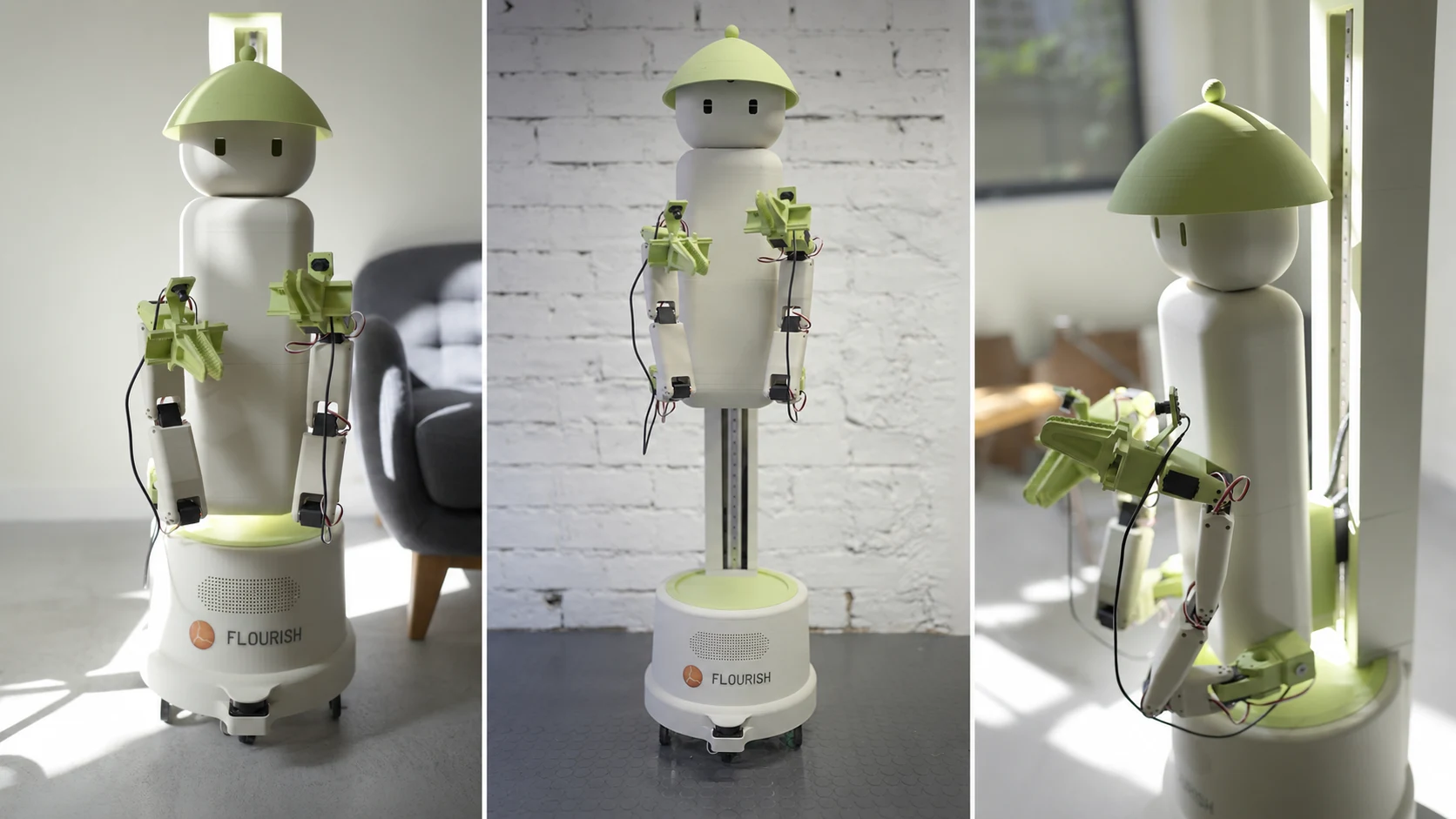
Flourish Robots emerged from stealth with Flourish 1, a wheeled semi-humanoid priced at $3,555 — a deliberate bet that a cheap, light body beats an expensive capable one for household chores. Pre-orders are open for an initial batch of 50 units, with deliveries scheduled to begin in December 2026, and the San Francisco startup is backed by a pre-seed round led by Families Fund. Owners teach tasks through a phone app — collecting shoes and clothes, wiping tables, watering plants, fetching objects — and Flourish fine-tunes existing pretrained models per home, using physical AI for manipulation and conventional navigation to move between rooms. The trade-offs are on the record: a 1.5 kg payload, a claimed 12-hour runtime, no stair climbing, and advice against handling breakable objects. Founder and CEO Antoine Marcel told Forbes the low payload and indoor focus are what allow simpler, cheaper hardware, and described current chores as reliable but slow.
Read more → https://www.humanoidsdaily.com/news/flourish-1-affordable-home-robot
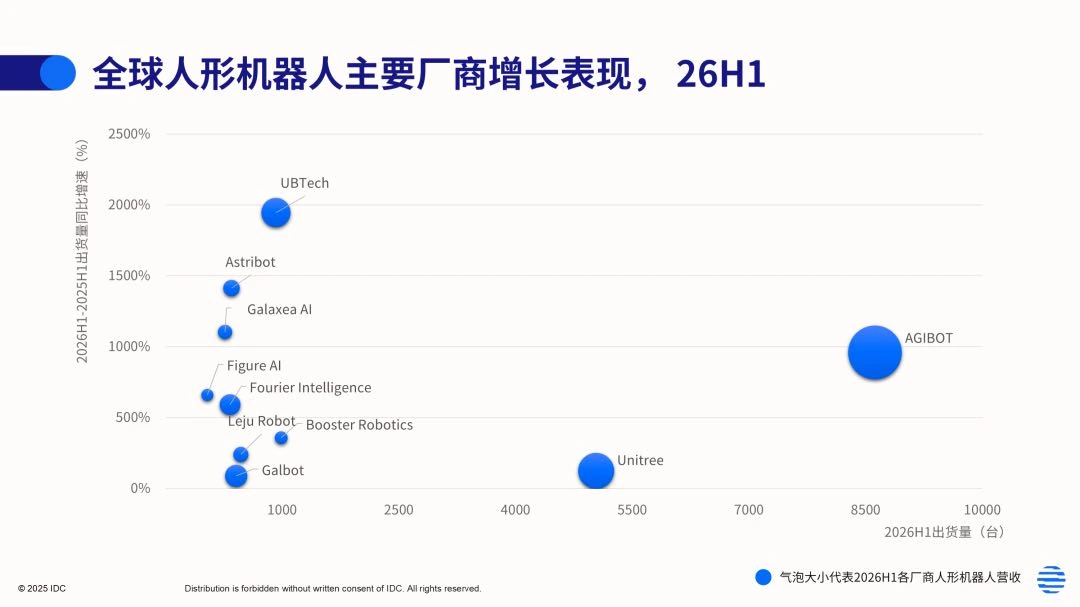
Global humanoid-robot shipments approached 25,000 units in the first half of 2026, up 432.1% year on year, according to IDC — and AGIBOT says it led with more than 8,600. In a September 30 release sharing the data, AGIBOT said its shipments represented roughly 35% of the global market. IDC notes that research and education, performances and displays, and government data centers still accounted for 69% of shipments — a reminder that most units are not doing commercial work yet. The figures are a new estimate for the same January–June period other analysts have covered, not an additional six months of growth: Counterpoint had put AGIBOT's share at 43.1% for the same window, and the two tallies are not reconciled, since they count different taxonomies of full-size bipeds, smaller humanoids and wheeled systems. AGIBOT's H1 figure is also separate from its announced 20,000 cumulative robots produced.
Read more → https://www.humanoidsdaily.com/news/idc-h1-2026-humanoid-shipments-agibot
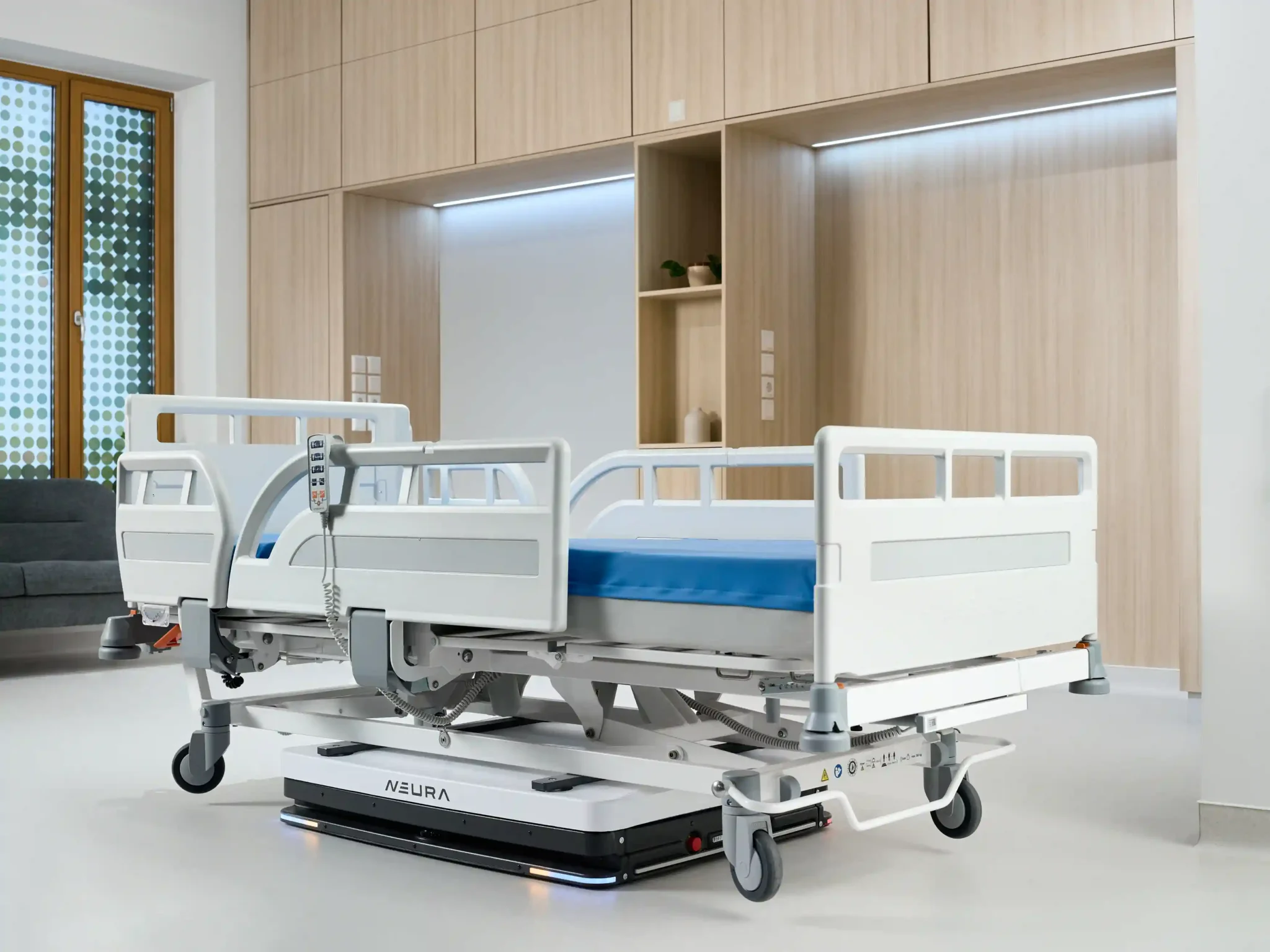
NEURA Robotics set up a dedicated healthcare unit, NEURA HealthTech, whose first product is an autonomous mobile platform for moving empty hospital beds. The unit is led by Sven Lange, and its initial platform moves empty beds — not patients — offered through partners on a monthly Robotics-as-a-Service basis. NEURA estimates that around 20 moves a day could save a facility more than 1,300 staff hours annually, though that is a company projection rather than a published hospital trial result. The company's wheeled service robot MiPA is being trained in its Gyms and pilot environments for patient-room assistance and medication support, and MAiRA robot arms are planned for instrument assistance and internal logistics. The announcement sketches a healthcare portfolio across several robot types without giving a launch date for MiPA's hospital role.
Read more → https://www.humanoidsdaily.com/news/neura-healthtech-mipa-hospital-robotics
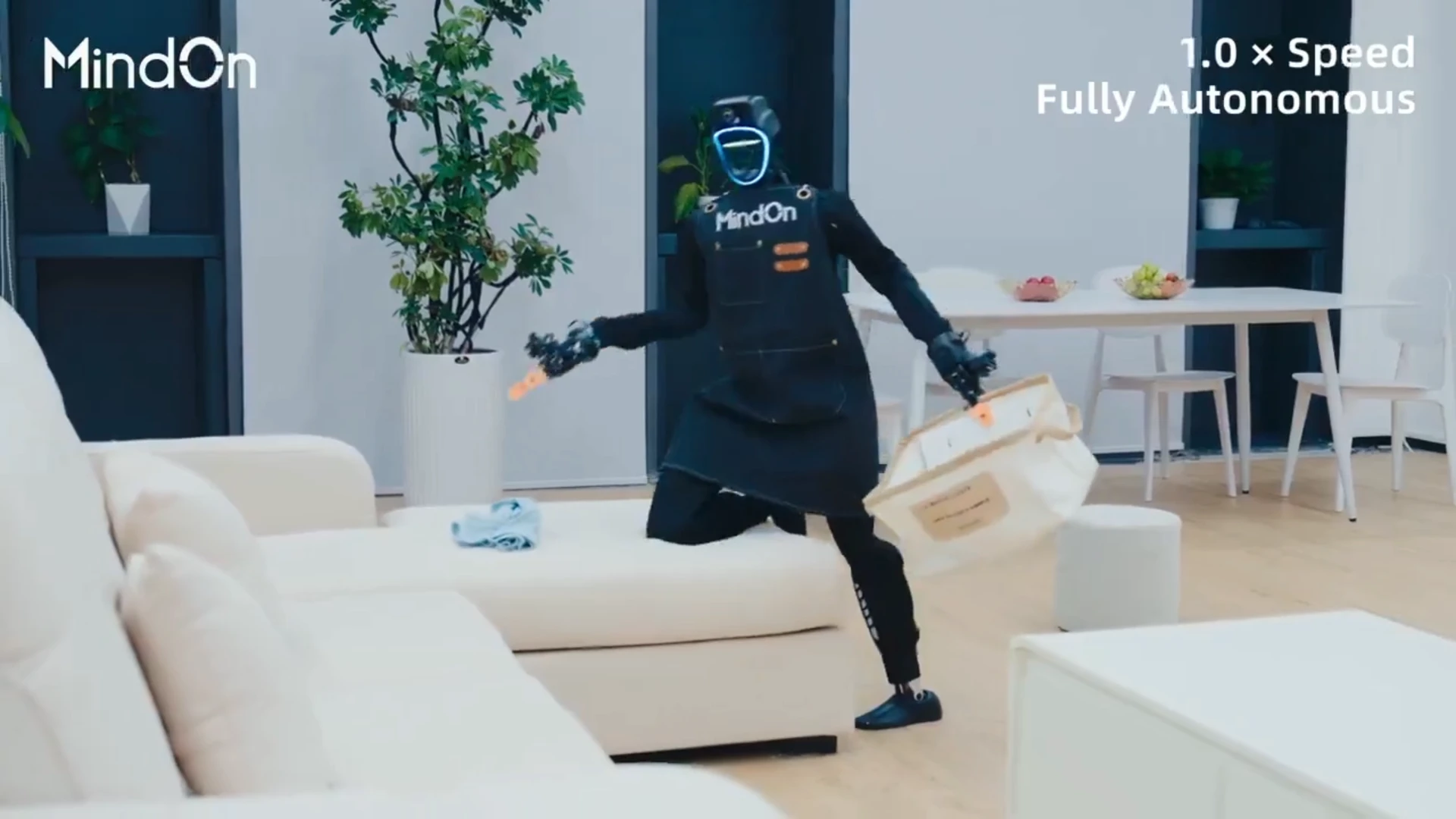
MindOn published a Mind-1 demonstration built around a question the field usually dodges: can a robot finish useful work at a useful pace? The September 30 video, labeled "1.0x Speed" and "Fully Autonomous," shows parcel handling, clothing folding and a humanoid collecting laundry across dual-arm systems. The company frames the clip as a move beyond merely completing a task, arguing execution speed is what makes robots useful workers over a shift rather than in a highlight reel. The label is a company claim, not an independently verified result, and it follows MindOn's viral November 2025 household-chore video and a mixed-robot logistics demonstration earlier this year. For a customer the measure that matters is throughput including retries and interruptions, not how fast a single motion looks.
Read more → https://www.humanoidsdaily.com/news/mindon-mind-1-human-speed-robot-demo

A new real-to-sim-to-real framework, PRISM, teaches humanoids to carry diverse objects by amplifying a handful of real videos into a large training set. Collecting the interaction videos that visual imitation needs — clips showing a person's full body and unoccluded contact with objects — is a practical barrier to scaling the approach. PRISM generates hundreds of "counterfactual" human-object interaction videos via video-to-video generation from a few exemplar real videos, then a contact-anchored real-to-sim pipeline reconstructs both human and object motion and retargets the imperfect video data into physically plausible trajectories. The intra-class variability across those synthesized videos is what lets a policy trained on them generalize to objects it never physically saw. It is a research release sitting on the seam where video generation, simulation and robot learning are collapsing into one pipeline.
Read more → https://arxiv.org/abs/2609.38172
Papers & Research

A new paper, EmoRES-TTS, makes emotion-conditioned text-to-speech more controllable without retraining the model. Emotion-conditioned TTS often fails to express the requested emotion reliably, and the usual fix — more training — is costly in both compute and emotion-labelled speech data. The authors study vector steering, a training-free method that edits the internal representations of a frozen model. They find that an emotion vector decomposes into a shared component that moves speech away from neutral expression and a residual component that directs generation toward the requested emotion; conventional methods treat the vector as one indivisible direction controlled by a single global strength, which limits adherence to the request. EmoRES steers the two components separately, driving the residual toward the target emotion while the shared part handles the move off neutral.
Read more → https://arxiv.org/abs/2609.38157

HybridCUA argues computer-use agents should stop choosing between clicking and typing — and learn to orchestrate GUI and command-line interfaces within one task. Existing computer-use agents either rely solely on graphical-interface interaction, which is inefficient and error-prone, or bolt on application-specific APIs and tools that take heavy engineering and do not scale across apps. The paper leverages the generality of the GUI and the efficiency of shell commands, and builds a data-construction pipeline producing GUI-only, CLI-only and interleaved GUI-and-CLI trajectories to teach models when and how to reach for the terminal. The contribution is the data recipe as much as the policy: the difficulty is not that agents cannot use a command line, but that they do not know when a command line is the right tool.
Read more → https://arxiv.org/abs/2609.38008

VisionHOPE treats a vision backbone as a self-modifying learning system rather than a fixed feature extractor. The paper releases hierarchical VisionHOPE-T/S/B checkpoints for ImageNet-1K classification, COCO object detection and instance segmentation, and ADE20K semantic segmentation, under an MIT license with code published on GitHub. The framing — that a backbone's internal computation should adapt itself during learning, not just its weights — sits alongside a broader 2026 push to make vision models do more per parameter. Pretrained weights are published for each size, so the claim can be checked rather than taken on faith.
Read more → https://arxiv.org/abs/2609.33325
News & Business
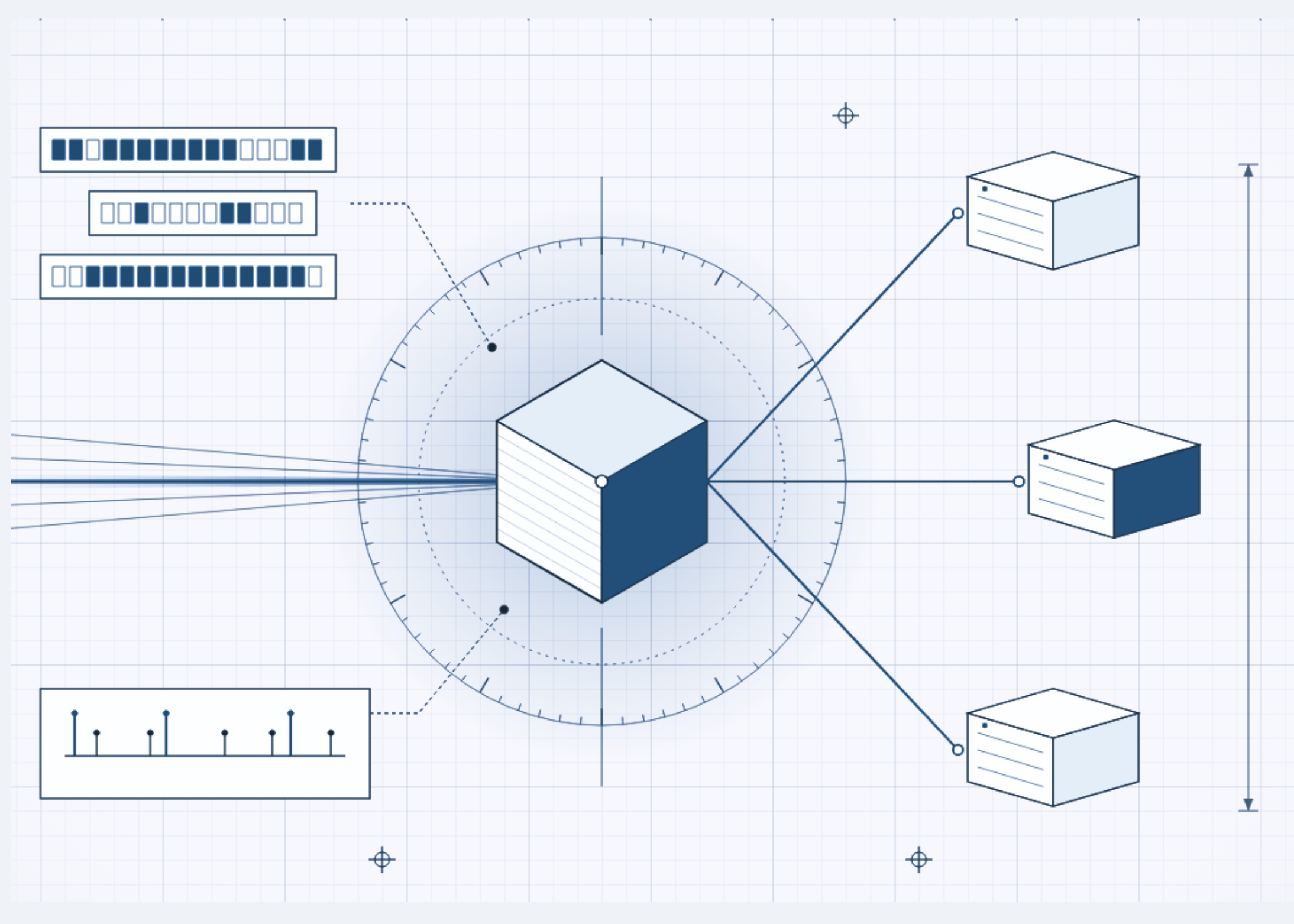
Perplexity built Photon, a Rust-based retrieval engine that trimmed its search p99 latency from 800 ms to 65 ms, and a "fast" preset that is about 68% cheaper for agent loops. A load balancer routes each request to a Photon broker, which fans out to a shard group running retrieval, initial ranking and second-stage ranking before merging candidates; a full web index now builds in a single-digit number of hours. Fast Search pairs Photon with lighter ranking tuned for agentic workflows; across 6 benchmarks and 3,554 tasks it scored 64.3% at $59.73 in estimated model-plus-search cost, against the default preset's 64.0% at $187.60. The trade-off is broader quality: internal long-tail relevance (DCG) fell from 2.45 to 2.21 and answer availability dropped 2.9 points, so Perplexity recommends Fast for day-to-day agent loops and the default for hard, ambiguous queries. Photon is not open source and is billed at $1 per 1,000 fast-search requests.

Supersonic Labs released Julia 1, a 144.3M-parameter decision model that turns a state, a question and possible answers into one clear decision — and runs on a CPU. The same interface handles classification, routing, ordered scores and Boolean decisions, positioning it against the small crop of non-generative "decision models" like TypeSafe's Jev. On evaluations run September 24 with H200 BF16 inference, Julia 1 scored 73.15% on typed decisions against Jev's 72.70%, 94.00% on AG News' four labels against 91.00%, and 86.00% on DAIR Emotion's six labels against 48.00%; it trailed Jev on a Banking77 pilot, 64.00% versus 87.00%. At 144.3M parameters and Apache-2.0 licensing, the pitch is not raw capability but cost, latency and predictability for the routing and scoring work teams still hand to general LLMs.
Read more → https://huggingface.co/SupersonicLabs/Julia-1

Fastino Labs released GLiNER2.5-Decide, a 340M-parameter encoder that folds structured extraction and classification into one pass without a generative decoder. It is built on the GLiNER2 extraction family and targets intent classification, sentiment analysis, topic classification and named-entity recognition — work teams otherwise route to large generative models at far higher latency and cost. Because it returns typed outputs directly rather than decoding free text, it sidesteps the schema drift that forces post-hoc parsing in agent pipelines. At 340M parameters and trending on Hugging Face within days of release, it belongs to the same shift visible across this edition: a fast-moving tier of small, task-specific models absorbing the classification work general LLMs do expensively.
Read more → https://huggingface.co/fastino/GLiNER2.5-Decide
That's today's horizon. The two stories braided together: the frontier got cheaper and faster while the rulebooks arrived late and toothless — a million output tokens for $10 on one side, a voluntary pact with no penalties on the other. And the layer underneath kept shrinking: a $3,555 chore robot, a 144M model on a CPU, a speech engine built to never drift. Until tomorrow — keep watching the layer below the model.