Today the story isn't a benchmark — it's where AI is landing: on corporate balance sheets, in bank operations, inside new factory shells, and under Apple's security model. Amazon looks to move $8 billion of Nvidia chips off its books, Barclays scales Claude across a global bank, Anthropic commits $100M to industrialize AI talent, and arXiv moves to cap the flood of AI-assisted papers. Meanwhile the open-model stack keeps getting cheaper to run and easier to trust. Here is today's horizon.
Frontier & Text Models
Anthropic is spending $100 million to manufacture the AI implementers enterprises actually lack. The company launched Claude Frontier Academy, a training program that aims to produce 10,000 Frontier Deployed Engineers (FDEs) by the end of 2027, using the same standard of skills as Anthropic's own engineers. The first cohorts come from Accenture, Bain, Capgemini, Commonwealth Bank of Australia, Deloitte, McKinsey, Morgan Stanley and Novo Nordisk. The bet is that the binding constraint on enterprise AI is no longer model capability but the people who can wire it into regulated, messy operations — a talent gap the labs are now funding directly.
Read more → https://www.anthropic.com/news/claude-frontier-academy
 Barclays is extending Claude across its global operations, targeting half its developers by year-end. The British universal bank is expanding its strategic collaboration with Anthropic to embed enterprise-grade AI across software development, legacy-system modernization and operational efficiency. Barclays expects Claude Code adoption to reach 50% of its developer population by the end of 2026, rising to a majority of software engineers in 2027. It is the clearest signal yet that regulated banks — not startups — are becoming the scale deployment case for frontier coding models.
Read more → https://www.anthropic.com/news/barclays-scales-claude
Barclays is extending Claude across its global operations, targeting half its developers by year-end. The British universal bank is expanding its strategic collaboration with Anthropic to embed enterprise-grade AI across software development, legacy-system modernization and operational efficiency. Barclays expects Claude Code adoption to reach 50% of its developer population by the end of 2026, rising to a majority of software engineers in 2027. It is the clearest signal yet that regulated banks — not startups — are becoming the scale deployment case for frontier coding models.
Read more → https://www.anthropic.com/news/barclays-scales-claude
Image & Vision
 DMAD rethinks few-step image generation by turning distribution matching into adversarial classification. Distribution Matching Distillation trains a few-step student from the difference between estimated target and student scores, so it must keep an auxiliary diffusion model fitted to the student's evolving distribution — extra memory and compute. DMAD recasts that matching as classification: two discriminator heads on a shared backbone separate real and teacher samples from the student's, and linear losses on their logits train the student without any auxiliary score fitting. The authors prove the losses recover the DMD gradient at the discriminator optimum — a cheaper path to fast visual generation.
Read more → https://arxiv.org/abs/2610.02188
DMAD rethinks few-step image generation by turning distribution matching into adversarial classification. Distribution Matching Distillation trains a few-step student from the difference between estimated target and student scores, so it must keep an auxiliary diffusion model fitted to the student's evolving distribution — extra memory and compute. DMAD recasts that matching as classification: two discriminator heads on a shared backbone separate real and teacher samples from the student's, and linear losses on their logits train the student without any auxiliary score fitting. The authors prove the losses recover the DMD gradient at the discriminator optimum — a cheaper path to fast visual generation.
Read more → https://arxiv.org/abs/2610.02188
Video & World Models
 MosaiChunk gives long-horizon video generation a spatio-temporal memory that survives objects leaving the frame. Long-horizon autoregressive video generation is limited by a finite context window: when an object or scene falls out of context, its fine-grained visual details are lost and hard to recover on reappearance. MosaiChunk is a spatio-temporal memory mechanism that composes a mosaic of selected historical key-value entries across space and time, keeping those details accessible as the sequence grows. It targets a core weakness of chunked video models without changing the underlying generator.
Read more → https://arxiv.org/abs/2610.02153
MosaiChunk gives long-horizon video generation a spatio-temporal memory that survives objects leaving the frame. Long-horizon autoregressive video generation is limited by a finite context window: when an object or scene falls out of context, its fine-grained visual details are lost and hard to recover on reappearance. MosaiChunk is a spatio-temporal memory mechanism that composes a mosaic of selected historical key-value entries across space and time, keeping those details accessible as the sequence grows. It targets a core weakness of chunked video models without changing the underlying generator.
Read more → https://arxiv.org/abs/2610.02153
Audio, Voice & Music
 ElevenLabs shipped Eleven v4, its most emotive text-to-speech model yet — and a low-latency Turbo variant built for agents. The model, ranked #1 by Artificial Analysis and preferred by roughly 75% of listeners in blind head-to-head tests, is built on an entirely new architecture designed to interpret tone, pacing, emotion and context while preserving speaker identity. Eleven v4 Turbo brings the same technology to agents with a median inference latency of about 100 ms — faster than the average pause between two people talking. As voice becomes the default interface for agents, the differentiator shifts from intelligibility to emotional range.
Read more → https://elevenlabs.io/blog/eleven-v4
ElevenLabs shipped Eleven v4, its most emotive text-to-speech model yet — and a low-latency Turbo variant built for agents. The model, ranked #1 by Artificial Analysis and preferred by roughly 75% of listeners in blind head-to-head tests, is built on an entirely new architecture designed to interpret tone, pacing, emotion and context while preserving speaker identity. Eleven v4 Turbo brings the same technology to agents with a median inference latency of about 100 ms — faster than the average pause between two people talking. As voice becomes the default interface for agents, the differentiator shifts from intelligibility to emotional range.
Read more → https://elevenlabs.io/blog/eleven-v4
 Hugging Face opened a dedicated leaderboard for open, multilingual text-to-speech and voice cloning. Published Sept. 30, the Open TTS Leaderboard focuses on open-source and multilingual models, letting users compare and vote on TTS outputs with voice-cloning evaluation built in. It fills a gap that has kept speech models hard to rank: closed vendor demos versus open weights were scored on different axes, and multilingual quality was rarely separated from English. The benchmark is designed to scale evaluation across languages rather than crown a single English winner.
Read more → https://huggingface.co/blog/open-tts-leaderboard
Hugging Face opened a dedicated leaderboard for open, multilingual text-to-speech and voice cloning. Published Sept. 30, the Open TTS Leaderboard focuses on open-source and multilingual models, letting users compare and vote on TTS outputs with voice-cloning evaluation built in. It fills a gap that has kept speech models hard to rank: closed vendor demos versus open weights were scored on different axes, and multilingual quality was rarely separated from English. The benchmark is designed to scale evaluation across languages rather than crown a single English winner.
Read more → https://huggingface.co/blog/open-tts-leaderboard
Robots & Embodied AI
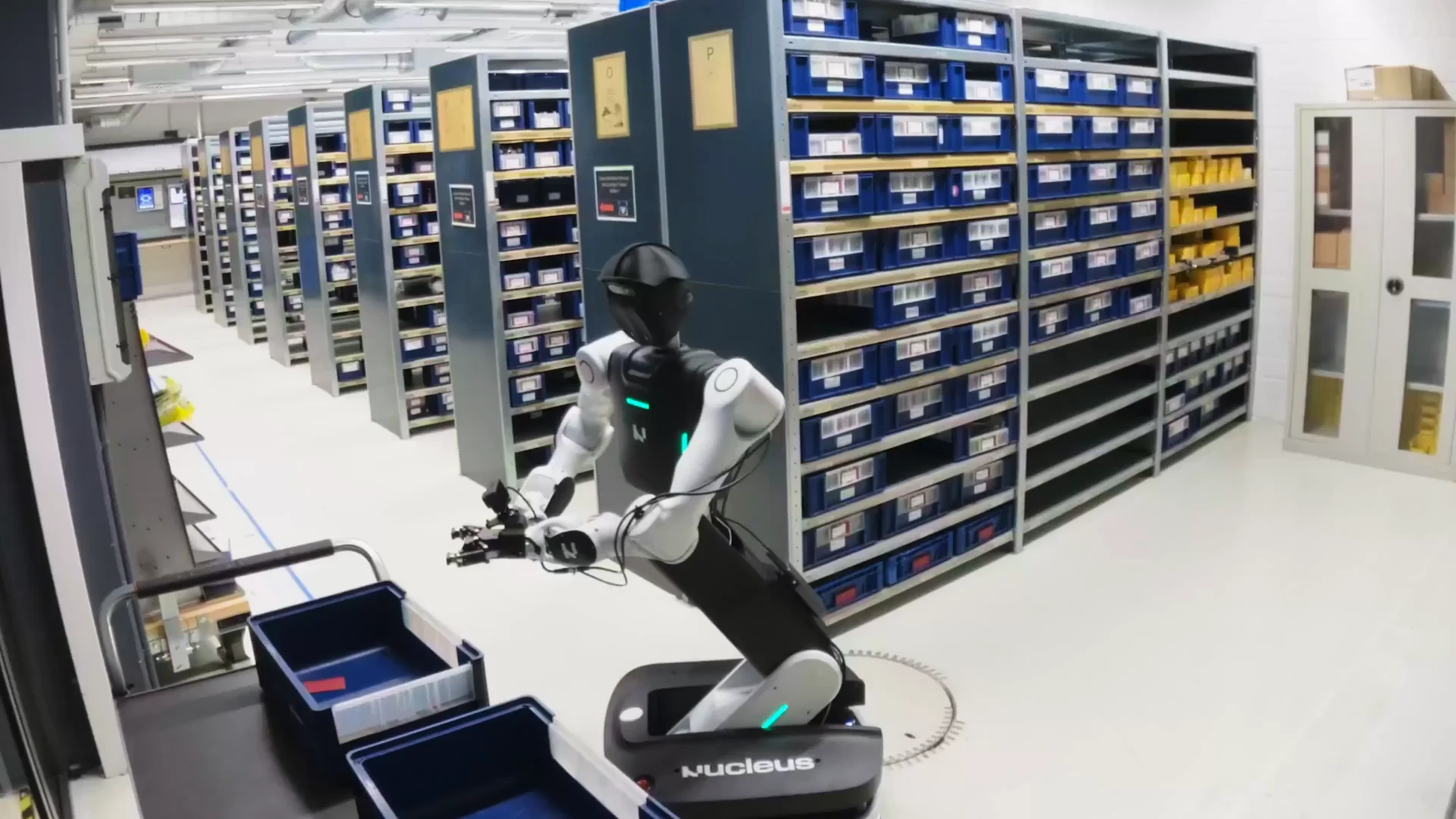 Nucleus published nearly two hours of uncut factory work and said the run was 60% autonomous. Founder and CEO Melvin Schwarz told Humanoids Daily the demonstration was 60% autonomous and 40% teleoperated, with the interventions left visible, though he did not specify how the split was measured. He says the company now regularly runs four-to-six-hour shifts, extending its strategy of blending autonomy with human assistance in industrial deployments. It is an unusually honest disclosure in a field that prefers polished highlight reels.
Read more → https://www.humanoidsdaily.com/news/nucleus-factory-demo-60-percent-autonomous
Nucleus published nearly two hours of uncut factory work and said the run was 60% autonomous. Founder and CEO Melvin Schwarz told Humanoids Daily the demonstration was 60% autonomous and 40% teleoperated, with the interventions left visible, though he did not specify how the split was measured. He says the company now regularly runs four-to-six-hour shifts, extending its strategy of blending autonomy with human assistance in industrial deployments. It is an unusually honest disclosure in a field that prefers polished highlight reels.
Read more → https://www.humanoidsdaily.com/news/nucleus-factory-demo-60-percent-autonomous
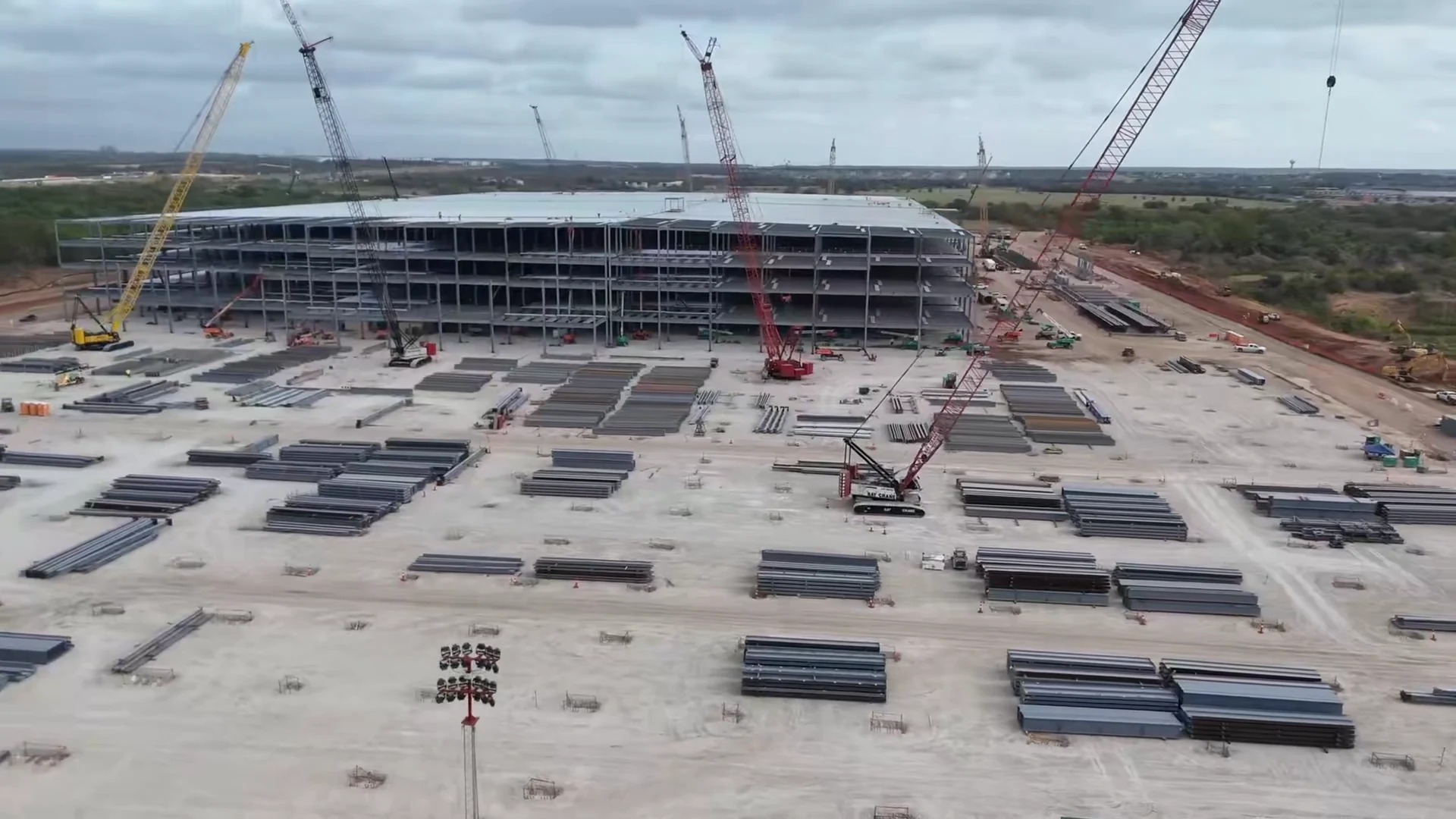 Tesla's dedicated Optimus factory is rising in Texas — but only about 40% of its steel frame is up. In his Oct. 1 update, observer Joe Tegtmeyer estimates that roughly 40% of the basic steel structure is assembled, stressing that this is not a measure of overall factory completion: upper-floor concrete is advancing while other sections still sit on foundations with no steel above them. He dates groundwork to late March and the first steel installation to May 27, and describes the project as a dedicated, more-than-seven-million-square-foot Optimus plant. Utilities, enclosure and production equipment are all still ahead — a reminder of how long the gap is between an Optimus demo and Optimus at volume.
Read more → https://www.humanoidsdaily.com/news/tesla-optimus-texas-plant-steel-40-percent
Tesla's dedicated Optimus factory is rising in Texas — but only about 40% of its steel frame is up. In his Oct. 1 update, observer Joe Tegtmeyer estimates that roughly 40% of the basic steel structure is assembled, stressing that this is not a measure of overall factory completion: upper-floor concrete is advancing while other sections still sit on foundations with no steel above them. He dates groundwork to late March and the first steel installation to May 27, and describes the project as a dedicated, more-than-seven-million-square-foot Optimus plant. Utilities, enclosure and production equipment are all still ahead — a reminder of how long the gap is between an Optimus demo and Optimus at volume.
Read more → https://www.humanoidsdaily.com/news/tesla-optimus-texas-plant-steel-40-percent
 InterEvolve lets a humanoid controller learn new loco-manipulation tasks at test time, without retraining. The work targets tasks a controller was never trained for, by repurposing skills it already has, improving from its own attempts, and retaining what it learns. The key insight is that a broad controller already holds much of the competence a new task needs, and that competence becomes accessible through an interface between planning and control. It is a step toward robots that adapt on the job rather than waiting for the next training run.
Read more → https://arxiv.org/abs/2610.02196
InterEvolve lets a humanoid controller learn new loco-manipulation tasks at test time, without retraining. The work targets tasks a controller was never trained for, by repurposing skills it already has, improving from its own attempts, and retaining what it learns. The key insight is that a broad controller already holds much of the competence a new task needs, and that competence becomes accessible through an interface between planning and control. It is a step toward robots that adapt on the job rather than waiting for the next training run.
Read more → https://arxiv.org/abs/2610.02196
Papers & Research
Mingbird argues most small-model agent failures are the harness's fault, not the model's. Small open-weight models (2B–9B) run on ordinary laptops, but under cloud-scale agent harnesses they rarely finish real tasks: tool prefill overflows the context, self-correction diverges, demonstrations loop, and tasks get silently abandoned. Mingbird is a local-first harness for Windows and Ollama whose ten mechanisms compensate point-by-point for those failure forms — a net-zero prefill budget, a finish gate that re-reads the task before accepting completion, and signature-level loop detection among them. On LRAB, holding machine, models and scoring fixed, it reaches 0.886 overall against 0.631 (goose), 0.479 (opencode) and 0.405 (agent-mini), with all 288 cells published. The lesson is that how you wrap a model can matter as much as which model you pick. Read more → https://arxiv.org/abs/2610.02001
 Omni-Embed-Mini binds six modalities into one space with only 0.9 billion parameters — and without forgetting text. Extending a text embedder to new modalities usually degrades text retrieval, and existing omni-modal embedders compensate with multi-billion parameters. Omni-Embed-Mini maps text, speech, audio, images, video and visually rich documents into one shared cosine space without updating any text-side parameter. Its trick is a teacher that needs no separate model: each media sample is paired with a dense cascaded caption, and the teacher target is simply the frozen backbone's own embedding of that caption, so teacher and student share byte-identical geometry.
Read more → https://arxiv.org/abs/2610.02148
Omni-Embed-Mini binds six modalities into one space with only 0.9 billion parameters — and without forgetting text. Extending a text embedder to new modalities usually degrades text retrieval, and existing omni-modal embedders compensate with multi-billion parameters. Omni-Embed-Mini maps text, speech, audio, images, video and visually rich documents into one shared cosine space without updating any text-side parameter. Its trick is a teacher that needs no separate model: each media sample is paired with a dense cascaded caption, and the teacher target is simply the frozen backbone's own embedding of that caption, so teacher and student share byte-identical geometry.
Read more → https://arxiv.org/abs/2610.02148
 Looped Transformers can decode better "for almost free," by reusing what the early loops already computed. Looped models achieve parameter efficiency by running a shared block across recurrent loops, and every loop yields a representation decodable to the same next token — yet standard decoding throws the earlier states away. Because earlier loops embody less computation, recurrence inherently supplies aligned weak-and-strong prediction pairs without any auxiliary model or extra training. The authors exploit those pairs to improve decoding, turning an architectural quirk into a free accuracy gain.
Read more → https://arxiv.org/abs/2610.02185
Looped Transformers can decode better "for almost free," by reusing what the early loops already computed. Looped models achieve parameter efficiency by running a shared block across recurrent loops, and every loop yields a representation decodable to the same next token — yet standard decoding throws the earlier states away. Because earlier loops embody less computation, recurrence inherently supplies aligned weak-and-strong prediction pairs without any auxiliary model or extra training. The authors exploit those pairs to improve decoding, turning an architectural quirk into a free accuracy gain.
Read more → https://arxiv.org/abs/2610.02185
 A pair of small security language models exposed how easily keyword benchmarks credit tool use that never happens. The paper documents a false positive in a matched-architecture pair of Spanish security models: a 661.6M model and a 1,109M model share decoder, tokenizer and special tokens, and score almost identically on lenient tool-use metrics (0.660 vs 0.650). But verbatim-reproduction checks on training examples separate them completely — the 600M emits valid tool calls on 6/6 examples, the 1B on 0/6. A first-token probe localizes the failure, arguing for strict, cheap diagnostics over headline benchmark scores.
Read more → https://arxiv.org/abs/2610.02142
A pair of small security language models exposed how easily keyword benchmarks credit tool use that never happens. The paper documents a false positive in a matched-architecture pair of Spanish security models: a 661.6M model and a 1,109M model share decoder, tokenizer and special tokens, and score almost identically on lenient tool-use metrics (0.660 vs 0.650). But verbatim-reproduction checks on training examples separate them completely — the 600M emits valid tool calls on 6/6 examples, the 1B on 0/6. A first-token probe localizes the failure, arguing for strict, cheap diagnostics over headline benchmark scores.
Read more → https://arxiv.org/abs/2610.02142
News & Business
 Prime Intellect launched Prime Inference, a serving layer for frontier open models. The platform offers serverless endpoints and reserved capacity on Prime's own GPUs across multiple datacenters, and it processed nearly a trillion tokens per day internally before release — traffic from RL rollouts, synthetic data and long-running coding agents. Prime reports its GLM-5.3 endpoint ranks among the fastest on OpenRouter, cites a near-zero tool-call error rate and 100% uptime since launch, and says a 1:4 prefill/decode ratio served 66 sessions per group at 101 tokens/sec per user. It is OpenAI-compatible, so any OpenAI SDK can point at the endpoint.
Read more → https://www.primeintellect.ai/blog/prime-inference
Prime Intellect launched Prime Inference, a serving layer for frontier open models. The platform offers serverless endpoints and reserved capacity on Prime's own GPUs across multiple datacenters, and it processed nearly a trillion tokens per day internally before release — traffic from RL rollouts, synthetic data and long-running coding agents. Prime reports its GLM-5.3 endpoint ranks among the fastest on OpenRouter, cites a near-zero tool-call error rate and 100% uptime since launch, and says a 1:4 prefill/decode ratio served 66 sessions per group at 101 tokens/sec per user. It is OpenAI-compatible, so any OpenAI SDK can point at the endpoint.
Read more → https://www.primeintellect.ai/blog/prime-inference
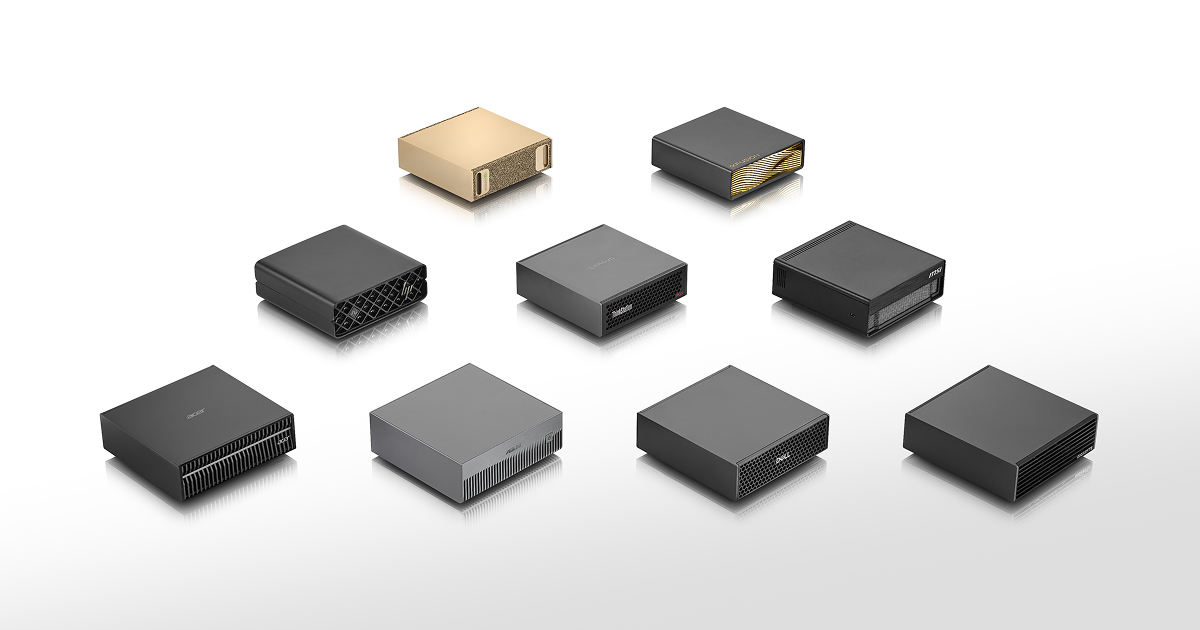 NVIDIA added a 64GB DGX Spark — a cheaper entry into local, desk-side AI compute — starting Oct. 23. The new configuration, offered by Acer, ASUS, Dell, Gigabyte, HP and MSI, keeps the GB10 Grace Blackwell superchip, DGX OS and full NVIDIA AI software stack of the 128GB model while supporting up to 100-billion-parameter models fully on device. Two 64GB units can be clustered with NVIDIA Sync Cluster Assistant without extra setup; in NVIDIA's Qwen 3.8 27B test the pair delivered up to 1.7x the performance of a single system. It ships ready for agents out of the box — Agent Toolkit, Nemotron open models, Ollama, vLLM and PyTorch with CUDA included.
Read more → https://blogs.nvidia.com/blog/local-ai-dgx-spark-64gb-sync/
NVIDIA added a 64GB DGX Spark — a cheaper entry into local, desk-side AI compute — starting Oct. 23. The new configuration, offered by Acer, ASUS, Dell, Gigabyte, HP and MSI, keeps the GB10 Grace Blackwell superchip, DGX OS and full NVIDIA AI software stack of the 128GB model while supporting up to 100-billion-parameter models fully on device. Two 64GB units can be clustered with NVIDIA Sync Cluster Assistant without extra setup; in NVIDIA's Qwen 3.8 27B test the pair delivered up to 1.7x the performance of a single system. It ships ready for agents out of the box — Agent Toolkit, Nemotron open models, Ollama, vLLM and PyTorch with CUDA included.
Read more → https://blogs.nvidia.com/blog/local-ai-dgx-spark-64gb-sync/
Amazon wants to move $8 billion of Nvidia chips off its balance sheet. The company is seeking to transfer roughly $8 billion worth of Nvidia's advanced Grace Blackwell AI chips to outside investors through a special-purpose financing vehicle, according to the Financial Times. Under the reported structure, investors would own the hardware while Amazon keeps using the processors in its U.S. data centers through lease arrangements — shifting the enormous upfront cost of AI hardware off the books while preserving access to the compute AWS needs. Amazon expects capital spending of roughly $220 billion this year, mostly on cloud infrastructure and chips. If hyperscalers increasingly finance GPUs through dedicated vehicles, chips start to look less like equipment and more like aircraft or real estate: assets financed separately from the companies that use them. Read more → https://techstartups.com/2026/10/02/top-tech-news-today-october-2-2026-amazon-cloudflare-google-microsoft-suno-tesla-more/
 Apple is tightening macOS "Full Disk Access" because autonomous AI agents make it dangerous. In a developer-news post on Oct. 2, Apple said it will introduce "additional controls" for the Full Disk Access setting, warning that "some developers are using Full Disk Access in ways that could put users at risk, exposing everything on their systems — including files, mail, messages, and even browsing history — without users' full knowledge and understanding." The company added that "as AI agents become increasingly capable and autonomous, the risks associated with this level of access will grow substantially." The announcement lands amid the rise of always-on agents like Meta's Muse and OpenAI's Dots — and marks the moment an OS vendor began treating agent permissions as a security boundary.
Read more → https://www.macrumors.com/2026/10/02/apple-announces-macos-full-disk-access-changes/
Apple is tightening macOS "Full Disk Access" because autonomous AI agents make it dangerous. In a developer-news post on Oct. 2, Apple said it will introduce "additional controls" for the Full Disk Access setting, warning that "some developers are using Full Disk Access in ways that could put users at risk, exposing everything on their systems — including files, mail, messages, and even browsing history — without users' full knowledge and understanding." The company added that "as AI agents become increasingly capable and autonomous, the risks associated with this level of access will grow substantially." The announcement lands amid the rise of always-on agents like Meta's Muse and OpenAI's Dots — and marks the moment an OS vendor began treating agent permissions as a security boundary.
Read more → https://www.macrumors.com/2026/10/02/apple-announces-macos-full-disk-access-changes/
 Adoption is everywhere; payment is not: only about 2% of U.S. households pay for an AI service. That is the gap at the heart of the boom — roughly 25% pay for SiriusXM, 55% for cloud storage and 91% for at least one streaming service, yet paying AI subscribers remain a rounding error, even as AI adoption reaches 41% of U.S. workers. The data points to a monetization problem hiding behind record usage and record capex: people are using AI daily without ever entering a paid plan, which is exactly why the labs keep chasing proactive, embedded agents that are hard to turn off.
Read more → https://techstartups.com/2026/10/02/only-2-of-u-s-households-pay-for-ai-even-as-ai-adoption-reaches-41-of-u-s-workers/
Adoption is everywhere; payment is not: only about 2% of U.S. households pay for an AI service. That is the gap at the heart of the boom — roughly 25% pay for SiriusXM, 55% for cloud storage and 91% for at least one streaming service, yet paying AI subscribers remain a rounding error, even as AI adoption reaches 41% of U.S. workers. The data points to a monetization problem hiding behind record usage and record capex: people are using AI daily without ever entering a paid plan, which is exactly why the labs keep chasing proactive, embedded agents that are hard to turn off.
Read more → https://techstartups.com/2026/10/02/only-2-of-u-s-households-pay-for-ai-even-as-ai-adoption-reaches-41-of-u-s-workers/
That's today's horizon — the compute bill moved off-book, the banks moved in, the factory shell rose, and the operating system started guarding its own disk.