In this edition
- Frontier & Text Models (5)
- Image & Vision (1)
- Video & World Models (2)
- Audio, Voice & Music (2)
- Robots & Embodied AI (4)
- Small & On-Device Models (1)
- Papers & Research (2)
- News & Business (2)
The frontier's centre of gravity shifted east and inward this week. China published a draft export-control update that would put model weights, training methods and agent tooling behind a licence, while OpenAI spent its week handing free seats to university labs and letting ChatGPT drive your open browser tabs. Underneath the headlines the scaffolding got quietly better: one Google model now pitches itself as the only brain a robot needs, a 19-million-parameter ear landed on-device, and two new papers show agents that know when to hand control to a stronger sibling — and one that simply beats Minecraft.
Frontier & Text Models

China's commerce and science ministries have released a draft rule that would put 23 key AI technologies behind export controls, including frontier model weights, source code and training methods. Restrictions would trigger when a system was trained on sensitive Chinese data, or once it crosses 2 trillion parameters, 10^26 FLOPs of training compute, or a global top-10 ranking. To avoid slowing its own labs, the draft fast-tracks open-weight releases with automatic approval on registration and exempts anything already public. The practical effect is a deliberate mirror of US chip controls: Chinese open weights stay legal to train at home, but need a licence to leave.

OpenAI has launched a free "Rosalind Academic Plan" that gives US university research labs up to 30 free seats for a year. Eligible labs — currently only those without an enterprise contract — get Business Standard access for up to twelve months, and API access is explicitly not included. The plan centres on GPT-Rosalind, an OpenAI model built for the life sciences that supports deeper reasoning on biological questions, wired through a "Rosalind Workbench" to tools for medicinal chemistry, genomics and lab experiments. Before granting access OpenAI vets the institution, the lead researcher and the planned use, then monitors how the model is used once approved.

Anthropic has handed a team from the nonprofit METR inside access to audit its models and safety practices. Six METR staffers received company hardware, office space and access to internal tools — roughly on par with Anthropic's own risk teams. Customer data, attorney-client-privileged material and details of the model architecture stay off-limits, and METR publishes its findings independently: Anthropic can request redactions in predefined categories, but METR is free to say publicly whether it thinks those redactions were justified. The company argues not all safety-relevant information can be public, either because it would help attackers or because it is commercially sensitive.
Read more → https://the-decoder.com/anthropic-gives-metr-inside-access-to-audit-its-ai-models-and-safety-practices/

ChatGPT's Chrome extension now reads and acts on your open browser tabs. Users target tabs with @chrome, Chat mode pulls data from several tabs at once, and Work mode drives them through Computer Use to send messages, fill out forms, download files or group tabs. OpenAI says GPT-6 Astra is the best computer-use model on the market right now and can handle complex multi-step workflows; in OpenAI's own examples the extension compares products across tabs by size, material, shipping time and return rules, or matches price pages from different sellers. The upgrade ships to every ChatGPT plan.

Reflection has released Beam-1.0, a 501-billion-parameter open model with just 23 billion parameters active per token and a 1M-token context window. The sparse mixture-of-experts model ships in BF16, FP8 and NVFP4 under Apache 2.0, and its headline pitch is token efficiency: Reflection claims comparable solution quality to leading open models using roughly three times fewer inference-time reasoning tokens. It targets software engineering — real GitHub issues, CLI and DevOps work, agentic coding harnesses — plus long-horizon tool use with MCP integration and browsing, and graduate-level maths and science.
Read more → https://huggingface.co/reflection/Beam-1.0-501B-A23B
Image & Vision

Black Forest Labs has released FLUX 3 Image Klein, a 5.6-billion-parameter open-weights image model small enough to run on an 8 GB GPU. It supports native 4K output, pixel-accurate editing and generation from up to ten reference images, with bounding boxes for element placement. BFL says it holds the highest Elo ratings of any open model in internal testing — ahead of closed rivals such as Ideogram V4.5 and its own FLUX.2 [pro] — and gains 91 Elo points over FLUX.2 [klein] with 38 percent fewer parameters than that model's 9 billion. An INT8 build generates an image in under nine seconds on an RTX 4070, under the FLUX Kommunity License.
Video & World Models

Gen4P turns a pretrained video generation model into a feed-forward 4D perceiver that recovers geometry and motion from a single monocular video. Rather than sampling a video model step by step, the framework reuses it: Gen4P processes clean video latents in one encoder pass and predicts the requested 4D attributes through on-demand querying, with no iterative denoising. If it holds up, the same weights that dream a scene can also be asked what the scene is — depth, correspondence and camera motion — which is exactly the grounding robot planners keep running short of.
Read more → https://arxiv.org/abs/2610.22371

Velox gives a world model a spatial memory, so long video rollouts stay coherent without an ever-growing KV cache. Chunked video diffusion models normally retain prior context in ever-larger caches, so later chunks get progressively slower; Velox instead builds camera frustum slabs with depth intervals from streaming geometry and uses them as a training-free attention router for region-level context selection. Uncovered regions fall back to the model's own routing without geometric bias. At chunk 48 it accelerates attention by 4.36x and denoising by 2.43x, and across the full 158-case WBench navigation split it stays within 0.15 points of dense LingBot-Fast-Cam.
Read more → https://arxiv.org/abs/2610.22311
Audio, Voice & Music

MOSS-Transcribe-Diarize 0.9B transcribes and separates speakers across up to 90 minutes of audio in a single pass. The end-to-end audio model handles long-form multi-speaker transcription, diarization, timestamps and acoustic event awareness across more than 50 languages, emitting a compact speaker-aware transcript with anonymous labels like [S01] and [S02] rather than a wall of undifferentiated text. It also takes custom hotword prompting for domain vocabulary, and it took first place in the 2nd MLC-SLM Challenge at INTERSPEECH 2026 across 14 languages; Hugging Face's own hf-audio org packaged the weights for plain transformers inference on 14 October.
Read more → https://huggingface.co/hf-audio/MOSS-Transcribe-Diarize-HF

Duyu-small is a bilingual Turkish-and-English speech recogniser with only 19.3 million active parameters, built to run on the CPU next to your microphone. It ships as ONNX graphs at int8 (56 MB) and 4-bit (34 MB) with a numpy-and-onnxruntime engine, and writes cased, punctuated text whether the speaker is in Turkish, English, or both within one sentence. Despite its size it beats whisper-base by a wide margin on Turkish: 12.45 vs 29.51 word error rate on voicedata-TR conversation, 7.87 vs 24.19 on FLEURS Turkish, and 16.37 vs 39.08 on call-centre turns. It concedes English — 22.88 on FLEURS en_us against whisper-base's 10.81 — which is fair for a model this small.
Read more → https://huggingface.co/KaanAydinli/Duyu-small
Robots & Embodied AI

Google wants Gemini 4 Argon to be the only brain a robot needs: it controls the hardware, builds practice worlds from photos or sketches, and grades the training video — the full robotics pipeline in one model. From inputs as simple as a photo or a sketch, the system generates interactive 3D environments where a robot can rehearse movement before doing it for real, and it scored 87 percent on Google's own ERQA benchmark. The published example prompts are the tell, though: a Boston Dynamics Spot learning to toss cans into a step-on bin still needs dense human prompting and guidance at every stage. Argon is available through Google's paid developer access programmes.
Read more → https://the-decoder.com/google-wants-gemini-4-argon-to-be-the-only-ai-model-robots-need/
Agility Robotics has named Nyobolt as the battery partner behind Digit 5's nine-minute recharge. The October 15 announcement ties the partnership to Agility's target of more than 20 hours of work inside a 24-hour day, on a proposed rhythm of 90 minutes operating followed by nine minutes of charging. That cadence, not the robot's hands, is what decides whether a humanoid is economically useful on a shift. Early access is expected in the first half of 2027.
Read more → https://www.humanoidsdaily.com/news/agility-digit-5-nyobolt-nine-minute-charging
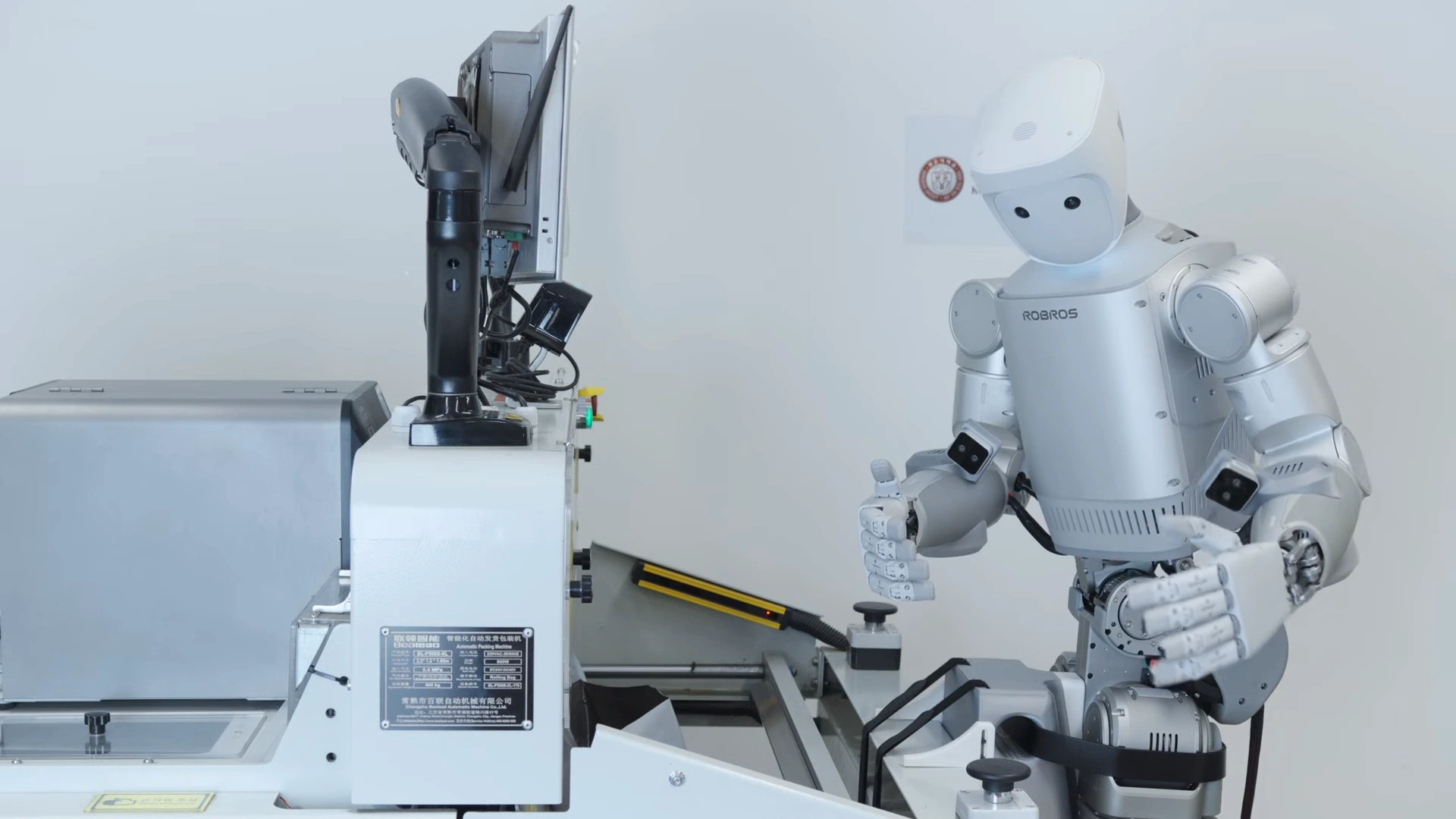
South Korea has approved a regulatory-sandbox trial that puts 20 Robros humanoids to work across manufacturing and logistics sites. The approval permits testing alongside or near workers, subject to risk assessments and mitigation measures — and explicitly does not establish completed deployments or production performance. Robros separately targets a first-half 2027 release of its own humanoid AI model, initially aimed at manufacturing. It is a reminder that in robotics, the regulator's signature is often the real milestone.
Read more → https://www.humanoidsdaily.com/news/robros-20-humanoid-industrial-trial-korea
Google DeepMind is building a new Cambridge-area robotics lab, according to its own Aaron Saunders, the former Boston Dynamics CTO. Saunders, who moved to DeepMind roughly a year ago, said the lab exists to house a growing robotics hardware team and invited machinists, engineers and researchers to get in touch. He disclosed no size, budget or exact location, and his reference to more news in 2027 does not specify an opening date or a product. Read it as a hardware hiring signal from a company that has spent the year insisting the model layer is the robot's brain.
Read more → https://www.humanoidsdaily.com/news/google-deepmind-cambridge-robotics-lab-aaron-saunders
Small & On-Device Models

Tencent's Hunyuan team has released Hy-Memory-30B-A3B, a compact long-term-memory writer distilled in two stages — memory on-policy distillation, then reinforcement learning — to decide what an AI should remember. It is a long-term-memory writer — about 3 billion active parameters out of a 30-billion-parameter mixture-of-experts with 128 experts — that executes the write path inside external memory frameworks, deciding what to retain, how precisely to represent it, and how new evidence should update the bank. It drops in as a replacement for the general-purpose LLM inside Mem0, MemOS and Tencent's own Hy-Memory, and is trained in two stages: Memory On-Policy Distillation, then Attributed Memory Reinforcement Learning. The card claims it transfers directly to unseen harnesses such as EverMemOS. Apache-2.0 weights.
Read more → https://huggingface.co/tencent/Hy-Memory-30B-A3B
Papers & Research

A new paper drops four Gemini 4 Argon agents into a sandboxed Minecraft survival world with one instruction — beat the Ender Dragon — and they do it without anyone assigning roles or writing game logic. Each agent controlled a player through the open-source Mineflayer library and coordinated with its teammates over in-game chat and shared memory. The agents had to plan, write code, gather resources and recover from deaths together. The interesting part is not the dragon; it is that unstructured, emergent division of labour held up well enough to finish the game.
Read more → https://arxiv.org/abs/2610.22319

LEASH offers an answer to a mounting bill: let a cheap open-weight agent act by default, and escalate to a stronger model only when it is unsure. Computer-use agents now run long-horizon tasks where calling a frontier model at every step is expensive, while a small open model alone often fails outright. Weak-to-strong escalation sits in between, and LEASH makes the handoff uncertainty-aware, so the strong model is consulted selectively rather than on a fixed schedule. It is the same instinct as the router in Velox, applied to who does the thinking instead of what gets attended to.
Read more → https://arxiv.org/abs/2610.22280
News & Business

CoreWeave CEO Michael Intrator and entities tied to him have sold nearly $1 billion of company stock since the AI cloud provider went public in March 2025. Reuters reported the disclosure against a backdrop of growing investor pressure, with yields on some CoreWeave corporate bonds surging above 15 percent. That combination — insider selling at scale and a punishing cost of debt — is the sharpest single datapoint yet that the market is repricing the AI infrastructure trade from growth story to credit risk.
TSMC posted nearly $24 billion in quarterly profit on demand for advanced processors, even as Gartner warned that more than $3.5 trillion in AI infrastructure spending could be at risk of impairment by 2030. The two halves of that sentence are the whole debate: record silicon profits today against a financing bill that may outrun the revenue needed to service it. The same digest notes that the US Federal Trade Commission has subpoenaed leading AI labs over potential consumer-protection violations — a regulatory thread that now runs alongside the money one.
That's this week's horizon. The frontier is being fenced by policy and audited by outsiders, while the real capability gains are landing in small, unglamorous places — a 19-million-parameter ear, a memory writer, a router that knows when to ask for help.