In this edition
- Frontier & Text Models (3)
- Image & Vision (1)
- Video & World Models (2)
- Audio, Voice & Music (2)
- Robots & Embodied AI (3)
- Small & On-Device Models (2)
- Papers & Research (2)
- News & Business (3)
The price war and the speed war landed on the same Monday. MiniMax shipped a reasoning model that scores 42 on the Artificial Analysis Intelligence Index for about $0.22 a task, Inception Labs put a diffusion language model on the market at 1,068 tokens per second, and Cloudflare introduced a model class that never generates a token at all — it returns typed values with confidence scores. Around them Kling pushed AI video to 30-second single passes, a Figure humanoid walked 348 miles without stopping, and OpenAI went shopping for $30 billion at a $1.4 trillion valuation before Anthropic's IPO opens its books.
Frontier & Text Models

MiniMax's new reasoning model scores 42 on the Artificial Analysis Intelligence Index — 13 points above its own predecessor, at less than half the cost per task. M3.1 Flash ties GLM-5.3-Flash, edges Gemini 3.8 Flash (41) and trails DeepSeek V4.1 Flash 1017 (45). Complex reasoning saw the biggest jump: 48 percent on Humanity's Last Exam, and 22 percent on CritPt, the research-level physics test where GLM-5.3-Flash manages 15 percent and Gemini 3.8 Flash 18 percent. On factual accuracy it answers 56 percent of AA-Omniscience questions correctly, against 28 percent for GLM and 43 percent for DeepSeek, and leaner output brings cost per task to roughly $0.22 while running three times faster than M3. The catch is candour: Artificial Analysis measured a 93 percent hallucination rate, because the model answers everything rather than declining.
Read more → https://the-decoder.com/minimax-m3-1-flash-shows-chinas-ai-price-race-has-no-floor-in-sight/

Inception Labs' Mercury 3 is the most capable diffusion language model shipped so far, generating 1,068 tokens per second on NVIDIA GPUs. That is 4–8x faster than the autoregressive models it is aimed at, with a 1M-token context window up from 260K in Mercury 2.5, at $0.20 per million input and $0.70 per million output tokens — half that during launch. Inception says it outperforms GPT-6 Luna and Claude Haiku 5.5 across its benchmark range, after scaling more than 40x in parameters since Mercury 1 for a 3x rise in measured intelligence. In a production web-agent harness on 50 live Mind2Web navigation tasks it completed 50 percent, more than GPT-6.1-Sol, using the same token volume and the same number of agent steps.
Read more → https://www.inceptionlabs.ai/blog/introducing-mercury-3
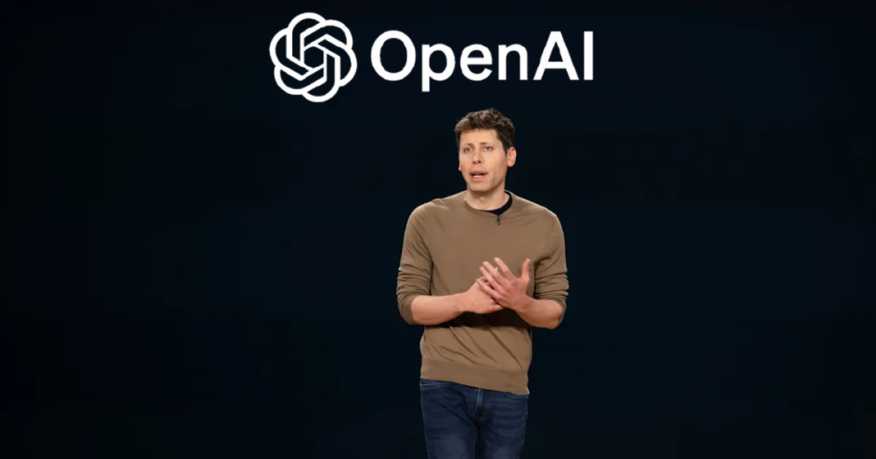
OpenAI is racing to raise roughly $30 billion at a valuation above $1.4 trillion, before Anthropic's expected mid-November listing gives investors a direct comparison. SoftBank, Abu Dhabi's MGX and existing backers are in talks to participate, Reuters reported, in an unusually fast round. The sequencing is the story: both labs are now drawing on the same pool of capital, and OpenAI wants commitments locked in before Anthropic's prospectus opens its numbers to public scrutiny.
Image & Vision

Kromoss is a text-to-image model built on MOSS-Image-Base at 1024 pixels, and its main job is fixing the base model's blurriness. The release is a full fine-tune that keeps the same architecture, inference pipeline, Qwen3.5-9B text encoder and FLUX.2-small decoder VAE, so it drops into existing workflows unchanged, and ships an 8-step turbo LoRA distilled in data space that generates at CFG 1 with no negative branch. The checkpoint is update 9,000 of a run over 576,000 training images, using EMA weights. For anyone already running MOSS-Image in ComfyUI, it is a one-file swap that cuts inference from 50 steps to 8.
Read more → https://huggingface.co/lodestones/Kromoss
Video & World Models

Kling AI's version 4.0 generates up to 30 seconds of video in a single pass and accepts ten keyframe images to pin down scene transitions. Prompt comprehension expands to 8,000 tokens, and the upgraded "Omni Reference" system takes up to 15 reference assets at once — ten images, five videos totalling 30 seconds, and seven elements — with storyboards, wireframes, white-model videos and depth maps all usable as input. A "Creative Recreation" mode turns existing clips into templates whose products, characters, expressions or backgrounds can be swapped independently, and the release adds stereo audio plus multilingual lip sync, alongside a lighter Flash variant. Against Wan 3.0 and Seedance 2.5 it holds its own but does not pull ahead on shot logic, physics or natural dialogue.

A video world model that keeps its memory as oriented planes instead of per-pixel point clouds stays coherent across hundreds of frames for about 5 MB of state. PPMem bolts a planar prediction head and a Depth Token Fusion module onto a video diffusion transformer, so each autoregressive chunk emits RGB frames and planar geometry together; the planes merge into a persistent memory that conditions the next chunk through rendered depth. Seven parameters per primitive capture walls, floors and facades, and roughly 100,000 primitives cover a full scene — three orders of magnitude more compact than point clouds while remaining metric, explicit and exportable as surfaces. On DL3DV and RealEstate10K it beats prior 3D-grounded world models on video quality and still yields metric depth and surface normals.
Read more → https://arxiv.org/abs/2610.23795
Audio, Voice & Music

Fish Audio's Drama 3 is a 35B-parameter text-to-speech model with 3B active per token, built for multi-character scenes and long-form narration. Speaker tags address up to 16 distinct characters inside one text, long input is chunked and streamed automatically, and the decoder is a codebook-MTP design that reads ten codebooks causally across the whole sequence, with FP8 MoE experts and the remaining weights in bf16. It supports voice cloning and natural-language control, and it ran on SGLang-Omni and vLLM-Omni from launch day instead of waiting for a bespoke serving stack.
Read more → https://huggingface.co/fishaudio/drama-3

Cactus Compute's Whistle fits a 16.9 MB speech model into a single file that transcribes seven languages on a phone CPU with no GPU and no dependencies. It handles 16 kHz mono audio of any length — one pass up to 30 seconds, windowed beyond — in English, German, French, Spanish, Italian, Dutch and Polish, detecting the language unless you name it, and returning an empty transcript for silence rather than an invented sentence. Beyond transcription it emits word-level timestamps aligned from the decoder's own attention and a speech embedding per 80 ms frame for retrieval. It reuses the same .cact container and quantisation as Cactus's Needle, so a device already running one runs both from the same binary.
Read more → https://huggingface.co/Cactus-Compute/whistle
Robots & Embodied AI
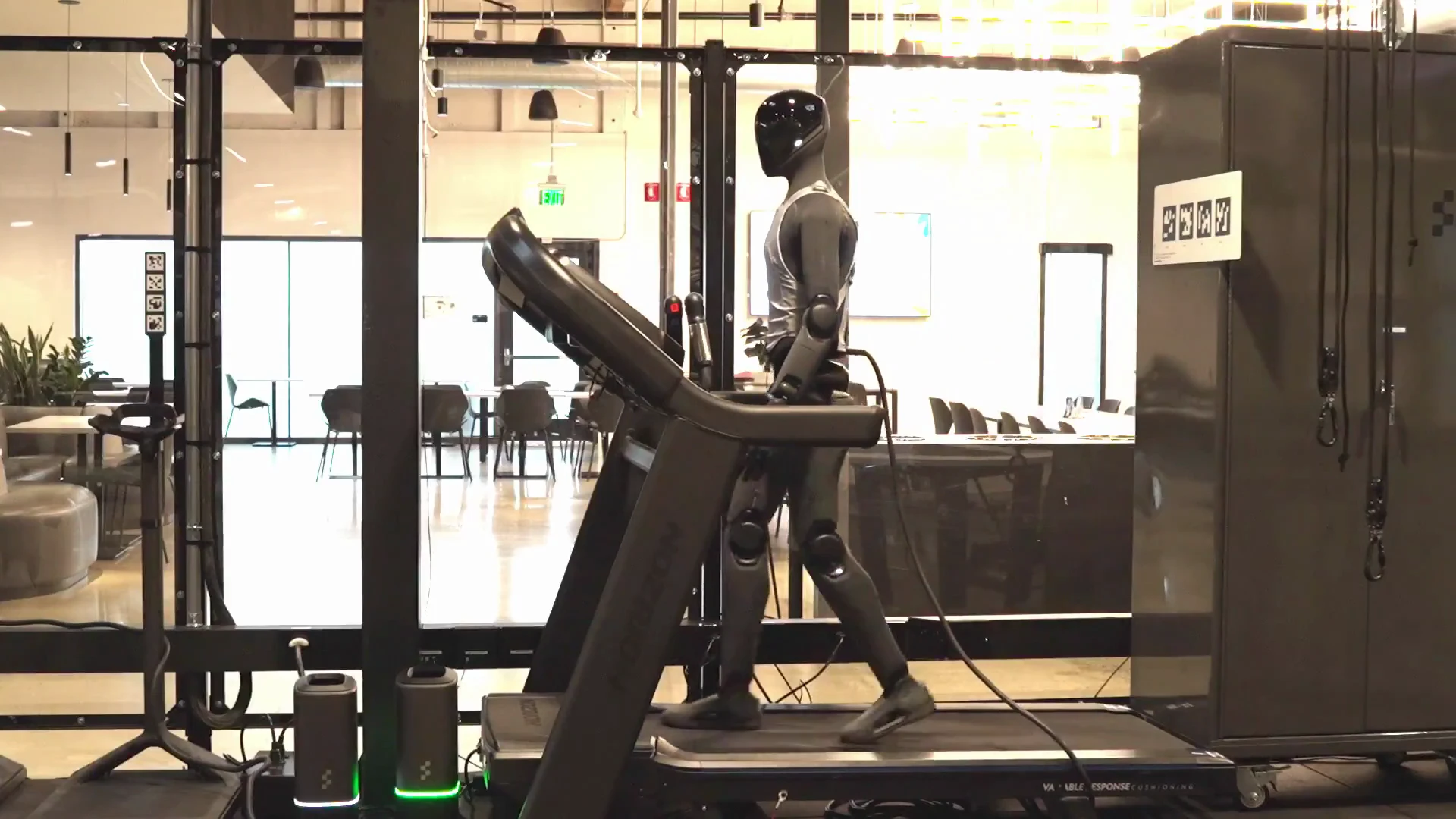
A Figure 03 humanoid has walked 348 miles — roughly 560 kilometres — and 1.2 million steps across nine consecutive days on a treadmill, and was still walking when Brett Adcock posted the update. Adcock said the run "started as a side project to stress the robot for any failures." The treadmill is the interesting part: it turns the walking cycle into a controlled repeatable load, which is how you surface wear that a demo never exposes. No test protocol, power arrangement or intervention log was published, so read the number as duration of a walking test, not battery runtime — and it follows Figure's 200-hour autonomous package-sorting run earlier this year, which it says produced no hardware failures.
Read more → https://www.humanoidsdaily.com/news/figure-03-nine-day-treadmill-million-steps
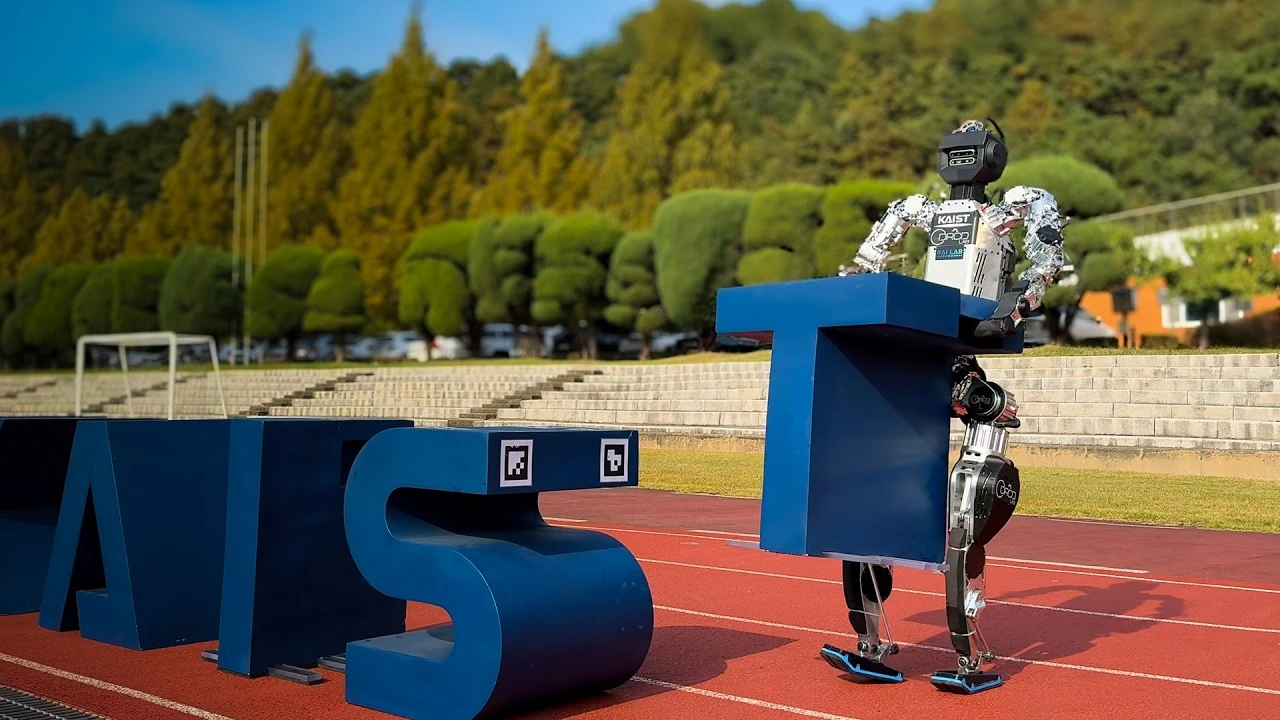
KAIST's Humanoid v0.9 now pushes objects weighing up to 35 kg and lifts up to 20 kg, using onboard vision to arrange letters spelling "KAIST". The demo shifts the lab's work from locomotion — its earlier moonwalk — to whole-body locomanipulation, coordinating walking and handling in one policy. DRCD Lab built the robot with RAILAB supplying the arms, and the interaction skills come from deep reinforcement learning plus learning from human demonstrations. Onboard visual feedback is doing the work that teleoperation or external motion capture usually does, which is the part worth watching.
Read more → https://www.humanoidsdaily.com/news/kaist-humanoid-v0-9-whole-body-lifting-pushing
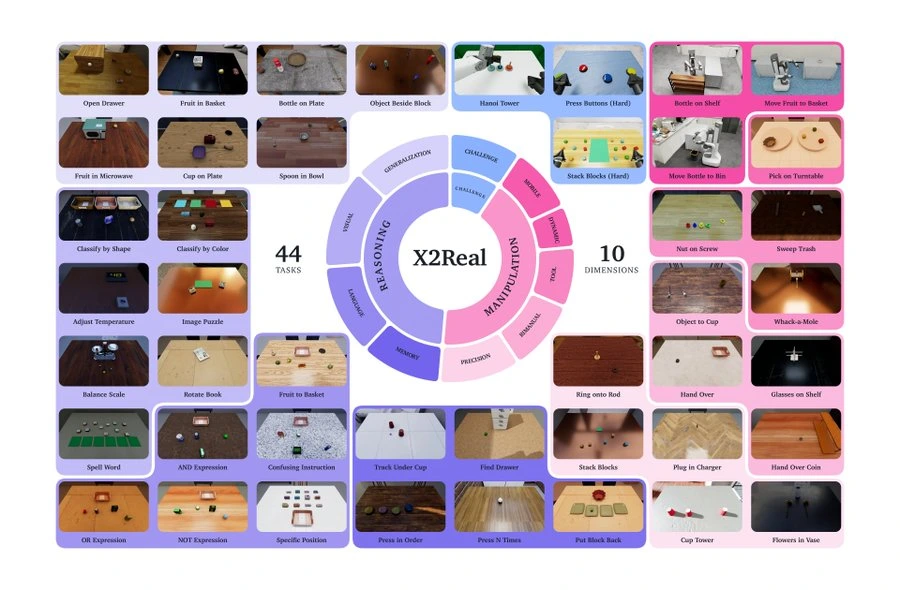
X Square's X2Real asks the question every robot lab quietly dodges: how much does a good simulation score actually tell you about hardware? The benchmark spans 44 tasks across 10 capability dimensions, built on NVIDIA's Isaac Lab-Arena, and its technical report compares simulation against physical robots on eight tasks with WALL-OSS-0.5. Task progress correlated at 0.84 and success rates at 0.74 — neither figure means 84 percent of tasks transferred. Precision is where it breaks: placing glasses on a shelf succeeded in 70 percent of physical trials and none of the simulated ones, which is a simulator underestimating a capable policy. The public release ships 73 runnable configurations across ArtiXon Arm-6A, Quanta X1, ARX R5 and Franka, but excludes out-of-distribution task definitions.
Read more → https://www.humanoidsdaily.com/news/x-square-x2real-simulation-real-robot-benchmark
Small & On-Device Models

A 950,000-parameter tiny model reaches 11.43 percent word error rate on LibriSpeech test-clean without any rescoring at all. AuroraASR-1M gets there by weight sharing: four unique Conformer-lite blocks are each applied twice, followed by a CTC head over a 256-piece BPE vocabulary, trained for 379 epochs on the full LibriSpeech set. It is English-only and 16 kHz, and it lands between far larger reference points — Citrinet-256 at 10M parameters scores 3.8 on test-clean, Whisper Tiny at 39M scores 5.6 — while beating Femto-ASR's 2.39M-parameter 10.95/25.36 pairing on the harder test-other split at 26.50. A useful datapoint for anyone who assumed a usable recognizer needs tens of millions of weights.
Read more → https://huggingface.co/AuroraAI-Research/AuroraASR-1M

The embedding table is the most overpriced component in a small model, and a frozen 16 MB replacement apparently costs almost nothing in quality. In Gemma 3 270M the embedding table holds 168M of 268M parameters and, because quantisation leaves embeddings in 16-bit, most of the file once everything else is compressed. The author swaps it for one frozen table of 512-bit codes — 16 MB, no trainable parameters, derived once by principal-component projection and sign binarisation — and trains the same body from scratch on the same 2.05 billion tokens with and without it. The learned table buys 0.20 nats of validation loss for 2.6 times the trainable parameters, yet the frozen version is better or tied on LAMBADA, HellaSwag and PIQA. With a ternary BitNet b1.58 body the whole model is a 46 MB file that generates 615 to 740 tokens per second on a laptop CPU in 62 MB of memory, five to six times the speed of the float model's 8-bit GGUF at a seventh of the memory.
Read more → https://arxiv.org/abs/2610.22428
Papers & Research

Xiaomi's new 4B small model grounds every answer in a mask it predicts from its own visual representations instead of borrowing a segmentation encoder. Xiaomi-Lens-0 is built on Qwen3.5 and adds a lightweight decoder that fuses vision-encoder patch features with visual latents and the language model's mask-token states, so mask supervision flows back into the shared backbone. Each latent decodes to a mask, which lets the model interleave reasoning with region-specific latents and think spatially during a chain of thought. Across all eight RefCOCO, RefCOCO+ and RefCOCOg splits it gains 5.6 points on average over Qwen3.5, takes the highest segmentation cIoU among the compared models, and beats its base on every perception benchmark tested.
Read more → https://arxiv.org/abs/2610.23279

A new benchmark finds state-of-the-art audio language models performing at near-chance levels on low-level acoustic perception, while human annotators score highly. VocalGrad reduces the problem to a binary classification of which direction an acoustic property changed over time, deliberately stripping out semantics and higher-level reasoning so the measurement isolates perception rather than inference. Linear probing then separates two failure modes: in some categories the task-relevant information survives in the internal representations but the language-model head never uses it, and in others the information becomes progressively less linearly decodable. It lands in the NeurIPS 2026 Evaluations and Datasets track, and it suggests that much of what looks like "hearing" in these systems is really text-side inference.
Read more → https://arxiv.org/abs/2610.23745
News & Business

Cloudflare's Clairic is an extraction model that answers with values instead of text — no token generation, just typed fields decoded under the rules of their type. You send a state and a schema, and it returns one value per field: an exact span with character offsets, a number, a calendar date, a duration, a list, or an estimate across your grid. Every scalar answer carries a p_null — the probability the input does not determine the value — plus a confidence score, which is exactly what you need to decide what to automate and what to send to a human. It handles forecasts up to 64 future steps with a median and an 80 percent interval, splits fields across parallel passes when they do not fit in one, and is available now as a Workers AI preview with open weights promised.
Read more → https://developers.cloudflare.com/changelog/post/2026-10-19-clairic-workers-ai/
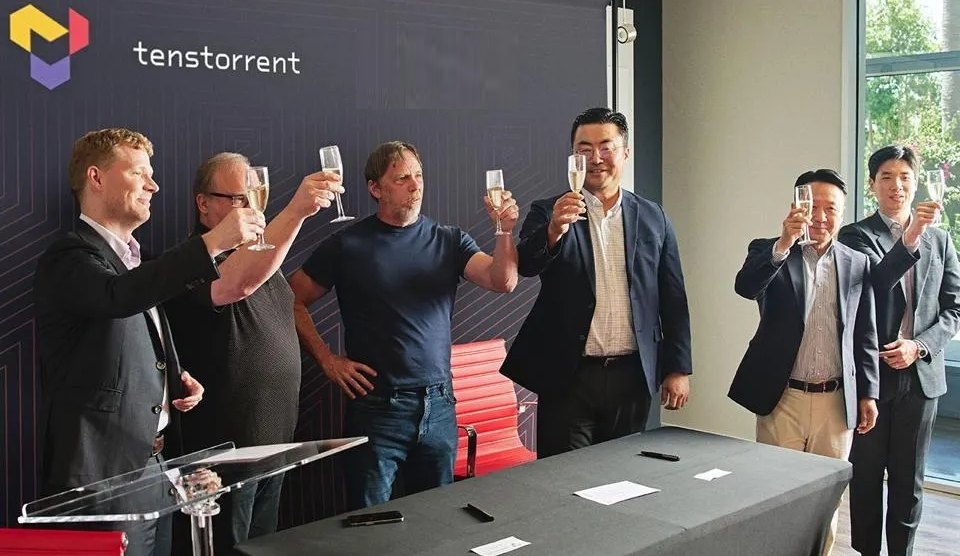
Tenstorrent raised $1.5 billion in a Series E that more than doubles its valuation to $6.2 billion, up from roughly $2.6 billion. The Jim Keller-led chipmaker is positioning its AI servers and open software stack as the alternative to Nvidia's proprietary hardware. Trace Capital and Innovation X led the round, with ARK Invest, Fidelity, Morgan Stanley, T. Rowe Price, SanDisk, Tether Investments and Cadence Ventures participating. It is a large bet on a second source of compute at exactly the moment the neocloud buildout is starting to wobble.

Stripe says agent-initiated purchases through its Link wallet grew 38-fold in transaction count in September, and 20-fold in payment volume. The company will not disclose absolute numbers, and the growth started from a small base, so the multiples say little about scale. What it will say: about 70 agents were using Link when the analysis ran and roughly 200 are now, including Meta's Muse and Grok Bot; most transactions run about $100, but some users have agents booking flights or buying furniture worth thousands. Retail accounted for 36 percent of transactions and 32 percent of volume, travel 28 percent of volume. Link never hands an agent the real card number — it issues a separate 16-digit one with user-set spending limits, which is the actual product insight here.
Read more → https://the-decoder.com/stripe-says-ai-agent-purchases-are-adding-up-but-it-wont-share-the-numbers/
That's this week's horizon. The interesting shift is not that models got cheaper or faster — it is that two of today's releases abandoned next-token prediction entirely, one for parallel diffusion and one for typed extraction. See you tomorrow.