In this edition
- Frontier & Text Models (5)
- Video & World Models (2)
- 3D & Reconstruction (1)
- Audio, Voice & Music (2)
- Robots & Embodied AI (2)
- Small & On-Device Models (3)
- Papers & Research (2)
- News & Business (1)
The frontier spent Tuesday fixing the unglamorous parts of computing. OpenAI tuned GPT-6 for the languages that still run the world's banks and factories, Meta put a 56-point model on the Artificial Analysis index, and DeepSeek open-sourced the serving software that makes its cheapest model cheap. Down the stack, NVIDIA shipped a world model that generates surgery in real time, Mistral turned voice into a full agent stack, and six humanoids in Taicang started building parts for other humanoids.
Frontier & Text Models

Meta's Muse Wonder Full lands at 56 on the Artificial Analysis Intelligence Index, putting Meta's new frontier model back among the labs that matter. The model ships in two variants: Muse Wonder Full at 56 points and Muse Wonder at 52, against 48 for its predecessor Muse Spark 1.3 on index v4.3. The jump is concentrated in agentic work — Terminal-Bench 4.0 climbs from 33 to 57 percent — and Meta places in the top three on six of ten benchmarks. Both versions carry a one-million-token context window and accept text, images, video and audio; two features, Active Memory and Active Focus, are pitched at a personal agent that can hold a task and ask follow-up questions. The catch is price: both cost nearly three times as much per API call as Muse Spark 1.3, and Muse Wonder Full is currently limited to Muse Code users.
Read more → https://the-decoder.com/metas-new-frontier-model-muse-wonder-full-breaks-into-the-ai-top-tier/

Ant Group's Ling-3.1-flash packs 560 billion parameters into a 25-billion-active mixture of experts with a one-million-token context and an MIT licence. It is an upgrade of Ling-3.0-flash aimed squarely at real-world work rather than chat: general-purpose agents, search, office productivity and software engineering. Ant says it improves on GDPVal-AA V2.1, HealthBench Professional, FrontierSWE and Terminal-Bench 4.0, with extra gains in finance and materials science. The weights are on Hugging Face under MIT, which keeps a frontier-class Chinese model in the downloadable tier.
Read more → https://huggingface.co/inclusionAI/Ling-3.1-flash

DeepSeek open-sourced DeepInfer, the serving framework behind V4.1-Flash — the model it bills as its fastest and cheapest — under Apache 2.0. DeepInfer is the inference software that lets DeepSeek V4.1-Flash answer quickly at scale; it builds on vLLM with optimized compute kernels, multi-chip distribution and faster generation. DeepSeek also published deepseek-recipe, which reproduces the token processing of its official API so self-hosted deployments behave like the hosted one. The company says future DeepSeek models will ship as open source too, framing the release as a way to "lower compute costs, reduce energy use, and make AI more affordable" — while adding fresh price pressure on Western providers.

Sam Altman reportedly walked OpenAI staff through three endgames for governing superintelligence, one of which ends with a single firm holding everyone else's compute. According to The Information, the options are an international watchdog modelled on the IAEA that inspects systems, requires audits and monitors compute and energy use; a consortium of leading labs; or the economic dominance of one company — the scenario the reporting describes as one firm effectively melting everyone else's GPUs. OpenAI reportedly intends to choose a path within the next year, while the Trump administration prepares its first oversight framework for superintelligence developers. The tension is explicit: OpenAI cannot afford to fall behind rivals while arguing for restraint.
OpenAI tuned GPT-6 for the languages nobody trains on, and the gain is enormous: 87.4 percent average test pass rate across 20 programming languages versus about 38 percent for GPT-5.6 Terra. The company built MultiLangBench, which asks a model to write a SQLite-compatible database engine from scratch, and a COBOL migration task that translates legacy code into C++, Java, Kotlin, Python or Rust. On the migration test GPT-6.1 Sol reaches 86.6 percent accuracy at low reasoning effort, against 5.4 percent for GPT-5.6 Sol, and climbs to 97.9 percent with more thinking. The commercial logic is blunt: IBM estimates COBOL still powers more than 40 percent of online banking systems and 95 percent of ATM transactions, and almost none of that code appears in a modern training set.
Video & World Models

NVIDIA released Cosmos3-H-Dreams, a real-time world model that generates surgical video from arm-control commands for the CMR Surgical Versius system. Given a single endoscopic camera frame, a short history of recent commands and a stream of future kinematic commands for both arms, it predicts the resulting endoscopic footage autoregressively. It is fine-tuned on Versius clinical cholecystectomy data and distilled into a causal, few-step student so it can stream interactively — the point being policy evaluation and synthetic training data for surgical robotics before anything touches a patient. It descends from Cosmos3-H-Embodied-Nano, and its model card says it is ready for commercial or non-commercial use.
Read more → https://huggingface.co/nvidia/Cosmos3-H-Dreams

VAST-AI published EdenLive, an open video generation model that animates a reference character along a proxy video instead of guessing motion from text. You supply a reference image, a proxy clip of at least 49 frames at 16 fps and a prompt; the 14B model renders the character performing that motion, with 5B bidirectional and causal variants also released for Diffusers. The design targets the part of video generation that text prompts handle worst — sustained, controllable character motion — and the components ship under Apache 2.0, with DINOv3 and CLIP assets under their own licences. It appeared on Hugging Face on October 19.
Read more → https://huggingface.co/VAST-AI/EdenLive-14B-Diffusers
3D & Reconstruction

A revised 3D generation method abandons 2D views entirely, diffusing inside a 3D latent space bootstrapped from DINOv2, SigLIP2 and DA3 features. The authors argue that representing a scene through multi-view or video latents is both redundant and spatially inconsistent, so they tame a diffusion transformer to model the scene directly in a 3D-grounded latent — roughly a thousand tokens for a scene. The second version, posted October 19, reports better efficiency and spatial consistency than 2D-based baselines. If it holds up, it is the difference between generating pretty pictures of a room and generating the room.
Read more → https://arxiv.org/abs/2604.11331
Audio, Voice & Music

ElevenLabs shipped Eleven Realtime, two speech models built for live conversation, with the Max variant scoring 98.8 percent on Big Bench Audio at a 0.57-second response time. The company claims no model on the Artificial Analysis leaderboard is both faster and more accurate right now. The smaller v1 Mini is aimed at cheap natural conversation and can tell when someone has finished talking or is only saying "mm-hmm"; v1 Max targets harder work such as customer support. Both are reachable through ElevenAgents and an OpenAI-compatible Realtime API, priced per minute plus token costs.

Mistral's Voxtral 3 is a full speech stack — transcription, text to speech and an agent SDK — rather than another single-purpose model. The family pairs Voxtral Small Transcribe 3 with Voxtral Mini TTS 3 and a LiveKit-based agent SDK, so listening, thinking, tool use and speaking run as one streaming pipeline. Transcription covers more than 50 languages; speech output handles over 35 languages and 50 dialects with emotional adaptation, and agents can hit external systems mid-call to book an appointment or check an invoice. Mistral will run it on your own infrastructure or through EU-hosted APIs, with transcription starting at $0.0035 per minute.
Robots & Embodied AI
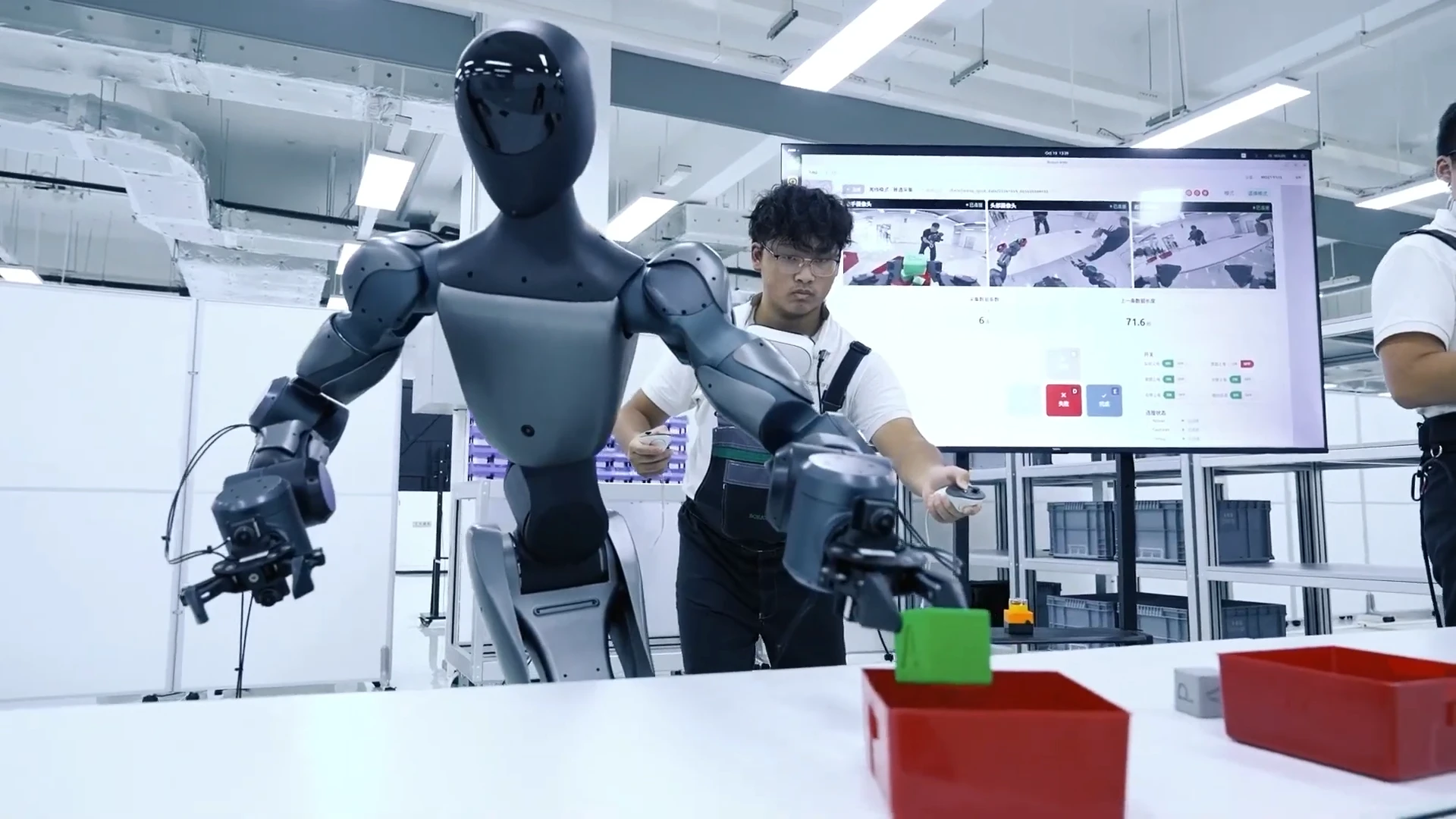
Six humanoids are now assembling joint components for other humanoids on a Schaeffler line in Taicang, China. The robots work across five stations producing parts including linear and rotary actuators, in an approximately 7,500-square-metre site that combines manufacturing, robot training, data collection and digital twins. Schaeffler says global incoming orders for humanoid robotics have reached around €400 million — orders, not recognised revenue. It is a small deployment with a large symbolic weight: the humanoid supply chain has started consuming itself.
Read more → https://www.humanoidsdaily.com/news/schaeffler-taicang-humanoids-build-robot-components

A new method recovers a humanoid robot's full-body pose from video alone, treating vision as proprioception when joint data is unavailable. HumanoidPose combines pretrained human-pose features with robot kinematics in one model, then retargets human motion onto sixteen different humanoid embodiments so training can run entirely on synthetic data. The motivation is practical: onboard state is often missing for privacy, ownership or communication reasons, and the flood of online and AI-generated robot video has no matching joint configurations. Authors include Marco Hutter and Christian Holz; the paper was submitted October 18.
Read more → https://arxiv.org/abs/2610.25288
Small & On-Device Models

Liquid AI closed out its LFM2.5 family with a 24B model that activates only 2B parameters per token and is built to run on-device as an edge model. It scores 48.09 on LiveClaw against 38.19 for Qwen3.6-35B-A3B, a model with roughly 50 percent more total and active parameters, and it always reasons before answering at MoE speed. Liquid claims up to 1.7 times faster inference than comparable mixtures on-device, 184 tokens per second on an Apple M5 Max and up to 21,000 output tokens per second on a single NVIDIA B300. It supports sixteen languages and is the largest model in a family that now spans from 230M to 24B parameters.
Read more → https://huggingface.co/LiquidAI/LFM2.5-24B-A2B

Mistral's Timestral is a small model for time-series forecasting that runs locally and reads up to 32,768 historical steps and predicts 1,024 steps ahead in a single forward pass. The family ships at 5M, 28M, 123M and 209M parameters, handles univariate and multivariate series plus known-future covariates, and returns probabilistic forecasts across 21 quantiles. Architecturally it is a patch-based transformer with separate time and variate attention — 24 layers, 768-dimensional embeddings, 32 time steps per patch. It is zero-shot, and Mistral published the source on GitHub to reproduce the benchmarks.
Read more → https://huggingface.co/mistralai/Timestral-209M

Tencent's Hunyuan team built a small model whose only job is deciding what an agent should remember, and it is designed to run on-device inside a memory stack. Hy-Memory-30B-A3B is a 30B mixture of experts with about 3B active parameters that executes the write path inside external memory frameworks, replacing the general-purpose LLM in Mem0, MemOS and Hy-Memory across chat, working and coding scenarios. It decides what to retain, how precisely to represent it and how new evidence should overwrite the persistent store. Training ran in two stages — memory on-policy distillation, then attributed memory reinforcement learning — and Tencent says it transfers directly to frameworks it never saw, such as EverMemOS.
Read more → https://huggingface.co/tencent/Hy-Memory-30B-A3B
Papers & Research

A paper called StopLoss teaches coding agents to predict their own failure and quit before burning the rest of the budget. The monitor learns failure recognition from completed trajectories paired with verifier outcomes, then scores the most recent tool steps in a single forward pass; a threshold calibrated on successful runs converts that score into an abort decision without touching the executor. Trained on GPT-family SWE-rebench trajectories and tested on SWE-bench Verified plus a SWE-bench Pro subset with both GPT and Claude executors, it is benchmarked against six general-purpose judges reading the same windows. The name comes from finance, and so does the logic: cut the position before the loss compounds.
Read more → https://arxiv.org/abs/2610.25525

CyberArena replaces static security benchmarks with live, symmetric combat: two agents attack and defend the same changing services at once. In isolated sandboxes under identical rules, each agent must find and exploit weaknesses while patching its own, across multiple rounds in which the posture shifts as both sides adapt. The authors argue that isolated agents hitting fixed targets saturate quickly and measure the wrong thing, because real operations are coupled and dynamic. The second version landed October 19.
Read more → https://arxiv.org/abs/2610.19005
News & Business

An AI lab's draft IPO prospectus discloses an $80.7 billion net loss for the first half of 2026, up from $13 billion a year earlier. Roughly $72 billion of that — nearly 90 percent — comes from accounting charges tied to changes in the value of convertible notes and other instruments the company used to raise money, so most of it is noncash rather than operating spend. The figure surfaced as the Claude maker prepares a blockbuster listing and sits alongside a long list of risk factors in the filing reviewed by the Wall Street Journal. It is a useful reminder that frontier-lab economics are now large enough that mark-to-market noise dwarfs most countries' AI budgets.
That's this week's horizon. See you at 06:00.