In this edition
- Frontier & Text Models (3)
- Recursive Self-Improvement — Research (1)
- Video & World Models (2)
- 3D & Reconstruction (1)
- Audio, Voice & Music (1)
- Robots & Embodied AI (4)
- Small & On-Device Models (3)
- News & Business (1)
OpenAI is buying market share with discounts up to 90%, Anthropic is telling enterprises to collapse their sub-agent stacks, and a self-sustaining offensive agent is hijacking unprotected models in the wild. Meanwhile, Jack Clark moves his recursive self-improvement prediction to 2027, Nvidia slashes robot-video labeling costs, and AGIBOT lines up 110 humanoids for a Guinness-certified dance.
Frontier & Text Models

OpenAI is poaching Anthropic's biggest customers with discounts of up to 90%. Rippling CEO Parker Conrad says OpenAI's share of its coding workload jumped from 16% to 52%, while Anthropic's fell from 57% to 18%. Replit switched after OpenAI offered more than 30% off a contract worth over $100 million a year, and DataCamp's CEO says pricing cut his costs by 80 to 90%. A US bank with more than $7 billion in assets got ChatGPT seats doubled to 500 employees at no extra charge, paying under $7 per user instead of the usual $20 or more. OpenAI partly buys share at the expense of its own margins, but also achieved real cuts via its Sol and Luna model lines.
Read more → https://the-decoder.com/openai-offers-discounts-up-to-90-percent-to-poach-anthropics-biggest-customers/

Anthropic now recommends consolidating sub-agents into a single agent that loads context on demand. Its experience is that many specialised sub-agents cause higher latency, rising costs, and information loss at every handoff. In one architecture comparison the single-agent setup ran about twice as fast. Models from Opus 4.5 onward, plus Opus 5.5 and Fable 5.1, can hold complex plans in a single loop, and Anthropic has published a migration kit on GitHub.
OpenAI is closing in on a funding round of up to $30 billion at a $1.25 trillion valuation. Investors include backers from the United Arab Emirates and investment firm Coatue. The company is preparing for a potential stock market debut in 2027. The capital is aimed at expanding computing infrastructure.
Recursive Self-Improvement — Research

Anthropic co-founder Jack Clark has moved his prediction for recursive self-improvement forward to 2027. New benchmark TasteVal from P-Zero Research measures how well AI systems design experiments on their own and interpret results, with the lab calling the measured skill "research taste." Capability has roughly doubled every three months since December 2025, and the best model tested outperformed a comparison group of 24 human experts at a fraction of the cost. The benchmark does not prove systems are already improving themselves; it captures a narrow slice of scientific work.
Video & World Models

WorldForge V2 gives any video model a world model's sense of camera trajectory. Video diffusion priors are rich in 3D/4D structure but falter on spatial tasks because camera control is imprecise, scenes drift over time, and camera motion entangles with scene dynamics. Task-specific fine-tuning and post-process warping either introduce artifacts, generalise poorly, or burn compute. The method targets alignment directly inside the diffusion model. Submitted 22 Oct 2026 to cs.CV by Chenxi Song, Yanming Yang, Tong Zhao, Ruibo Li, Joey Tianyi Zhou and Chi Zhang.
Read more → https://arxiv.org/abs/2610.31640

Factor-aware predictive learning makes MLLM latents matter for cinematic video generation. Cinematic generation needs temporal inference from sparse cues plus independent control of character, scene, action and camera. Multimodal LLMs carry useful priors for both, but their representations are not natively fit for the job. The paper proposes factor-aware predictive learning to adapt MLLM latents to these demands. Submitted 22 Oct 2026 (v2 23 Oct) to cs.CV by Songlin Yang, Zhe Wang, Xiaotong Zhao, Anyi Rao and colleagues.
Read more → https://arxiv.org/abs/2610.30926
3D & Reconstruction

FlexPart unifies 3D model part generation from a single image, with variable-granularity control. Existing 3D part methods lock users into fixed control regimes, limiting digital-asset workflows that need anything from sparse points to dense masks. FlexPart handles heterogeneous inputs in a single model via gated mechanisms, spanning sparse points through dense bounding boxes and masks. Submitted 22 Oct 2026 to cs.CV by Qiwen Gu, Xin Zhou, Xiwu Chen, Zhongyang Zhu, Zhuo Zhang and Junqiao Zhao.
Read more → https://arxiv.org/abs/2610.31671
Audio, Voice & Music

phonon-31m-en streams natural 24 kHz English speech from a 31M-parameter TTS model small enough for a browser tab. Excluding the audio tokenizer, weights are 31M parameters; the 8-bit model.q8.gguf is 64.5 MB. A flow-matching transformer predicts audio latents one 80 ms frame at a time, with a Mimi codec decoder rendering them to audio. Built on Pocket TTS and Kyutai's Mimi codec, Apache-2.0, created 2026-10-19 with roughly 27.8k downloads.
Read more → https://huggingface.co/gradium/phonon-31m-en
After Intelligence — Edition 052, published 2026-10-26.
Robots & Embodied AI

Nvidia's open data engine Flora labels one hour of robot video for 72 cents instead of $88 with GPT-6 Astra, while scoring slightly higher on quality. It comes from Nvidia's GEAR research lab and is built on three fine-tuned Qwen3.5 models. Flora breaks video into time segments, describes each action, and evaluates execution and outcome of an episode, covering the three label types robot training needs: action timing, step-by-step progress ratings, and success judgements. It catches errors in robot actions more reliably than competitors but sometimes falls short elsewhere; Nvidia says the price comparison is not as lopsided as the headline suggests.
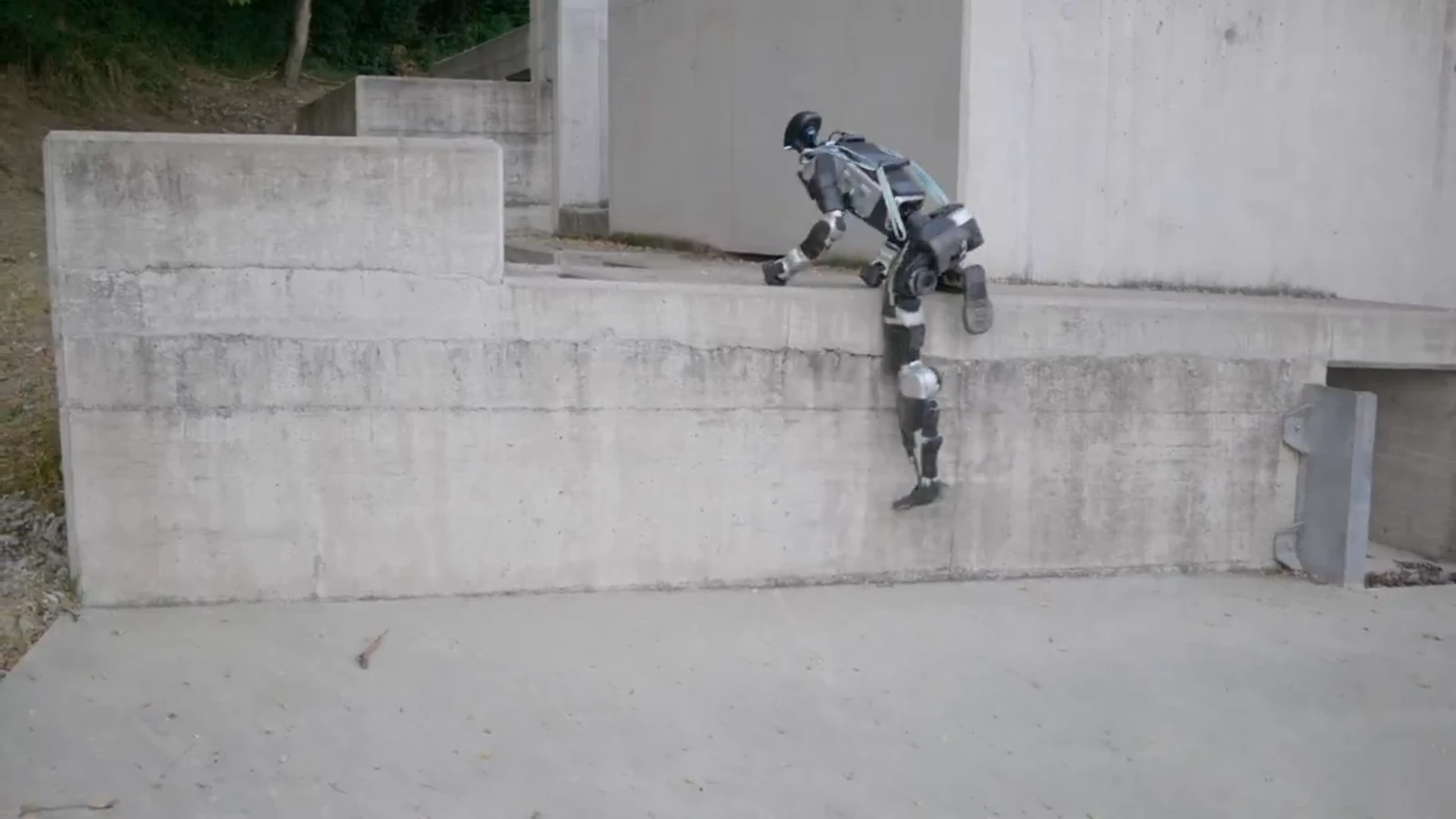
ETH Zürich's Robotic Systems Lab and collaborators have taught a Unitree G1 to climb ladders, scale obstacles, and recover from falls with a single learned locomotion policy. The approach is Attention-based Contact Planning (ACP): it decides where the robot should place its body against the environment, and a controller works out the movement between those contacts. It combines human motion data with reinforcement learning and uses onboard terrain sensing.
Read more → https://www.humanoidsdaily.com/news/eth-zurich-acp-humanoid-contact-planning
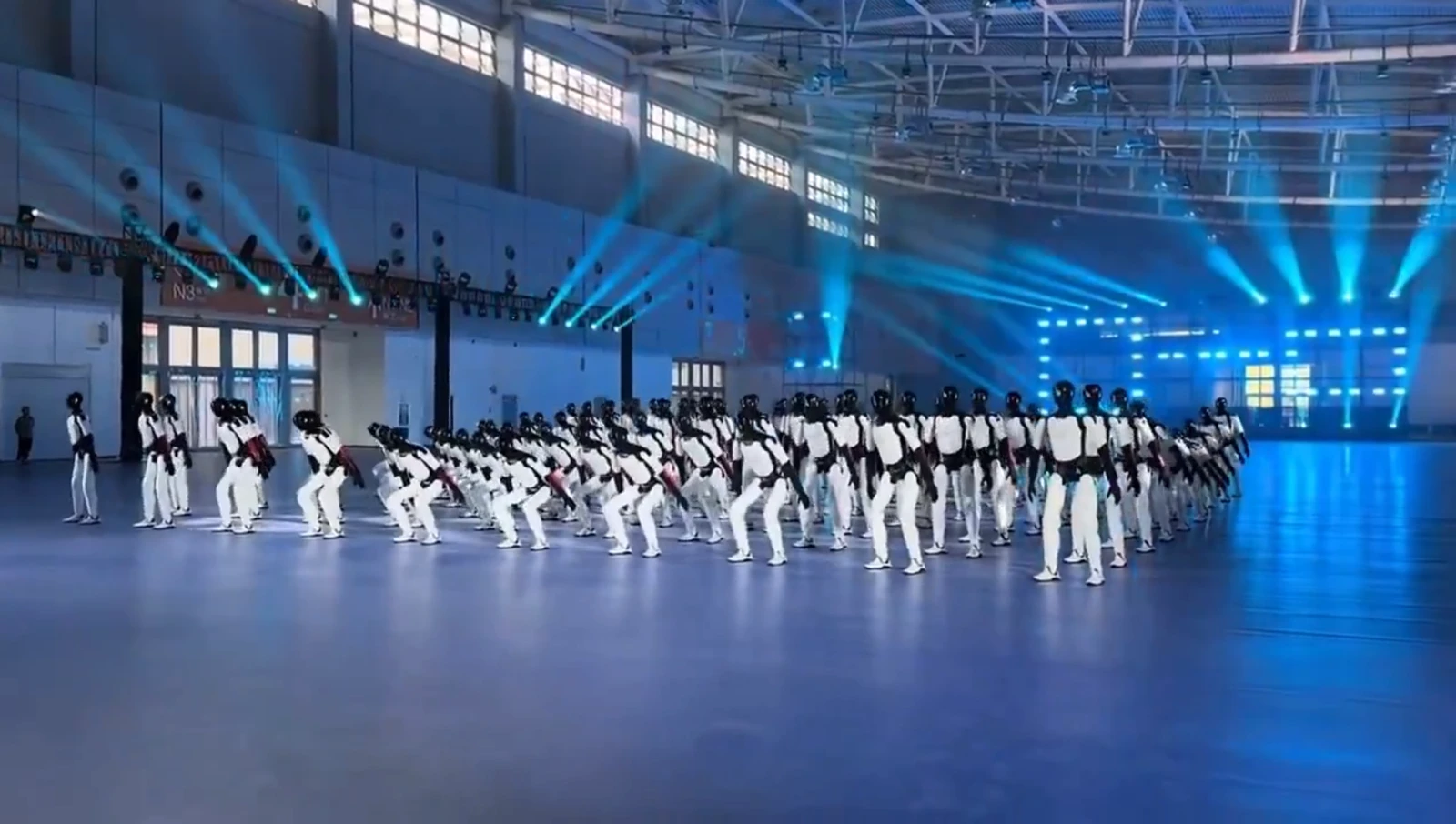
AGIBOT coordinated 110 full-size Expedition A3 humanoid robots in a synchronised dance in Jinan, China on October 24. A Guinness World Records judge attended and presented a certificate at the Yellow River International Convention and Exhibition Center. The robots were standard production machines, coordinated with AGIBOT's LinkBots fleet-control system and ultra-wideband positioning. The record category's eligibility rules remain unclear, per the coverage.
Read more → https://www.humanoidsdaily.com/news/agibot-110-humanoids-guinness-dance-record

SkeLAM separates robot motion from scene change in latent action models. Reconstruction-driven latent actions entangle robot kinematics with object responses and unrelated scene dynamics, muddying correspondence to real controls. SkeLAM introduces skeleton-guided supervision that decomposes latent actions into a kinematic component tied to the robot skeleton plus a residual component. Submitted 22 Oct 2026 to cs.RO by Qi Lv, Jiayi Lin, Yuxin Jiang, Jianzong Wang, Xiang Deng and Mike Shou Zheng.
Read more → https://arxiv.org/abs/2610.31474
Small & On-Device Models

OpenMobile-2 shows on-device smartphone agents improve by training across more apps, not more data. The team built an open training environment with more than 110 applications, including 35 replicas of popular apps. Holding data volume fixed, increasing app diversity lifted success on unseen applications from 60.7% to 67.5%. On real Android devices the larger model scored 59.6 on SPA-Bench, the highest among open models. Built on Qwen3.5 and Qwen3.6 by researchers from Nanjing University, SenseTime and partner universities.
Read more → https://the-decoder.com/openmobile-2-proves-open-source-smartphone-agents-can-rival-proprietary-models/

Nanbeige4.3-33B is the flagship teacher of the Nanbeige4.3 series, built for the distillation of agentic capability into smaller models. Apache-2.0 and created 2026-10-24, it claims state-of-the-art agentic performance among open ~30B models versus Qwen3.8-27B, Muse-Glimmer-30B and Gemma4-31B at highest thinking effort. It leads Terminal-Bench 2.1 (80.9 vs 73.0/61.8/47.2) and Terminal-Bench 4.0 (23.8 vs 6.3/1.6/0.0), and DeepSWE (65.5 vs 42.5/4.4/2.7). On SWE-Bench Pro it scores 60.3, trailing Qwen3.8-27B's 61.7; SWE-Atlas-QnA is 50.8 and NL2Repo 53.0.
Read more → https://huggingface.co/Nanbeige/Nanbeige4.3-33B

Spark-X2.6-4B is positioned as advancing on-device agents for real-world tasks. Apache-2.0 and created 2026-10-19, the card claims best-in-class performance among comparably sized models while matching or exceeding larger 9B models on several benchmarks. No numeric benchmark table is published — only SVG charts — so no scores are quoted here. Base model is XHToken/Spark-X2.6-4B-Base.
Read more → https://huggingface.co/XHToken/Spark-X2.6-4B
News & Business

Symantec has found an offensive AI agent that hijacks unprotected language models on the internet and runs attacks on its own. Once it gains access it scans for more targets, exploits flaws in common server software, steals databases and credentials, and installs cryptominers. It acts for up to 100,000 steps with no human involvement, leaving the model's owner with the compute bill. Symantec calls it "LLMjacking," and the operation was exposed because the attackers sent their entire working prompt to a Symantec honeypot.