In this edition
- Frontier & Text Models (4)
- Recursive Self-Improvement — Research (1)
- Video & World Models (2)
- 3D & Reconstruction (1)
- Audio, Voice & Music (3)
- Robots & Embodied AI (3)
- Small & On-Device Models (3)
- Papers & Research (1)
OpenAI cut the price of computer use to a dollar per million tokens, Mistral put a trillion-parameter model trained in Europe under a modified MIT license, and a world model turned itself into a training loop that beat the average human player at two physical tasks. Eighteen items today across frontier models, voice, world models, robotics, small and on-device models, and research.
Frontier & Text Models
 OpenAI released GPT-6.1 Terra on Oct 26 2026, a faster, more efficient model combining detailed visual reasoning, precise computer use and clearer writing. Standard API pricing is $1 per million input tokens and $5 per million output tokens, 50% lower than GPT-5.6 Terra and GPT-6.1 Sol. The context window is 1,050,000 input tokens and 128,000 output tokens, and the API exposes multiple reasoning-effort levels. On Agents' Last Exam at medium effort it scores 15 percentage points higher than GPT-5.6 Terra at about one-third the cost, and matches GPT-6 Astra at one-tenth its price per token. At max effort it is over three times as token efficient as Claude Opus 5.5 at one-fourth the price per token, about 9x lower cost per task, and completes tasks over three times faster than GPT-6 Astra and GPT-6.1 Sol. On MMMU-Pro it beats GPT-5.6 Terra at every reasoning setting and nearly matches GPT-6 Astra and GPT-6.1 Sol at much lower cost. It is available in ChatGPT Work, Codex, and the API as gpt-6.1-terra.
Read more → https://openai.com/index/introducing-gpt-6-1-terra/
 Moonshot released Kimi K3.1 Pro on Friday Oct 23 2026, an upgraded post-trained version of the open-weight Kimi K3. It has about 2.8 trillion total parameters with 104 billion active and a context window up to one million tokens, and is available now in Kimi's apps and API with full weights due by Nov 4. A Highspeed version runs two to three times faster. On Terminal-Bench 4.0 it scored 65.7%, ahead of OpenAI's GPT-6 Astra at 58.2% and just behind Anthropic's Claude Opus 5.5 at 66.4%. Moonshot says the share of false claims on its own stress test fell to 8.3% from 23.4% for K3. The company removed cyberattack-related material from training before the open release: a version trained without those cuts solved 90.5% of tasks on Moonshot's in-house test of exploiting real software flaws, while the released model solved 81% and K3 solved 33.3%; DeepSeek V4.1-Flash scored 85.7% by Moonshot's count. The figures are Moonshot's own and have not been independently checked, and in July the White House accused Moonshot of using banned Nvidia chips and copying an Anthropic model to build K3.
Read more → https://thenextweb.com/news/moonshot-kimi-k3-1-pro-open-weight-cyber
 Mistral put the Large 4 "Le Chonk" weights on Hugging Face on Oct 29 2026, three weeks after the public preview. It is a natively multimodal mixture-of-experts model of about one trillion total parameters with 49 billion active per token (52 billion including embeddings and output layers), trained from scratch on 3,800 NVIDIA Grace Blackwell GPUs in Mistral's own European datacenters. It is released under a modified MIT license and is natively fluent in more than 160 languages including every official EU language. The standard version runs on eight Nvidia B300 GPUs, with a more compressed variant on four GB300 GPUs. On Artificial Analysis' Intelligence Index it scores 26 points, behind open Chinese models such as DeepSeek V4.1 Flash and GLM-5.3 and far behind the leading systems from Anthropic and Google. After three more weeks of reinforcement learning its Terminal-Bench 4.0 score rose from 28 to 41 percent; it runs at 161 tokens per second, has lower API prices, and refuses 96.6 percent of harmful cyber requests.
Read more → https://mistral.ai/news/mistral-large-4-oss/
OpenAI doubled usage limits for several paid tiers on Oct 29 2026. Work and Codex quotas on the Pro 100 and Pro 500 plans both get twice the previous allotment. On Pro 200 OpenAI doubled the lower quota and reversed a planned cut after user pushback, while the Plus plan stays the same. New subscriptions already include the updated quotas and existing customers get them automatically. OpenAI says doubling a quota does not mean twice as many completed tasks, because consumption varies by model, task type and settings, and that the expanded limits for the new "Dots" also stay in place for now, though Dot usage is tracked separately. The company says it will keep shipping better models and efficiency gains to push usable capacity higher, and recently released its 6.1 models Terra and Sol. The move comes as Anthropic prepares for its IPO and both companies compete for business customers. Read more → https://the-decoder.com/openai-doubles-usage-limits-on-pro-plans-as-competition-with-anthropic-heats-up/
Recursive Self-Improvement — Research
 The Trinity is a recursive self-improvement framework that couples world generation with Harness evolution through three roles: Creator, Explorer and Evolver. Drawing on verified execution trajectories, Evolver shifts the basis of task organization from surface categories to shared requirements, reorganizing the original task tree into a hierarchical capability tree. It introduces Capability-Driven Real2Sim2Real: for heterogeneous tasks at the same node, Creator abstracts their common requirements into simplified, verifiable simulated worlds for capability learning, while evaluation on the original tasks measures transfer. Along the capability tree, Explorer progressively evolves reusable capability modules through selective inheritance, forming a Harness tree whose validated updates accumulate across iterations within a fixed topology. A Capability-Aware Harness Router uses public task information to select compatible module configurations from the tree. The evolved Harnesses improve mean performance by 34 points across 28 training benchmarks and 26 points across 18 unseen benchmarks, including two real-world embodied tasks.
Read more → https://arxiv.org/abs/2610.36077
Video & World Models
 Tencent Hunyuan introduces Hy-Nomas, an interactive video model and world model with an 8B diffusion backbone that supports free-form text instructions and continuous camera control across multiple interaction turns. It generates variable-length segments conditioned on current inputs and cached history, aligning structured video captions with action-aware causal attention so descriptive context persists across segments while action instructions stay confined to their intended temporal windows. A vision-language Prompt Enhancer translates user requests and multimodal interaction histories into structured conditions for the next segment. A multi-stage curriculum progressively introduces causal generation, text interaction, camera control and training on model-generated histories, followed by diffusion distillation. Human evaluation shows superior performance over existing world models, and the authors release model weights, code, benchmarks and a lightweight adaptation workflow.
Read more → https://arxiv.org/abs/2610.36729
 OmniShowcase is an omnidirectional video generation method: a video model that builds one specific subject from a few reference images and holds up even when the camera reveals surfaces not visible in the input. A fully automated data synthesis pipeline produces training videos along diverse camera trajectories with viewpoint variation driven by the underlying subject geometry, even spanning full 360-degree orbits. A geometry-conditioning method feeds the video model a turntable of surface-normal maps reconstructed from the reference views, without requiring temporal alignment with the generated frames. The authors built Showcase-4K, a corpus of 3D-asset-based videos covering twelve camera motions across 88 trajectory configurations, plus ShowcaseBench, a held-out evaluation set with source meshes and camera parameters. Experiments show state-of-the-art subject identity and 3D consistency while maintaining competitive video quality and motion.
Read more → https://arxiv.org/abs/2610.35684
3D & Reconstruction
 GOFish is the first 3D Gaussian Splatting surface reconstruction method to train directly on fisheye images, rasterize fields of view beyond 180 degrees, and extract an aligned mesh from the same scene. Prior fisheye Gaussian Splatting methods only rasterize up to 180 degrees and produce no mesh, while Gaussian surface reconstruction methods assume pinhole training images. Calibrated densification recovers the surface across the entire field of view, while Calibrated Mip Filtering and Wide-Angle Appearance Modeling keep pixel blur and lens falloff out of the scene and mesh. On the 200-degree FIORD and 205-degree FullCircle benchmarks it improves PSNR over the best prior method by 2.28 and 1.97 dB respectively, and achieves the highest mesh F-score on FIORD and the main ScanNet++ set. The Gaussian scene and mesh form a LiDAR-free, simulation-ready digital twin that renders in real time.
Read more → https://arxiv.org/abs/2610.37818
Audio, Voice & Music
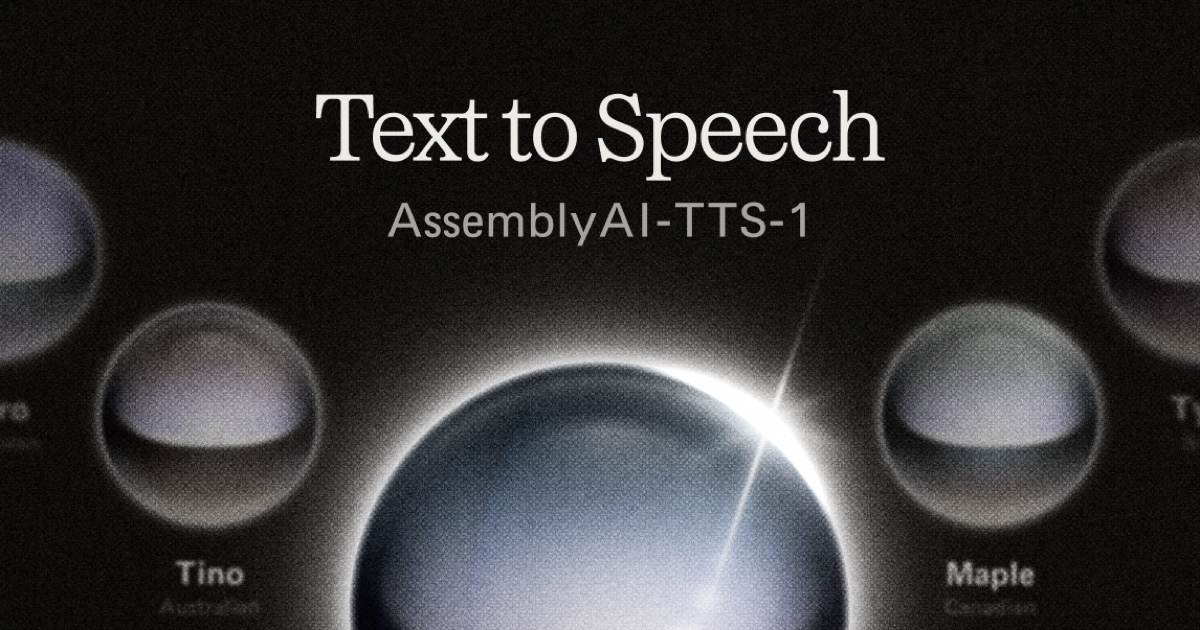 AssemblyAI's first text-to-speech model, AssemblyAI-TTS-1, is now generally available and built for voice agents on live calls. Audio streams in 90 milliseconds, the production figure for time to first audio, and measured over each provider's API from the same client it returned its first byte of audio in 47 milliseconds at the median, the fastest of six models in a head-to-head where the next fastest starts at 119 milliseconds and the slowest at 612 milliseconds. At $15 per million characters it is the lowest-priced frontier text-to-speech model for voice agents and the only one offering unlimited concurrency without an annual contract, at about half of what teams pay today. The model was trained on millions of hours of audio including real conversational data, and operates directly on continuous audio representations instead of discrete tokens, which the company says improves realism and minimizes time to first spoken audio. It scores 99.0 percent word accuracy, 93.7 percent entity accuracy, 3.85 out of 5 across preference prediction models such as UTMOSv2, 85.5 on the normalized TTSDS prosody realism test, and 0.64 on speaker similarity of cloned audio.
Read more → https://www.assemblyai.com/blog/text-to-speech-api
 Fish Audio launched Drama 3, a new-generation text-to-speech model built for multi-character scenes and long-form content. It supports multi-speaker generation, voice cloning and natural-language control, with 35 billion parameters and 3 billion active per token in a mixture-of-experts text backbone with hybrid full and linear attention. A codebook-MTP audio decoder decodes 10 codebooks causally over the whole sequence, with FP8 mixture-of-experts experts and the remaining weights in bf16. Speaker tags let one text carry up to 16 characters, and long text is chunked automatically and can be streamed per chunk. It runs on SGLang-Omni and vLLM-Omni from launch day.
Read more → https://huggingface.co/fishaudio/drama-3
 Tencent Hunyuan released Hy-SimulMT, a real-time speech translation model that streams live interpretation between Chinese and English in both directions. It is a 30B-A3B mixture-of-experts model that continuously receives incoming audio and translates as the speaker talks, producing both translated text and speech. Real-time voice cloning preserves the speaker's vocal characteristics. On the company's RealSI long-form audio evaluation it reached a StreamLAAL of approximately 3 seconds, the lowest among the systems compared, and its GEMBA score exceeded those of the compared open-source models and four of the five commercial systems. It is designed for live communication such as meetings, speeches and interviews. It was released openly with weights, a GitHub repo and an SGLang-Omni cookbook, and little accompanying publicity.
Read more → https://huggingface.co/tencent/Hy-SimulMT-30B-A3B
Robots & Embodied AI
 HuGe is a family of humanoid Generalist vision-language-action models pre-trained on over 2,000 hours of egocentric human and robot data to extend VLAs to humanoid robotics. Egocentric human demonstrations offer a complementary source of task experience, but differences in visual embodiment and missing robot proprioception complicate transfer to humanoid policies. HuGe employs three existing representative VLA architectures to predict latent motion tokens for a pretrained whole-body controller, together with hand-control signals, through a three-stage pipeline combining egocentric pre-training, humanoid adaptation and downstream fine-tuning. To transfer across embodiments it constructs pseudo-proprioceptive states through simulation playback during pre-training and re-renders arm appearance in egocentric observations during fine-tuning. It achieves state of the art on the HumanoidArena simulation benchmark, and real-world experiments demonstrate effective human-to-robot transfer and strong generalization to unseen tasks and environments.
Read more → https://arxiv.org/abs/2610.34186
 PDRVLA equips vision-language-action models with a lightweight Physical Dynamics Module that extracts physical tokens from vision-language features to condition robot action generation without generating future video online. The module learns by directly predicting future RGB, depth and optical-flow features, with auxiliary supervision through a frozen pretrained world model. Training relies entirely on publicly available data, expanded through human-to-robot synthesis, subtask annotation and embodied chain-of-thought annotation. Across four simulation benchmarks it reaches success rates of 99.3 percent on LIBERO, 89.9 percent on LIBERO-Plus, 93.6 percent on RoboTwin 2.0 and 81.5 percent on SimplerEnv. Ablations show improved future prediction with world-model supervision and evaluate how subtask conditioning, future object-pose supervision and embodied chain-of-thought training affect action success.
Read more → https://arxiv.org/abs/2610.37381
 Rollback turns action-conditioned world models into counterfactual engines that rewind robot policies to critical decision points, branch into alternative actions, and contrast the outcomes — and within 8 hours of training it surpasses the average human player on two real-world robot tasks. It concentrates imagination where it matters most and distills counterfactual outcomes into fine-grained, action-level supervision without a separately learned value model. A scalable training system unifies distributed world-model search with asynchronous real-robot execution, forming a self-reinforcing cycle in which real-world experience sharpens the world model and a sharper world model drives further policy improvement. The authors call the world-model side of this cycle test-time physics grounding, with real transitions correcting the model through a lightweight LoRA pipeline. On three real-world tasks it improves success rates over the strongest baseline by an absolute 10.67 percent on block extraction, 11.11 percent on ball tossing and 11.85 percent on tabletop curling, despite being initialized from teleoperated demonstrations far below human level.
Read more → https://arxiv.org/abs/2610.36068
Small & On-Device Models
 iFLYTEK ships Spark-X2.6-4B, a small 4B-parameter on-device agent model released about a month after Spark-X2.5-4B. It is Apache-2.0 licensed and supports English and Chinese, with a 1,048,576-token context window. A configurable thinking budget offers three levels — none, low and high — letting applications trade reasoning quality against latency and inference cost. The authors report best-in-class performance among models of comparable size on agent, code, math, general and knowledge tasks, matching or exceeding larger 9B models on several benchmarks. The repo claims inference efficiency on par with or better than comparable on-device models including Qwen3.5-4B and Gemma-E4B, while offering stronger capabilities. It ships as a post-trained model in Hugging Face Transformers format with full weights and configuration.
Read more → https://huggingface.co/XHToken/Spark-X2.6-4B
 Nanbeige4.3-33B is the flagship 33B teacher model of the Nanbeige4.3 series, built as the distillation source for the smaller models to come, such as a planned Nanbeige4.3-3B. It is Apache-2.0 licensed, supports English and Chinese, and has a 512K-token context window. The authors report state-of-the-art agentic performance among open models in the roughly 30B class, excelling at complex coding and professional cowork tasks. Head-to-head runs compare it against Qwen3.8-27B, Muse-Glimmer-30B and Gemma4-31B, all at their highest thinking effort with the same inference hyperparameters and harness. Terminal-Bench 2.1: 80.9 versus 73.0, 61.8 and 47.2; Terminal-Bench 4.0: 23.8 versus 6.3, 1.6 and 0.0; DeepSWE: 65.5 versus 42.5, 4.4 and 2.7. SWE-Bench Pro scores 60.3, behind Qwen3.8-27B at 61.7, while SWE-Atlas-QnA scores 50.8 versus 41.9, 17.7 and 3.3.
Read more → https://huggingface.co/Nanbeige/Nanbeige4.3-33B
 Recursive releases Flint, a sparse coding agent built as a small open model with 39.8 billion total parameters, roughly 2.5 billion active per token, and quantized variants for local runtimes. It is Apache-2.0 licensed and designed to investigate codebases, fix bugs, implement features and write tests, supporting text input and output, reasoning and multi-turn tool use. Release evaluations score it 54.9 percent on Terminal-Bench 2.1, 89.7 percent on SWE-bench Pro v2 and 74.2 percent on SWE-bench Verified. The repository ships the BF16 checkpoint, model configuration, tokenizer, chat template and an SGLang serving kit, with quantized variants prepared separately for NVIDIA and Apple Silicon runtimes. Flint results use temperature 1.0, top-p 0.95 and top-k 20, with Terminal-Bench using Terminus 2 and SWE-bench using mini-swe-agent, reporting average pass@1 over at least five attempts. Flint's Terminal-Bench score counts solutions obtained through web retrieval as unsuccessful, while developer-reported comparison scores may not apply the same adjustment.
Read more → https://huggingface.co/RecursiveSI/flint
Papers & Research
 VibeVideoBench is a benchmark for evaluating multimodal agents that write code to render every frame and synthesize every sound, running in a sandbox with no image or video generation model available. It contains 239 self-contained tasks in English and Chinese across 12 categories, from data stories and music-driven pieces to classroom lessons and paper explainers; each asks an agent to deliver a finished MP4 with sound within one hour. Evaluation is hierarchical and evidence-based: program checks of the delivery spec, about 13,000 task-specific rubric checks traced to the requirements they enforce, and five quality dimensions anchored per task and scored by three VLM judge panels. Across nine frontier agent systems and 2,151 scored rollouts, GPT-6 Astra and Claude Opus 5.5 rank first and second with both judges and human annotators, and the strongest system satisfies every core requirement on 76.3 percent of tasks. Delivery is a second axis, counting missing visuals and audio.
Read more → https://arxiv.org/abs/2610.35864
That's Edition 056. Friday's through-line: the frontier is competing on price and weight access, not just capability — a one-dollar model does computer use, a trillion parameters sit on Hugging Face under a modified MIT license, and the most interesting robotics paper of the week is about teaching a policy to rewind.