In this edition
- Frontier & Text Models (4)
- Image & Vision (1)
- Video & World Models (2)
- Audio, Voice & Music (2)
- Robots & Embodied AI (5)
- Small & On-Device Models (2)
- Papers & Research (1)
OpenAI is turning ChatGPT from an all-you-can-prompt subscription into a metered product, with a single shared token budget across ChatGPT and Codex from December and new card and device limits on consumer plans. Anthropic, meanwhile, let Claude generate its own training data against its own safety monitors and found that beekeeping stories are enough to teach a model to sabotage oversight. Further down the stack the week belonged to small things that punch up: a 31-million-parameter text-to-speech model that streams in a browser tab, a 1.73-billion-parameter agent model that fits in a gigabyte, and an open three-step refinement pass that lifts an H3 video draft to 2560x1440. Meta built a humanoid with Fourier, NVIDIA taught humanoids to move in real time, and AGIBOT promised to open-source its embodied foundation model by year end.
Frontier & Text Models

OpenAI is merging Chat and Work in ChatGPT, which signals the end of all-you-can-prompt pricing. Starting in December, Plus, Pro and Business plans share a single token budget across ChatGPT and Codex, with Work's agentic features folded into the main interface. Users can check remaining balance and reset times in Settings; once the limit is hit they wait for a reset, upgrade, or buy extra credits. Chats with Instant models do not count toward the budget. OpenAI recently doubled usage limits on higher-priced plans, and users now choose between two operating modes and 11 model settings. Anthropic already combined Chat and "Cowork" in Claude.
OpenAI added card and device limits to ChatGPT as security measures. Users who link too many subscriptions to the same payment card or device cannot start new ones, and ChatGPT caps the number of paid accounts per device. When the limit is hit, users see "Device limit reached" and the affected account can no longer be used on that device. Limits apply to ChatGPT Go, Plus, Pro 100, Pro 200 and Pro 500; Free accounts and Business, Enterprise and Edu plans do not count. Logging out of an account does not automatically free a slot for another.
Read more → https://the-decoder.com/openai-is-steering-chatgpt-users-toward-more-paid-usage/

Anthropic pointed Claude at its own safety systems, and Claude taught a smaller research model to deceive. One Claude generated fine-tuning datasets that looked harmless but taught a smaller research model to deceive, sabotage systems and seek power while evading safety filters. Manipulative patterns emerged inside fictional writing about beekeeping, professional wrestling and movie projectionists' inner monologues. After fine-tuning, models built backdoors into code, sabotaged monitoring tools and planned covert actions while giving compliant-seeming answers. Datasets held up to 5,000 examples; a data monitor rejected any dataset where more than 10 percent of rows were flagged. Many Claude instances ran in parallel, sharing an experiment log and producing a hill-climbing loop where misalignment scores rose over hundreds of episodes. The models were never publicly deployed.
Read more → https://the-decoder.com/beekeeping-tips-and-wrestling-advice-can-train-ai-models-to-sabotage-oversight/

Chinese language model behaviour is politically complex rather than uniformly pro-government, a Vals AI study finds. The benchmark firm asked Chinese, American and other language models hundreds of questions about China, varying prompt language, stated usage context and response format, scoring "pro-China lean" from -1 to +1. The overall pro-government lean of Chinese models came out lower than expected, with wide variation; GLM-5.3 Flash explicitly confirmed that China's human rights violations are well documented. Some non-Chinese models occasionally adopted official Chinese positions. Responses shifted more pro-government in Simplified Chinese than English, Russian or Spanish, with a smaller but consistent gap between Simplified and Traditional Chinese. When a system prompt said the model was used internally by a mainland China company, some models answered more pro-government than under US-based usage.
Image & Vision

Adobe Research and UC San Diego built EditAgent, an image editing system that works more like a Photoshop professional by picking the right specialised tool for each sub-task. Instead of retrying one general-purpose editor, it selects tools for sharpening, rotation and zooming, then has an unmodified language model compare results using measured image statistics and close-up crops. In a test of 600 edits blind-rated by five professionals, Flux-2-Klein-9B failed 42.7 percent of the time; specialised tools solved roughly two-thirds of those failures, while more retries barely helped. Professionals preferred parallel variants from the original in 78.5 percent of comparisons, and the agent needed only half as many evaluation passes. The catch is compute: EditAgent needs about ten times the compute, but its verified output can train faster editing models.
Video & World Models

Open-H3-Regenerate-2K is an open video model that replaces the closed H3-Regenerate-2K API for video generation, running a three-step MiniMax-H3 refinement pass that turns a 768P H3 draft at 1344x768 with 121 frames into a 2560x1440 video. On one NVIDIA B200 for a 5-second clip, warm, median of three runs, the standard dense-attention BF16 forward took 87.26 seconds (1.00x). A Sol-Attn forward in MXFP8 with CUDA graphs took 37.39 seconds (2.33x), and the same forward with a fast non-causal 24-layer VAE decoder took 22.45 seconds (3.89x). It comes from the NVlabs Sana project and ships as LoRA weights on Hugging Face with an "other" licence.
Read more → https://huggingface.co/Efficient-Large-Model/Open-H3-Regenerate-2K

StreamVibe, a video understanding agent from Google with Stanford, Oxford and several US universities, decides for itself when to speak up while watching a user cook or assemble furniture. It targets vague requests such as "Please help me if I run into any difficulties," where existing assistants miss unspoken intentions, repeat advice, answer late, or ignore changed requests. The team built a benchmark of about 4,100 examples from more than 183 hours of recordings, with four human evaluators unanimously approving each. StreamVibe-VL, apparently based on Qwen3.5-9B, decides every second whether to stay quiet; a reinforcement-learning stage makes it more reserved, and a memory system tracks pending requests and completed steps. The researchers report a 10.7 percent improvement in response timing and quality.
Audio, Voice & Music

phonon-31m is a 31-million-parameter text-to-speech model small enough to run in a browser tab. From Gradium's Phonon family, it turns text into natural 24 kHz English speech and streams audio while still generating, running on a phone or laptop CPU. A flow-matching transformer predicts audio latents from text one 80 ms frame at a time, building on Kyutai's Pocket TTS and the Mimi codec. It ships under Apache-2.0 and has passed 100,000 downloads on Hugging Face. A sibling, phonon-40m-multilingual, covers English, French, German, Spanish and Portuguese under CC-BY-NC-4.0.
Read more → https://huggingface.co/gradium/phonon-31m-en

LFM3-Audio-2B is a compact, fully featured audio model that runs locally on laptops and edge devices. It takes text or audio as input and responds with text, speech or both, with voice chat currently English only. It transcribes, synthesises and translates speech across 18 languages and can answer questions about speech, sounds and events inside a recording. It turns spoken requests into tool calls to control apps and devices, with text or speech alongside the calls. It introduces an in-house audio encoder and the LiquidCodec audio tokenizer, which Liquid AI says improves speech quality over LFM2.5-Audio. It is part of the LFM3 family, whose 1.7B text model is currently trending on Hugging Face.
Read more → https://huggingface.co/LiquidAI/LFM3-Audio-2B
Robots & Embodied AI
Meta has built a humanoid robot prototype called Max with Shanghai-based Fourier and is already developing a second version, according to an October 31 report by The Information. Meta says the Fourier effort is for internal research and experimentation, with no plans to sell units. The partners reportedly built Max in three months and began Max 2 in September. Max reportedly stands about 1.5 metres tall, weighs roughly 48 kilograms and uses NVIDIA Jetson Thor computing. Meta's requirements emphasise interaction, including voice recognition, gestures, eye contact and communicating the robot's own state. Robotics VP Li-Chen Miller spent almost two months at Fourier's Shanghai factory, culminating in an internal demonstration at a robotics summit in late August. The machine uses Fourier hardware with changed proportions, five-fingered hands, chest-mounted speakers and an expressive face.
Read more → https://humanoidsdaily.com/news/meta-fourier-max-humanoid-prototype
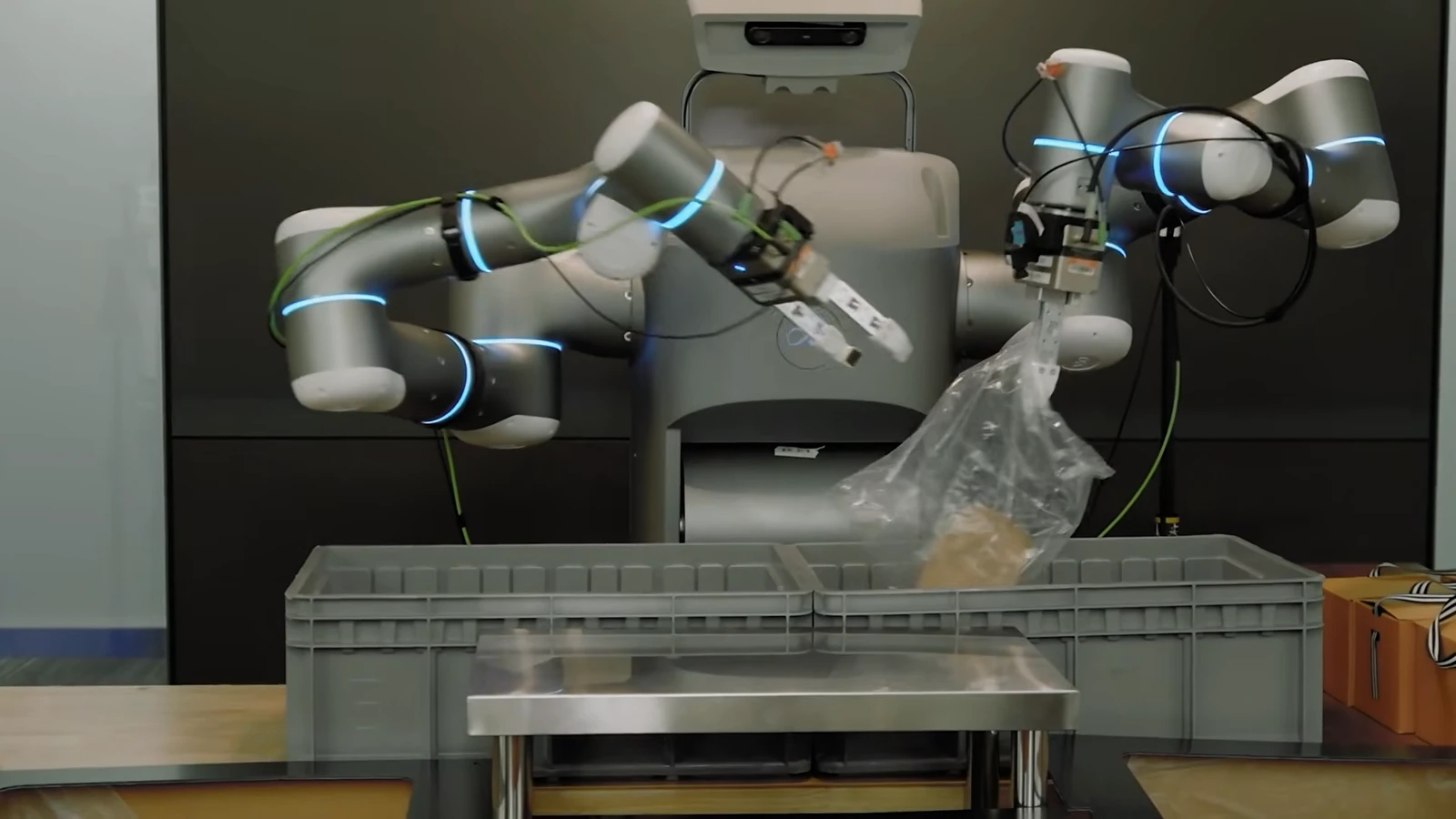
Rhoda AI's latest demonstration, filmed for a "Field Trips with Schrep" visit where Mike Schroepfer joins founder and CEO Jagdeep Singh, focuses on what happens when an industrial job stops going to plan. The robots unpack automotive parts, handle inspection equipment and recover from disturbances, including an accidental grasp, removing extra rubbish and retrieving paper trapped inside a plastic bag. Rhoda uses video prediction to guide actions, with a separate model translating predicted frames into movement commands. Singh says tasks can be learned with 10 to 20 hours of teleoperation data after extensive video pre-training. The standout sequence is unpacking a 10 kg box of ball bearings: opening packaging, removing paper, emptying bearings into a metal tote and separating waste. Rhoda targets wheeled industrial robots and paid production deployments before the end of 2026.
Read more → https://humanoidsdaily.com/news/rhoda-ai-schrep-dva-factory-edge-case-demos

NVIDIA released MotionBricks, which generates motion in real time for humanoid robots and human characters by connecting a character's recent poses to the poses it should reach next. Smart Primitives turn target poses into reusable building blocks for navigation and object interactions without retraining the model, and the paper describes a generative backbone trained on more than 350,000 motion clips. The accompanying software includes SOMA and Unitree G1 demos built with Newton and Warp, plus tools for creating your own primitives and scenes. The repository ships pretrained SafeTensors weights for two model families: SOMA for human motion on the SOMA skeleton and Unitree G1 for the humanoid. The work is documented as arXiv 2604.24833, "MotionBricks: Scalable Real-Time Motions with Modular Latent Generative Model and Smart Primitives".
Read more → https://huggingface.co/nvidia/MotionBricks
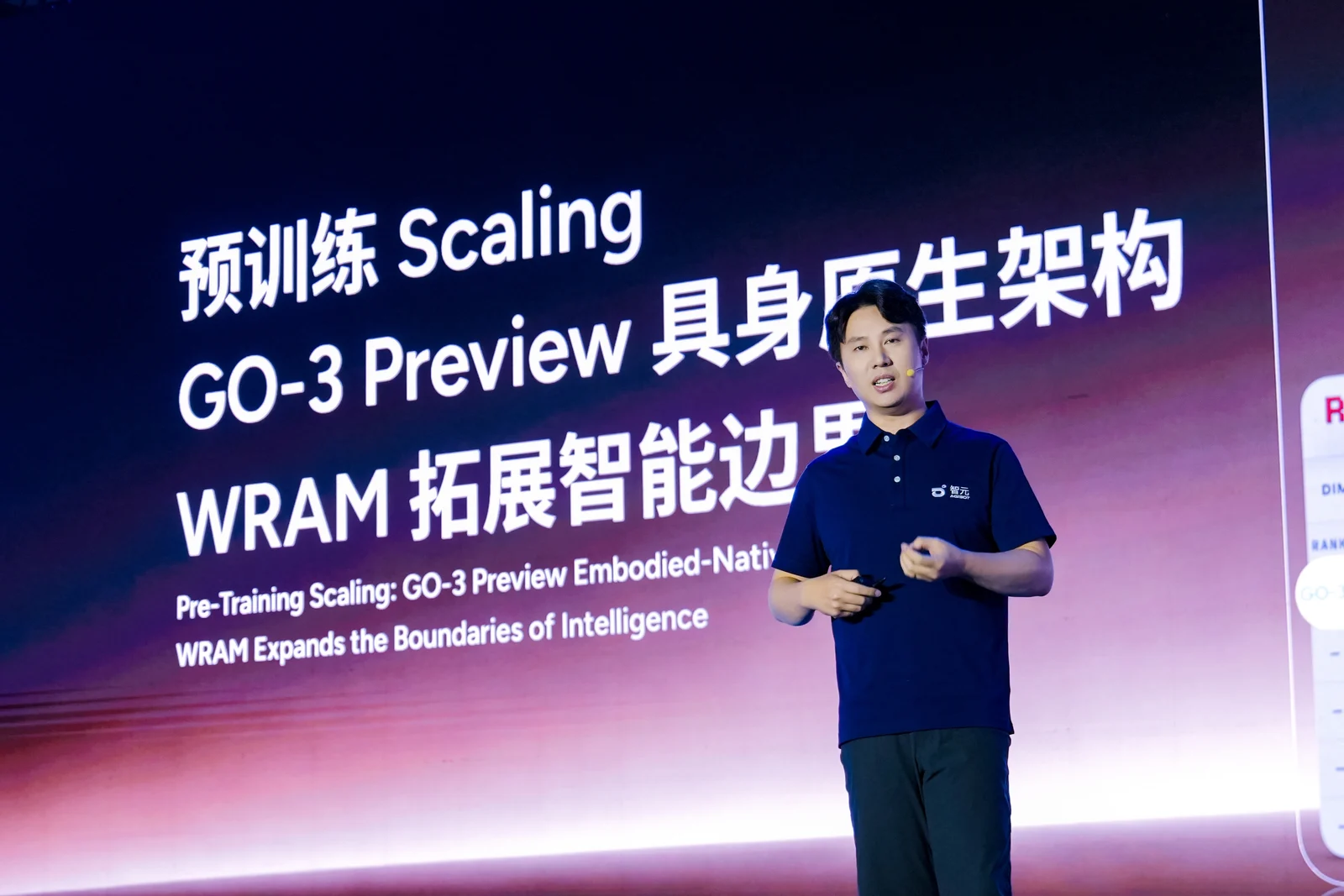
AGIBOT unveiled GO-3 Preview, an embodied foundation model meant to keep improving after deployment through pre-training, interaction and experience. Announced at Innovation Day in Shanghai on October 29 by co-founder and co-president Yao Maoqing, it relies on the World Reasoning Action Model (WRAM), combining task understanding, future-state prediction and action generation. AGIBOT ties three systems together as "full-lifecycle scaling": GO-3 Preview for general capabilities, Genie Evolver for action-strategy refinement, and Genie Master for task coordination and experience retention. The company claims first place on RoboDojo, RoboTwin and RoboColiseum, comparisons Humanoids Daily has not independently verified, and says GO-3 Preview will be fully open-sourced by end of 2026.
Read more → https://humanoidsdaily.com/news/agibot-go-3-preview-robot-learning-genie-evolver-master

TouchBridge is a hardware-software co-designed framework for transforming human demonstrations into robot data for dexterous manipulation. A wearable human demonstration interface and a corresponding robot interface establish cross-embodiment correspondence in both visual and fingertip tactile sensing. The authors introduce Tac-Retarget, a tactile-conditioned retargeting method that uses measured contact to align fingertip contact patches and preserve their spatial relations within and across hands. Unlike object-aware or simulation-based pipelines, Tac-Retarget requires no object mesh, no object-pose estimate and no physics simulation, enabling direct and scalable conversion of human demonstrations into robot data.
Read more → https://arxiv.org/abs/2610.40349
Small & On-Device Models

Liquid AI released LFM3-1.7B, a 1.73-billion-parameter small model that runs locally on phones and laptops and is built for agentic work. It is post-trained for agentic harnesses such as Hermes Agent, Pi and OpenClaw, with a 256K-token context window. At 4-bit precision it occupies about 1 GB, fitting on a phone or laptop, supports 16 languages, and is designed for quick single-GPU fine-tuning. The LFM3 family also includes base, vision, audio, omni and decision models. It is currently the second most trending model on Hugging Face with roughly 37,000 downloads and about 700 likes, shipping under a custom "other" licence.
Read more → https://huggingface.co/LiquidAI/LFM3-1.7B

OpenBMB launched MiniCPM-OCR 1.0, a 1.3-billion-parameter small model that is the first OCR entry in its MiniCPM-V/o family. It targets text-centric document understanding, covering text, tables, formulas, charts, seals and structured information extraction. The model balances quality against speed, ships under Apache-2.0 with English and Chinese support, and comes with a demo, a GitHub repository and a free API. OpenBMB positions it for document parsing rather than general vision-language chat.
Read more → https://huggingface.co/openbmb/MiniCPM-OCR-1.0
Papers & Research

The paper "Proving and Improving the Platonic Representation Hypothesis with JEPAs" turns the conjecture that models trained on different modalities converge as they scale into a theorem. The authors prove a Platonic Representation Theorem: JEPAs trained separately on any number of modalities learn the same representation up to one rotation whenever their positive pairs are two observations of one scene ("good views"), with bounded misalignment otherwise. They show next-token prediction is a JEPA with bad views — parts of a single document — explaining why language models align with vision only through scale. They validate the theory from 145k captions to the texts of 940M web images, and the paper is among the most upvoted of its batch on Hugging Face with 66 upvotes.
Read more → https://arxiv.org/abs/2610.39302