In this edition
- Frontier & Text Models (3)
- Recursive Self-Improvement — Research (1)
- Video & World Models (2)
- Audio, Voice & Music (3)
- Robots & Embodied AI (3)
- Small & On-Device Models (1)
- Papers & Research (3)
- News & Business (3)
OpenAI's frontier model drew a circuit board, Anthropic found 35 percent of the latency hiding in every API call, and the humanoid trade finally got a Nasdaq ticker. Today's edition also carries a four-parameter law for inference energy, a dubbing model that stops fighting the original mouth, and the Stanford paper arguing that half of what we "know" about language models has already expired.
Frontier & Text Models

OpenAI says GPT-6 Astra took a hardware device for its Codex coding agent from blank page to working prototype in under a week. Astra handled the enclosure design, PCB layout with component selection and trace routing, firmware and the user interface, with a contract manufacturer producing a small batch of prototypes in under a month. Several revision rounds were required because Astra did not always account for manufacturing constraints, tolerances and assembly details. On OpenAI's BenchCAD 2.0 benchmark, which tests reconstruction of 3D parts and assemblies and identification of PCB connections, GPT-6 Astra scores 0.594 at its highest reasoning level, while a newer internal model scores 0.875, about which OpenAI has shared no details. OpenAI says its hardware teams use Codex and ChatGPT for CAD models, manufacturing drawings and simulations across robotics and compute infrastructure, with token usage up 23x since February.
Read more → https://the-decoder.com/openai-says-gpt-6-astra-designed-a-hardware-device-from-scratch-in-under-a-week/

Anthropic's Message Threads stops resending the entire conversation on every turn and cuts time to first token by about 35 percent. Released as a public beta on the Claude platform, Message Threads transmits only what has changed since the last message rather than the full conversation history. The 35 percent time-to-first-token reduction applies to requests between 500,000 and one million tokens, with coding agents, computer-use agents and document- or image-heavy workflows benefiting most. The thread stays encrypted in memory between requests and expires after five minutes of inactivity, while token usage is unchanged because Claude still reads the full history. It works on the Claude platform and through AWS, Microsoft Foundry and Google Cloud.

Anthropic's amended IPO filing shows $33.24 billion in revenue for the first nine months of 2026 and a $104 billion net loss. The amended S-1 filed Monday with the SEC reports nine-month revenue up nearly 1,200 percent year on year, with Q3 revenue of roughly $17 billion up 1,127 percent from the prior-year quarter but only 47 percent sequentially versus 144 percent in Q2 and 132 percent in Q1. Q3 net loss was $23.29 billion, bringing the nine-month loss to approximately $104 billion versus $25.1 billion in the same period of 2025, with much of the loss from noncash accounting adjustments on convertible notes and derivative liabilities whose values shifted as Anthropic's valuation rose. Operating results swung from $974 million operating income in Q2 to a $567 million operating loss in Q3, and Anthropic disclosed approximately $895.4 billion in aggregate spending commitments under purchase agreements and leases, nearly all tied to computing capacity and infrastructure spread over multiple years.
Recursive Self-Improvement — Research

A small model of 4 billion parameters comes within a point of its far larger teacher once the teacher's harness is distilled into it, at a fraction of the inference cost. TinyAstral (arXiv 2610.41216, Oct 30 2026) treats robot agents built on vision-language models as depending on both the planner and its harness — the tools, feedback, memory and recovery logic around it — and asks whether improvements to a large teacher's harness can be carried into a compact agent with lower inference compute cost. The two-stage approach first improves a frozen open-weight teacher's harness through recursive self-improvement, where frontier LLM agents read the teacher's trajectories and propose harness edits accepted only if they pass a paired statistical test; then the final harness is frozen, teacher trajectories with reasoning and failure recovery are collected, and a small student is distilled to replace the teacher in the same harness. On RoboTwin, harness evolution raises the teacher's success from 33.4% to 63.6% and the final 4B student reaches 62.8%, with distilled 4B students scoring close to their corresponding teachers across four harness versions. On identical episodes the final 4B student outperforms open 4B agents, the open 27B harness-RSI model SenseNova-RoboRSI, and its own teacher placed in three competitors' harnesses.
Read more → https://arxiv.org/abs/2610.41216
Video & World Models

Wave Forcing pushes a video model towards the speed of light for streaming video generation by never letting a denoising step wait for the previous chunk to finish. arXiv 2611.00859 addresses real-time long-video generation, where existing chunk-wise autoregressive methods need two forward passes even with one-step denoising because serialized denoising and history-cache refresh are separate, and longer rollouts degrade quality and cause camera drift. Wave Forcing co-designs generation, training and execution: chunk-wise causal attention lets it read earlier, cleaner chunks before their denoising completes, and staggered denoising and cache-refresh stages are distributed across full-model replicas to reach 1F1C — one output chunk per concurrent forward round after pipeline fill. A three-stage training procedure introduces mixed-noise denoising, motion supervision, and causal adaptation using self-generated history, while Wave Runtime adds Wave Parallelism for early K/V delivery, communication-computation overlap, optimized kernels and pipelined VAE decoding. On Wan2.1-T2V-1.3B, 5-step Wave Forcing keeps overall quality comparable to Rolling Forcing while getting a higher Dynamic Degree on short and long videos, and 4-step Wave Forcing reaches 147.6 DiT FPS.
Read more → https://arxiv.org/abs/2611.00859

Long-horizon video generation forgets what leaves the frame, so History Forcing distills a world model's memory of it back into a few-step student. arXiv 2611.02782 tackles few-step autoregressive video diffusion, where consistency over long rollouts is hard, especially when subjects or scenes reappear after going out of sight, and existing distillation methods do not fully exploit richer historical information to constrain the student's current prediction. History Forcing is a unified on-policy distillation framework that strengthens historical supervision by using the residual between teacher predictions with and without informative historical context to decouple that supervision. History is taken either from earlier generated chunks with less accumulated drift or from a fixed-view teacher rollout that keeps the scene visible while the student looks away, then weighted and added to the score or velocity prediction to form a corrected target. The method achieves state-of-the-art performance among 1.3B models, with a VBench quality score of 85.07 for 15-second video generation and a VBench-Long aggregate score of 79.82 for 60-second generation.
Read more → https://arxiv.org/abs/2611.02782
Audio, Voice & Music

Gradium's six 40-million-parameter speech models now run entirely in a browser tab through WebGPU. The repository blixt/phonon-40m-webgpu holds Gradium's six Phonon 40M models converted for blixt/phonon, a WebGPU runtime that runs them in the browser. Each model ships two files: converted weights (MODEL.int8.bin, 53.7 MB in place of the 122 MB checkpoint) and Gradium's tokenizer. The six models cover English, French, German, Spanish, Portuguese, and one multilingual model covering all five languages, building on Pocket TTS and the Mimi codec by Kyutai.
Read more → https://huggingface.co/blixt/phonon-40m-webgpu

A new autoregressive audio model generates a talking head and its speech together in high resolution, and can keep going for an hour of continuous audio. TaoMate-HD, described on arXiv 2611.03394, is an autoregressive model for high-resolution audio-video streaming in which digital humans produce detailed video while continuing speech as new text arrives. For each short chunk, two denoising steps establish coarse video structure at low resolution and a final step refines it to high resolution, with audio generated through the same trajectory; each stage passes its audiovisual predictions to the same stage of the next chunk as history, which is retained across text updates to infer what has already been spoken. Experiments show a 1.6x speedup over direct high-resolution generation, optimized stage-parallel deployment adds a further 1.9x overall speedup over serial progressive generation, and continuation training reduces character error rate by 11.18 percentage points relative to baseline while supporting hour-long audiovisual generation.
Read more → https://arxiv.org/abs/2611.03394

Dubbing a video with new speech normally makes an audio model fight the original mouth movements, so VidDub stops asking it to reconstruct them. VidDub, described on arXiv 2611.03404, targets video dubbing that synthesizes lip movements matching target speech while preserving speaker identity, head pose and background. Existing editors are mostly trained by self-reconstruction under original paired audio, even though the source mouth becomes a conflicting target when driving speech is replaced; VidDub introduces replacement-aware cross-audio supervision where paired-audio samples use full-frame reconstruction while unpaired replacement-audio samples mask out source-mouth reconstruction losses and supervise the mouth solely through audio-visual synchronization. Because offline dubbing provides the complete source video and target speech beforehand, VidDub is a full-context diffusion editor distilled into two denoising steps (2 NFE) using a replacement-aware teacher plus matched trajectory regression and distribution matching distillation. Across three training seeds, masking conflicting source-mouth reconstruction improves cross-audio Sync-C by 0.833, and the authors will release VidDub-Bench, fixed evaluation manifests and evaluation code.
Read more → https://arxiv.org/abs/2611.03404
Robots & Embodied AI
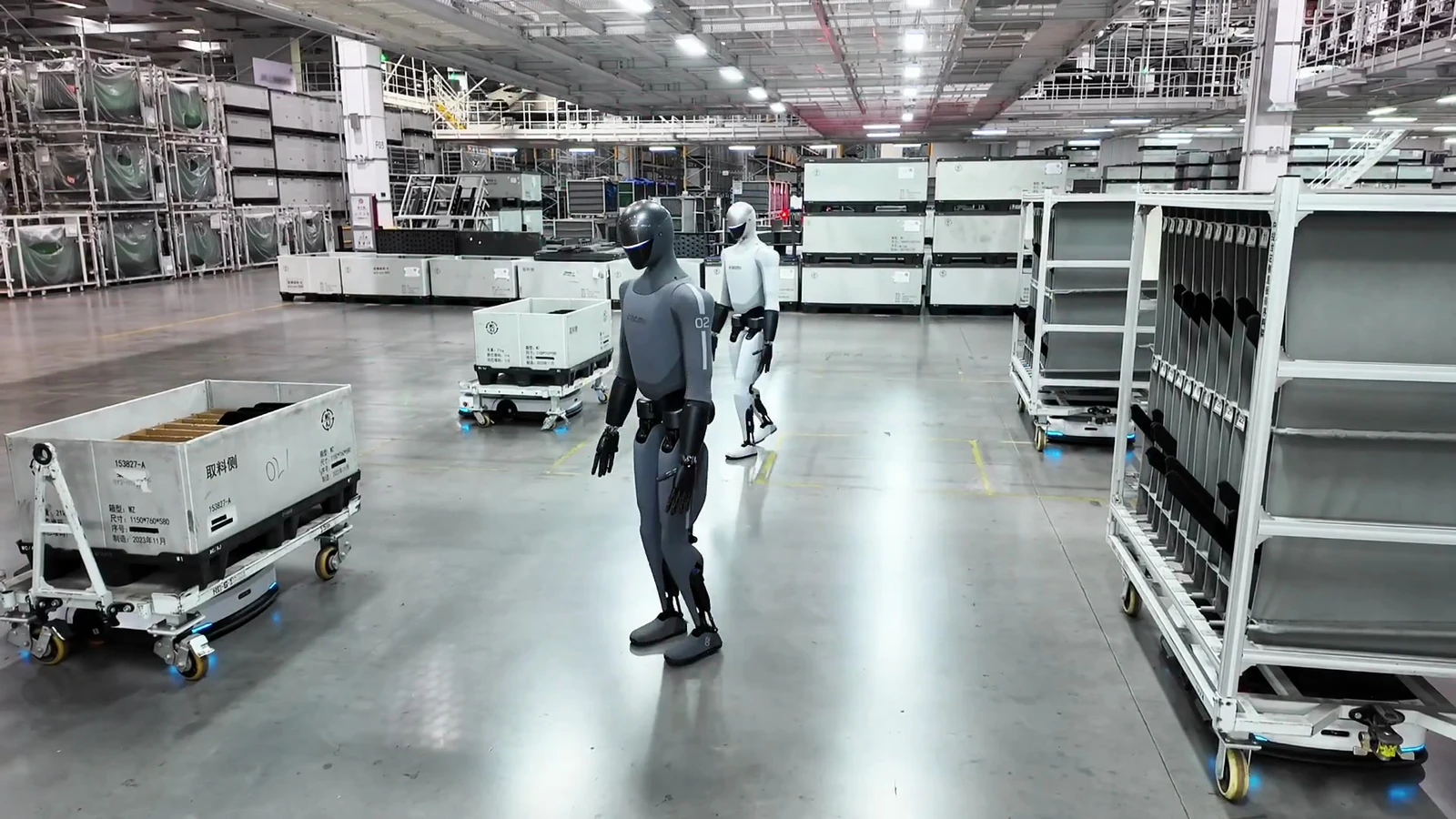
Xiaomi put two humanoid robots on an eight-hour sorting shift at its car factory. The November 3 video focuses on a center-console side-cover sorting workstation, where Xiaomi says its full-size humanoid completed an eight-hour task with claimed autonomous anomaly detection and correction alongside coordination with the production line system. The robots move components between large containers on mobile platforms and upright racks with individual slots, with on-screen cumulative working-time counters and overlays labelling the footage autonomous at playback speeds of 5x and 100x. The announcement does not provide throughput, intervention rates or battery-management details, and does not quantify how often recovery was needed.
Read more → https://www.humanoidsdaily.com/news/xiaomi-humanoids-eight-hour-auto-factory-sorting

Agility's humanoid business cleared its shareholder vote and expects to start trading on Nasdaq as AGLT on November 5. Churchill Capital Corp XI shareholders approved the SPAC's merger with Agility Robotics at a November 2 meeting, with more than 84% of votes cast supporting the combination, and the transaction plus associated private investment financing are expected to close November 4 subject to remaining conditions. Shares are expected to begin trading on Nasdaq November 5 under AGLT, with warrants under AGLTW. The approximately $465 million gross capital total comprises roughly $164 million in Churchill XI's trust account, a $201 million PIPE led by Foxconn, and the $100 million in equity funding Agility received after the merger announcement; it is a gross figure before transaction expenses, not $465 million of new cash at closing. Digit 5 early access is planned for the first half of 2027, with general availability six to nine months later.
Read more → https://www.humanoidsdaily.com/news/churchill-xi-shareholders-approve-agility-robotics-merger

Six humanoid robots ran a convenience store for 24 hours straight on a livestream. AGIBOT ran six G2 robots through a convenience-store shift in a 24-hour livestream called "Robots Never Clock Out", from November 2 at 10:00 a.m. to November 3 at 10:00 a.m. China time, describing the robots as store trainees facing rush-hour crowds, overnight duty and the morning breakfast period. Planned work included stocking shelves, making coffee, preparing hot food, greeting customers and clearing rubbish, organised into four periods: the lunch rush, evening rush, late-night duty and breakfast preparation. The livestream provides a longer window into operation than a short demonstration, but does not by itself establish uninterrupted autonomous work by every robot.
Read more → https://www.humanoidsdaily.com/news/agibot-g2-24-hour-convenience-store-livestream
Small & On-Device Models

A 2-billion-parameter multimodal decision model now runs on-device in LiteRT, answering a question about a 10-second audio clip in a median 89 milliseconds. litert-community/d1-Omni-2B-LiteRT is a conversion of LiquidAI/d1-Omni-2B to LiteRT, made with litert-torch 0.10.0 for the CompiledModel API of ai-edge-litert 2.3.0. Measured on an Apple M4 Max with Metal at float32 precision, one question about a 10-second audio clip takes a median 89.0 ms, and one question about the source model card's support ticket takes 40.9 ms. d1-Omni-2B is a Liquid AI decision model for text, pictures and audio built on LiquidAI/LFM3-Omni-2B that reads a state, pictures, audio clips and any number of named questions — written or spoken — and returns typed answers with probabilities from one forward pass without generating tokens, including yes/no, choices, ordered levels, text, number or date spans, and boxes.
Read more → https://huggingface.co/litert-community/d1-Omni-2B-LiteRT
Papers & Research

CoworkOS treats long-horizon knowledge work as an operating-system problem rather than a prompting problem. CoworkOS (arXiv 2611.03178, Nov 2 2026) is a general-purpose harness that separates task strategy from execution management: the model decides actions, delegation and acceptance, while the runtime maintains state and feedback. Its three-layer architecture enables direct execution or delegation to Subagents, synchronously or asynchronously, under stable responsibilities, and a shared application layer lets humans and agents inspect and revise the same evolving documents, presentations, CAD models and Blender scenes. To sustain continuity, it adds hierarchical workspaces and persistent semantic memory so working files, key decisions and long-running job logs remain shareable, reusable and resumable after interruption. Across 12 benchmarks and 6 categories of real-world applications it is highly competitive with frontier agent applications such as Codex and DeepSeek Harness, and in a sustained-work case study it uses GLM-5.3 as its backbone.
Read more → https://arxiv.org/abs/2611.03178

A four-parameter law predicts the energy cost of a model's inference run to within 12 percent without any per-model fitting. The SIMPLE law (arXiv 2611.03330, Nov 2 2026) addresses the fact that generative AI is billed per token yet tokens are not equally expensive: each token enters the KV-cache and raises the cost of those that follow, so energy grows non-linearly along a sequence whose tokens look identical. The authors derive closed-form expressions for the computational and memory-access complexity of inference in terms of architectural hyperparameters, covering MHA and GQA, obtaining a four-parameter law that separates prefill from decode and decode into KV-cache cost and next-token computation. Over traces of 13 dense LLMs from six families on NVIDIA H100 GPUs it attains R2 = 0.969 and 11.97% MAPE, 3.1–3.5x below the previous state of the art, without per-LLM calibration. Prefill energy grows quadratically with hidden dimension, more aggressive GQA KV grouping reduces per-token energy by up to 3x relative to standard MHA, and raising the reasoning token budget pushes output length past the analytically derived energy minimum, so Intelligence per Joule peaks at an intermediate budget.
Read more → https://arxiv.org/abs/2611.03330

A Stanford paper tested 50 widely cited claims about large language models against 20 current models and found that 44 percent have already expired. The study by Owen Queen and James Zou tested models released between July 2024 and September 2026 by eight different developers, finding that 44 percent of the 50 findings have expired, 34 percent have weakened significantly, only 16 percent still hold and 6 percent have gotten stronger. Among the 22 findings with an estimated expiration date, the average lifespan was 15.7 months, with 16 percent expired after one year and 39 percent after two. Claims about what models cannot do expire fastest: five of nine reasoning-related findings are considered expired and none held up or strengthened, including counting letters in "strawberry", arithmetic in unfamiliar number systems, losing information in the middle of long contexts, and giving up correct answers when users push back. In a case study on fabricated scientific citations, the original 2023 Walters and Wilder study found GPT-3.5 made up 55 percent of its references, and when the same prompts were sent to current models, hallucinated references dropped from 55 percent to zero, but not everywhere.
Read more → https://the-decoder.com/rapid-llm-development-is-outrunning-the-research-meant-to-explain-it-study-finds/
News & Business

AI agents are now steering the Allen Telescope Array, and the SETI Institute says work that used to take weeks finishes in hours. The SETI Institute and Breakthrough Listen use AI agents at the Allen Telescope Array in Northern California to control the telescope and analyze incoming radio signals on the fly, though researchers still type in their commands for now. The system runs on Nvidia's Holoscan platform, which processes telescope data in real time on hardware Nvidia says can handle up to 2.4 terabits per second. As an early result, the team detected a pulsar in the Crab Nebula in real time using AI, a first, leveraging the regular signals pulsars emit as good test cases for detection. The team now wants to test open-source software that can run locally on the edge, with an eye toward future sensors on the far side of the Moon.

Huawei is telling some AI chip customers to source their own high-bandwidth memory, which in practice means the black market. Huawei plans to launch the Ascend 960DT early next year, claiming double the performance of current chips, but Chinese suppliers cannot produce enough HBM and U.S. export rules block direct purchases from Samsung and SK Hynix, which together control over 80 percent of the global market. Smugglers bundle HBM with cheap sub-threshold server processors, ship the packages through Hong Kong, and Shenzhen workshops separate the memory chips from the processors in a fragile, high-error-rate process. Smuggled HBM3E prices have jumped from a few hundred dollars to around $4,000 per unit in one year, and with each AI chip needing six to eight units, memory alone can cost up to $32,000; older Nvidia GPUs stripped for parts also feed the supply. South Korea's customs authority had uncovered $560 million in trade violations by May, already surpassing the previous full-year record, with a third involving strategic goods like chips.

A major investment bank has pulled advanced coding assistants away from its traders and bankers, leaving them to engineers only. Goldman Sachs has cut off most employees from advanced AI coding tools including the Claude Code assistant and Microsoft's GitHub, according to Bloomberg, citing internal guidelines from October, with only engineers still permitted to use them. Traders and bankers had spent months using the tools to monitor trading flows and create content, and the rollback is reportedly causing frustration inside the firm. In July, Goldman CIO Marco Argenti had publicly praised "vibe coding" by non-technical staff, in which a trader or asset-management employee would build a quick prototype with AI and hand it to an engineer to scale for production. Spokesperson Nick Carcaterra cited "a variety of factors including productivity and risk management", adding that the experimentation phase is over and the firm is limiting the tools to the people "who are best suited to leverage them for the long term".
Read more → https://the-decoder.com/goldman-sachs-pulls-ai-coding-tools-from-traders-and-bankers/
After Intelligence is a daily read on the models, machines and money moving the field. Nineteen items, every number checked against the page it came from.