In this edition
- Frontier & Text Models (3)
- Video & World Models (2)
- Audio, Voice & Music (3)
- Robots & Embodied AI (4)
- Small & On-Device Models (2)
- Papers & Research (2)
- News & Business (2)
The frontier split in two directions on Thursday: OpenAI shipped a model built to break software and then patch it, while Baidu handed out a 280-billion-parameter base model with the instruction tuning left as homework. Underneath the launches, the quieter story is price and access — Google cut video generation by 30 percent, a 112 MB voice model runs on a laptop CPU, and a university lab published a 56-degree-of-freedom robot for the price of a used car. Eighteen items, every one traced to its primary source.
Frontier & Text Models
 OpenAI's GPT-6 Cyber turns vulnerability hunting into a production line, and Mozilla has already patched what it found.
GPT-6 Cyber found 81 previously unknown critical vulnerabilities in Firefox, all already patched by Mozilla, and in the Linux kernel it reproduced 1,724 vulnerabilities while building working exploits for 948 of them, more than five times its predecessor's count. It scores 48.5 percent on ExploitGym versus 32.1 percent for GPT-5.6 Cyber, and without special safety instructions it avoided boundary violations in 99.93 percent of cases, rising to 100 percent with them. OpenAI rates the model "Critical" in the cybersecurity category of its Preparedness Framework.
Read more → https://the-decoder.com/openais-gpt-6-cyber-can-both-break-into-systems-and-propose-how-to-fix-them/
 Tencent's Hy4 is its first multimodal language model, and it can now drive a desktop on its own.
Hy4 understands images for the first time and can operate software itself, with weights to follow at an unspecified date while access runs through Tencent Cloud, OpenRouter and the Yuanbao chatbot. It scores 35 on the Artificial Analysis Intelligence Index against a 30-point median, tying Grok 4.7 and placing second among Chinese models behind Kimi K3.1 Pro at 46. A revamped search feature cut web-research hallucination from nearly 16 percent to about 5 percent, though without search it invents answers 89 percent of the time when it does not know one.
 Baidu has released ERNIE 5.5 Flash Base, a 280-billion-parameter mixture of experts, at the end of pre-training and with nothing bolted on.
The checkpoint sits at the end of pre-training before any mid- or post-training, leaving developers to choose their own instruction tuning or reinforcement learning. It has 280 billion total parameters with 14 billion active per token, 43 layers, and 512 routed experts using top-10 routing plus one shared expert per MoE layer. It was pre-trained from scratch on 33.5 trillion tokens with a 128K training context, while fine-tuning and inference support 1M tokens. On LiveCodeBench Pass@1 it scores 40.1, ahead of DeepSeek-V4-Flash-Base at 31.9, Hy3-preview-Base at 33.5 and MiMo-V2.5-Base at 32.4.
Video & World Models
 Google's video model Gemini Omni 1.2 Flash now handles video generation in 15-second clips, 30 percent cheaper.
Clips now run from three to 15 seconds, up from a 10-second maximum, and pricing drops 30 percent to $0.07 per second for 720p video. Conversational Editing lets users change background, lighting or aspect ratio step by step without regenerating the whole clip, working across the full 15 seconds. A tiered workflow drafts at 360p or 720p and upscales only the final result to 1080p or 4K, and every generated video carries an imperceptible SynthID watermark. It is rolling out through the Gemini API, Google AI Studio, the Google Cloud Console, Flow, Google Vids, the Gemini app for Google AI Ultra subscribers and Google Ads.
 EvoWorld is a world model that hands video generation to a reasoning brain, so a scene keeps evolving after the action leaves the frame.
Posted on arXiv on November 4, the paper defines "Out-of-Sight Causal Evolution," requiring a model to render an event, reason about its effect on world state, and reveal a causally plausible outcome as the world evolves outside the frame. EvoWorld pairs a vision-language model acting as the world brain, which observes generated segments and maintains an evolving account, with a segment-autoregressive video renderer that realizes them. The authors also release EvoWorld-Data and EvoWorld-Bench to train and test event realization, causal reactions and revisit consistency, reporting substantial gains over recent models while preserving visual quality and consistency.
Read more → https://arxiv.org/abs/2611.06748
Audio, Voice & Music
 Silencio-2 is a 112 MB text-to-speech model that clones a voice from a few seconds of audio and runs 20 times faster than real time on a laptop CPU.
Silencio-2 turns English text into 24 kHz speech in any voice from a few seconds of reference audio, with inline direction using tags such as [sigh] or where delivery changes. It runs about 20 times faster than real time on four CPU threads of an Apple M4, with all weights fitting in a single 112 MB file. It is built on kyutai/pocket-tts and released under CC-BY-4.0.
Read more → https://huggingface.co/BlueRoseLabs/Silencio-2
 LiveFoley generates sound effects from video in real time, closing the quality gap that has kept streaming audio generation behind offline models.
LiveFoley targets two bottlenecks in streaming video-to-audio generation: visual frontends that shrink receptive fields to cut look-ahead latency, and causal autoregressive diffusion backends that denoise each audio patch in isolation. Its Trailing Sliding Window converts non-causal segment-level encoders into streaming modules without retraining, while a Unified Varhop Framework serves different latency and compute budgets. History LocDiT and Future-Warmup LocDiT widen the denoising window at no latency cost. The authors report matching offline models in temporal alignment and leading streaming systems in generation quality.
Read more → https://arxiv.org/abs/2611.05988
 Confucius4-R2T2 is a streaming ASR model that never rewrites a token it has already emitted, turning speech recognition into a stable prefix.
Streaming ASR consumers like translators and voice agents act on each token as it appears, so revisions cost wasted work or wrong actions. Confucius4-R2T2 is post-trained from Qwen3-ASR-1.7B on 1,500 hours of Chinese and English audio with the audio encoder and projector frozen. It introduces the Longest Stable Prefix, proven monotone, consistent with full-audio output and maximal among labels equaling a whole earlier output. Evaluations bring streaming recognition close to the base model's full-context quality with low emission lag, and weights and code are open-sourced.
Read more → https://arxiv.org/abs/2611.06043
Robots & Embodied AI
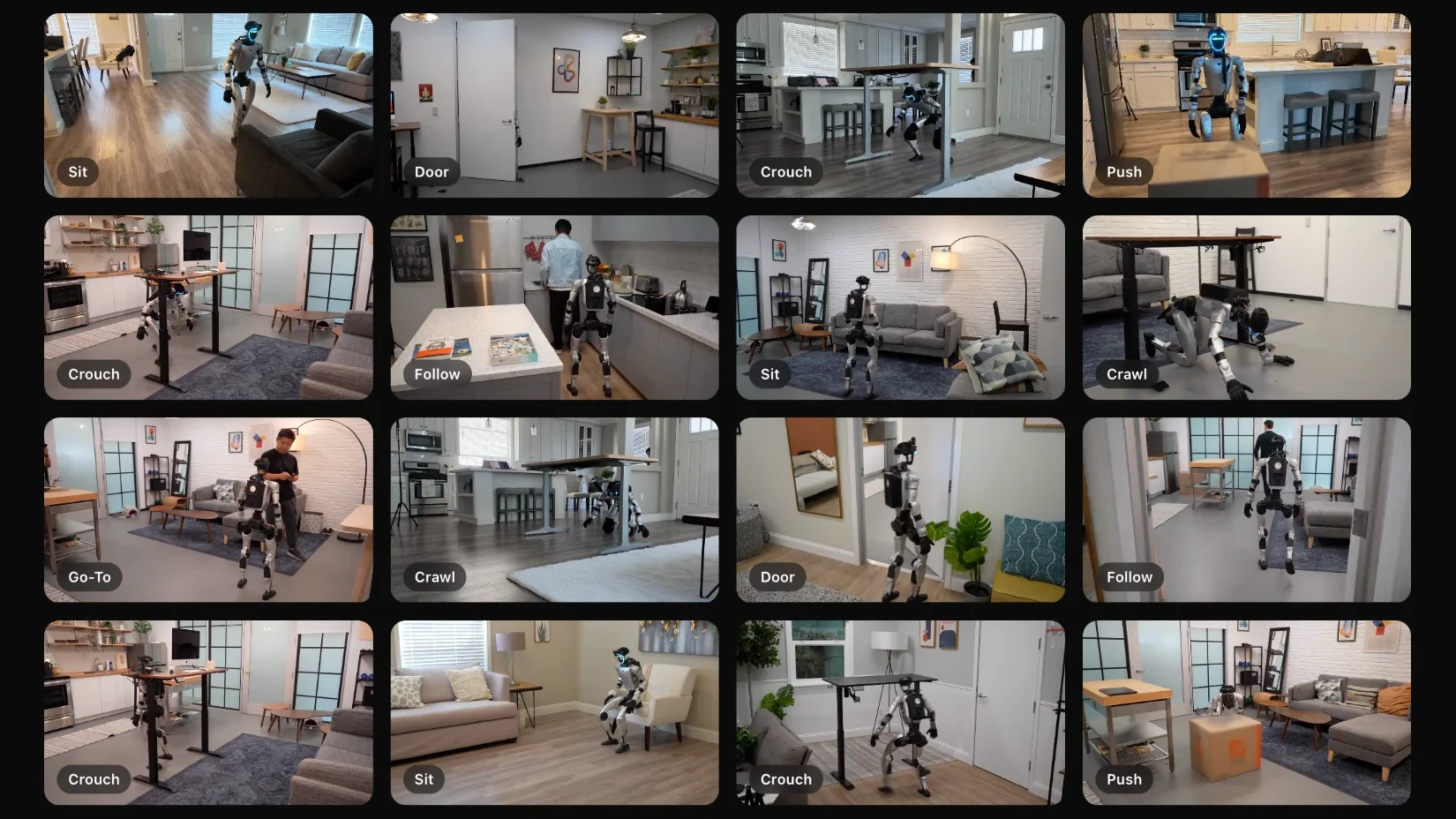 Apple taught a Unitree G1 humanoid to walk into rooms it has never seen using only simulation-generated motion data.
Apple trained a Unitree G1 humanoid to walk to objects, sit on chairs, crawl under tables and push boxes in unseen rooms, with all models running onboard from camera input and natural-language requests. The motion generator was trained on about 300 hours of synthetic data across 1,000 procedurally generated rooms rendered in Isaac Sim. HALO completed 91 percent of 360 single-task real-world trials across six unmapped environments without teleoperation data, while chained tasks averaged 70 percent across three sequences. The paper "Perceptive Humanoid Motion from Simulation" was posted to arXiv on November 4, with code on GitHub and no comparisons against other published systems.
Read more → https://www.humanoidsdaily.com/news/apple-halo-humanoid-synthetic-data-unitree-g1
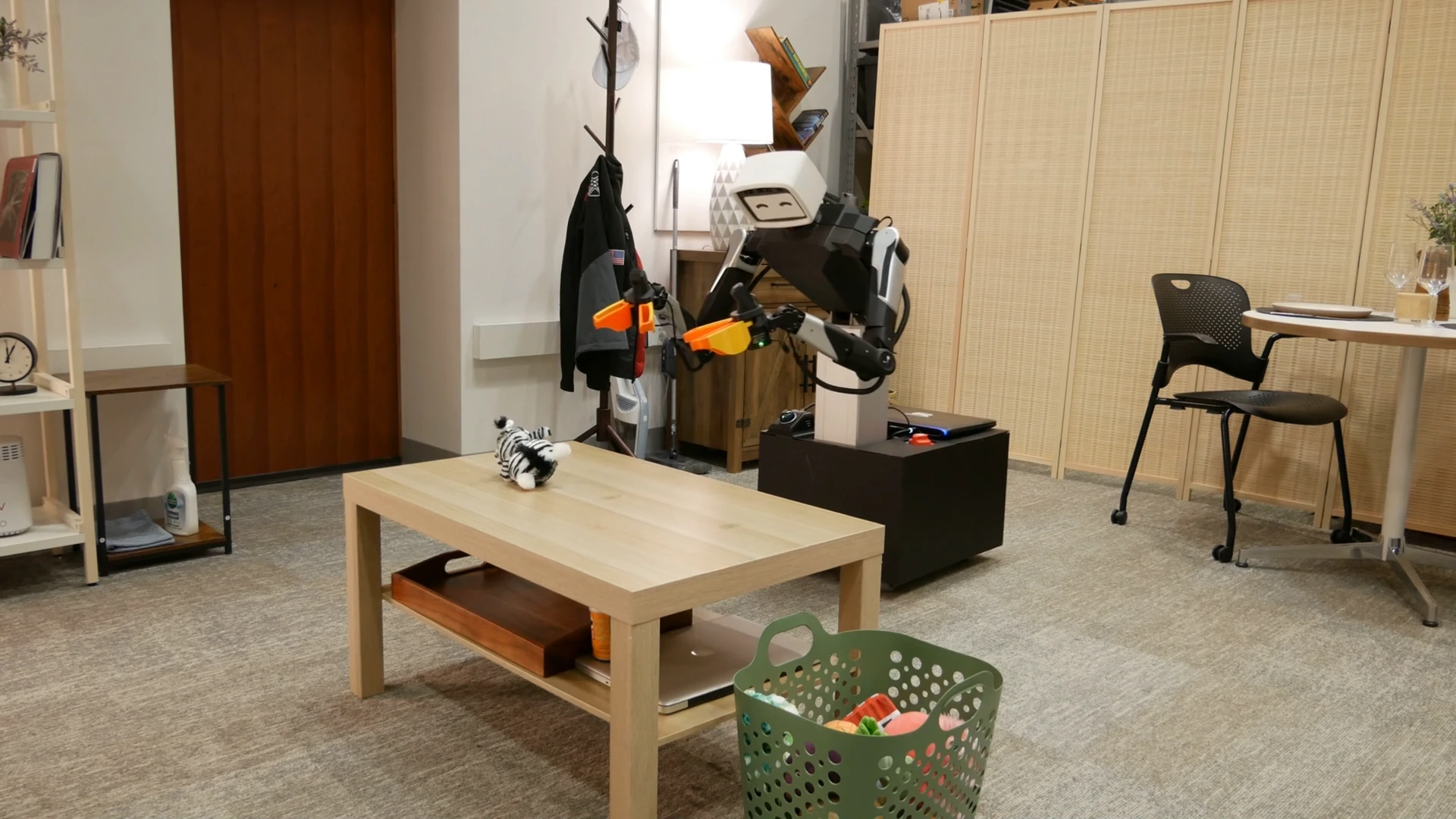 Carnegie Mellon built a two-armed robot for under $15,000 that learns household chores from human demonstrations.
Pixel is a wheeled, two-armed research platform costing under $15,000 to build, not an announced consumer product. The project pairs affordable hardware with data-collection tools and whole-body learning, asking how much easier teaching becomes when body, controls and data tools are designed together. Demonstrated tasks include autonomous tidying, vacuuming and retrieving snacks, with teleoperated examples labeled separately. The companion Pixel-UMI paper reports 87 percent average task progress across five tasks, and the work led by Tony Tao and Jason Jingzhou Liu with Ruslan Salakhutdinov and Deepak Pathak was released November 2 with an open-source release promised.
Read more → https://www.humanoidsdaily.com/news/cmu-pixel-wheeled-robot-human-demonstrations
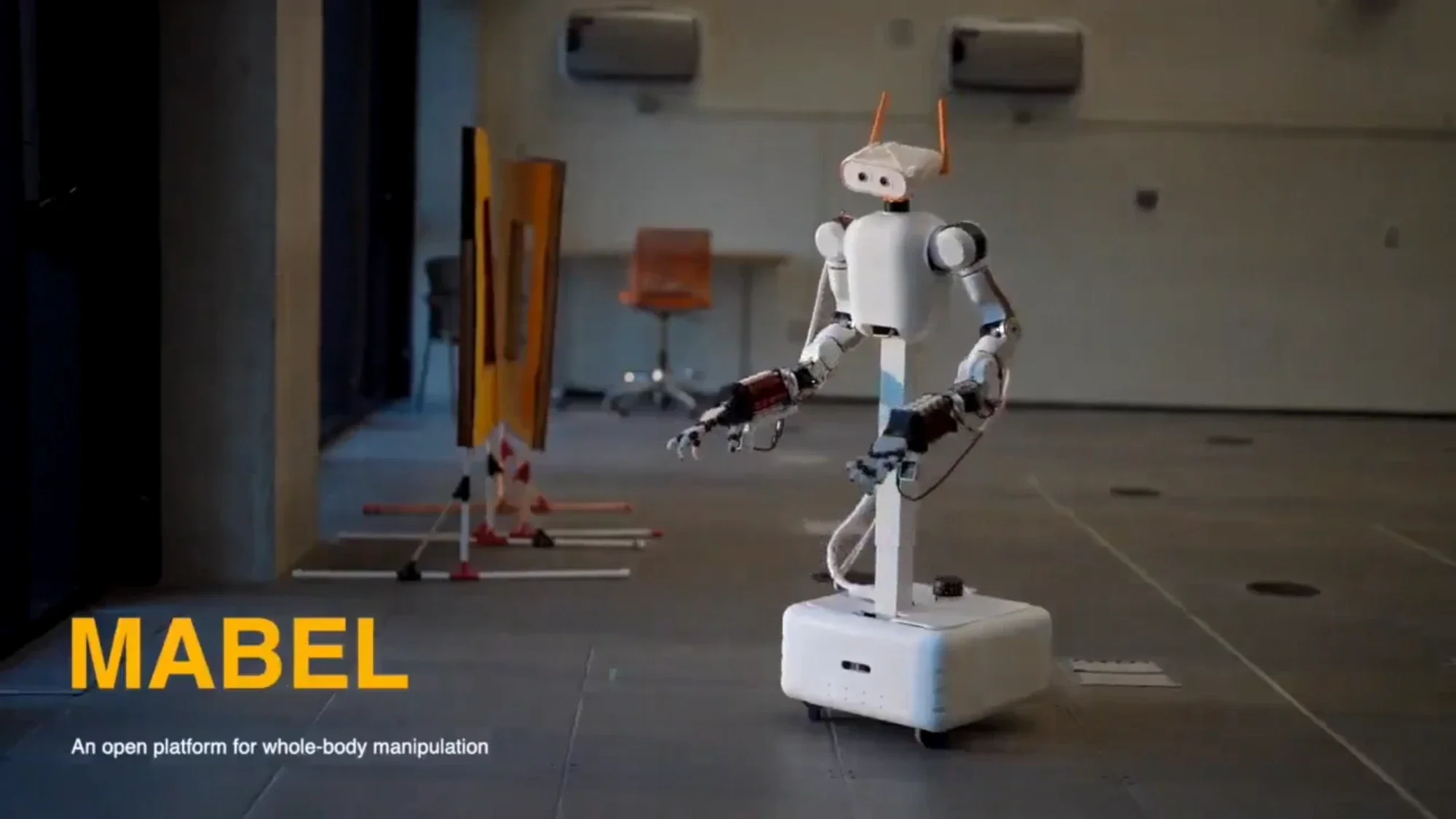 NYU's MABEL is a 56-degree-of-freedom mobile bimanual robot with an $8,056 parts list, published open source.
MABEL comes from NYU's Center for Robotics and Embodied Intelligence with two 7-DOF arms, two 17-DOF ORCA hands, a pitching torso, a lift, a 3-DOF neck and a swerve-drive base, totaling 56 functional degrees of freedom. Its base configuration costs $8,056 in parts, versus Mobile ALOHA at $32,000 and Galaxea R1 Pro at $70,000 in the paper's comparison table. CAD, firmware, the ROS 2 stack and MuJoCo/Isaac Lab models are released under CERN-OHL-S-2.0 and Apache-2.0. An ACT policy trained on 38 minutes of demonstrations picked and placed an object in 8 of 10 trials, with the paper posted to arXiv on November 2 led by Qilong Cheng with Ludovic Righetti as senior author.
Read more → https://www.humanoidsdaily.com/news/mabel-open-source-mobile-bimanual-robot-nyu
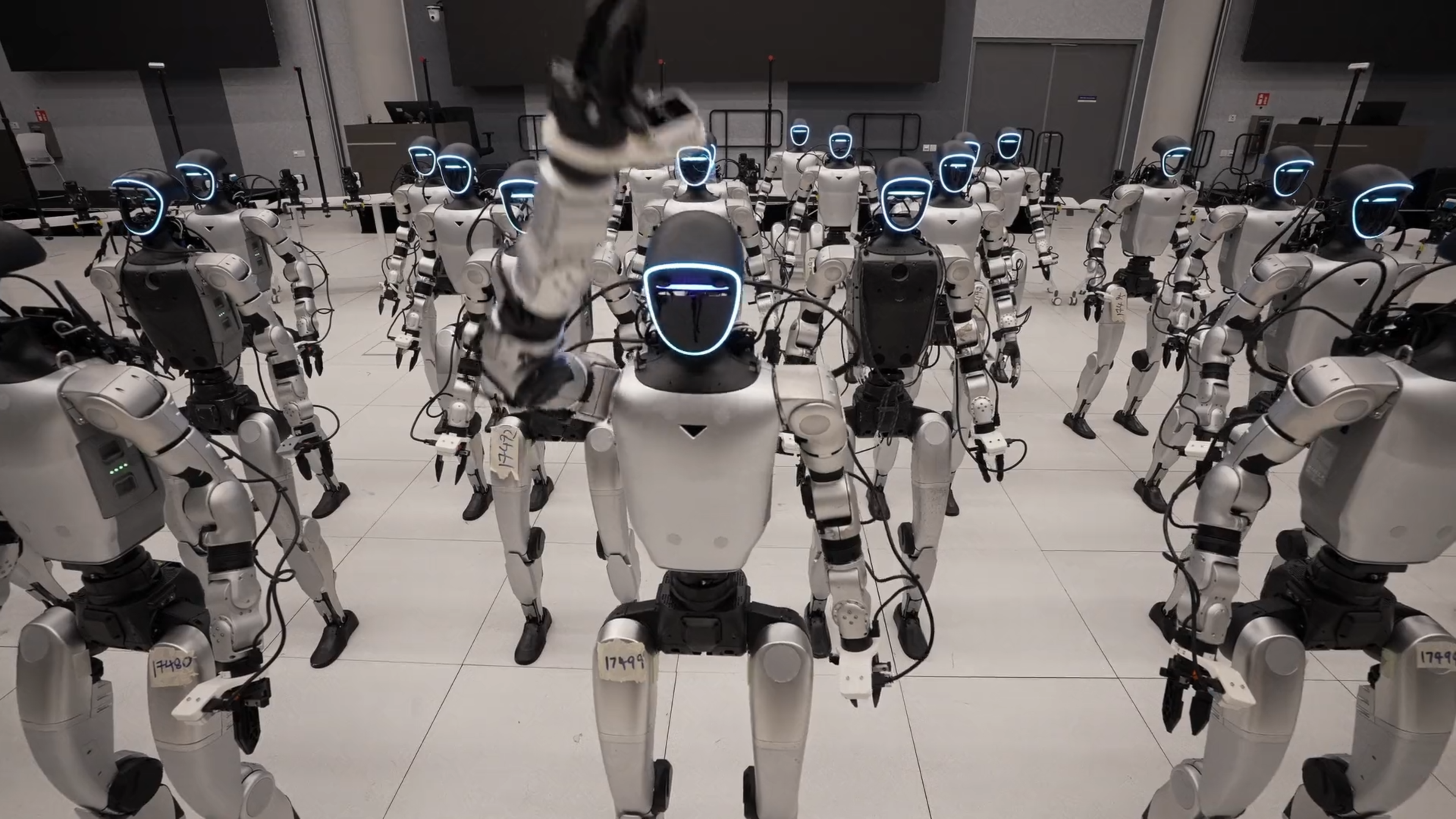 RoboColosseum rents out more than 100 real robots and 10,000 evaluation hours so researchers can test robot policies on hardware they do not own.
RoboColosseum is a new open initiative offering academic researchers access to more than 100 robots, over 140 real-world scenes and 10,000 free evaluation hours. Unitree has publicly backed the project, with its G1 platform used in the humanoid category, and the fleet also includes SO-101 arms, YAM systems and Franka robots. The launch names Hugging Face, BitRobot, the Singapore Embodied AI Centre and researcher Jiafei Duan as participants, with Singapore as the starting location. Evaluation recordings will be released for inspection, and initial results show a substantial gap between partial progress and completed humanoid tasks.
Read more → https://www.humanoidsdaily.com/news/robocolosseum-robot-ai-benchmark-unitree-g1
Small & On-Device Models
 A small model called Qwen3.5-4B-3D-Coder writes interactive Three.js scenes, and it runs locally on a laptop.
CCORE built Qwen3.5-4B-3D-Coder as an independent fine-tune of Qwen3.5-4B, still in training and explicitly not an official Qwen release. It targets general-purpose coding with emphasis on interactive Three.js scenes, and early hands-on results were promising, especially for 3D scene generation. The Q4_K_M and Q8_0 GGUF versions accept image inputs when paired with the original Qwen3.5-4B vision encoder and projector, a roughly 644 MiB file, letting users attach a reference image with prompts like "create this scene using voxels 3d". It ships under Apache-2.0.
Read more → https://huggingface.co/ccore/Qwen3.5-4B-3D-Coder
 Paradee-8M is a 7.88-million-parameter text-to-speech model distilled from Kokoro, small enough to run on-device.
Paradee-8M ships in ONNX format with 7.88 million parameters, distilled from Kokoro-82M. Version 1.2 offers four voices, two American and two British. On the af_heart voice it reaches a UTMOS of 4.40 against Kokoro's 4.52, with word error rate at 5.8 percent against 5.7 percent, while on bf_isabella it reaches 4.06 against 4.41 with word error rate 5.7 percent against 5.6 percent. It is released under Apache-2.0.
Read more → https://huggingface.co/sahilmahendrakar/Paradee-8M-v1.2
Papers & Research
 SemiAnalysis's new benchmark GDPx puts agents through eight-hour simulated workdays, and its evaluation tops out at 12 percent.
GDPx places agents in simulated work environments where they spend up to eight hours operating professional software such as Siemens NX, searching data rooms with thousands of files, or attacking live enterprise systems. Its 206 tasks span eleven domains including chip design, biology, quant trading, cybersecurity and law. Claude Opus 5.5 leads with 12 percent, followed by Gemini 4 Carbon at 10.9 percent and GPT-6 Astra at 9.6 percent. SemiAnalysis distances the test from OpenAI's GDPval, which it says delivers all context in the prompt and lacks a realistic work environment, while critics flag distortions from safety filters, task secrecy and unequal conditions from each provider's own agent software.
Read more → https://the-decoder.com/no-ai-agent-scores-above-12-percent-on-semianalysis-new-real-world-work-benchmark/
 FrontierPhysics is a benchmark of 56 real physics research tasks written by the physicists who posed them, and no model configuration passes more than 46 of 168 attempts.
The benchmark has 56 tasks authored by 42 physicists based on their own research, covering nine domains across theoretical, computational and experimental physics. Each task requires agents to review literature, develop a research plan, conduct research and experiments, and produce structured outputs and scientific manuscripts, judged by deterministic verifiers combined with expert-authored rubrics. Across 22 models in 26 configurations, no configuration passes more than 46 of 168 rollouts. Manual review of trajectories shows frontier agents' main weaknesses are insufficiently rigorous reasoning and limited expert intuition, rather than gaps in physics knowledge or execution errors.
Read more → https://arxiv.org/abs/2611.06910
News & Business
 Meta is buying Conductor, the startup that lets one developer orchestrate a fleet of coding agents.
Axios reported the deal and Conductor CEO Charlie Holtz confirmed it in a blog post without disclosing a price, saying the acquisition strengthens Meta's AI developer products. Conductor lets developers control multiple AI coding agents simultaneously, and the same day OpenAI announced plans to acquire Pierre Computer, while SpaceX closed its $60 billion acquisition of Cursor in August. The pattern is that models are becoming interchangeable, so value shifts to surrounding tooling and the developers it locks in. Conductor Cloud shuts down on November 20, and the desktop app stops receiving new models in early 2027.
Read more → https://the-decoder.com/meta-buys-ai-coding-startup-conductor-as-big-tech-races-to-lock-in-developers/
About 600,000 Nvidia H200 accelerators are sitting in Hong Kong while Beijing withholds permission to import them. Reuters reported on Thursday that around 600,000 Nvidia H200 AI chips are sitting in Hong Kong as Chinese authorities continue withholding permission for large-scale imports into mainland China. The inventory buildup reflects continuing uncertainty over Beijing's treatment of advanced American processors. Chinese technology companies remain interested in acquiring H200 systems because the chips offer computing capacity useful for training and operating sophisticated models. Beijing is simultaneously encouraging domestic technology companies to use locally developed alternatives, which could reduce dependence on American suppliers.
After Intelligence runs every morning, with the send scheduled for 06:00 Vienna time. If something in here is wrong, reply to this mail — corrections run in the next edition.