In this edition
- Frontier & Text Models (4)
- Image & Vision (1)
- Video & World Models (1)
- 3D & Reconstruction (1)
- Audio, Voice & Music (2)
- Robots & Embodied AI (4)
- Small & On-Device Models (2)
- Papers & Research (2)
- News & Business (1)
The open-weight race moved in two directions at once on Friday: Thinking Machines shipped its second-generation base model at 594 billion parameters while a Swiss startup put a cageless, wheeled humanoid on the factory floor. Behind both sits the finding that matters most for the next twelve months — a METR audit that measures AI accelerating a frontier lab's own research at roughly twice the old pace, and finds no bottleneck that would slow it down.
Frontier & Text Models
 Thinking Machines' Inkling 2 Small is a 594-billion-parameter mixture of experts that puts a 17-billion-parameter frontier model behind an open-weight promise.
The MoE design activates 17 billion of its 594 billion parameters per token and accepts both text and image input with adjustable thinking depth. On the Artificial Analysis Intelligence Index it scores 31, roughly level with Gemini 3.8 Flash, while AutomationBench-AA jumps from 5 to 46 percent and hallucination rate drops from 61 to 27 percent, though response rate falls from 77 to 53 percent. It averages about 150,000 output tokens per task at $1.18, nearly six times the predecessor but far below Gemini 3.8 Flash and Claude Sonnet 5.5. Weights will follow under Apache license after an initial proprietary release on the Tinker platform.
Read more → https://the-decoder.com/thinking-machines-inkling-2-small-claims-top-spot-among-western-open-weight-models/
 Claude can now read your bank account through Plaid and answer questions about your spending.
The feature uses read-only access through Plaid, so Claude never sees bank passwords and cannot move, manage or invest funds. Users can break spending down by category, check upcoming payments or ask whether they are spending more than they earn. It is in beta in the US for Pro, Max and Ultra subscribers, with conversations in that section excluded from model training and no ads or sponsored recommendations. Anthropic eventually wants to connect Claude with licensed financial advisors and regulated firms.
Read more → https://the-decoder.com/anthropic-adds-bank-account-access-to-claude-so-users-can-track-their-spending/
 Anthropic's $1.5 trillion IPO is meeting resistance as investors balk at the valuation.
Reuters reports potential backers doubt the roadshow can start next week as planned, and the Wall Street Journal says IPO investors are skeptical. After eyeing up to $2 trillion in September, some investors now consider even $1.5 trillion too rich, with one reportedly floating just $1 trillion. They want a steeper discount because Anthropic is still losing money, burning cash to scale infrastructure, and October revenue numbers are missing from the updated S-1 filing. Some estimates put the offering at up to $100 billion in size, and a delay is possible.
Read more → https://the-decoder.com/anthropics-1-5-trillion-ipo-hits-resistance-as-investors-balk-at-valuation/
 A METR audit of Anthropic found the lab's models improving about twice as fast since October 2025, and roughly 80 percent of that acceleration traces to AI doing the lab's own research.
METR had eleven weeks of access from 12 August to 29 October 2026 and found Anthropic's AECI composite scores climbing about 1.9 times faster than between March 2024 and October 2025, from roughly 15 points per year to 29. About 80 percent of that acceleration comes from AI used in Anthropic's own research rather than faster growth in training compute. One employee said work is now only bottlenecked on ideas and compute, and October 2026 Slack polls put internal productivity at roughly twelve times higher, up from 1.2x with Claude 3.7 Sonnet. METR sees signs of life but no fully autonomous research, and found no bottlenecks likely to slow the pace over the next twelve months.
Image & Vision
 WeLM-Image is one image generation model that folds multimodal understanding, text-to-image, instruction-guided editing and multi-reference synthesis into a single interleaved sequence.
It is built for single-GPU deployment inside WeChat's large-scale consumer applications, processing text, reference images and target latents as one interleaved sequence. A Mixture-of-Transformers backbone combines shared attention with independent understanding and generation parameters to limit optimization interference, while MoE modules give 31.7 billion stored parameters with about 5.4 billion generation parameters activated per target latent token. The model supports native 1.5K resolution with bilingual annotations and progressive training, ranking first among evaluated open-source models on PRISM-Bench, Qwen-Image-Bench and UnicBench at 1536 resolution. MeanFlow-based few-step distillation yields WeLM-Image-Turbo.
Read more → https://arxiv.org/abs/2611.07392
Video & World Models
 MoviEdit is a video model for long-form, multi-shot editing that holds one intended edit coherent across every cut, viewpoint and change of subject.
The hard part is scale: an edit has to survive abrupt changes in scene, viewpoint and subject appearance across far longer visual context than single-shot editors handle. Automatic data pipelines over synchronized multi-view footage, real multi-shot videos and generated content yield 87,000 paired editing videos without manual annotation. Its cascaded bidirectional-autoregressive architecture first establishes a globally coherent draft on a spatiotemporally compressed representation, then autoregressively propagates and refines it over the full video. The authors introduce MoviEdit-Bench and report that it substantially outperforms existing open-source models and performs on par with industry frontier models on text-guided and image-guided editing.
Read more → https://arxiv.org/abs/2611.02737
3D & Reconstruction
 EDGAR is a one-step diffusion refiner for gaussian avatar reconstruction that cleans up the blur, stretching and temporal flicker of monocular head avatars.
Monocular gaussian-splatting head avatars suffer from under-constrained geometry and texture, producing blurring, stretching and temporal instability that EDGAR corrects while preserving identity. The authors built EDGAR-SET, a hybrid triplet dataset of real and synthetic samples that pairs degraded renderings with ground-truth and reference images to simulate realistic failure cases. A fusion block injects identity features from the self-supervised Sapiens model into a one-step diffusion backbone, with a Mixture-of-Experts handling diverse degradation types and severities. Refined multi-view renderings become pseudo-targets that optimize a single underlying gaussian avatar, so EDGAR is not applied at inference; experiments across three reconstruction methods under three settings each show gains in perceptual and reconstruction quality.
Read more → https://arxiv.org/abs/2611.07909
Audio, Voice & Music
 Speculative Listening lets a streaming audio model draft its next speech chunk during idle compute, cutting the wait before a reply starts by 73 percent.
Chunk-interleaved full-duplex speech models leave compute idle during listen chunks and serialise speak and tool-call chunks, so the method drafts the next chunk during idle time under silence plus a branch from the runner-up first token, keeping drafts in a cross-chunk pool verified when audio arrives. Testing four models showed the next audio chunk did not change the output in 95.3 percent of chunks, and 88 percent of changes began at the first output token, making the approach training-free and lossless. On the eight-task TickTock-Bench, speak chunks run 2.6 to 2.8 times faster and tool-call chunks up to 23.4 times faster. Average decoding delay before a response starts falls 73 percent to 74 to 241 milliseconds, near the 200 millisecond human turn gap, and maximum lag behind real time drops 94.4 percent.
Read more → https://arxiv.org/abs/2611.06982
 VeriSpoof is a single audio model that handles five speech-forensics jobs at once, from flagging a deepfake to naming the generator that made it.
One set of weights unifies deepfake detection, generator attribution across generator, acoustic model and vocoder, recording-condition analysis, synthesized-span localisation and source verification, with every decision accompanied by grounded rationales checkable against waveform measurements, span labels or generator metadata. Across 14 Speech-DF-Arena test sets, VeriSpoof-Plus reaches 2.14 percent pooled equal error rate, ranking third of 28 systems and first among open-weight systems. VeriSpoof-Base, trained only on official training splits of eight corpora, reaches 4.43 percent EER, less than half that of the next open-weight detector. The same weights verify whether recordings from unseen generators share a source at 6.2 percent EER.
Read more → https://arxiv.org/abs/2611.04634
Robots & Embodied AI
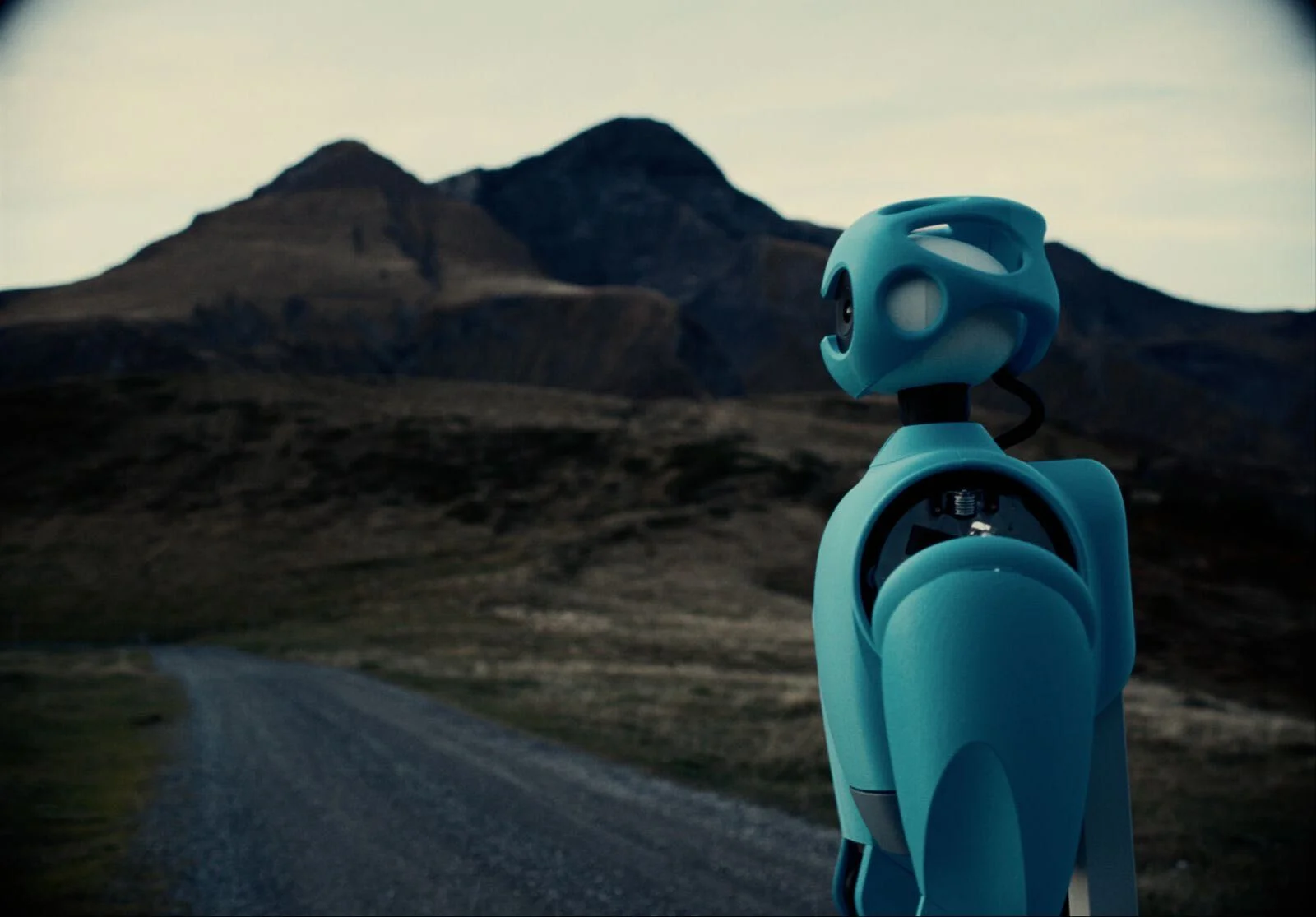 Embodied AI's AIR is a two-armed robot on a wheeled base that the Swiss startup says can work beside factory staff without a safety cage.
The 25-person EPFL spinout, based in Lausanne with an office in Rome, presented AIR at Humanoid Europe 2026 in Munich and opens orders after the unveiling. Heavy components sit in the torso while light, soft arms give way on contact, letting the robot share a line with people, and a remote operator runs its first shift before the robot takes over within about a month using data from those shifts. Embodied AI reports a 95 percent average task success rate in paid pilots with manufacturers including a consumer electronics maker and an automotive and industrial technology supplier it has not named. CE marking is planned for 2027 when the EU's new Machinery Regulation takes effect; no price, payload or delivery date has been published.
Read more → https://www.humanoidsdaily.com/news/embodied-ai-air-wheeled-humanoid-factory-humanoid-europe
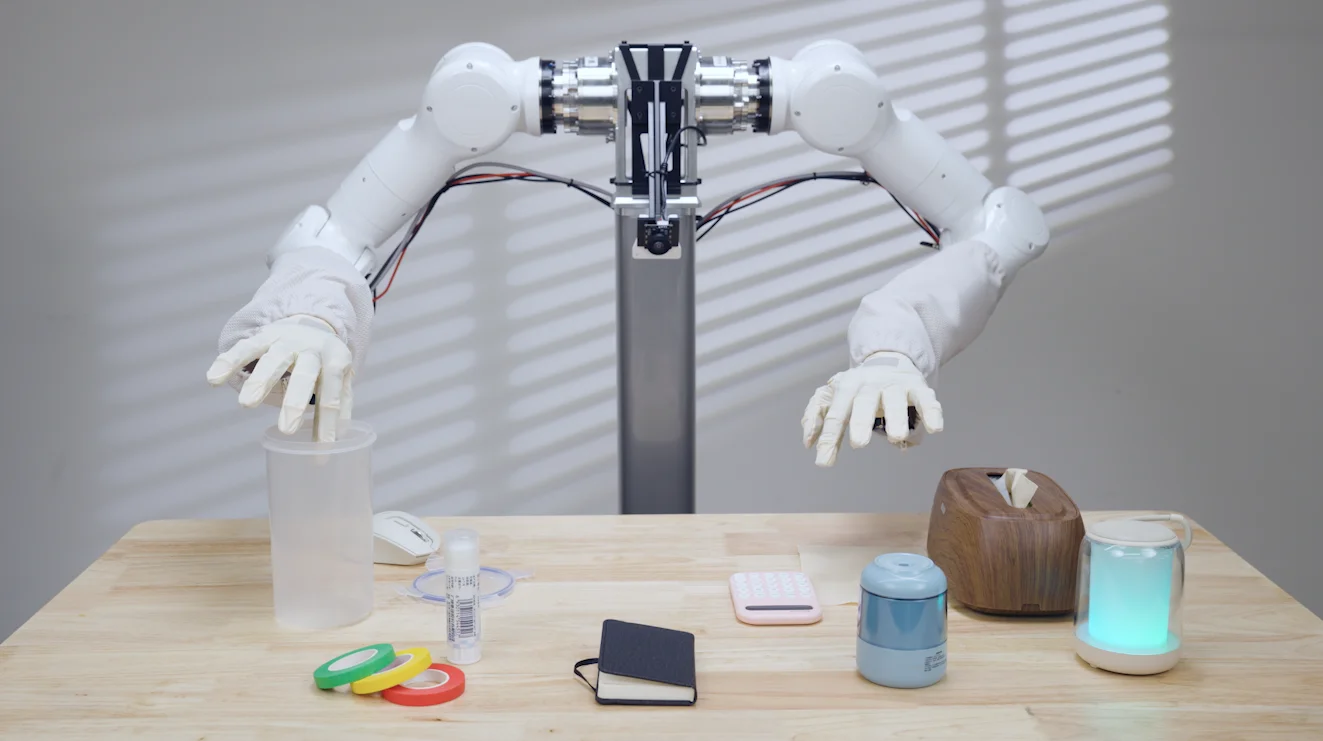 LiberAI's Liber-0 is a world action model for robot manipulation pretrained on 2.2 million hours of human experience instead of robot demonstrations.
The Beijing startup, founded in December 2025, pretrains on large-scale human video for broad exposure to people, objects and environments, while glove-recorded human demonstrations and robot demonstrations connect visual observations to the physical actions that produce them. On 60 GPT-6-proposed target tasks and 600 trials, a checkpoint not trained on robot demonstrations collected for those tasks reached 63.5 percent on pick-and-place, 34.0 percent on other manipulation and 10.5 percent on the hardest long-horizon tasks, for 36.0 percent overall. In controlled single-source tests with identical robot post-training, 10,000 hours of glove recordings outperformed 2 million hours of web video. In an eight-task evaluation, using 25 percent of the robot pool plus the full glove pool reached a progress score of 75.6 against 72.8 for the full robot pool with equal numbers of demonstrations.
Read more → https://www.humanoidsdaily.com/features/liberai-unveils-liber-0-zero-shot-robot-manipulation
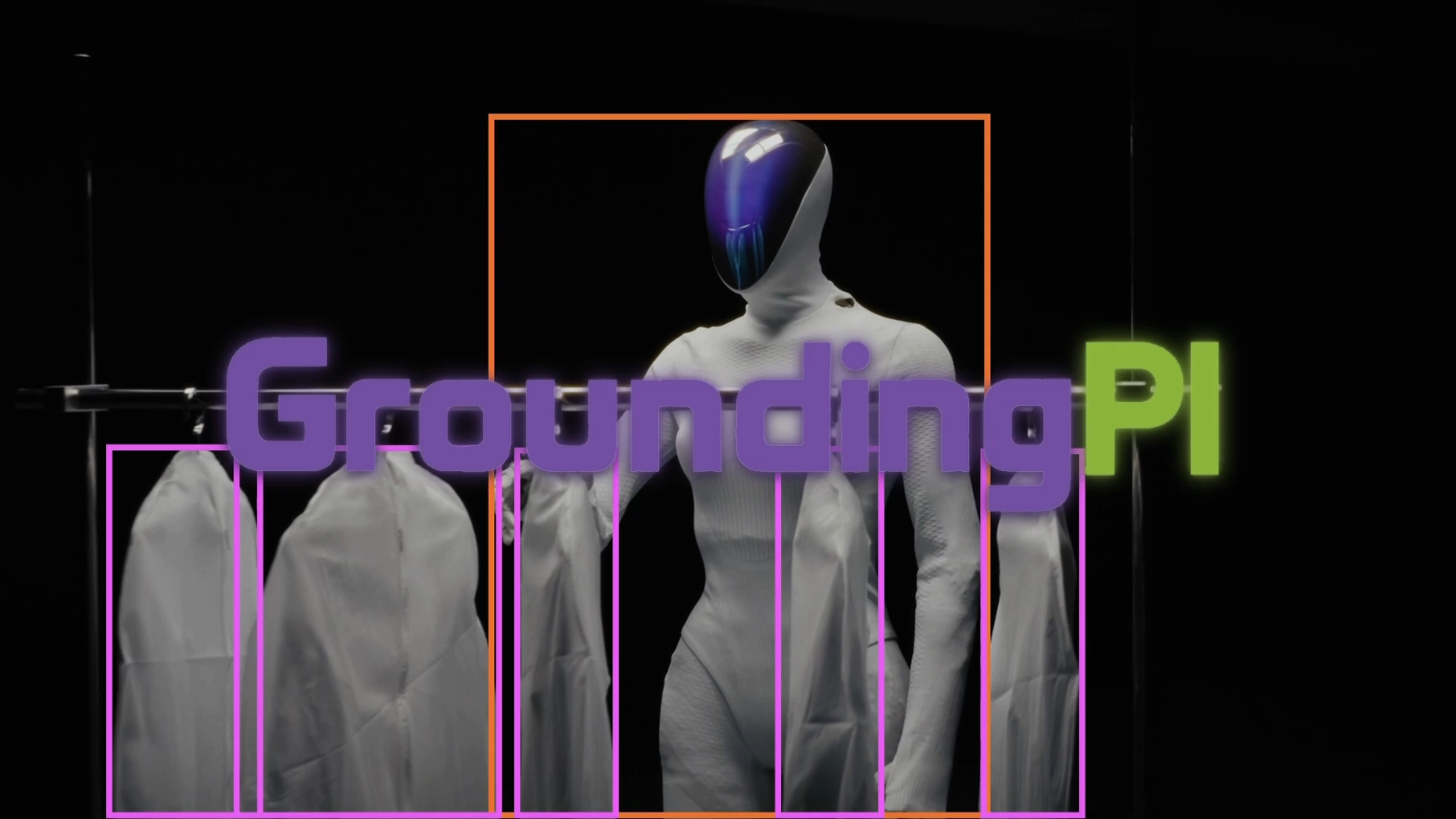 XPENG's GroundingPI is a robot perception model that tops a 34-benchmark suite and needs fewer demonstrations to steer a humanoid's hands.
The roughly four-billion-parameter model locates objects and their parts precisely, representing locations as points and bounding boxes, and XPENG developed it with Peking University, the University of Hong Kong and other institutions, with weights and code available. Across 34 benchmarks covering 11 capability categories, the researchers report an aggregate score of 73.68 against 71.54 for GPT-6 Astra under equal weighting across categories for this perception suite only. In the simulated RoboCasa-GR1 humanoid dexterous-hand test, policies using GroundingPI with 50 percent of the demonstrations outperformed comparison models using 75 percent, with additional gains in RoboTwin 2.0 two-arm manipulation and across four out-of-distribution RoboTwin tests. The paper appeared on 30 September and weights followed in early October; XPENG does not announce deployment in its IRON humanoid, and the authors flag weaknesses in small-object localisation and text recognition.
Read more → https://www.humanoidsdaily.com/news/xpeng-groundingpi-robot-vision-manipulation
 NEURA Robotics will train its 4NE1 humanoid to inspect substations and patrol power grids for E.ON, with first field experience slated for 2027.
The partnership covers inspections, asset monitoring and support for workers carrying out demanding or potentially hazardous tasks, with MITNETZ STROM as the pilot partner; no fleet size or commercial rollout targets were disclosed. Training takes place at TUM RoboGym in Munich, a 2,300-plus square-metre centre opened in October at Munich Airport's LabCampus, combining human demonstrations captured through sensor-equipped suits, motion capture and teleoperation with real robot data and simulation. Grid specialists will define the use cases and demonstrate their workflows so the robots learn the practical knowledge experienced workers use, and the partners argue that stairs, doors, control cabinets and tools are built around human access, so robots such as the 4NE1 should navigate those environments without modifying facilities.
Read more → https://www.humanoidsdaily.com/news/neura-eon-enviam-grid-robotics-2027
Small & On-Device Models
 Preferred Networks' PLaMo 3 Translate is a small model family for translation across 53 languages, with GGUF and MLX builds that run locally from 0.8B to 31B parameters.
The models are built on PLaMo 3 NICT, a pretrained model from joint research by Preferred Networks and Japan's National Institute of Information and Communications Technology, further trained on tens of billions of tokens of translation-focused data. Four sizes are offered — 0.8B, 2B, 8B and 31B — each with FP8, W4A16, W4AFP8, NVFP4, GGUF and MLX-4bit variants in separate repositories. The models handle surrounding context and a glossary, offer plain or polite style for Japanese output, and were trained with a maximum of 32,768 tokens for input and output combined. Preferred Networks says even the 2B model outperforms the translation-specialized LLMs it compared against on every metric, measured as averages of PFTB, SaaS and WMT24++ COMET-22 plus FLORES+ chrF++, and the PLaMo Community License makes personal, academic and other non-commercial use free with no registration.
Read more → https://huggingface.co/pfnet/plamo-3-translate-8b
 Muir is a small model family from 166M to 1.34B parameters whose linear attention beats a Transformer baseline on perplexity while keeping constant-memory inference, so it runs locally without a growing cache.
Linear attention compresses context into a fixed-size key-value state for linear-time training and constant-memory inference, and gated delta-rule models such as Gated DeltaNet-2 decay that state with channel-wise erase and write gates. The authors show state updates are far less sensitive to erasure than to writes, because key activation and unit normalization concentrate key energy onto a sparse subset of channels, so the erase gate can be parameterized at lower rank. Muir fuses all gates into a sensitivity-allocated low-rank projection, re-weights state rows with a matched-filter readout gate, and reinvests the saved parameters in a wider feed-forward network, while a parallel update keeps it numerically stable at large chunk sizes. Across 166M to 1.34B parameters it lowers perplexity by 1.8 to 2.0 percent over Gated DeltaNet-2 and 2.5 to 3.6 percent over a Transformer, raises commonsense accuracy by up to 1.9 points, and improves extractive recall.
Read more → https://arxiv.org/abs/2611.08376
Papers & Research
 A new paper called VFlash replaces one-coordinate-at-a-time decoding with a drafter that emits a whole visual primitive in one pass, making 3D motion forecasts roughly 25 times faster.
Autoregressive vision-language models emit one coordinate token at a time, so richer visual predictions for robotics and autonomous driving get steadily more expensive. VFlash exploits the known structure of visual primitives to predict their coordinates jointly with a lightweight drafter whose layout adapts to the primitive's type, dimensionality and length, training on annotated primitives and accepting structurally valid predictions without requiring target-token agreement. Preliminary single-rollout measurements indicate about 25 times faster generation for 3D point motion forecasting, and a world action model conditioned on VFlash plans reaches 70.2 percent average success across four MolmoSpaces task suites against 62.6 percent for the baseline.
Read more → https://arxiv.org/abs/2611.08449
 A new paper trains a sparse autoencoder on a mixture-of-experts layer and finds each expert owns a narrow, human-readable specialty, down to separate specialists for Java and front-end code.
Existing analyses of expert specialization count how often an expert is selected on domain-labeled corpora, which fixes the taxonomy in advance, stays coarse and records selection rather than contribution. Because an MoE layer's output is a router-weighted sum of expert outputs and the SAE encoder is affine, the pre-activation of every latent decomposes exactly over the experts, giving each expert a dominant set of latents it principally drives. On layers 4, 30 and 46 of Qwen3-30B-A3B, contribution is far more concentrated than gating, most latents have only one or two dominators, and dominant sets overlap on just a few expert pairs. Auto-interpreting them reveals division of labour below coarse domains, with distinct experts for Java and front-end web code, or for geometry and for arithmetic and polynomials, while coarse domains themselves take very unequal numbers of experts; the SAEs and code are released.
Read more → https://arxiv.org/abs/2611.08089
News & Business
 Perplexity now sells always-on AI agents that keep working a project inside their own virtual machine, with a desktop, a browser and a Slack thread.
The existing Perplexity Computer executes one-off assignments, while the new Teammates stay active and work through ongoing projects independently, each running on its own virtual machine with a desktop and browser. Users track progress through dedicated threads in the Perplexity app and can interact with the agents via Slack. Teammates require the Max plan at 200 dollars per month, while rival agent products start at 20 and 100 dollars; SpaceX recently imposed stricter usage caps on Grok Bots after heavy demand. Perplexity's annualized revenue topped 750 million dollars as of August.
Read more → https://the-decoder.com/perplexity-now-has-its-own-always-on-ai-agent/
After Intelligence runs every morning, with the send scheduled for 06:00 Vienna time. If this edition was forwarded to you, the archive and the subscribe form are at newsletter.premarcu.com.