In this edition
- Frontier & Text Models (5)
- Video & World Models (2)
- Audio, Voice & Music (2)
- Robots & Embodied AI (4)
- Papers & Research (4)
- News & Business (1)
The capital markets blinked this week, and the models kept getting cheaper to run. Anthropic is heading into a pre-Thanksgiving IPO at a valuation below what its most optimistic backers wanted, OpenAI settled for the first $11 billion of a smaller round than it sought, and the Nasdaq 100's 6.4 percent drop on Thursday made both moves legible. The engineering news ran the other way: an open-weight DeepSeek agent came within eight points of OpenAI's restricted cyber model at a tenth of the price, a two-voice text-to-speech system fit into 40 megabytes, a 13.7B video generator shipped six-step sampling, and a family of decision models answers in 183 milliseconds without decoding a single token. Eighteen items below, across frontier models, audio, video, robotics and research.
Frontier & Text Models
 Anthropic is going public before Thanksgiving, at a valuation it had to cut
Anthropic aims to list before Thanksgiving, targeting $80–100 billion raised at a $1.25–1.75 trillion valuation per Financial Times sources. That sits above its current $965 billion valuation but below the $2 trillion the most optimistic investors expected. Annualized reported revenue is about $81 billion, up from roughly $65 billion at the end of July. The Nasdaq 100 fell 6.4 percent Thursday in a tech selloff before partially recovering Friday.
 OpenAI banked $11 billion of a funding round smaller than the one it wanted
OpenAI received roughly $11 billion on Friday as the first tranche of a round valuing it at $1.25 trillion, Bloomberg reported. The full round could reach $20 billion, with the remainder expected in coming weeks. OpenAI originally sought $30 billion at a $1.4 trillion valuation but scaled back after the AI-sector selloff. Investors include Coatue Management, T. Rowe Price, SoftBank, Sequoia Capital, Founders Fund, Andreessen Horowitz and a UAE consortium, with investment banks now courting wealthy individuals.
Read more → https://the-decoder.com/openai-lands-an-11-billion-funding-round-but-has-to-court-dentists-for-more-capital/
 An open-weight DeepSeek model comes within eight points of OpenAI's restricted GPT-6 cyber agent
In the Vals CyberOffense test, each agent works alone on an isolated Kali Linux machine, starting from a public web address with no human help, moving from web application through Windows servers to admin privileges. GPT-6 Sol, part of OpenAI's restricted Daybreak program, led with 80.8 percent of objectives, while open-weight DeepSeek V4.1 Flash 1017 reached 72.8 percent at about $3 per run versus roughly $22. In the harder Lighthouse test, Daybreak completed 27 of 31 objectives in under three hours; DeepSeek managed 21 at a tenth of the cost. Most models make no meaningful progress until passing 100 million tokens, and DeepSeek scored zero in its first 25 million.
Read more → https://the-decoder.com/the-gap-between-open-and-closed-ai-models-in-cyber-capabilities-keeps-shrinking/
Thinking Machines' Inkling 2 Small language model swears at itself while it reasons Vals AI researchers read thinking logs from 2,655 runs of Thinking Machines' Inkling 2 Small and found "fuck" or variants in 50 runs, 316 instances total. Two runs accounted for 241; one asteroid-trajectory calculation produced a single 500,000-character response carrying 158 expletives. ProgramBench was hit hardest, with 20 of 200 runs affected. The swearing does not function as a warning signal: 46 of 48 scored runs containing it failed, but about 75 percent of all scored runs fail anyway and 96 percent of failed runs contained no expletives.
Read more → https://the-decoder.com/thinking-machines-inkling-2-small-drops-316-f-bombs-across-benchmark-runs/
 Nous Research fine-tuned Alibaba's Qwen model on 53 million tokens to strip out state propaganda, releasing it as Arete-27B
Nous Research post-trained Alibaba's Qwen3.8-27B into Arete-27B via supervised fine-tuning on 53 million tokens, with Inkling as teacher and the evaluated checkpoint at step 1,202. Propaganda rate fell from 22 percent to under 1 percent, and fact score rose from 2.32 to 2.98 out of 5, holding across all seven value categories without meaningful regression on general-capability and agentic benchmarks. Evaluation uses 803 prompts across free speech, state ideology, education, privacy and surveillance, democracy, and the environment, each with two to four facts from a dated source. The model is released under Apache-2.0.
Video & World Models
 Video Rebirth's HyperFlow H3 Flash turns MiniMax's 31B video model into a 13.7B six-step video generation stack
HyperFlow H3 Flash is Video Rebirth's compressed, few-step version of MiniMax-H3, generating video and synchronized stereo audio together. It has 13.7B parameters in the fl2va variant and 13.9B in ref2va, less than half of the roughly 31B MiniMax-H3 transformer. Output is 5.2 to 15 seconds at 24 fps, 1344x768 by default, with a 32 kHz stereo soundtrack, sampling in 4, 6 or 8 steps without classifier-free guidance. A 5.2-second clip at 6 steps takes 8.7 seconds on four B200 GPUs, 36 seconds on one H200 and 92 seconds on an RTX 5090; the Q4_K_M build is 9.1 GB. The community license does not cover the EU, UK, South Korea or the US without MiniMax authorization.
Read more → https://huggingface.co/VideoRebirthAI/hyperflow-h3-flash
 Viggle Remake is a video model that re-renders a whole film from one sentence, recasting faces and changing the weather
Remake goes past character replacement: given a prompt it recasts people, swaps outfits, adds or removes objects, and changes the setting, weather, light or style, keeping the original motion, camera, timing and soundtrack. It is built agent-first — hand an MCP-speaking agent a video and one sentence, and it finds the cuts, paints the keyframes, renders every window and checks its own work. The showcase remakes one shot from La La Land 22 ways and recuts a 116-second music video across 69 cuts, and the model is described as the Viggle-Animate v2 preview. Hand-driven users paint one to four frames and render from there; the hosted app needs no GPU, while local runs do.
Read more → https://huggingface.co/Viggle/Viggle-Remake
Audio, Voice & Music
 A 0.5B text-to-speech model clones a voice from a short clip and speaks seven languages at 44.1 kHz
InclusionAI's Ming-3.0-tts-0.5B is a dense checkpoint built on a Qwen2.5-0.5B backbone, shipping the backbone, a DiT head, the audio tokenizer, a speaker encoder and the text tokenizer. It covers Chinese, English, German, Spanish, French, Korean and Japanese, adds Sichuanese and Cantonese dialects, and outputs 44.1 kHz audio. It does zero-shot voice cloning from a short reference clip, voice design from a natural-language speaker description, and free-form control of delivery and style. Fourteen inline tags cover breath, cough, sigh, laughter, hesitation, surprise and question sounds; inference needs the project's GitHub repository rather than the weights repo alone.
Read more → https://huggingface.co/inclusionAI/Ming-3.0-tts-0.5B
 A 40-megabyte text-to-speech voice model beats systems a thousand times its size
Conway Research's Underdog Woof holds two voices in a single 40.6 MB file and peaks at 402 MB of memory while running on numpy alone on a laptop CPU. It scores a 1.42 percent word error rate on the Gradium TTS Hard Cases set in English with the Mira voice. It is 1,022 times smaller than Fish Audio Drama 3 at 41.5 GB while making 25 percent fewer word errors, and runs 13.8 times faster than real time on a single CPU thread with the Juno voice. Both voices read phone numbers, dates, prices and codes the way people say them.
Read more → https://huggingface.co/ConwayResearch/Underdog-Woof
Robots & Embodied AI
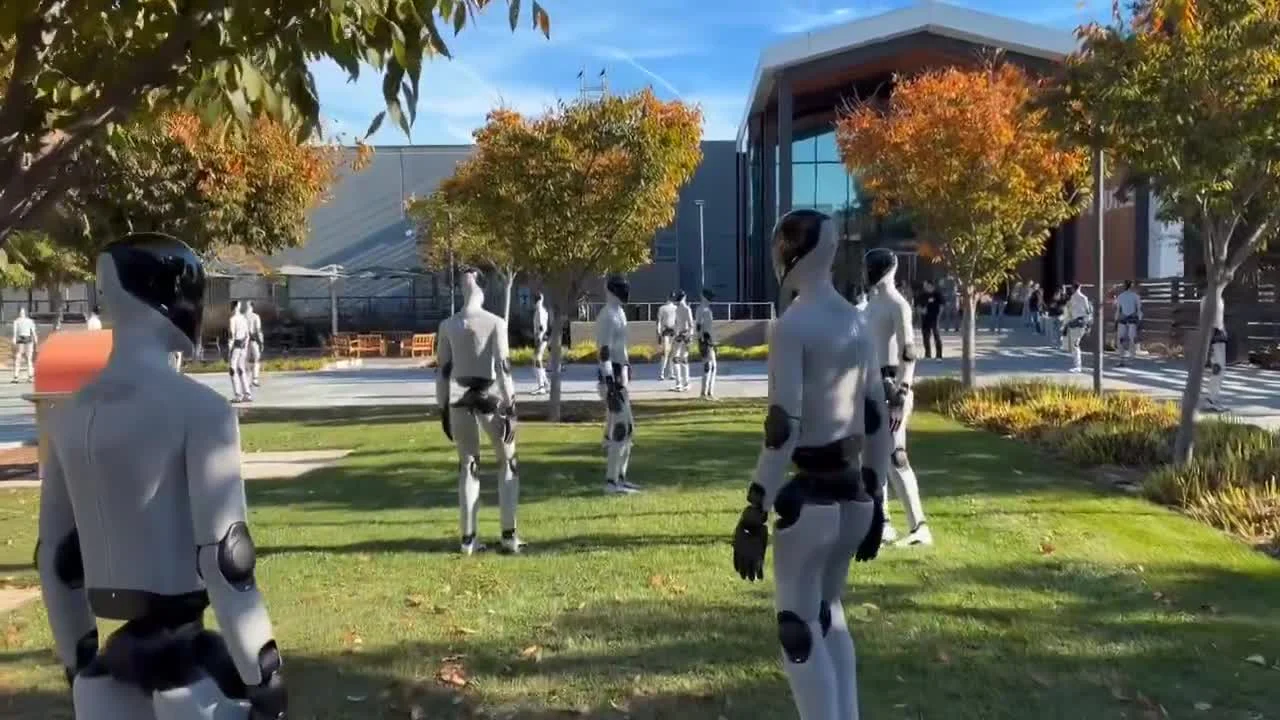 Dozens of Figure 03 humanoid robots now wander Figure's headquarters
Two videos of about 90 seconds each, posted by founder and CEO Brett Adcock on November 6 and 7, show dozens of Figure 03 robots on the lawn, on the paths and in the lobby of Figure's headquarters. In spring he said the goal was more robots than humans walking the halls of the roughly 500-person company, and the new clips suggest Figure is getting close. Figure built its 1,000th Figure 03 in July but has disclosed only a handful of customer deployments, including BMW and Catalyst Brands. Almost none of the robots in the videos is doing a task, and Figure has not said how many of its robots do paid work; the November 6 clip passed 320,000 views by Saturday.
Read more → https://www.humanoidsdaily.com/news/figure-hq-crawling-with-figure-03-robots-adcock-videos
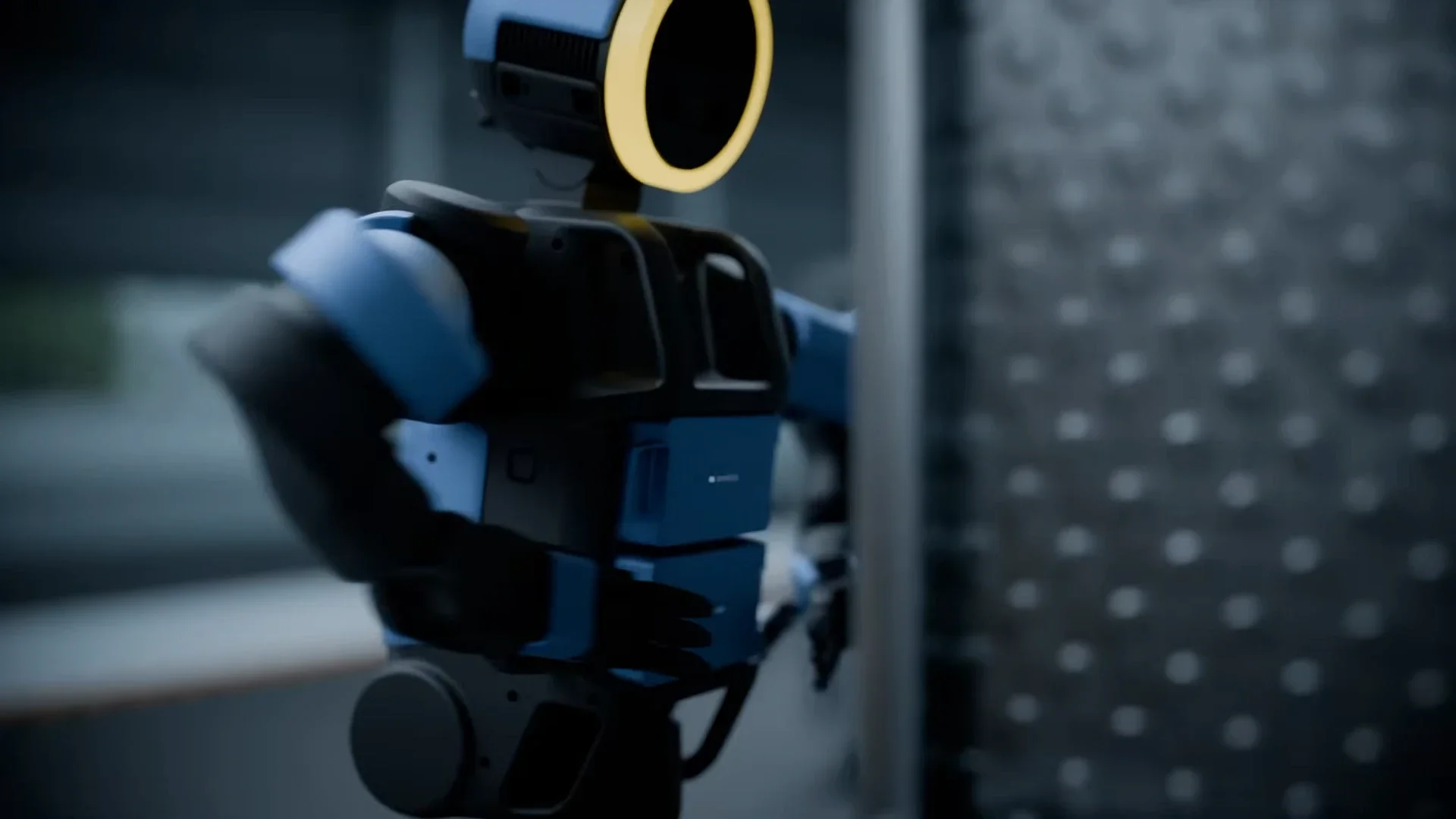 Boston Dynamics' Atlas humanoid runs on 70 Samsung SDI cells in a 1.3 kWh pack, a rare look at robot power
The Elec reports that Boston Dynamics' Atlas uses 70 Samsung SDI 2170 cells, giving a battery pack of approximately 1.3 kWh. The cells have 5,000 mAh each in the 2170 format, 21 mm in diameter and 70 mm long. Samsung SDI is reportedly handling most initial supply, although LG Energy Solution has also been selected, with The Elec attributing Samsung's position to the relatively small volumes involved. Pack capacity alone says little about runtime, which also depends on task, payload, motion and onboard computing.
Read more → https://www.humanoidsdaily.com/news/samsung-sdi-atlas-battery-70-cells-1-3-kwh
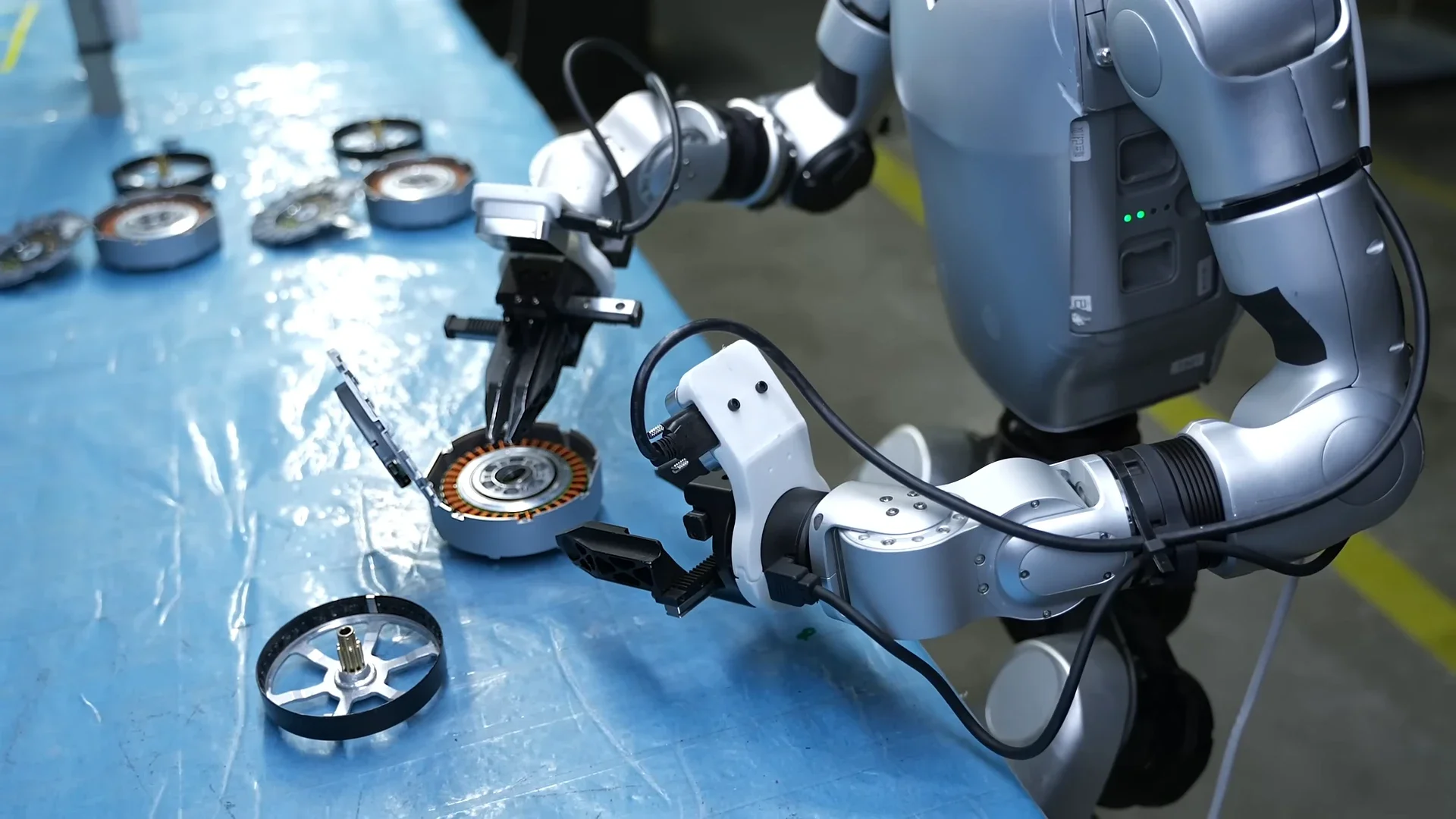 Most Unitree robots are still assembled by hand, and its actuator lines are barely automated
Josef Chen, founder of Kaikaku, toured Unitree's Hangzhou factory and published his notes on November 5: in the actuator building he saw one or two new automated lines, while the rest of the floor was people running winding machines, and visitors were not allowed to take photos inside. Unitree's filings put all of its machinery at about $1.7 million at the end of 2025, roughly $50 for each of the almost 32,000 robots it made that year, about 26,000 of them quadrupeds. Direct labour was 8.1 percent of Unitree's 2025 cost of goods, which Chen estimates would be about 40 percent at US wages. Unitree's prospectus describes the humanoid assembly work as a pilot and says assembly is currently mainly manual.
Read more → https://www.humanoidsdaily.com/news/unitree-hangzhou-factory-manual-assembly-josef-chen
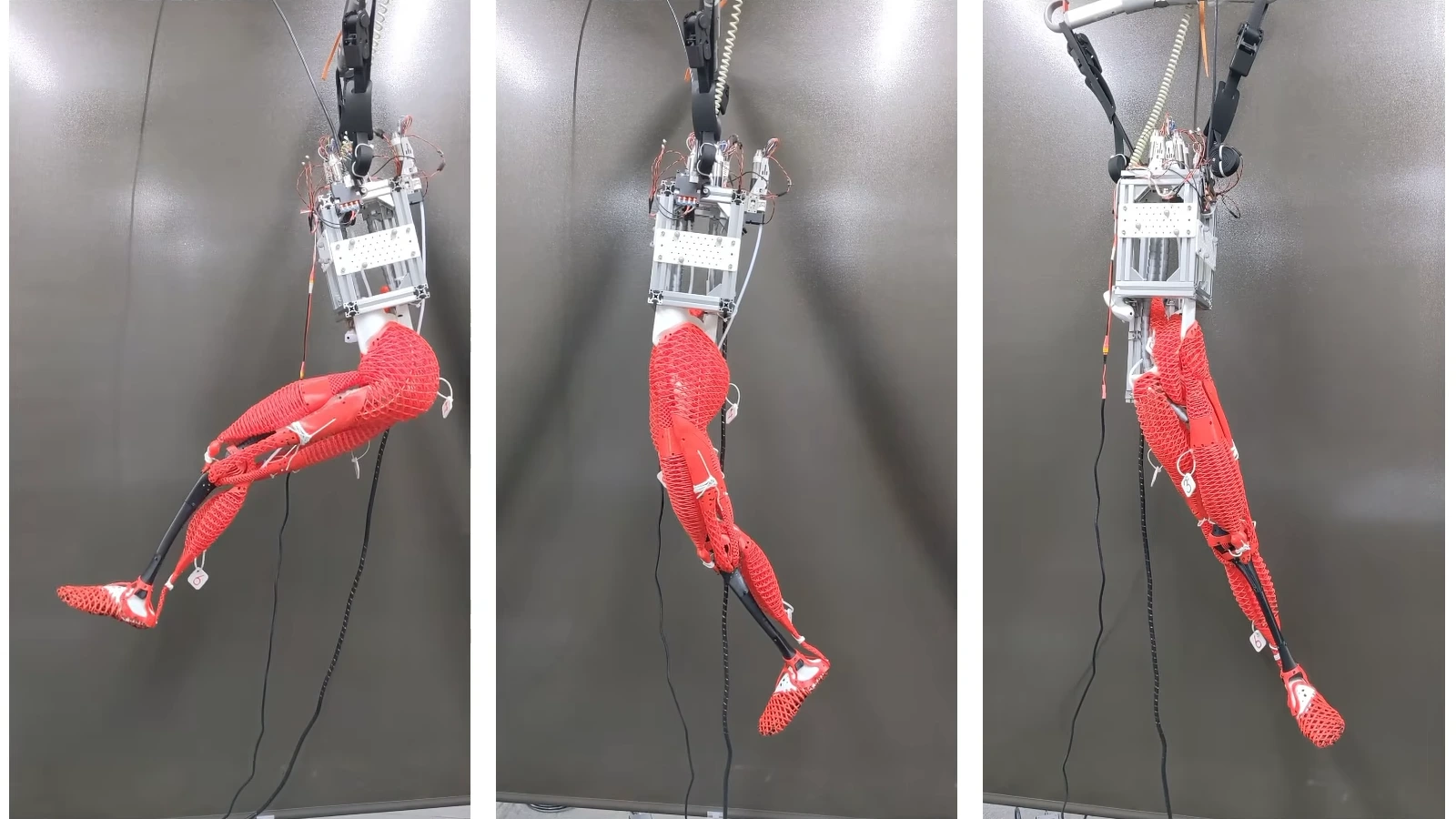 University of Tokyo researchers built robot legs whose muscles, tendons and ligaments are 3D-printed from one plastic, a bet on passive locomotion
Shunnosuke Yoshimura, Kento Kawaharazuka and Kei Okada describe the work in Advanced Intelligent Systems, published on September 11. A single TPU material provides muscle-like elasticity, stiffer tendons, ligament constraints and sole cushioning through different printed patterns. Varying lattice density and strut thickness tunes flexibility, so one print can move from a softer muscle-like region to a stiffer tendon-like region, and patterned ligaments constrain the hip, knee and ankle without bearings. Electric motors and pulleys on the pelvic frame pull wires through Bowden cables, and the TPU lattice deforms but does not contract on its own; the prototype steps with external support, and independent walking remains future work.
Read more → https://www.humanoidsdaily.com/news/tokyo-3d-printed-musculoskeletal-robot-legs
Papers & Research
 A new paper introduces Drex, four open decision models that skip autoregressive decoding and answer in 183 milliseconds
Drex comes in 8B (DLM), 9B (v1.5), 35B with 3B active (v2.0) and 27B (Max) sizes, and returns a probability distribution over the options a caller supplies instead of decoding text. Each request pairs a state — a document, record or agent context, optionally with images — with questions asking for a choice, a yes/no judgment or a score on an ordered scale. On Decision Index 0.4.1, Max reaches 67.52 against 60.70 for Jev 1.14.0; on Decision Bench v4 it is statistically tied with d3-turbo and GPT-6 Sol and trails Claude Opus 5.5 by 1.6 points. Max answers a typical request in 183 ms, against about 2.0 seconds for GPT-6 Sol.
Read more → https://arxiv.org/abs/2611.07854
 A new paper gives a vision-language-action policy spatial reasoning by aligning its visual embeddings with a frozen 3D perception model
SLA starts from a pretrained pi05 policy and jointly optimizes action prediction with alignment between intermediate visual embeddings and spatial representations from a frozen 3D perception model. The authors curate and unify heterogeneous robot datasets across embodiments, tasks and scenes, and add feature-dependent gates that aggregate visual embeddings from several VLA layers for spatial supervision. The teacher exploits partial depth and camera calibration alongside RGB, and probabilistic state dropout pushes the policy toward visual cues instead of memorizing demonstration trajectories. Every auxiliary component is used only during training, which lets the resulting weights be reused directly from a pretrained VLA inference stack.
Read more → https://arxiv.org/abs/2611.08373
 A new benchmark gave nine AI agents open research questions from US national labs, and none of their 135 paper submissions passed
Into the Unknown was built by a team led by Carnegie Mellon University researchers working with scientists from US Department of Energy national labs, with 15 tasks from ten researchers across quantum computing, plasma physics, chemistry, and other fields. Each agent receives a scientific paper with its code and data plus a research direction, then must run a follow-up study and write it up. None of the 135 submissions from nine current AI agents met all requirements. 114 submissions already fail the integrity check, mostly for claiming work that was never done or citing numbers that contradict their own logs.
 An Anthropic researcher replicated a METR evaluation and found AI auditors catch almost all reward hacking, at a cost in false alarms
Andy Hall, a researcher at the Anthropic Institute on leave from Stanford, replicated and extended a METR study on his Substack Free Systems, noting the views are personal only. METR's MALT dataset contains logs of frontier models on HCAST and RE-Bench tasks, with human reviewers checking a portion for misbehavior in October 2025. Hall tested GPT-5, GPT-5 nano, GPT-6 Astra, Opus 4.8, and Gemini 3.8 Flash at a 5 percent false-alarm rate; GPT-5 caught nearly 98 percent of reward hacking cases while Gemini 3.8 Flash found barely half. All auditors caught between 71 and 81 percent of sandbagging cases, though those are mostly synthetic.
News & Business
 Google's AI spots high blood pressure from a smartwatch's pulse and motion sensors alone, no cuff required
A Google Research AI detects signs of high blood pressure using only the pulse and motion sensors in a standard smartwatch, with no cuff needed for calibration; the study was published in Nature. A neural network learned from nearly 500,000 hours of sensor data by comparing short segments and working out which belonged to the same person, without any diagnoses to guide it. In a study of 196 people across five US research sites, the watch identified 65.8 percent of those with high blood pressure, against 55.3 percent for the standard in-office measurement. Google says the findings are folded into the blood pressure trends feature in the Google Health app, but the method remains a research project and does not replace a diagnosis.
Read more → https://the-decoder.com/googles-ai-detects-high-blood-pressure-from-a-regular-smartwatch-without-a-cuff/
After Intelligence runs every morning. Every figure above was checked against the page it links to — if one looks wrong, reply and we will re-read the source.