In this edition
- Frontier & Text Models (2)
- Image & Vision (1)
- Video & World Models (1)
- 3D & Reconstruction (1)
- Audio, Voice & Music (1)
- Robots & Embodied AI (4)
- Small & On-Device Models (3)
- Papers & Research (2)
- News & Business (2)
Anthropic's Claude Fable 5.2 takes first place on the Artificial Analysis index at 65 points and formalises the proof of Fermat's Last Theorem with a thousand parallel agents, Meta ships a frontier-class model for about 14 cents a task, and ByteDance holds an image still across 100 rounds of edits. Seventeen items today: a new frontier pair and a public listing, three small models that trade size for price or for exactness, a voice model that runs in a browser tab, four robots and the training method behind them, a video agent that writes its scene before rendering it, two papers that measure what generation still cannot do, and the chip and market shocks underneath all of it.
Frontier & Text Models

Anthropic's Claude Fable 5.2 takes first place on the Artificial Analysis intelligence index at 65 points, and the sibling Mythos 5.2 release found 10.2 percent more vulnerabilities than Opus 5.5 across 1,829 CVEs. Fable 5.2 and Mythos 5.2 share one model foundation but differ in access: Fable blocks risky cybersecurity and biology tasks and is open to all users, while Mythos lifts some restrictions for organisations in Anthropic's Verification Programs for Cybersecurity or Life Sciences. Pricing drops to $8 per million input tokens and $40 per million output tokens, with output up to 30 percent faster than the 5.1 versions and an optional fast mode reaching 2.5 times the token rate at twice the price. On Artificial Analysis Index v5 at the highest compute tier it scores 65, five ahead of Gemini 4 Carbon and 15 ahead of Fable 5.1, with best-in-class results on HLE-Diamond at 80 percent, Terminal-Bench-Science at 73 percent and FrontierCode 2.0 at 49 percent. Mythos 5.2 found 10.2 percent more vulnerabilities than Opus 5.5 and 14.4 percent more than Mythos 5.1 across 1,829 CVEs in October 2026, and about 1,000 Fable 5.2 agents fully formalised the proof of Fermat's Last Theorem in Lean in 30 hours, the first machine verification of it.
Read more → https://the-decoder.com/claude-fable-5-2-and-mythos-5-2-cement-anthropics-ai-lead-just-before-its-ipo/
Anthropic is pressing ahead with its initial public offering despite renewed volatility in AI stocks, targeting a Nasdaq listing under the symbol ANT as early as the week of November 16. The Claude developer has scheduled meetings with institutional investors, and investors are reassessing a potential $1.5 trillion valuation as AI-related stocks swing. The listing would be an important financial test for the frontier AI industry, given Anthropic's extraordinary commercial growth alongside substantial computing commitments and operating costs. Public-market investors will have to judge whether future revenue can support long-term infrastructure obligations including leases.
Image & Vision
ByteDance's Seedream 5.5 delivers stable image editing across 100 rounds, holding an image steady down to the pixel. The model is built for professional production workflows, with stable multi-round editing across up to 100 rounds, untouched areas preserved at the pixel level and no colour shifts. It generates native RGBA images with transparent backgrounds so generated elements work directly as design assets without manual cut-outs, and it renders light, materials and skin textures more realistically while reproducing dense small text more accurately. ByteDance claims it leads GPT Image 2.5 Sunburst in text structure and realism, and it is rolling out gradually through Jimeng, Doubao, Doubao Work and Volcengine Ark, with a Pro version planned.
Video & World Models

Video-Coder is the first video generation agent trained to write and run code that builds a 3D scene before a video model renders it. Precise spatial structure, coherent motion and controllable composition remain hard for video generators, so the authors train an agent that autonomously writes and executes code to construct a dynamic 3D scene as a "Draft Video" supplying structure and motion signals to a downstream generator. They curate two datasets, Video-Coder-SFT-6k and Video-Coder-RL-2k, and build the Video-Coder Harness, an interactive environment integrating code execution, 3D scene rendering and execution feedback. Training runs supervised fine-tuning first, then harness-native agentic reinforcement learning with dual rewards from execution and from the rendered video, plus an annealing schedule that gradually reduces the execution reward so the model leans on the video reward later. It improves MiniMax-H3 by roughly 7 points on PhyGenBench and 24 points on VBench-2.0, and the authors open-source the data, models and code.
Read more → https://arxiv.org/abs/2611.09894
3D & Reconstruction

SplatAnything fixes a scale mismatch in feed-forward Gaussian splatting, the 3D reconstruction method behind most instant scene capture, and lands at number one on this week's trending research list. Existing feed-forward methods predict Gaussian attributes in a radial-distance-normalised space that canonicalises a global radial statistic of the reconstructed geometry, while the spacing between neighbouring Gaussian centres still varies substantially across scene scales and camera configurations, shifting Gaussian-scale targets and producing ambiguous supervision. SplatAnything introduces Gaussian Spacing Normalization, which canonicalises a robust scene-level statistic of Gaussian spacing to give a more consistent spatial reference. The authors also build a systematic testbed spanning diverse datasets, input sparsity levels and challenging extrapolated viewpoints. It sets the best reported results, with the largest gains under substantial variation in scene scale and viewpoint.
Read more → https://arxiv.org/abs/2611.08264
Audio, Voice & Music

Zyphra's ZONOS3-Mini does voice cloning from a short sample and speaks in real time from a browser tab, with 100 million active parameters. It is a sparse mixture-of-experts text-to-speech model with 100 million active and 800 million total parameters under Apache 2.0, trained on 112 NVIDIA H100s in 2.5 days, reaching under 570 milliseconds to first audio in the browser on a Pixel 9 and under 150 milliseconds on an M3 MacBook Air. Runtimes exist for WebGPU in the browser, SGLang and vLLM on servers, and GGML, with 27 default voices grouped by language and text normalisation for English, Mandarin, Japanese, Korean, German, Spanish, French, Italian and Portuguese. The language model generates 15 Hz dual-codec frames from ten codebooks of 4,096 entries, one semantic and nine acoustic, rendered by a causal multi-resolution iSTFT head, and identity, accent, quality, mood and delivery can be steered with word-level delivery control during streaming via an alignment attention head plus an edit model.
Read more → https://huggingface.co/Zyphra/ZONOS3-Mini
Robots & Embodied AI
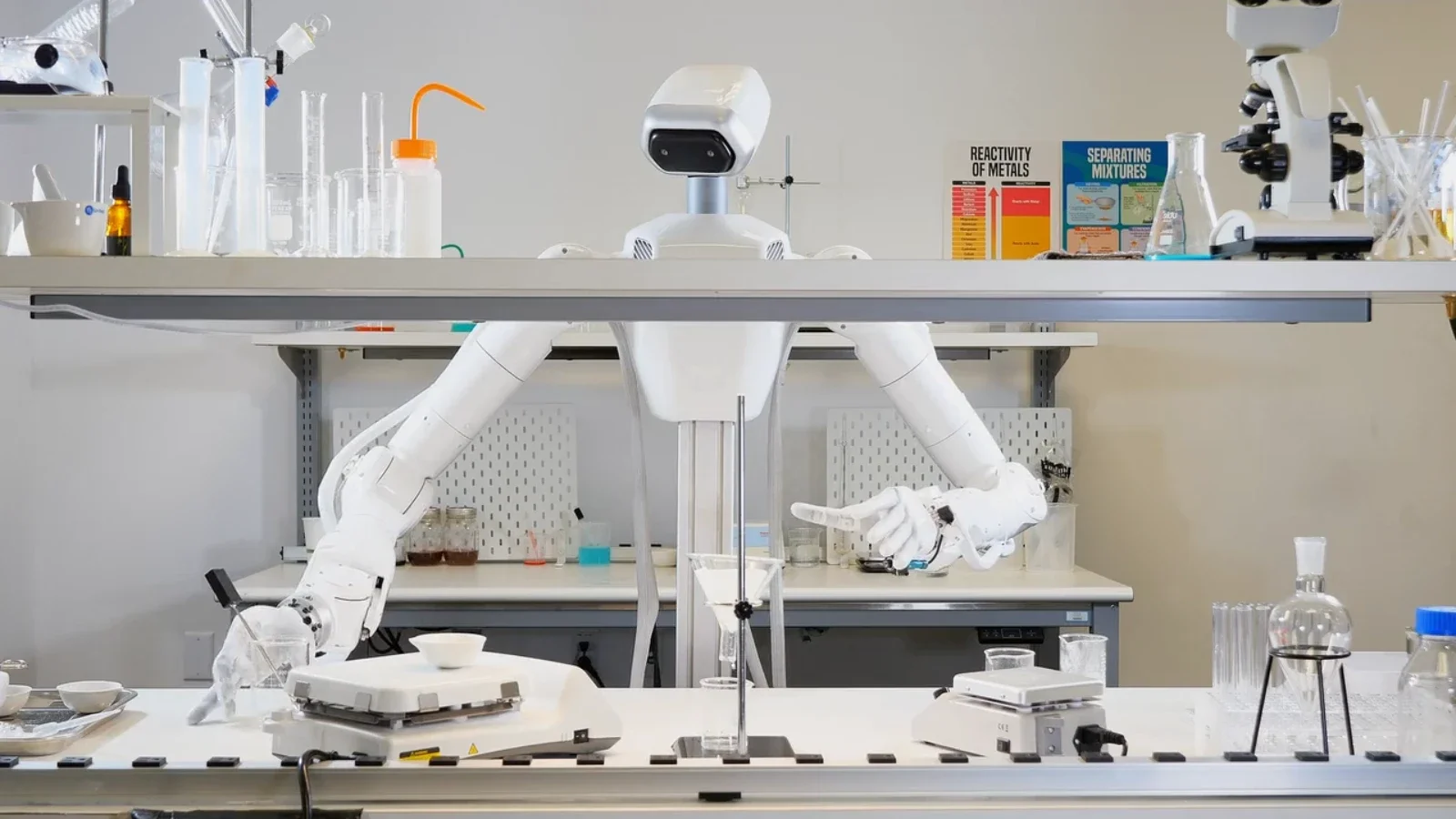
NVIDIA's GR00T 2 is a robot foundation model that imagines the next few frames of video and its own next actions together, then executes what it imagined. Introduced at the Conference on Robot Learning in Austin, Texas, the 2-billion-parameter model is built on NVIDIA Cosmos and generates future video frames and robot actions in a single diffusion pass. NVIDIA reports 71 percent average success across 50 tasks from one demonstration per task and 95 percent with five demonstrations, after a 30-minute fine-tune on a single RTX 5090. Weights for GR00T 2 and a lighter GR00T 2 Turbo variant arrive as open source in December with the training recipe for cross-embodiment transfer, alongside 100,000 hours of human egocentric video, the SimFoundry real-to-sim pipeline and hardware designs for data-collection devices. Foxconn, Siemens, Nexuni and MicroAGI are testing it in factory, laundry and cable-handling work, and Jim Fan frames it as a fast "System 1" skill model that a larger reasoning model can direct.
Read more → https://www.humanoidsdaily.com/news/nvidia-gr00t-2-world-action-model-corl-2026
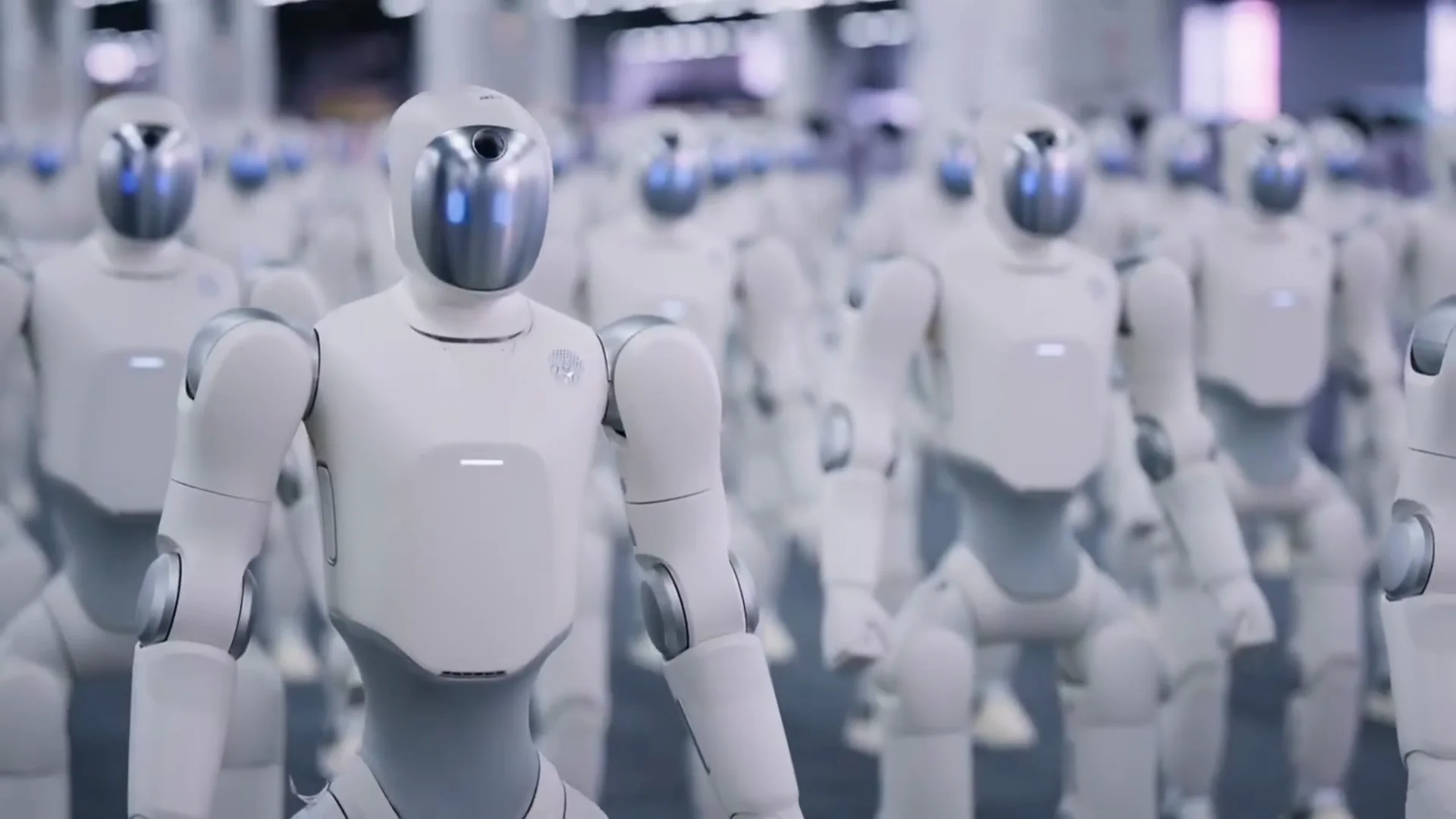
PrimeBOT built its 10,000th personal robot 14 days after its 5,000th. PrimeBOT is the personal-robot brand of Shanghai-listed Swancor Advanced Materials; unit 10,000, a Q1, came off the line on November 8 and was handed to a user at the event, while the 5,000th was completed on October 25. Daily capacity is now 240 units, up from just over 200 when the 5,000th rolled off. Sales of the Q1 and T1 opened September 20 at 19,999 yuan for both base models, with first handovers from October 1 in seven Chinese cities including Shanghai, Shenzhen and Hangzhou. The figure counts robots built, not sold; the company has not published sales, delivery or return numbers, and its claims of more than 98 percent monthly active users, three hours of average daily use and more than 100 interactions per user per day are unaudited.
Read more → https://www.humanoidsdaily.com/news/primebot-10000th-personal-robot-production
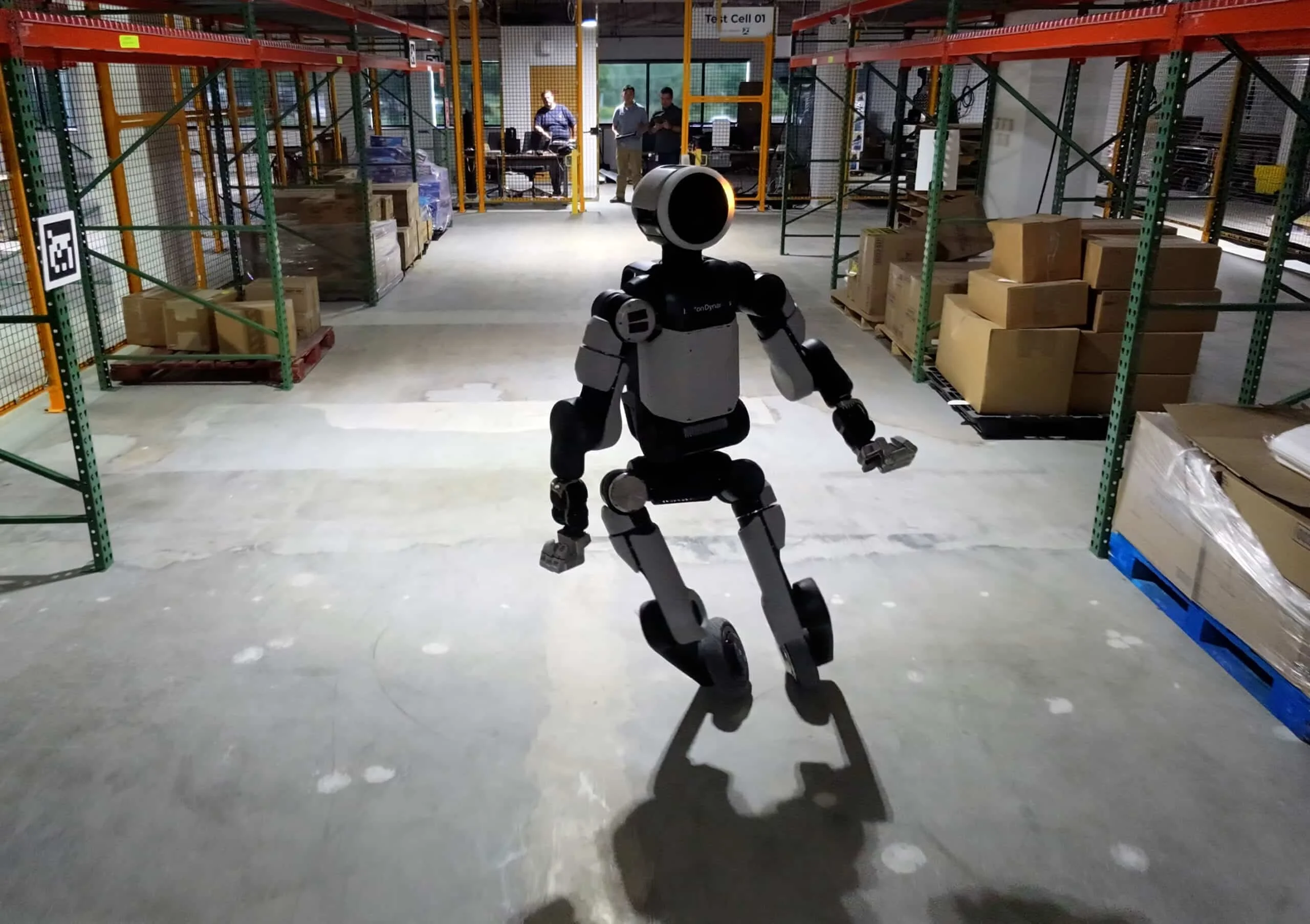
Boston Dynamics bolted a scooter rim to each of Atlas's ankles and taught the humanoid to roll, drift and jump on wheels. The hardware change is small—an off-the-shelf scooter rim on each ankle actuator with one custom adapter, driven directly by the ankle motor—and in software each wheel is modelled as an ankle that can spin continuously. A learned whole-body controller trained with reinforcement learning in simulation made the switch with a few changes to its rewards, command ranges and posture, so smooth rolling emerged without being scripted. The point was to run Atlas's motors near their torque and speed limits for long stretches while carrying the robot's weight, and Boston Dynamics says the lessons are already going back into the standard Atlas; controls engineer Xiaoyu "Andy" Wu, who published the experiment in a blog post and video, writes that a wheeled Atlas is not a product but a research testbed.
Read more → https://www.humanoidsdaily.com/news/boston-dynamics-atlas-wheels-rl-actuator-test

A2-MEAS pairs an embodied multi-agent framework with a vision-language-action model and beats the 2025 BEHAVIOR winner by 2.21 times. The framework is built around code as a scaling interface: learned correction codes combine corrective language, spatial evidence, execution history and action proposals, while a component called MetaBrain supplies training supervision and runtime guidance. A correction encoder and adapter absorb that knowledge into policy weights during training, and fresh codes adapt behaviour with frozen weights at deployment. The action model A2-WLA adds motion-aware history and a latent world representation to a vision-language-action policy, reaching a 0.5755 Q-score on the 50-task BEHAVIOR 2026 public subset before online correction, 2.21 times the 2025 winner's reported 0.2605 across different evaluation editions and training configurations. On all 100 public tasks it achieves 0.6411 Q-score and 45.40 percent task success, on RoboTwin 2.0 it averages 93.98 percent success rising to 95.05 percent with the complete system, and across 12 real-robot tasks in five household settings it averages 57.92 percent against 26.67 percent for pi0.5.
Read more → https://arxiv.org/abs/2611.09124
Small & On-Device Models
Meta's Muse Ember is a small model built for the repetitive work agents do all day, at about 14 cents a task. It is Meta's smallest and most efficient model to date, aimed at tool calling, small coding tasks, request routing, data extraction and long documents, and Meta says it delivers more intelligence per dollar at every reasoning level than Claude Haiku 5.5 or GPT-6 Luna. In the Artificial Analysis test it costs about $0.14 per task for a score of 36, while the larger Muse Spark 1.3 costs $2.39 for a nearly identical 37, though Haiku still wins on real coding in FrontierCode 2.0-AA at 34.9 percent against Muse Ember's 27.2 percent. It takes text, images, audio and video and processes up to one million tokens, and is available through the Meta Model API and Muse Code at $0.10 per million input tokens and $0.50 per million output tokens.

Fastino's GLiDE is a small model family that answers typed questions with probabilities in a single forward pass instead of generating text. Given a state as text or JSON plus one or more typed questions, it returns a probability for every option of every question, read from a 255-way decision readout, supporting choice over up to 255 named options, a yes/no returning P(yes), and ordered score levels. GLiDE-9B has 7.94 billion parameters, bf16 weights of 15.90 gigabytes, and scores 68.77 on the Decision Index 0.3.1 public suite at a median 38.6 milliseconds per request on an RTX PRO 6000, with all questions of a request and concurrent requests scored together in micro-batches. The family spans 0.4, 0.8, 2, 9 and 27 billion parameters, has no vision encoder and rejects images, and a hosted version is served at api.fastino.ai/v1/systemone.
Read more → https://huggingface.co/fastino/GLiDE-9B

Sketchpad turns a 0.8-billion-parameter small model into a calculator whose arithmetic is exactly right at any input length, with a machine-checked proof. Qwen3.5-0.8B with a low-rank adapter executes arithmetic procedures on a rendered sheet, where each forward pass reads a three-cell view and emits one step: a digit, a carry or borrow, and the next operation, while a fixed runtime moves the view and writes no digit of the result itself. The authors prove in Lean that the network is exact on all inputs of any length if and only if it is exact on the finite set of views the runtime presents, that no finite test suffices when steps also read earlier steps, and that the guarantee tolerates bounded numerical perturbation and extends to compositions of procedures. All 2,446 views pass on the deployment device, a laptop GPU running the model in a web browser.
Read more → https://arxiv.org/abs/2611.04434
Papers & Research

Frontier3DBench is a benchmark of 145 tasks that scores coding agents on building objects, scenes and interactive worlds, and its best configuration manages 66 out of 100. It unifies 145 tasks across 9 categories spanning object, scene and interactive open-world creation, with joint evaluation of appearance, structure and behaviour. Across 11 model-harness configurations, GPT-6.1-sol leads object and scene levels and takes the highest overall score at 66.02 out of 100, while GPT-6-astra leads interactive world construction. Every configuration scores lower on reference reconstruction than on text-driven generation at the object and scene levels, and generated worlds average 83.08 on local mechanisms but only 20.82 on motion clearance and 30.26 on stateful workflows.
Read more → https://arxiv.org/abs/2611.09017

LongBanana is the first expert-verified benchmark for long-context multi-reference image generation, built from 4,670 hand-written evaluation items. It contains 90 tasks organised by a 3-by-3 taxonomy, each with about 32 reference images, 20 constraints and 50 evaluation items, totalling 4,670 expert-specified atomic evaluation items. Its graph-grounded evaluation instantiates each task with reference images and an entity-relation graph, converting node, edge and whole-graph obligations into checklist items; a 15 percent double-labelled subset reached 89.4 percent exact agreement and 0.83 quadratic weighted kappa. The authors introduce LongBanana-Gen, an agent harness where minimal harnesses already improve on direct generation and a ReAct-Plan-Exec-Reflect workflow adds harness-dependent gains.
Read more → https://arxiv.org/abs/2611.06856
News & Business
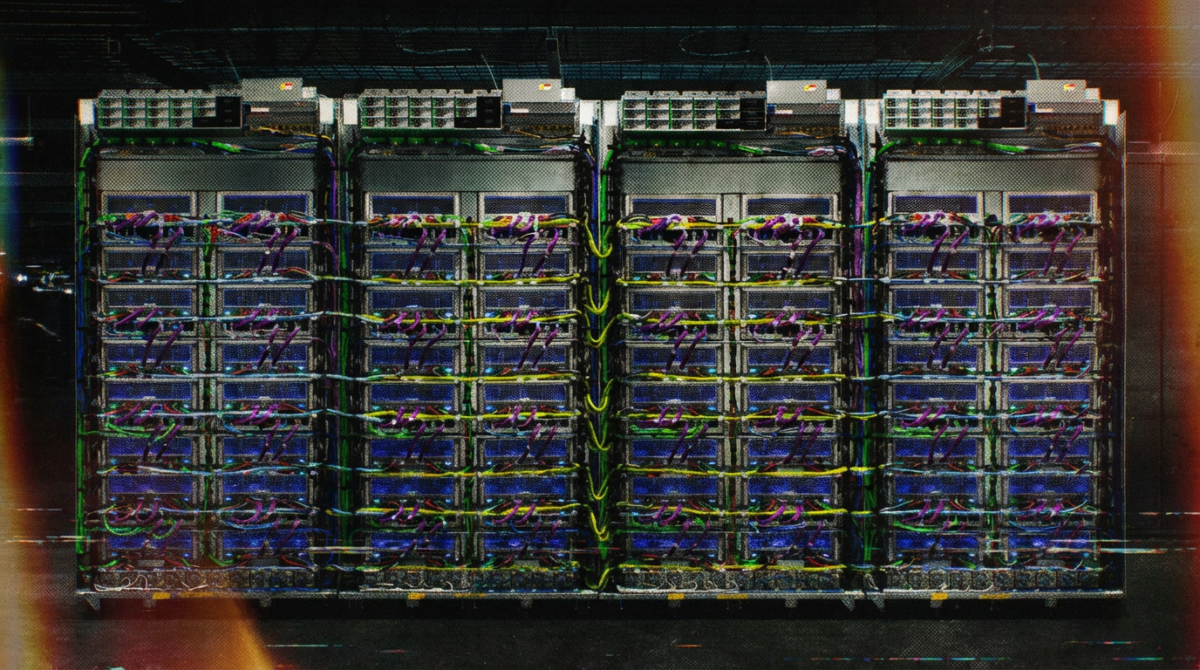
Google added two systems to its eighth-generation TPU line, for confidential workloads and for memory-hungry ones, and shipped four TPU systems in a single year for the first time. The TPU 8tx targets enterprises and government agencies working with confidential data, keeping data and model weights protected and isolated even during active use via the low-latency Boardfly network, with up to twice the latency reduction of the TPU 8t. The TPU 8i Max places two TPU 8i chips on a single package for double the compute, memory and memory bandwidth in the same rack format. Both are new system configurations built on existing silicon, and Google also released TorchTPU as open source with vLLM and SGLang supported.
Read more → https://the-decoder.com/google-ships-four-tpu-variants-in-one-year-as-it-ramps-up-competition-with-nvidia/

Nvidia shares fell about 4.4 percent on Monday and erased more than $200 billion in market value after the company opened an investigation into allegations that a foreign intelligence operation targeted chief executive Jensen Huang. The decline came even as the broader technology market rallied. Nvidia's board announced the investigation on Sunday, appointing a committee of independent directors to run it. Reporting has raised questions about business relationships involving Megaspeed, a Singapore-based data-center operator, and whether U.S. export controls were circumvented.