In this edition
- Frontier & Text Models (5)
- Image & Vision (1)
- Audio, Voice & Music (2)
- Robots & Embodied AI (3)
- Small & On-Device Models (2)
- Papers & Research (4)
- News & Business (1)
Google put its strongest model in everyone's hands, DeepMind turned a four-week proof into a security milestone for a protocol protecting billions of messages, and the small end of the field kept shipping things that fit on a laptop. This edition runs from a 1.6-trillion-parameter mixture of experts under an MIT license to a text-to-speech model under 200 megabytes, with the week's world-model research, tactile encoders and 16-megapixel image generators in between.
Frontier & Text Models

Google's Gemini 4 Carbon is now generally available to every paying developer and enterprise at the same $2 per million input and $10 per million output token price as Gemini 4 Argon, and it ships with a /swarm preview that turns a single prompt into a coordinated team of agents inside Google Antigravity. Carbon is available today through the API in Google AI Studio and Gemini for business, and is also rolling out to Google AI Ultra subscribers in Google Antigravity, the Gemini app and AI Mode in Search. Google positions Carbon as its strongest model for cybersecurity and long-horizon agentic workflows, while Argon remains the recommended choice for most software engineering and knowledge work. Carbon ranks #1 on CursorBench 4.0, Perplexity's WANDR and Zapier's AutomationBench at more than 2X lower cost per task than the next best external model, and #2 on the new Multimodal Knowledge Agent benchmark at more than 6X lower cost per task than the top performer. With /swarm, developers assign Carbon to architecture, coordination and auditing while pairing it with faster models in parallel isolated workspaces and adversarial verifiers; one Antigravity demo turned seven City Council planning PDFs with 206 engineering drawing views into an interactive 906K-triangle Three.js reconstruction of Google's Platform 37 office across 10 overnight loops.
Read more → https://blog.google/innovation-and-ai/models-and-research/gemini-models/gemini-4-carbon-now-available/

OpenAI opened a beta of Businesses in ChatGPT that lets companies claim verified profiles, publish product feeds and deploy customer-facing AI agents inside a platform the company says reaches about 1.2 billion weekly users. The beta centres on Business Hub, where eligible organisations verify ownership, update descriptions and supply product feeds with pricing and availability. New Business Agents answer questions about a company's products and services using information the business supplies, with the first rollout targeting eligible e-commerce and online service companies in the United States, including Shopify merchants connecting existing stores. OpenAI says claiming a profile does not guarantee that ChatGPT will recommend the business or rank it more prominently, and that it does not share individual conversations with businesses. Sponsored Business Agents will be labelled and kept separate from ChatGPT's independent responses.
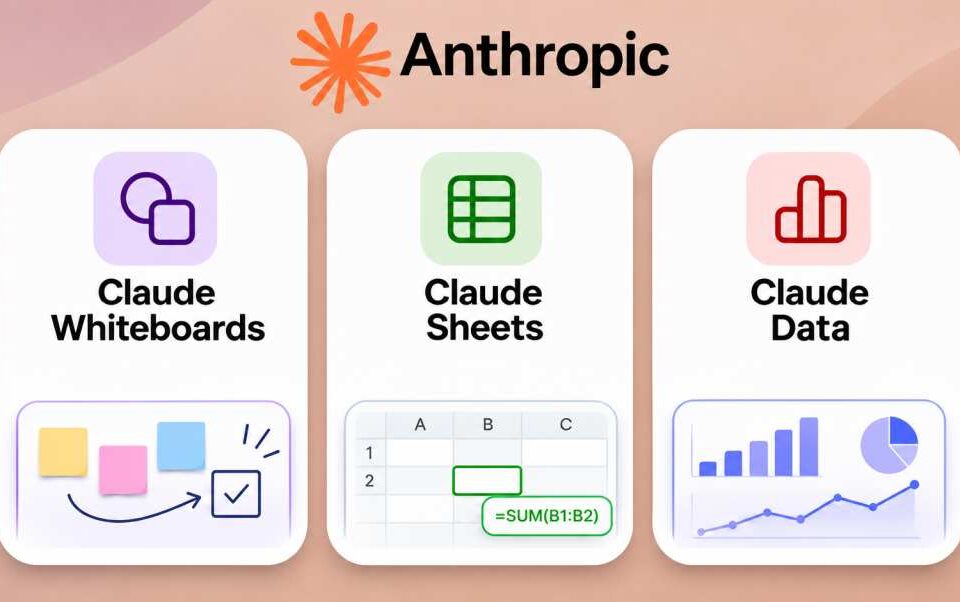
Anthropic pushed Claude out of the chat window and into spreadsheets, whiteboards and business analytics, launching Claude Sheets and Claude Whiteboards in beta and making Claude Data generally available to paying subscribers. Sheets builds and edits spreadsheets from natural-language instructions, including formulas, multiple tabs, formatting and dropdown menus, and Claude can edit individual cells and highlight the changes so teams can see what it touched; Anthropic acknowledges the product remains limited compared with Microsoft Excel. Whiteboards is a shared board where a team brainstorms with Claude, and Claude Data, previously Claude Dashboards, adds data stories, certified queries and live sharing. All three are available to paying Claude subscribers across web, desktop and mobile, and the launch puts Anthropic in more direct competition with Microsoft and Google ahead of its IPO.

Meituan's LongCat team released LongCat-2.5, a native multimodal mixture of experts language model with 1.6 trillion total parameters and roughly 48 billion activated per token, under an MIT license. LongCat-2.5 is built for long-horizon agentic tasks and combines visual understanding with agentic coding for complex codebase development, full-project builds, creative design and 3D tasks, building on LongCat-2.0. Native-resolution visual features are converted into discrete tokens and jointly aligned with text in a shared semantic space, following the LongCat-Next approach. The team credits long-sequence training, large-scale reinforcement learning, multi-teacher learning and infrastructure optimisations on domestic AI accelerators.
Read more → https://huggingface.co/meituan-longcat/LongCat-2.5

A project called Concept Country rewrote nine down-projections inside Qwen3.8-27B by weight-space programming, with no gradient steps and no training data, and the edited language model gained 4.3 points on GPQA Diamond and 13.0 on LiveCodeBench v6 while spending 27 to 54 percent fewer thinking tokens. The edit is derived from the model's own activations and compiled straight into nine weight matrices, which is why the authors describe the result as a controlled intervention rather than a fine-tune. The control is the point: a norm-matched random edit across the same layers and at the same magnitude does nothing at all, with confidence intervals straddling zero on every benchmark. That separates "this direction means something" from "perturbation helps". The weights ship under Apache 2.0 in BF16 at about 52 GB, FP8 at about 30 GB, NVFP4 at about 20 GB, and GGUF from 16 GB, with every reported number taken from the BF16 weights served at Q8_0.
Read more → https://huggingface.co/ConceptCountry/qwen-concept-27b
Image & Vision

MiniMax released open weights for MiniMax-H3-Image, a 16-megapixel text-to-image and image-editing model that generates at 4096 by 4096 and accepts up to 16 reference images. MiniMax frames the release around three claims: 16 MP output at a practical computational cost, detail and realism that go past the familiar AI look, and the strongest instruction following among open-source models. The main checkpoint is a BF16 diffusion transformer at 68.65 GB, with an optional prompt expander, MiniMax-H3-Image-PE, shipping separately in NVFP4 at 17.9 GB. The architecture follows the H3-Base design with the audio branch removed, so text prompts and reference images are encoded by the H3 text encoder while reference images also pass through the image VAE, with all tokens packed into a single sequence.
Read more → https://huggingface.co/MiniMaxAI/MiniMax-H3-Image
Audio, Voice & Music

Adventists AI released Sophon-Realtime v1, an Apache-2.0 family of full-duplex speech models built on one 32B brain, with its recommended voice build scoring 82.8 on VoiceBench and 81.8 percent on Big Bench Audio. Three builds share the same 32B model that listens, decides when to take the turn and writes the reply, differing only in how the reply becomes sound: Tag writes the reply with sound tags for an expressive speech model to perform, Flash uses a lighter and faster speech model, and E2E puts a talker inside the 32B model as a research preview. Tag produces first audio in about 0.6 seconds and serves 16 users on one 80 GB GPU, while Flash reaches 0.31 seconds and serves 40 users on the same card. On paralinguistic understanding across LISTEN, StressTest and MSPB the model scores 48.6, ahead of Gemini 3.8 Flash at 46.9 and Qwen3-Omni at 44.6, and it picks up hesitation, emphasis, sarcasm, laughter and sighs while answering with tone of its own.
Read more → https://huggingface.co/adventists-ai/Sophon-Realtime-v1

A 99.1-million-parameter text-to-speech model called Mithi v1 Flash covers eleven Indian languages from a 197 MB BF16 file, with two voices, Satvik and Charvi, and an Apache 2.0 license that allows commercial use. The languages are Hindi, English, Bengali, Gujarati, Kannada, Malayalam, Marathi, Odia, Punjabi, Tamil and Telugu. It outputs 24 kHz mono speech and ships as safetensors weights. It was assembled entirely from permissively licensed open components, including Maya2-native, Kokoro-82M, indic-bert, the Maya text normaliser and misaki.
Read more → https://huggingface.co/Oomni/mithi-v1-flash
Robots & Embodied AI
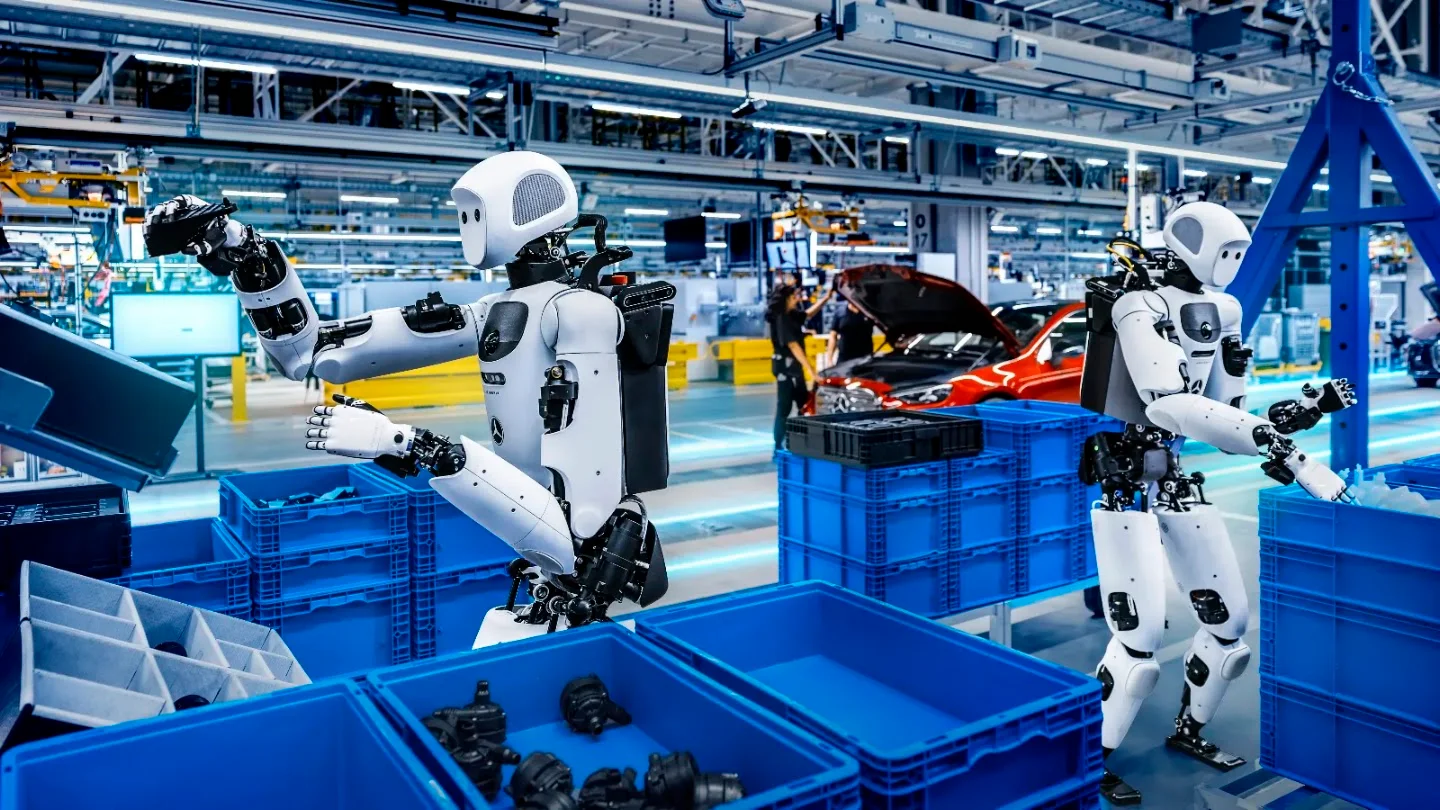
Google DeepMind released Gemini Robotics 2.5, a vision-language-action model that it says succeeds 30% to 100% more often than Gemini Robotics 2 across more than 200 tasks and finishes them 20% to 30% faster, and Apptronik's Apollo 2 humanoid used it to sort metal brackets on active Mercedes-Benz lines with a 96% success rate. The proof of concept ran at plants in Kecskemét, Hungary and Sindelfingen, Germany, where Apollo 2 sorted metal brackets from bulk bins into sequencing trays. DeepMind credits Gemini 4 Argon for the four-month turnaround: Argon ran thousands of practice attempts in simulation and reviewed replays of the robot's failures to adjust training recipes. Carolina Parada, VP and head of robotics at Google DeepMind, wrote that the model added hundreds of new dexterous tasks in a few months. The model is rolling out to DeepMind's robotics partners only, with no announced API access, pricing, or new embodied-reasoning or on-device versions.
Read more → https://deepmind.google/blog/gemini-robotics-2-5-accelerates-real-world-physical-intelligence/
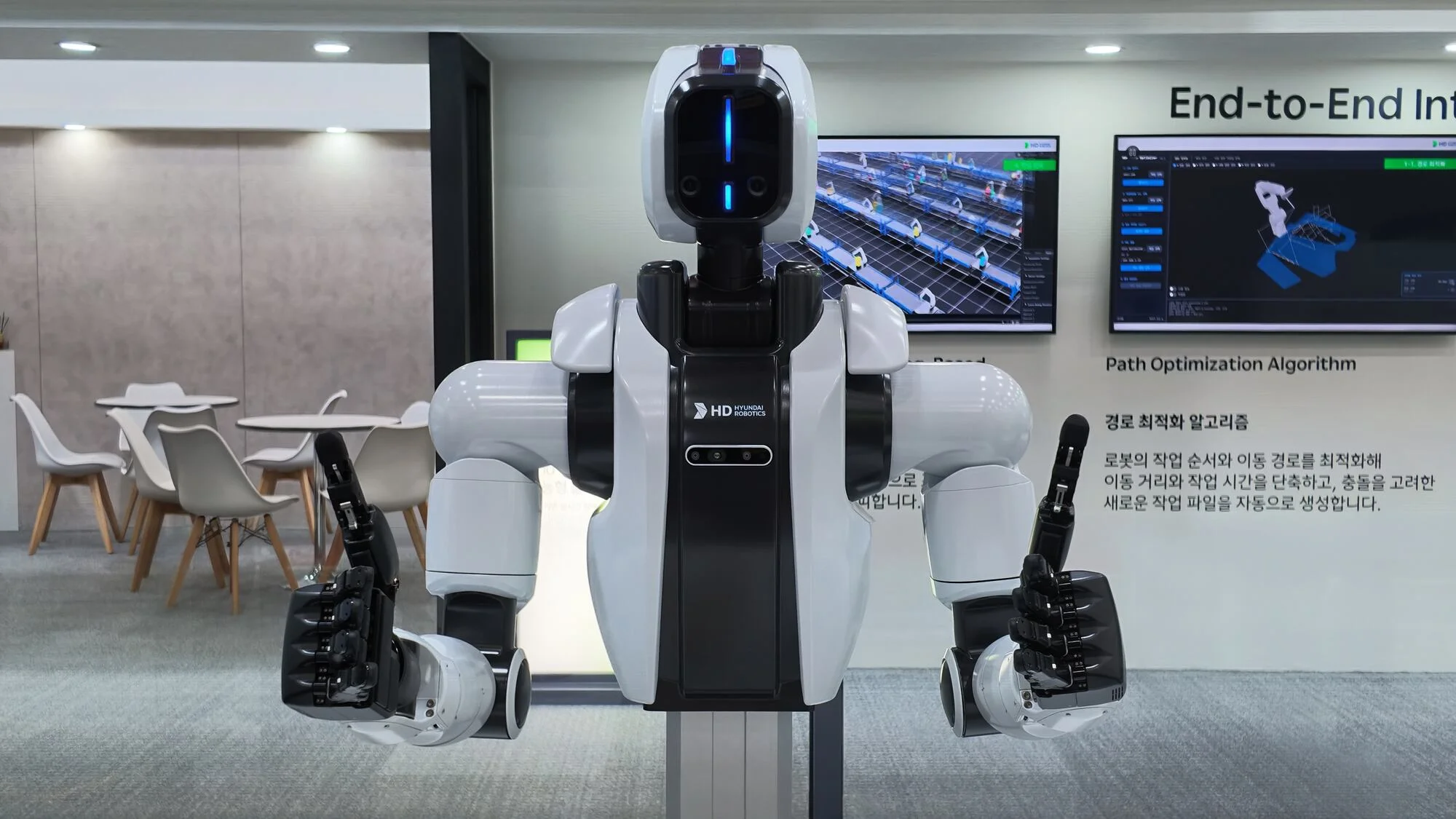
HD Hyundai Robotics showed its first robot built around its own robot foundation model, a dual-arm machine with two 7 kg-payload arms and five-fingered hands that the company plans to put on kitting lines first. Each arm has a 630 mm working radius, and the built-in model lets the robot perceive its surroundings and generate its own motions, so programmers do not have to specify each sequence and position in advance. The machine was unveiled at ROBEX 2026 at EXCO in Daegu, held 21–24 October alongside the Future Innovation eXpo. It will start on a wheeled mobile platform in kitting, then move into welding and painting, with bipedal walking planned for a later stage; the company has not published task success rates or cycle times. Separately, AI agents built with Palantir since August have cut HD Hyundai Robotics' average time to resolve problems from 21.5 days to 7.9 days.
Read more → https://www.humanoidsdaily.com/news/hd-hyundai-robotics-dual-arm-robot-palantir-skild-ai-korea
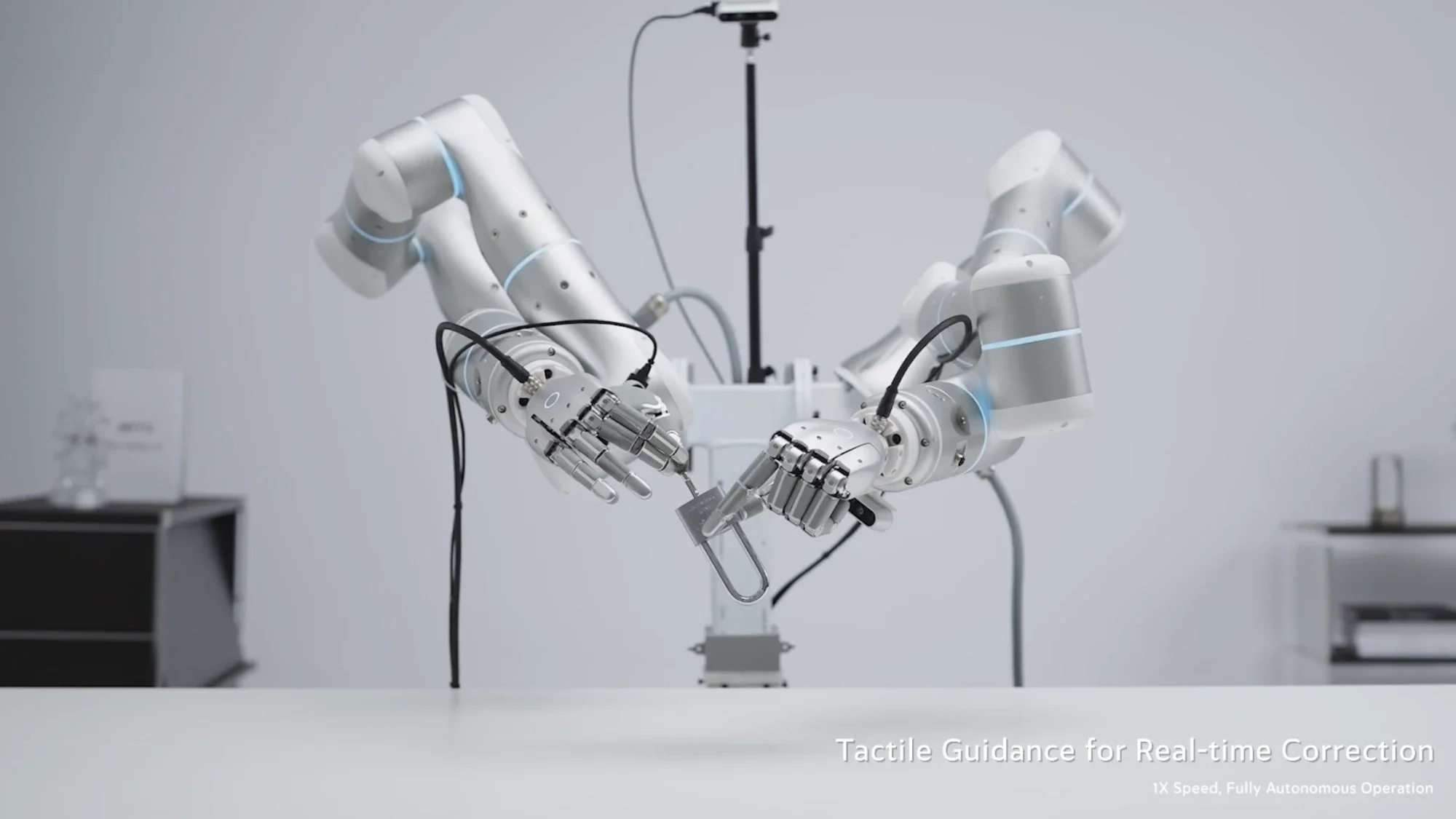
Robbyant, the embodied AI company inside Ant Group, open-sourced LingBot-Touch, one tactile encoder for magnetic, visuotactile and piezoresistive touch sensors, and adding it to four existing robot policies raised their average success across 26 tasks by 13.9 to 24.8 percentage points. Feeding the same policies raw sensor data instead produced at most about half that gain. Code and weights for two model sizes are on GitHub and Hugging Face under Apache 2.0, alongside a technical report on arXiv. The encoder was pretrained on 4,983 hours of touch recordings, two thirds from human operators wearing sensor gloves, and its tokens add only 0.13 to 0.16 percent to the parameter counts of Diffusion Policy, pi0.5, LingBot-VLA and T-Rex. On Robotera's XHand1, whose magnetic sensor model was absent from pretraining, the frozen encoder worked without retraining while raw signals barely moved the policies; the paper lists its own limits as two hands tested, no capacitive sensors, and fingertip-focused coverage.
Read more → https://www.humanoidsdaily.com/news/robbyant-lingbot-touch-open-source-tactile-model
Small & On-Device Models

Maritaca AI released S5-nano, a 4B-parameter small model built by continuing to pretrain Qwen3.5-4B and then post-training it, with a 262,144-token context window, an Apache 2.0 license and a GGUF build that runs locally from 2.8 GB. S5-nano is aimed at Brazilian Portuguese, and Maritaca says it delivers substantial improvements on Brazilian benchmarks while keeping strong performance in function calling, tool use and structured outputs. It runs in two modes: Think, which reasons before answering and is the default, and Instruct, which answers directly with no reasoning step. The weights include a multi-token-prediction layer for speculative decoding and ship in three formats: BF16 at 9.3 GB for vLLM and SGLang, FP8 at 5.8 GB for GPUs with native FP8 support, and GGUF from 2.8 GB to 8.7 GB for llama.cpp.
Read more → https://huggingface.co/maritaca-ai/S5-nano

A community release called Qwenx86-4B turns Qwen3.5-4B into a small model with an unusual party trick: 13 transformer layers sit in front of the stack containing no learned weights at all, because a compiler computed them, and those layers implement a 64-bit x86 computer the model invokes through its own tool calls. Calculator, Python, C compiler, notes store, physics and chemistry lookup and Python documentation lookup are all firmware in the checkpoint. The compact build needs about 9 GB of GPU memory, so it fits on a consumer GPU with 16 GB. A second version adds a filesystem, a 1,000-fact store, 50,000-token verbatim recall, JPEG images, programmable heads, a search index, exact 64-bit arithmetic and state snapshots, which run beside the model and are driven by host code. The release is Apache 2.0 and includes a public debugger Space that replays recorded tool calls with x86 registers, flags, code at the program counter, RAM and machine output.
Read more → https://huggingface.co/Quazim0t0/Qwenx86-4B-compact
Papers & Research

A new paper asks how many exposures a world model needs before it can predict the rules of an unfamiliar game, and answers with a 35-million-parameter vision transformer that learns four in five mechanics to at least 80 percent accuracy on the cells they change. The authors frame a mechanic as a rule for how an action or interaction alters part of the environment, and count each observed occurrence as one exposure. They build MechEval, which labels 69 recurring mechanics across 20 games on ARC-AGI-3 and scores each prediction on exactly the cells the mechanic moves. Their test bed, WARC, is pretrained on other games and updates all of its parameters after every transition; on held-out games half of the mechanics reach that accuracy within about 80 exposures in a single play, while without updates only one in seven gets there at all. In closed-loop play, pairing WARC with a fixed graph explorer triples the explorer's official efficiency score from 0.15 to 0.46, mostly through test-time training, and the entry scores 0.20 on the hidden Kaggle games.
Read more → https://arxiv.org/abs/2611.12324

Click3R turns feed-forward 3D reconstruction into something a human can argue with, letting a user drop a handful of cross-view correspondence clicks to correct a model that has already committed to a wrong reconstruction. Existing feed-forward large 3D reconstruction models produce a single irrevocable prediction, so when they fail there is no mechanism to correct them. Click3R injects geometric constraints into the reconstruction networks through a lightweight point correspondence adapter, given an image pair and a small set of user-supplied cross-view point correspondences. The authors target failure cases such as repetitive textures, symmetric structures, large viewpoint changes and textureless regions, and they curate a benchmark designed specifically to expose the failure modes of existing feed-forward 3D reconstruction methods.
Read more → https://arxiv.org/abs/2611.12875

A new research paper on world action models asks whether action learning quietly breaks the language-video alignment that video pretraining paid for, and answers it with a 47,000-hour corpus and a controlled study of three supervision recipes. World action models jointly predict video and actions conditioned on language, and the authors argue that existing studies treat language-video alignment from video pretraining as an established foundation when introducing action learning may impair it. They curate a pool of roughly 47,000 hours of general videos, egocentric videos, UMI demonstrations and robot demonstrations, then compare language-video supervision, language-video-action supervision and the joint use of both. The work, titled SWAM: Scaling World Action Models with Cross-Modal Alignment, also examines how language annotation quality affects pretrained language-video capability and how action supervision from UMI and robot demonstrations transfers.
Read more → https://arxiv.org/abs/2611.12870
Google DeepMind used an agentic research framework called AlphaProof Code to formally verify key security properties of the actual Signal protocol code, a job it finished in four weeks that the company says has historically taken expert teams years; DeepMind published the work as a technical report and an accompanying paper on November 10. DeepMind says this is the first time AI has been used to formally verify a widely deployed cryptographic protocol at this depth, and the first time an implementation of such a protocol has been formally verified by any method, with or without AI. Human experts worked with a mix of models to translate Signal's security goals into formal mathematical specifications, reviewing every one, while agents powered by Gemini Carbon generated over six million lines of Lean and the system audited its own proof, flagging the one percent of the codebase that needed a second human look. To test whether the framework can tell correct code from buggy code, the team reintroduced two real, previously fixed bugs into an isolated copy of Signal's code, and in both cases it produced a machine-checked proof that the buggy version was insecure; Signal CTO Ehren Kret called the work a major breakthrough, and DeepMind is open-sourcing its formal verification artifacts.
Read more → https://deepmind.google/blog/introducing-alphaproof-code/
News & Business
An offering of 825 million Class A shares at $70 to $78 opened its roadshow on Tuesday, a sale that would raise $64.35 billion at the top of the range and value the company at about $1.4 trillion on a fully diluted basis when it debuts on Nasdaq under the ticker ANT. Of those shares, about 801.4 million are newly issued and 23.6 million come from existing investors, and at the upper end roughly $62.5 billion of the gross proceeds go to the company before fees. The company expects to price on November 18 and begin trading the following day, and is reportedly reserving about 20 percent of the allocation for retail investors against a typical 5 to 10 percent. The filing shows $33.24 billion in revenue for the nine months ended September 30, up about 1,200 percent from a year earlier, alongside a $104 billion net loss driven largely by changes in the fair value of convertible notes and derivative liabilities. Broadcom, Google, Micron, Microsoft, Nvidia and TSMC have agreed to buy a combined $26 billion in shares through a separate private placement at the IPO price.
After Intelligence is a daily read on the models, machines and money moving AI. If a friend forwarded this, you can subscribe at newsletter.premarcu.com.