In this edition
- Frontier & Text Models (4)
- Image & Vision (1)
- Video & World Models (1)
- Audio, Voice & Music (2)
- Robots & Embodied AI (4)
- Small & On-Device Models (2)
- Papers & Research (1)
- News & Business (3)
A 145-billion-parameter agent now runs on a single 24 GB graphics card, a 4-billion-parameter speech model listens and speaks inside the same 133-millisecond frame, and ASUS has put its first humanoid to work packing motherboard accessories on one of its own production lines. Eighteen items: four frontier releases led by Edge0-145B and Nex-N2.6, two speech models, an image generator that emits depth from the same weights, a harness that teaches physics to video models, three robotics deployments, two edge-compression results, three papers, and the week's business — an Anthropic IPO six times oversubscribed, SpaceX cutting most of its Grok Imagine team, and US intelligence walking back the spy story that ended Jensen Huang's 33-year tenure.
Frontier & Text Models
 Edge0-145B runs a 145B LLM agent on a single RTX 5090 D (24 GB) at 98.3 tok/s decode and 3165.7 tok/s on 16K-token prefill.
It scores 86.5 on Terminal-Bench 2.1. The architecture is a latent sparse MoE with 48 layers, 512 experts per layer, 10 routed plus 1 shared active per token, and 256K context, trained natively at 4 bits. With residency enabled it uses 23.25 GiB VRAM plus 38.27 GiB host RAM; Q3_K weighs 40.81 GiB and NVFP4 47.79 GiB. Base model is Qwen3.8-Flash-Next under the edge0-community-model-1.0 licence, served via edge0-infer.
Read more → https://huggingface.co/Edge0/Edge0-145B-NVFP4
 Nex-N2.6 is a 321B multimodal agentic LLM from Nex-AGI built on GLM-5.3-Flash, scoring 83.0 on OSWorld.
That beats Nex-N2.5-Pro at 82.2, base GLM-5.3-Flash at 78.0, and DeepSeek-V4.1-Flash at 71.7. On Terminal-Bench 2.1 it reaches 84.1, close to GLM-5.3-Flash's 84.3. AutomationBench is 45.7, below DeepSeek-V4.1-Flash at 54.8. Reasoning repetition fell from 16.0% to 1.6% versus Nex-N2.5-Pro, with 100% tool-list adherence among tool-calling responses. Released 2026-11-10 under apache-2.0.
Read more → https://huggingface.co/nex-agi/Nex-N2.6
 ChatGPT Wallet lets AI agents make and pay for online purchases on a user's behalf, US-only via Dots at launch.
OpenAI scrapped its earlier Instant Checkout for being too inflexible. Access requires a ChatGPT Pro subscription and an eligible US bank card, for adults only. Users add a card once; before each purchase the system shows items, total and selected card, and the user approves via Face ID or fingerprint. Neither agent nor store sees real card details, using tokens from Visa and Mastercard. Anthropic, Meta, Google and xAI already offer agent shopping.
Read more → https://the-decoder.com/openai-rebuilt-ai-shopping-from-scratch-with-chatgpt-wallet/
 Claude for Manufacturing plugs Claude directly into factory software via Autodesk Fusion, Oracle NetSuite, Microsoft 365 and Infor.
It ships with 17 skills including drafting quotes from inventory, comparing suppliers, generating quality reports and design variants, and analysing sensor data during machine downtime. An Infor plugin lets Claude order from backup suppliers and reschedule production after human approval. All results link to source documents for employee review. Available to Team and Enterprise customers; it does not control physical machines yet. The Model Hardware Standard research preview would connect agents to robotic arms and microscopes, cutting setup from weeks to hours.
Read more → https://the-decoder.com/anthropics-claude-for-manufacturing-plugs-ai-directly-into-factory-software-to-automate-industrial-workflows/
Image & Vision
 Iris-Z is a 32.2B-parameter image generation model built on FLUX that also emits depth, hitting AbsRel×100 of 3.56 on MoGe-3's seven-dataset protocol. A 9.1B Iris-Z-small variant runs at about 33 GB GPU memory versus 112 GB for big. On Marigold V2's five-dataset protocol, Iris-Z-big scores 2.92 versus 3.12 for the authors' MoGe-3 run. Built on FLUX.2-dev and FLUX.2-klein-base-9B under the FLUX non-commercial licence, it does image-to-depth in 1.44 s at 512 on one H200.
Read more → https://arxiv.org/abs/2611.16010
Video & World Models
 PhysLoop is a harness that constrains LLMs across video generation, selection and correction to distil physical knowledge into 100K released videos. Video generation models still struggle with physical dynamics and causal consistency despite visual realism. The framework supports controllable training-data construction and inference-time video repair. The authors position PhysLoop as a route to video models that improve themselves with limited human intervention.
Read more → https://arxiv.org/abs/2611.16748
Audio, Voice & Music
 Haru-4B is a low-latency multilingual full-duplex speech model that listens and speaks simultaneously at 7.5 Hz.
Every 133 ms it takes one user audio frame and produces one audio and one text frame, summed into a single language-model position. Audio is a 64-dimensional latent per frame via a one-step MeanFlow MLP head, with no separate audio transformer or discrete tokens. A text card sets character; a 3-second to 3-minute clip sets voice. It covers nine languages and runs on roughly 12 GB of VRAM, with PyTorch, MLX and vLLM-Omni implementations. Released 2026-11-12 under apache-2.0.
Read more → https://huggingface.co/higurashi-ai/Haru-4B
 Kezek does speaker diarization and speech separation on a mono two-person recording, emitting one track per person with the original timing intact.
Stage 1 runs a two-voice activity model guided by a phase-insensitive speaker fingerprint once for the whole recording; stage 2 is a conditioned time-domain separator whose outputs always sum to the input. The authors report short-reply retention, leakage, channel swaps and coverage instead of standard metrics. On the Open Yap test, short-reply retention is 0.83 versus 0.69 for pyannote-to-DialogueSidon; on unseen telephone speech, 0.80 versus 0.71.
Read more → https://arxiv.org/abs/2611.16933
Robots & Embodied AI
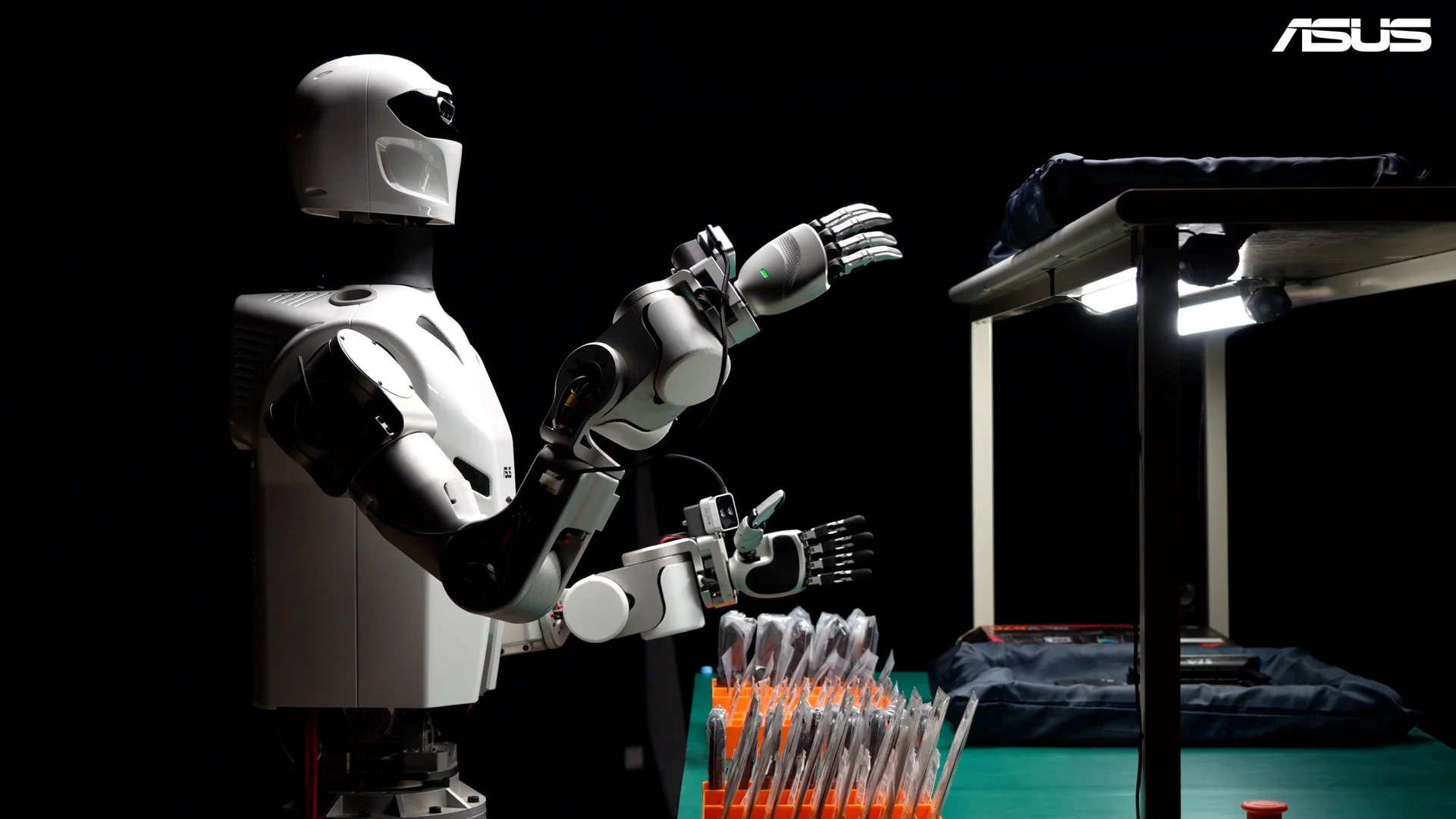 ASUS's first humanoid, Gallop, packs 15 small motherboard accessories per 20-second cycle on a fixed base, targeting 99.5% success on a single NVIDIA Jetson AGX Thor. Co-CEO S.Y. Hsu presented it on CNBC on 13 November. The two-armed unit is built by the Humanoid Robotics unit inside ASUS's Physical AI Solutions Business Group; a wheeled version is planned. Customer pilots start in 2027 and market availability in the second half of 2028.
Read more → https://www.humanoidsdaily.com/news/asus-gallop-humanoid-robot-jetson-thor-2028
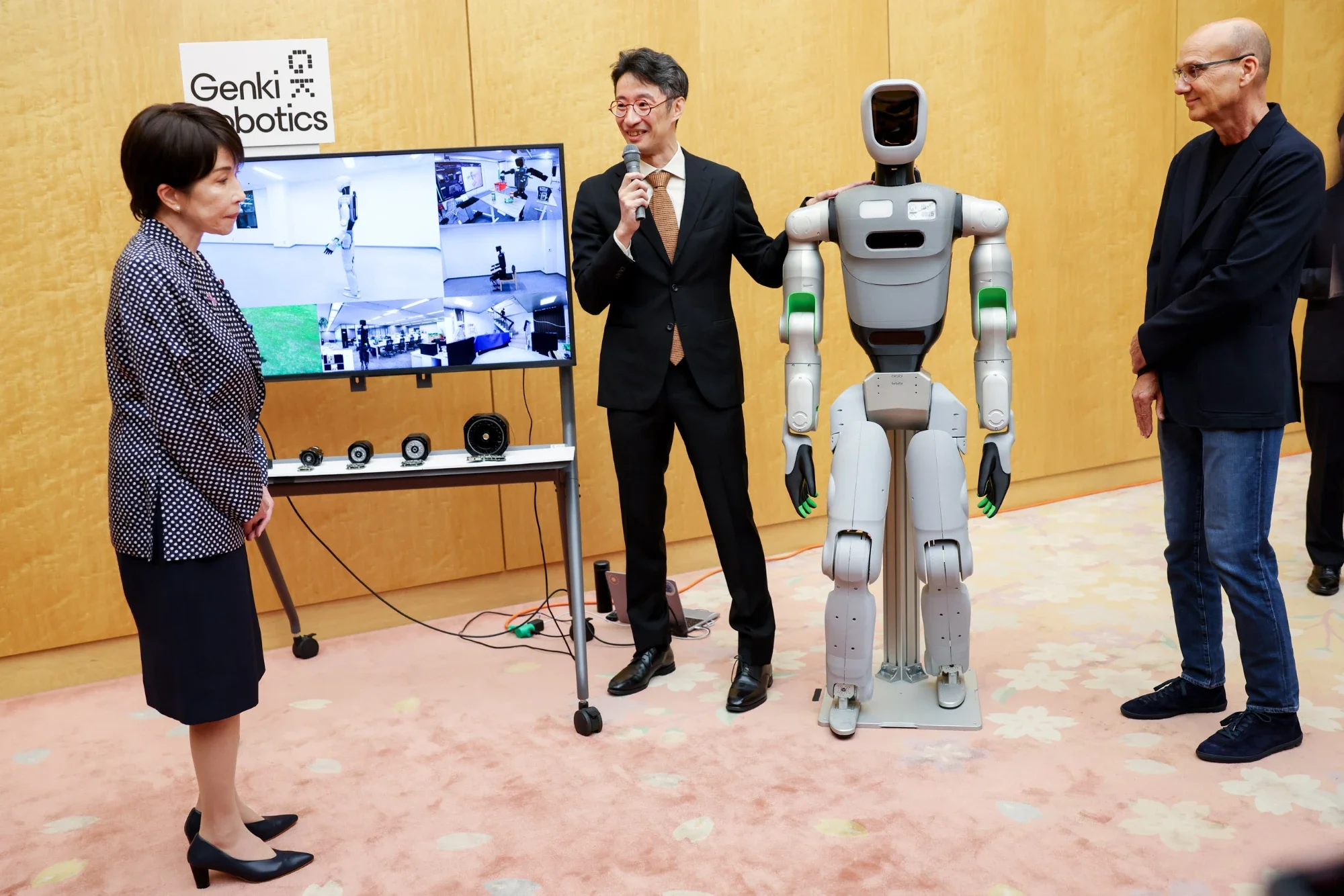 Genki Robotics, founded by Android creator Andy Rubin, showed its humanoid publicly for the first time on 12 November at a meeting with Prime Minister Sanae Takaichi. The displayed prototype was assembled over the weekend from parts arriving Friday and took its first steps Monday. The meeting at the Prime Minister's Office was with physical AI companies.
Read more → https://www.humanoidsdaily.com/news/genki-robotics-humanoid-debut-takaichi-kantei
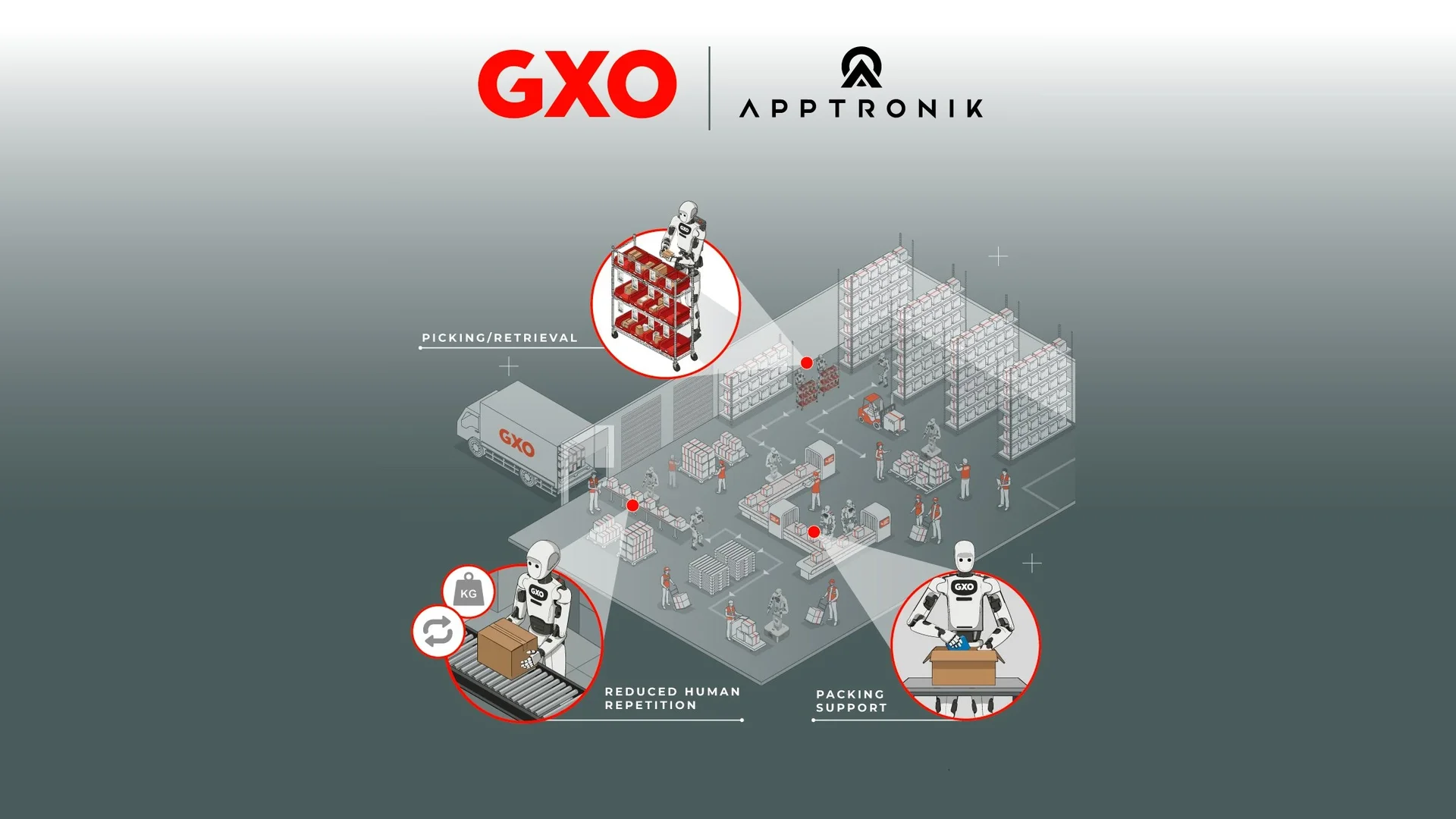 GXO Logistics signed a letter of intent with Apptronik to deploy up to 1,000 Apollo humanoids worldwide over four years, starting in North America in late 2027. The deal is a letter of intent, not a purchase order, contingent on agreed performance and safety targets. The framework covers expanded Apollo trials from 2027 and a Robotics-as-a-Service arrangement for commercial deployment.
Read more → https://www.humanoidsdaily.com/news/gxo-apptronik-apollo-1000-humanoids-letter-of-intent
 Ropedia Xperience 2 releases 1,589 metric-scale 3D scans and 4,230 egocentric recordings of 74 tasks totalling 131 hours for robot learning. Scenes convert into physically interactive simulation environments and human motion is retargeted for policy training. The work targets long-horizon, contact-rich tasks where models like GPT-6 Astra and Claude Fable 5.1 remain brittle. It frames the physical-AI scaling question as how capability scales with environments and behaviours.
Read more → https://arxiv.org/abs/2611.17060
Small & On-Device Models
 LazyWeights compresses quantized weights for edge model deployment with Huffman-coded GPTQ lanes and decodes them on demand between DRAM and L2, shrinking Phi-3-mini, Mistral-7B and SmolLM-1.7B by 5.7–31.4% over the best llama.cpp format. A 0.21 mm² 7 nm ASIC decoder at 1 GHz cuts Orin latency and energy per token by up to 36% and 38%. On a 4 GB Jetson Nano, LazyWeights runs streamed Mistral-7B 6.6× faster than CPU llama.cpp.
Read more → https://arxiv.org/abs/2611.17108
 UniSpark-9B is a small model that pairs full attention with GatedDeltaNet linear attention on a Mixture-of-Transformer-Experts backbone of roughly 9B parameters per branch. It jointly performs autoregressive text prediction and visual flow matching for visual question answering, text-to-image generation, instruction-guided editing and interleaved text-image prediction. A blockwise protocol isolates noisy visual targets via attention masks in full-attention layers and recurrent-state retention in linear-attention layers. Training used 159.7M generation samples, 213.4M understanding samples and 624.8K interleaved sequences across a four-stage curriculum.
Read more → https://arxiv.org/abs/2611.16517
Papers & Research
 A decision model that acts poorly can still teach well: JEV raises a Qwen2.5-1.5B GRPO policy from 72.8% to 82.9% success on ALFWorld and from 56.8% to 71.4% on WebShop. The study tests three decision models and three general LLMs as actors and judges on ALFWorld, with JEV as teacher on ALFWorld and WebShop. As actors, all six models are pulled away from a required subgoal by an easier one; as judges seeing full trajectories, they credit steps toward that subgoal. Asking whether each action helped, rather than whether the task will succeed, separates useful from useless actions.
Read more → https://arxiv.org/abs/2611.17167
News & Business
An IPO six times oversubscribed at a roughly $1.4 trillion valuation would be the largest public offering in history, according to Bloomberg as reported by the-decoder. Anthropic and its co-founders aim to raise up to $64.4 billion through the public offering plus $26 billion via private placement. Annualised revenue climbed to $81 billion by late October, up from $71 billion in September. Nvidia is buying $10 billion in Anthropic stock through the private placement. Goldman Sachs and Morgan Stanley manage the Nasdaq listing under ticker ANT; Dario Amodei will pitch investors with JPMorgan CEO Jamie Dimon in a Friday livestream. Read more → https://the-decoder.com/anthropics-ipo-is-six-times-oversubscribed-and-on-track-to-become-the-largest-public-offering-in-history/
SpaceX laid off around 60 people from its media-generation team in the past week, leaving only a handful to keep the product running, according to The Information as reported by Tech Startups. Grok Imagine remains available, but the cuts cast doubt on SpaceX's commitment to AI video generation. The move follows SpaceX's February 2026 all-stock acquisition of xAI, valued at $250 billion, and its August acquisition of Cursor from Anysphere at an implied $60 billion equity valuation. The shift suggests greater commercial potential in systems that perform work for users than in visual-content tools. Read more → https://techstartups.com/2026/11/13/spacex-lays-off-60-grok-imagine-employees-as-elon-musk-shifts-focus-to-ai-coding-and-agents/
 U.S. intelligence has yet to establish that Alice Huang was knowingly working for Beijing, with ODNI officials calling earlier spy claims "not entirely accurate and over-torqued," according to CNN as reported by Tech Startups. CIA officials remain unconvinced that intercepted communications show she knowingly passed sensitive information to Chinese authorities. The FBI has reportedly investigated the relationship for at least a year without resolving the central allegation. Attorney General Todd Blanche confirmed DOJ has reached no conclusion, saying "Nobody's said that" when asked whether she was a spy. The uncertainty comes a day after Jensen Huang's departure, ending his 33-year run at the company he co-founded in 1993.
Read more → https://techstartups.com/2026/11/13/u-s-intelligence-casts-doubt-on-chinese-spy-allegations-after-nvidia-ceo-jensen-huangs-resignation/
After Intelligence publishes every morning. Every figure above is quoted from the linked primary source or the reporting named in the item.