In this edition
- Frontier & Text Models (3)
- Image & Vision (1)
- Video & World Models (3)
- Audio, Voice & Music (2)
- Robots & Embodied AI (4)
- Small & On-Device Models (2)
- Papers & Research (2)
- News & Business (1)
A 400-million-parameter decision model answers a typed question in 6.9 milliseconds, six wheeled humanoids finish 1,730 tasks on an operating convenience-store overnight shift in Shanghai, and a former OpenAI researcher says he has found Nvidia's Blackwell signature inside six Chinese models. Elsewhere this Sunday: Richard Sutton argues that scaling alone will not produce intelligence, Anthropic's own IPO chart implies it could retrain Mythos for a fraction of the original compute, Salesforce ships a 26.6-billion-parameter speech recogniser, and two research efforts try to move video generation out of its compressed latent space.
Frontier & Text Models

Richard Sutton, author of the 2019 essay "The Bitter Lesson", says raw compute alone is not enough to build intelligence, and that a language model that stops learning after training cannot get there. Turing Award winner Sutton published a post on X arguing that raw compute alone is insufficient for intelligence and that AI science is "far from finished", requiring clever new methods; the post drew wide discussion in the AI community. In the 2019 essay he argued that general methods which scale with compute eventually outperform sophisticated human-engineered approaches. He has called synthetic data a "big mistake", noting that the real world is infinitely complex and any simulation captures only a microscopic slice. What he wants instead are agents with world models that keep learning from their own experience — unlike today's language models, which stop learning once training ends.
Read more → https://the-decoder.com/the-inventor-of-the-bitter-lesson-has-a-bitter-lesson-for-llm-scaling-enthusiasts/
A former OpenAI researcher says forensic analysis found Nvidia Blackwell fingerprints inside six Chinese models, evidence that export-controlled hardware reached DeepSeek, Moonshot AI, MiniMax and Ant Group. AI researcher Will DePue published the analysis after working at OpenAI on Sora, Sora 2, GPT-4o, o3 and GPT-5, then founding the nonprofit research group Unemployment Labs. He reports that six Chinese models released since April 2026 carry the distinct signature of Nvidia's Blackwell generation, while earlier models such as DeepSeek-V3 do not. He wrote on X that senior researchers at OpenAI and Anthropic have independently checked and confirmed his findings. US officials and news outlets had previously suspected DeepSeek and Moonshot AI of using Blackwell chips but never published proof.

Anthropic's own IPO roadshow slide shows pre-training compute climbing so steeply that former researcher Jacob Coxon says it could already retrain its Mythos frontier model with a fraction of the compute it once needed. Coxon, a former OpenAI and Anthropic researcher, left Anthropic after roughly four months and cites a slide from the IPO roadshow as a major reason. The chart plots a "Pre-training compute multiplier" for code from July 2024 to October 2026 on a logarithmic y-axis, compressed so that 10x and 100x increases look nearly identical — yet the curve still climbs steeply. He writes that Mythos, a spring capability jump, "was not a one-time deviation, but a point on a superexponential", and that it could already be retrained with a fraction of the original compute. Anthropic notes that the data points are internal estimates, for illustration only.
Image & Vision

Open Vision Banana turns pretrained image generators into vision-language perception models and beats the closed Vision Banana on zero-shot segmentation. Vision Banana framed vision tasks as conditional image editing but never published its data, weights, code or implementation details. Open Vision Banana is a fully open, reproducible recipe for converting pretrained generators into unified multi-task perception systems; the authors identify colour encoding, prompt design, parameter adaptation and task balancing as the choices that matter most for generalization, noting that individually helpful choices can hurt when combined. Starting from 4B and 9B open-weight base models and 2.1 to 3.8 million training pairs from public data, it surpasses Vision Banana's reported Cityscapes zero-shot performance, 73.9 against 69.9 mIoU, and rivals affine-invariant depth estimators with the strongest reported numbers. Non-zero-shot variants come within five points of Vision Banana on referring and reasoning segmentation but lag further on instance segmentation, and all models largely retain the base model's image-editing abilities.
Read more → https://arxiv.org/abs/2611.15844
Video & World Models

PAN 2 is a 29-billion-parameter world model that turns one observation and a text plan into twenty seconds of simulated video, a video model an agent can reason with before it acts. PAN 2 was developed by the Institute of Foundation Models at MBZUAI. Given a current observation — an optional image plus text — and actions described in text, it simulates the outcome as a video of up to 20 seconds, so an agent can imagine the results of its candidate actions before choosing among them. It follows the Generative Latent Prediction architecture formalised in "Critique of World Models", coupling conceptual reasoning by a large language model with perceptual reasoning from a 29-billion-parameter MMDiT trained from scratch on hundreds of millions of videos. Default sampling runs 704 by 1248 at 24 frames per second, with 241 frames for entries without a duration and up to 481 frames; it is Apache 2.0 and supported in Diffusers and vLLM.
Read more → https://huggingface.co/IFM/PAN2

Duo v1 is a world model built for full-duplex interaction that keeps perceiving audio and video while it answers, a video model that never stops listening. The authors introduce the Reciprocal World Model, which treats intelligence and physical reality as equally fundamental to what constitutes a world, and identify two capabilities: Intent, the cognition underlying world interactions, and Realization, which generates coherent audio-visual behaviour. Duo v1 uses autoregressive modelling for continuous interaction reasoning and participation decisions, synchronises tokens across Intent and Realization on a unified timeline with attention masks that prevent access to future inputs, and mitigates distribution shift through dual rollout distillation. Both modules continuously perceive real-time audio, video and text, enabling full-duplex interaction with spontaneous conversations and interruptions. Beyond conversation, users can share real objects, reshape virtual scenes, guide assistants or play audiovisual games without mouse or keyboard controls.
Read more → https://arxiv.org/abs/2611.15131

PixVid lifts a pretrained video model into pixel space for video generation, doubling resolution at the same per-frame token count. Frontier video generators work in a VAE latent space that compresses video in both space and time, which made training tractable but now limits high-resolution, controllable and interactive generation: doubling resolution quadruples token count, conditions apply to groups of frames rather than individual ones, and each response must wait for the rest of its multi-frame block. PixVid keeps the diffusion transformer and replaces the VAE decoder with a convolutional head that renders its outputs into pixels for every frame, and the authors find that predicting clean video rather than velocity, together with a larger noise shift, is key to quality. Finetuned from Wan2.1-14B, it is competitive with the latent baseline within about 1.3 million training clips; working framewise in pixels it generates at 2x higher resolution, keeps depth-conditioned video editing aligned under fast motion, and responds to each action at the next frame.
Read more → https://arxiv.org/abs/2611.17336
Audio, Voice & Music

Salesforce's SOV-Transcribe-1 is a 26.6-billion-parameter speech model that ranks first among open-weight systems for non-streaming transcription. The model has 26.6 billion total parameters with 4.6 billion active, including the audio encoder, pairing a Whisper large-v3 audio encoder with a Gemma 4 26B A4B mixture-of-experts, and is released under Apache 2.0. It handles up to 30 minutes of audio in English, French, German, Spanish, Italian, Portuguese and Dutch; as of November 12th, 2026 Salesforce reports it ranks first among open-weight models for non-streaming speech-to-text on Artificial Analysis and second of 23 systems on VoiceCodeBench for entity accuracy and task success. Natural-language instructions switch between verbatim and cleaned-up transcripts and control punctuation, capitalisation and number formatting, with developers able to supply names or domain vocabulary as context. A vLLM plugin adds native support to vLLM 0.32.0 until upstream support lands.
Read more → https://huggingface.co/salesforce-sovereign-intelligence/SOV-Transcribe-1

Streaming speech ASR systems with nearly identical word error rates fail in completely different ways, and a new four-level failure taxonomy shows the differences a single number hides. The test set streamed to eleven ASR systems comprised 106 scripted English dictations from one speaker, read in a quiet room, with a fan on, and whispered, plus 20 clips in each of eleven other language and dialect sets and 400 recordings joining clips in two languages. Errors were sorted by a fixed rule into four levels: recognition, output formatting, language handling and, for self-hosted models, audio dropped before the model. Zoom Scribe and OpenAI's GPT-Live-Transcribe show nearly identical word error rates on quiet English at 7.4 and 7.3 percent but diverge to 34.7 and 8.8 percent on whispered English, while Zoom and both AssemblyAI models omitted 26 to 28 percent of whispered words. Running Whisper behind a Silero voice activity detector that drops silence raised whispered word error rate from 10.1 to 51.4 percent; the code, recordings, references and transcripts are released.
Read more → https://arxiv.org/abs/2611.16919
Robots & Embodied AI

OpenAI has folded its robotics researchers into its main research team and its applied robotics and hardware teams into Greg Brockman's organization, betting that general-purpose models can drive robots directly. Robotics researchers are moving to the main research team under Chief Research Officer Mark Chen, while applied robotics and hardware teams join Brockman's Applied organization. The decision came so suddenly that an already-booked booth at the Conference on Robot Learning in Austin sat empty, Fortune reports. OpenAI later clarified that it reorganized rather than disbanded the team, and that robotics work continues. In an Nvidia study, an Astra-powered agent reached a 74.8 percent success rate on simulated robotics tasks against 51 percent for the best specialized models, using a simulated DROID robot rather than a physical one.

Runway has released Praxis-1 with open weights and source code under Apache 2.0, a robot model that turns what it learned from video into robotic manipulation commands. Runway introduced Praxis-1 in late September but initially gave access only to select partners. The model takes camera images, text instructions and information about a robot's position, predicts how the environment will change, calculates the required movements, and continuously adjusts its control as new frames arrive. It builds on a video model trained on ordinary footage of object motion and interaction, then fine-tuned with videos of human actions, and Runway says it can be adapted to new robot systems through additional training. It occasionally confuses similar-looking objects and cannot yet reliably plan complex action sequences alone; a detailed research report with new performance tests shipped alongside the release.
Read more → https://the-decoder.com/runways-open-source-praxis-1-turns-video-ai-into-a-robot-controller/

A controlled study of GPT-6 robot arms finds that the harness around the model, not extra training, lifts a robotics score from 29.7 to 50.3. GPT-6 Astra can drive a robot arm through a fixed harness, and scores on the RoboDojo simulator have risen quickly, but reported systems differ in harness and test subset and often change several designs at once. The authors disassembled the designs and tested them in one framework: the harness around the model, the action interface, reuse of experience, and the scene geometry given to the model. A lean harness that keeps the full episode history and stops each motion early goes a long way; reusing experience changes behaviour but is not a free lunch; scene geometry helps most, even when depth is predicted from RGB alone. JustRUA starts from the official L3 harness, keeps only what matters most, and raises the RoboDojo score from 29.7 to 50.3 with no learned policy or task-specific tuning.
Read more → https://arxiv.org/abs/2611.16009
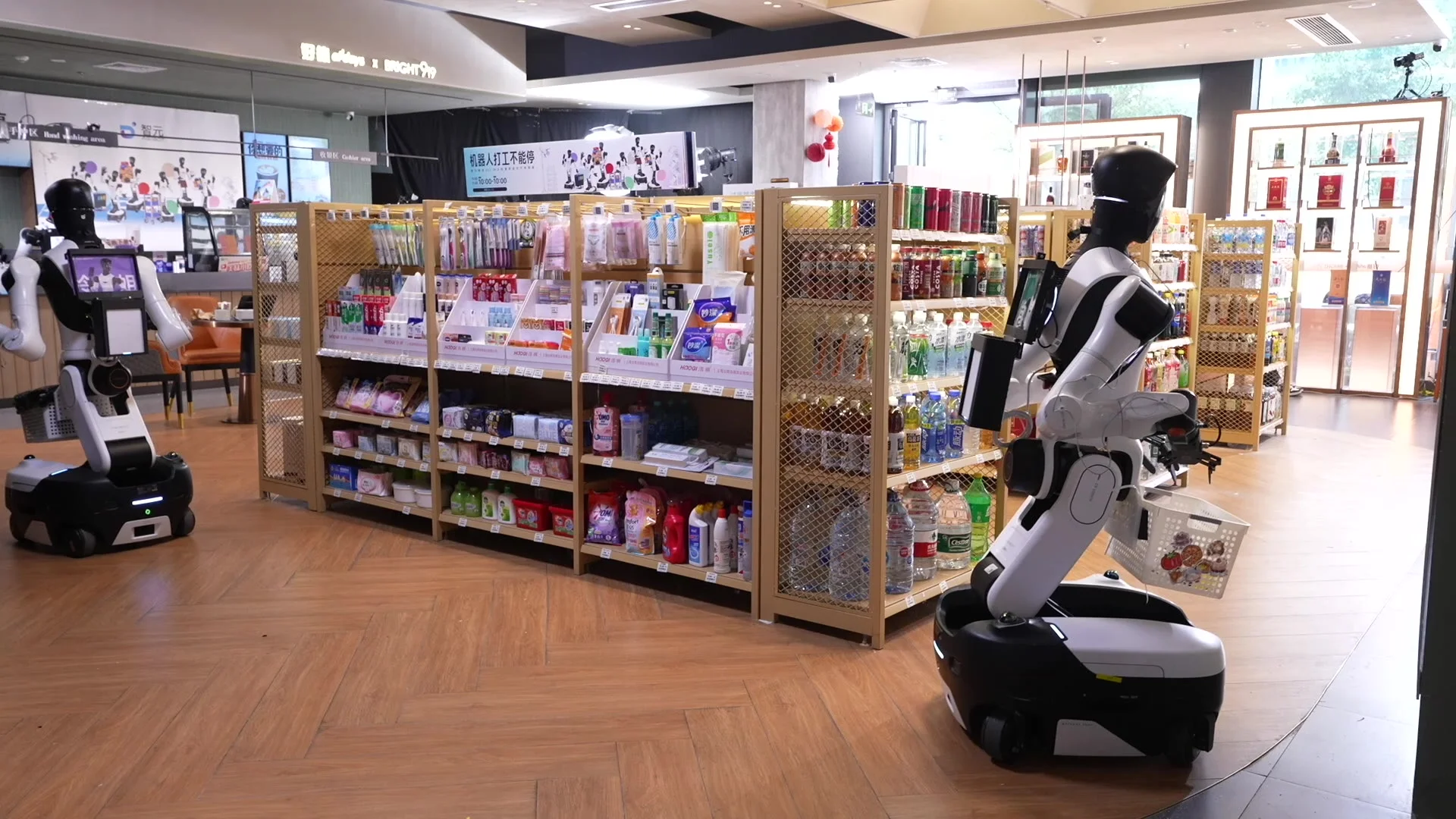
Six AGIBOT G2 humanoid robots worked a real 24-hour shift in an operating Shanghai convenience store and completed 1,730 tasks between them. The six wheeled humanoids worked from 10 a.m. on November 2 to 10 a.m. on November 3 in a store in Shanghai's Xuhui District, completing 683 customer-service interactions, 369 product pickups and deliveries, 147 coffee orders, 126 breakfast servings, 277 shelf inspections and restocking tasks, and 128 table-cleaning tasks. Four of the six passed the final assessment, which scored time on duty, task completion, customer feedback, response times and the handling of unexpected situations, with evaluators using look-alike products, rearranged shelves and a blocked aisle. AGIBOT's Genie Master framework coordinated the machines and fed the results of successful runs back into training.
Read more → https://www.humanoidsdaily.com/features/agibot-g2-robots-complete-1730-tasks-24-hour-convenience-store-trial
Small & On-Device Models

Fastino's GLiDE-0.4B is a 0.40-billion-parameter small model that answers typed decision questions in one forward pass at a 6.9-millisecond median. GLiDE 0.4B is an encoder model released under Fastino's community licence with bf16 weights and compute. Fastino reports a Decision Index 0.3.1 public suite score of 51.10, measured with the official kit on one RTX PRO 6000 at 6.9 milliseconds median latency per request. Given a state in text or JSON and one or more typed questions, it returns a probability for every option through a 255-way decision readout without generating text: "choice" over up to 255 named options, "noul" returning P(yes), and "score" for ordered levels. Questions in a request are scored together in micro-batches, prompts hold up to 7,999 tokens, requests with images are rejected, and the model is also served through Fastino's hosted API.
Read more → https://huggingface.co/fastino/GLiDE-0.4B

HDM-4B is a 4-billion-parameter small model that decides when thinking is worth paying for, matching a larger system at 72.5 percent lower latency. The authors propose "zero-or-T thinking": a model either answers from the implicit thinking inside one forward pass, generating no token, or performs full autoregressive reasoning at a cost of T tokens when that is worth paying. A hybrid decision model uses one frozen backbone for both modes, with a lightweight self-routing block estimating the "value of thinking" — the utility the slow mode adds over the fast one — and running slow only where that value exceeds a per-request price lambda. Where no per-decision label exists, as in episodic agentic tasks, Calibrated Decision Policy Optimisation trains the block from episode-level returns. On JevBench, HDM-4B scores 0.857 against Jev's 0.851, a 0.7 percent gain, at 0.179 seconds median against 0.652, or 72.5 percent faster; on MiniWoB, HDM-27B cuts token cost by 80.1 percent.
Read more → https://arxiv.org/abs/2611.16961
Papers & Research

A new paper bakes the cross-view attention of a decoder-only view-synthesis model into a lightweight MLP, rendering novel views up to 23 times faster. Decoder-only large view synthesis models with a KV-cache achieve state-of-the-art quality by regressing novel views from a neural network without reconstructing 3D geometry, while test-time training layers save computation but sacrifice quality. Test-Time Baking repurposes the fast-weight MLP of test-time training to learn the cross-view attention mapping explicitly from its input-output pairs rather than replacing attention entirely, keeping the same rendering efficiency while delivering higher quality. It also disentangles context tokens into camera-only context rendering tokens as input and context ground-truth tokens with image content as the mapping target, relieving the baked MLPs of the mismatch between context processing and novel-view rendering. The method achieves up to 23x rendering speedup with quality on par with the state of the art across several tests.
Read more → https://arxiv.org/abs/2611.17331

A new benchmark called WorldDraft asks whether a video model can render a 4D world that code has already built, and finds the best of twelve models leak up to 64 percent of conflicting source cues. Multimodal coding agents decouple 4D world construction from visual generation, repurposing video models from world generators toward generative renderers. A reliable generative renderer hinges on world preservation, retaining prescribed 4D kinematics and camera paths, and visual realization, persistently binding text-specified target attributes over time. WorldDraft comprises 432 strictly paired test cases across 48 executable 4D world families spanning six dynamic challenge categories, and its 3x3 factorial design crosses draft granularity from abstract proxy to previs with appearance alignment from neutral to conflicting under identical dynamics. Across 12 representative models the authors find world preservation and visual realization in stark operational tension, richer draft scaffolding anchoring structure while impairing appearance fidelity, and conflicting source cues triggering severe source leakage of up to 64 percent; they propose WorldDraft-Primer, a plug-and-play visual prompting strategy that improves both objectives across frozen video renderers.
Read more → https://arxiv.org/abs/2611.16217
News & Business
Corporate AI spending in the United States reached a new high in October, but growth slowed to 1.65 percent month over month as the heaviest users pulled further ahead of everyone else. The Ramp AI Index, which tracks AI spending among business customers of financial services provider Ramp, showed a 1.65 percent increase month over month in October 2026. The top one percent of companies by AI spending paid a median of 10,200 dollars per employee per month, up nine percent, while a typical company spent just 16 dollars and 32 cents, a slight increase of less than a dollar from the previous month. The index draws on payment data from more than 85,000 US companies, though free tools and usage through personal accounts may be missing, and Ramp warns that the customer base skews growth-oriented, tech-savvy and larger than US businesses overall, so AI adoption is likely overstated. Business customers' spending on OpenAI grew 2.1 percent month over month.
After Intelligence is a daily read on the models, machines and papers moving the field. Tomorrow: another 18. Send this to someone who still thinks scaling is the whole story.