In this edition
- Frontier & Text Models (4)
- Image & Vision (1)
- Video & World Models (2)
- Audio, Voice & Music (2)
- Robots & Embodied AI (2)
- Small & On-Device Models (1)
- Papers & Research (1)
- News & Business (2)
Fifteen stories this morning: a Chinese frontier model that never saw an Nvidia accelerator, a language model that paints 700,000 brushstrokes as Python, a driving world model that predicts its own top-down layout, and the small end of the stack where a 4B decider and an 80M voice model now both run on your own hardware.
Frontier & Text Models
 Meituan has released the weights of LongCat-2.5, a 1.6-trillion-parameter mixture of experts model trained entirely on Chinese silicon. The drop comes one week after the model's unveiling, with roughly 48 billion parameters active per token, API context up to one million tokens and responses up to 128,000 tokens across text, image and video input. The self-hosting guide specifies 194 Huawei Ascend Atlas A2 accelerators—2 for image processing, 64 for prompt ingestion, 128 for response generation—with no Nvidia guidance. Experts are quantized to 4-bit, lifting prompt throughput 43.3 percent and response throughput 42.77 percent versus 8-bit. It scores 88.4 on Terminal Bench v2.1 (behind Opus 5 at 89.1, GPT-5.6 Sol at 88.8, DeepSeek-V4.1-Flash at 90.6), 64.6 on DeepSWE (up from 9.7), 38.5 on Terminal Bench v4.0, and a table-leading 91.9 on BrowseComp run in Meituan's own environment. Released under MIT, with promotional API pricing near €0.27 per million input tokens and €1.07 per million output tokens; predecessor LongCat-2.0 was trained in late June on more than 50,000 Chinese AI chips.
 Gemini 4 Carbon is the first non-OpenAI model in a while to take the top of the MathArena benchmark, at roughly 15 times the cost of GPT-6.1 Sol. It knocked GPT-6.1 Sol from the top spot, with Claude Fable 5.2 placing second. OpenAI's models that allegedly solved equations like Navier-Stokes are not publicly available yet. Carbon's most common failure mode is exceeding the time limit; it almost never gives up, in one case launching a script that ran more than eleven hours without checking its progress. With the reasoning settings used in testing, Carbon cost roughly 15 times as much as GPT-6.1 Sol, and Fable 5.2 roughly 40 times as much.
Read more → https://the-decoder.com/gemini-4-carbon-takes-the-matharena-crown-but-costs-15-times-more-than-gpt-6-1-sol/
 Claude Fable 5.2 does not call an image model; it paints, writing 1,000 to 2,000 lines of Python that place hundreds of thousands of simulated brushstrokes. Unlike diffusion models that gradually refine noise, Fable 5.2 simulates the physical painting process—bristle texture, paint application, and mistakes it then paints over. Anthropic developer Jake Eaton demonstrated the approach on X: asked for a painting as hard to distinguish from a photograph as possible, the model produced a shopping cart in a parking garage using about 700,000 simulated brushstrokes, with no external image model and no pre-rendered or traced source images. After earlier Opus 5.5 attempts drew criticism for merely imitating existing art, Eaton had Fable 5.2 develop its own artist personas with fictional backstories and consistent styles. In an experiment by Anthropic engineer Michael Graczyk asking for a bird at sunrise, the 21-second video begins from exactly 111 strokes on a blank canvas; the first stroke used hex colour #30346a, a width of 90 pixels, and five slightly wobbling waypoints with about a seven-pixel wobble added on purpose. Strokes cannot be undone once placed, and between passes the model looks at the canvas and paints over its own mistakes.
Read more → https://the-decoder.com/anthropics-claude-fable-5-2-doesnt-generate-images-it-paints-them/
 OpenAI is reportedly close to solving the Hodge conjecture, the second Millennium Prize Problem it has been linked to. Reported by a person familiar with the matter, the company's Navier-Stokes solution remains officially unconfirmed. The Hodge conjecture asks whether certain geometric properties of shapes can always be described through simpler algebraic building blocks, and employees expect a solution soon. An announcement could be delayed because, after the PR crisis around Navier-Stokes, OpenAI wants to get the messaging right. The Navier-Stokes result used a variant of its next pretrained model, codenamed "Doug", likely at a cost of millions of dollars. Chief researcher Jakub Pachocki had said at the Astra launch that OpenAI would focus on agent work first rather than math, though some inside the company believe math results could feed back into that effort. The math community is described as more angry than impressed, with some mathematicians seeing their field under threat.
Image & Vision
 G-STAR is a text-to-image model that scales token capacity with spatial compression; its image generation runs at 2.5 seconds per image on a single H200. Discrete autoregressive models face a trade-off between long token sequences that preserve representation quality but slow generation and aggressive spatial compression that reduces capacity; the authors show via product quantization that under a fixed nominal information budget the group size should scale quadratically with the per-axis spatial compression factor. Their spatial-group co-scaling framework enables 32-times and effective 64-times compression while preserving strong reconstruction, understanding and generation, and a semi-autoregressive decoder combines parallel feature computation with lightweight causal modeling to handle intra-group dependencies. The highly compressed models perform competitively across five text-to-image benchmarks: GenEval, DPG-Bench, PRISM, LongText-Bench and Qwen-Image-Bench, and at 1024 by 1024 resolution deliver a 20-times speedup over prior discrete autoregressive models. It was posted to arXiv on November 8.
Read more → https://arxiv.org/abs/2611.13004
Video & World Models
ByteDance's Seedance 2.5 is a joint audio-video model for 30-second cinematic storytelling; its video generation supports reference control and editing aimed at production work. ByteDance calls it a next-generation audio-video joint generation model that creates videos up to 30 seconds in a single generation, with the option to extend twice, delivering smoother, more consistent motion and more realistic visuals. It understands reference videos more precisely, capturing intention, framing and cinematic language to move beyond motion transfer into creative interpretation, and its editing responds to a wider range of audio and visual requests. For professional production it adds white-model control, green-screen editing, professional camera movement and performance blocking. ByteDance listed it in its model changelog this week.
Read more → https://seed.bytedance.com/en/seedance2_5
 BirdDreams is a driving world model that jointly handles video generation and a schematic bird's-eye view, so scene layout becomes part of the predicted future. It is an autoregressive driving world model that jointly generates perspective video and a schematic bird's-eye-view video, attacking the problem that learning vehicle motion from perspective video alone is hard because motion is entangled with appearance and vehicles can be occluded. The BEV is rendered from scene annotations for training and depicts roads and vehicles as simple shapes at a fixed metric scale, giving a top-down view of positions and motion. Because layout is part of the predicted future, the model no longer needs future trajectories supplied as inputs, unlike prior work that conditions generation on layouts. It was posted to arXiv on November 10.
Read more → https://arxiv.org/abs/2611.14815
Audio, Voice & Music
 An 80-million-parameter text-to-speech model called Soprano now runs through llama.cpp, putting expressive 32 kHz speech inside a sub-1 GB local runtime. Soprano-1.1-80M is Apache-2.0 and needs under 1 GB of memory, generating up to 2000 times real time on GPU and 20 times real time on CPU with lossless streaming under 15 ms latency on GPU and under 250 ms on CPU. Version 1.1 shipped in January with 95 percent fewer hallucinations and a 63 percent preference rate over Soprano-80M, supporting infinite generation via automatic text splitting across CUDA, CPU and MPS on Windows, Linux and Mac. The ggml-org project published a GGUF build for llama.cpp on 16 November at 00:28.
Read more → https://huggingface.co/ekwek/Soprano-1.1-80M
 Microsoft's VibeVoice speech recogniser now has a local build too: an ASR model that adds speaker diarization across more than 50 languages under an MIT licence. Tagged for automatic speech recognition, transcription, diarization and speech-to-text, microsoft/VibeVoice-ASR has a paper at arXiv 2601.18184 and a language list spanning English, Chinese, Spanish, German, Japanese, Korean, French, Russian, Arabic, Hindi and dozens more. It has drawn 1,331 likes and 717,567 downloads on Hugging Face. The ggml-org project published its GGUF build for llama.cpp on 16 November at 00:30, minutes after the Soprano build and alongside builds of drama-3, ZONOS3-Mini and higgs-audio-v3-stt.
Read more → https://huggingface.co/microsoft/VibeVoice-ASR
Robots & Embodied AI
J.P. Morgan expects US humanoid robot production to reach 300,000 to 400,000 units by 2030 and about 1.5 million by 2035. Reported by Reuters on Thursday, the drivers named are labor shortages, improving economics and rising production capacity, with manufacturing, logistics and warehousing as the first markets. The bank estimates humanoid costs are nearing parity with labor and that running robots across multiple shifts could save a customer about $100,000 a year. It names hands, actuators, the robot's AI "brain" and production capacity as the binding bottlenecks, alongside AI training data and compute. Most US manufacturers outside Tesla are targeting 10,000 to 30,000 units a year; Figure built its BotQ plant for an initial 12,000 robots a year with a goal of 50,000, and Agility's Digit 5 bill of materials is planned to fall from about $150,000 at launch to a target of $30,000 at 10,000 units a year. Tesla began Optimus production in Fremont in October and expects deliveries to outside customers toward the end of 2027, wanting roughly 10,000 to 20,000 robots for its own training fleet first. Near-term picks are component suppliers Timken, ROBOTIS, Leader Drive, Orbbec and Cognex.
Read more → https://www.humanoidsdaily.com/news/jp-morgan-us-humanoid-production-400000-2030-forecast
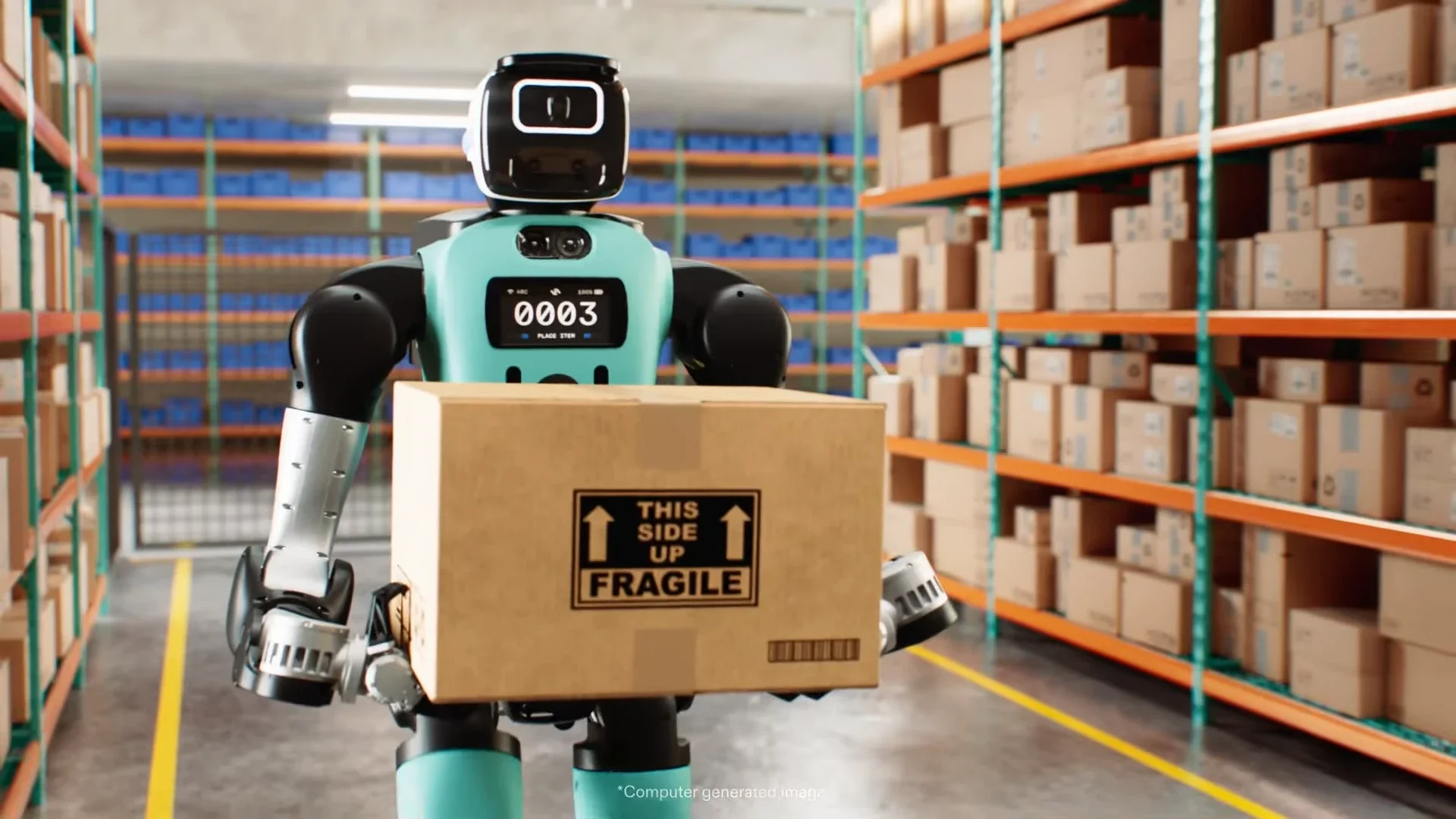 Agility's stock began trading on Nasdaq under the ticker AGLT, making the maker of the Digit humanoid the first pure-play robotics company listed in the United States. Its warrants list as AGLTW, following the November 4 completion of its merger with Churchill Capital Corp XI, a SPAC sponsored by former Citigroup banker Michael Klein. The deal and related financings raised about $465 million in gross capital before expenses, against more than $600 million projected when the merger was announced in June at a roughly $2.5 billion valuation; the financing includes a PIPE led by Foxconn and $100 million in pre-closing equity. Agility points to more than $300 million in multi-year Digit 5 orders tied to contractual milestones, while its S-4 showed $1.78 million in 2025 sales against a $138.1 million net loss. The "first" claim is limited to US exchanges: UBTech has been listed in Hong Kong since December 2023 and Unitree IPO'ed in August.
Read more → https://www.humanoidsdaily.com/news/agility-aglt-nasdaq-trading-debut
Small & On-Device Models
 Perplexity has released pplx-decider-v1.3, a 27-billion-parameter decision model, alongside a 4-billion-parameter flash variant distilled from it. Both are Apache-2.0. The 27B model is a multimodal classification model built on Qwen3.8-27B that needs about 49 GiB of BF16 weights plus working memory; it adds a capability called Locate, which pulls verbatim text spans out of the input state with character offsets and confidence scores. The flash variant runs on Qwen3.5-4B, needs about 8.5 GiB of BF16 weights, and shares the same request schema and API, including text, image and Locate support. Perplexity says to reach for it when latency or cost matters more than the last points of accuracy, and its decision types cover choice, yes-or-no and graded scores over criteria. The repositories are gated behind an authenticated Hugging Face token.
Read more → https://huggingface.co/perplexity-ai/pplx-decider-flash-v1.3
Papers & Research
 A Berkeley paper called SuperMimic trains a working motion tracker in 3 hours on a single GPU, where the previous baseline needed 7 days on 128 of them. Posted to arXiv on October 20 and listed as a CoRL 2026 oral, it is authored by Qiayuan Liao, Yiyang Shao, Junfeng Long, Kevin Zakka, Roberto Horowitz, Pieter Abbeel and Koushil Sreenath. It trains a tracking policy by backpropagating through a learned differentiable world model instead of model-free reinforcement learning, cutting GPU-hours by more than $1000\times$. On a benchmark of 129,514 motions it fails on 25 versus the baseline's 179; with 9.8 hours on two GPUs it fails on none, and the policy transfers to a physical Unitree G1 across diverse and acrobatic motions. No official code shipped with the paper; ETH Zürich's Chong Zhang published an unofficial reimplementation the next day, with InstantTrack, BlinkMimic and XMimic following on top of it. BlinkMimic reports 3.4 minutes on one RTX 4090 and XMimic 0.86 minutes on four H100s, both on a 40-clip benchmark in simulation, and none of the community projects reports a real-robot test.
Read more → https://arxiv.org/abs/2610.28480
News & Business
 Australia's central bank has built a monitoring system for AI's effect on jobs, and its first reading lands on young workers in software and customer service. The analysis, written by Mike Major for the Reserve Bank of Australia, targets where effects should appear first: entry-level workers and highly exposed occupations such as programming, clerical work and customer service. Job postings have fallen across all groups since ChatGPT launched in late 2022, with the steepest drop in the highest-exposure group, where workers aged 15 to 24 and young college graduates show weaker employment rates than older workers. Major cautions against early conclusions, since the study does not establish direct causation and measures theoretical exposure rather than actual company use. An August 2025 Stanford study of millions of US payroll records found employment among 22- to 25-year-olds in exposed occupations down 13 percent in relative terms since late 2022 and nearly 20 percent among young software developers, while experienced workers held steady.
 Days before what could be the largest IPO in history, Dario Amodei told a JPMorgan audience that compute is the deepest business dilemma his company faces. Speaking at a JPMorgan Chase investor event in New York on Friday, in conversation with Jamie Dimon, Amodei said "there's a huge uncertainty in what's going to happen next year." His argument: the technology is advancing so fast that nobody yet knows how that progress translates into economic value, but compute has to be bought one to two years ahead, before anyone knows whether revenue will justify the cost. Buy too little and there are no resources for customers and new technology; buy too much and "you can financially overextend yourself." The company has committed nearly $901 billion, most of it to compute and chips, according to Bloomberg, with roughly $71 billion due by September 2027, a figure Bloomberg notes exceeds the market capitalisation of about two-thirds of S&P 500 companies.
After Intelligence is a daily read on the models, robots and research that actually shipped — not the announcements that didn't.