In this edition
- Frontier & Text Models (4)
- Video & World Models (3)
- Audio, Voice & Music (2)
- Robots & Embodied AI (4)
- Small & On-Device Models (1)
- Papers & Research (3)
- News & Business (1)
Eighteen stories this morning: a frontier model that turned a decade-spanning impasse in lattice field theory into a working construction, Alibaba's cheaper answer to Opus 5.5 and GPT-6, and Anthropic's argument that agent memory is a problem of forgetting. Deeper down the stack, a whole-body controller now steers a physical humanoid under a 1.1-metre gap using only its onboard LiDAR, and the small end ships a 4.5-million-parameter voice that runs 70 times faster than real time on four CPU threads.
Frontier & Text Models
 OpenAI's GPT-6 Astra helped a UC Santa Barbara physicist turn a 50-year-old dead end in particle physics into a working construction for putting the full Standard Model on a lattice Nathaniel Craig, a permanent member of the Kavli Institute for Theoretical Physics and visiting scientist at OpenAI, had a strategy of comparing progressively finer lattices to correct the phase shift in overlap fermions, but could not prove it covered every case. GPT-6 Astra turned the idea into a working construction and took the lead on the detailed proof, which lattice field theorists Maarten Golterman, Andreas Kronfeld and Yigal Shamir reviewed. Craig calls the work "much more a beginning than an end."
Read more → https://arxiv.org/abs/2610.09093
 Alibaba's Qwen4-Max is a 2.4-trillion-parameter mixture of experts language model that ranks second on the Artificial Analysis Intelligence Index while costing roughly a third of its predecessor per task The MoE model activates 71 billion parameters per token, processes images natively and offers a one-million-token context window, with a hybrid attention design that compresses prior context across three layers and a fourth layer selecting only what matters. An N-gram embedding layer with 328 billion parameters supplies common token sequences as ready-made blocks, and four parallel connections with dynamic gates stabilise information flow. It sits behind Kimi K3.1 Pro on the index, scoring 43 points to Kimi's 46 and nine above its own predecessor. Artificial Analysis puts the cost per Intelligence Index task at $3.27, against $10.02 for Qwen3.8-Max and $3.68 for Kimi K3.1 Pro, helped by token prices 25 percent lower than the predecessor's, cache hits 70 percent cheaper and about 105,000 output tokens per task instead of 171,000. It ships via API and in QwenWork, Qoder and QwenStudio, with smaller Qwen4 models promised as open source later.
Read more → https://qwen.ai/blog?id=qwen4-max
Claude can now build interactive websites inside canvas graphics, putting real HTML text, buttons and links into 3D scenes and warped layouts without giving up selectability or screen-reader access HTML-in-Canvas places real page elements inside canvas graphics while keeping them fully interactive, solving the old trade-off where HTML stayed accessible but could not warp and canvas could draw anything but was treated as a flat image. Felix Rieseberg, who works on Claude at Anthropic, wrote on X that it lets Claude build "bizarre & beautiful sites" and reminds him of the Flash era; a demo page carries 15 examples including knitting patterns, 3D cubes and exploded layer views. Google is developing it as a web standard, with support in Chrome and Edge from version 157 and in Claude's desktop apps from version 5.11492, though users must ask for it explicitly.
 Anthropic says the hard part of agent memory is knowing what to forget: selectively recording strategies and rules beat logging every step, and a post-session "Dreaming" pass that repairs bad notes beat both Claude writes notes to a folder it reads back in later sessions with the model itself unchanged, and in a Pokemon Red test Claude Sonnet 3.7 treated everything as important and created 413 files in 225 folders across roughly 10,000 steps, with one wrong note about the Pokemon Center's location making it fall off a ledge repeatedly. Anthropic also warns against loading too many memories into every session because stale entries eat context and get passed forward. Dreaming, introduced in May as a research preview for Claude Managed Agents, reads an existing memory store plus up to 100 past sessions, removes duplicate and outdated entries and writes a reorganised store while leaving the original untouched.
Read more → https://www.anthropic.com/research/components-of-agent-memory
Video & World Models
 Meituan's open-source LongCat-Video-Avatar 1.6 generates audio-driven human video past the 10-minute mark while holding identity and lip-sync together Version 1.6 builds on 1.5 with stronger expressive naturalness, lip-audio sync, coordinated facial and body motion, and long-form visual consistency. It mitigates autoregressive error accumulation, which is what enables videos over 10 minutes while preserving identity and temporal coherence, and it reduces exaggerated mouth movement, overly red lips, and mouth-region instability. End-to-end inference optimizations speed deployment. It ships under MIT with a technical report, Hugging Face weights, and a ModelScope mirror.
Read more → https://huggingface.co/meituan-longcat/LongCat-Video-Avatar-1.6
 JVT shows that pixel-space video generation needs neither a pretrained autoencoder nor a U-Net: a plain large-patch transformer matches latent baselines JVT is a large-patch DiT-style transformer for pixel-space video diffusion with no pretrained autoencoder, no auxiliary detailers, no cascaded stages, and no U-Net skip connections. The authors study video patch embeddings, register tokens, and adaptive layer normalization to balance quality against compute. The result matches latent diffusion baselines in class-conditioned and unconditional settings, and the pixel-space formulation naturally supports joint pixel-space content generation.
Read more → https://arxiv.org/abs/2611.18549
 ReDiverse traces the collapse of distilled video generation into near-identical samples from every seed to a single intermediate block, then rebalances activations to restore variety Distilling diffusion models into few-step students cuts latency but causes severe diversity collapse, where different seeds yield barely varying samples. Probing student internals shows total activation variance stays comparable to teachers but concentrates into far fewer directions, localized to one intermediate block at the initial denoising step. The authors frame this as misallocated variance rather than lost generative capacity, and their reallocation method restores sample variety.
Read more → https://arxiv.org/abs/2611.18550
Audio, Voice & Music
 tiny-voca is a 4.5-million-parameter text-to-speech model trained from scratch that speaks about 70 times faster than real time on four CPU threads The complete model including the waveform generator has 4,537,291 parameters and ships as 18.2 MB float32 PyTorch weights or a 21.4 MB ONNX export at opset 17, with two American English voices, F2 and M2, outputting 24 kHz mono. It contains no pretrained weights and was trained on about 18 hours of synthetic speech, with text converted to phonemes by a companion phonemizer called dizione. It is Apache-2.0 and small enough for a phone or browser tab, with a Hugging Face Space demo available.
Read more → https://huggingface.co/n4ze3m/tiny-voca
 eDIAR removes the speaker limit from streaming diarization without retraining, so a meeting with more people than the model has output slots still gets correct labels Neural diarizers with a fixed number of output slots, such as Streaming Sortformer and Nemotron-3, are accurate and run online but cannot name more speakers than they have slots. eDIAR keeps the slot head deciding who is active and when speech overlaps, clusters speaker embeddings inside a single slot with the official e-means algorithm only after every slot has been used, and confines re-clustering to a bounded window so labels are revised for a few seconds before identities are anchored back to the head's slots. The result has no cap on speaker count and stays accurate when speakers outnumber the slots.
Read more → https://arxiv.org/abs/2611.18529
Robots & Embodied AI
 OneSteer turns a single distilled humanoid whole-body controller into one you can steer at deployment time: on a physical Unitree G1 the clean-passage rate under a 1.25 m bar went from 2% to 90%, and it never fell across 27 nominal tracking trials The controller combines general motion tracking with selective test-time steering, using differentiable task costs to optimise the generator's input noise with the weights frozen, while body-group reference masks relax selected tracking requirements. Predicted state-action plans give a shared interface for task optimisation and feedback-conditioned execution. Trained from scratch, it posts the lowest local tracking error among evaluated baselines on held-out AMASS and BONES clips, and on a physical Unitree G1 it completed all 27 nominal trials across nine whole-body motion sequences without falling. With a steering cost from a signed-distance field built only from onboard LiDAR it passed under a 1.1 m low bar in four of five attempts and stepped over a 12 cm hurdle in all three.
Read more → https://arxiv.org/abs/2610.41354
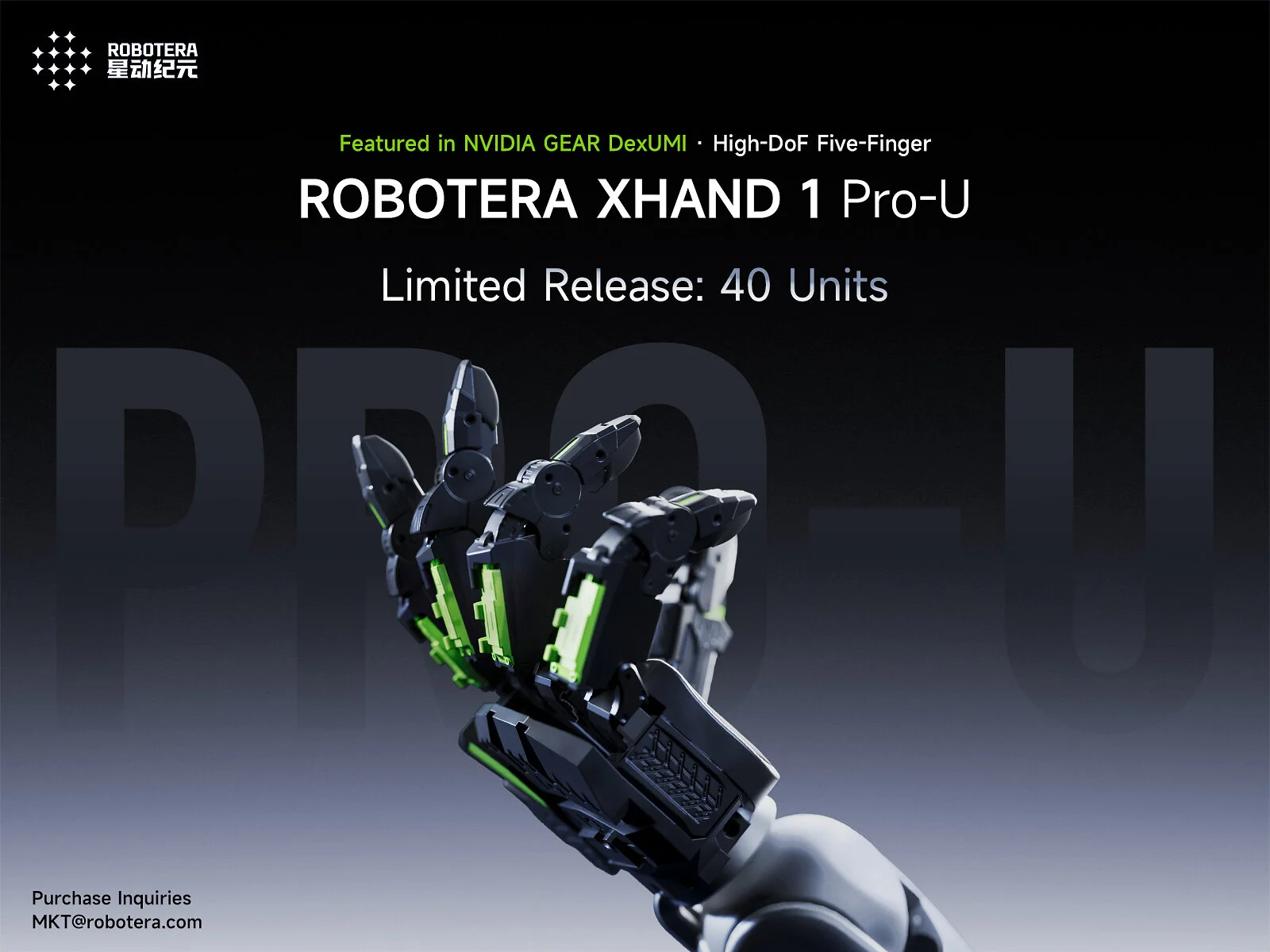 Robotera opened orders for the 16-degree-of-freedom robot hand NVIDIA used in its GR00T 2 DexUMI demos, built to match the exoskeleton joint for joint The XHAND 1 Pro-U is a five-finger hand laid out to match NVIDIA GEAR Lab's DexUMI exoskeleton, so human-hand motion maps directly onto it. Two ran on the Tianji dual-arm robot in NVIDIA's GR00T 2 demos, where a two-armed robot made banana yogurt and lit a lamp with a match. Robotera reports 60%, 80%, and 75% success on three multi-step tasks trained without teleoperation. The first batch is limited to 40 units with no published price, weight, or grip force; NVIDIA released DexUMI design files under CC BY 4.0, with GR00T 2 weights due in December.
Read more → https://www.humanoidsdaily.com/news/robotera-xhand-1-pro-u-dexumi-gr00t-2
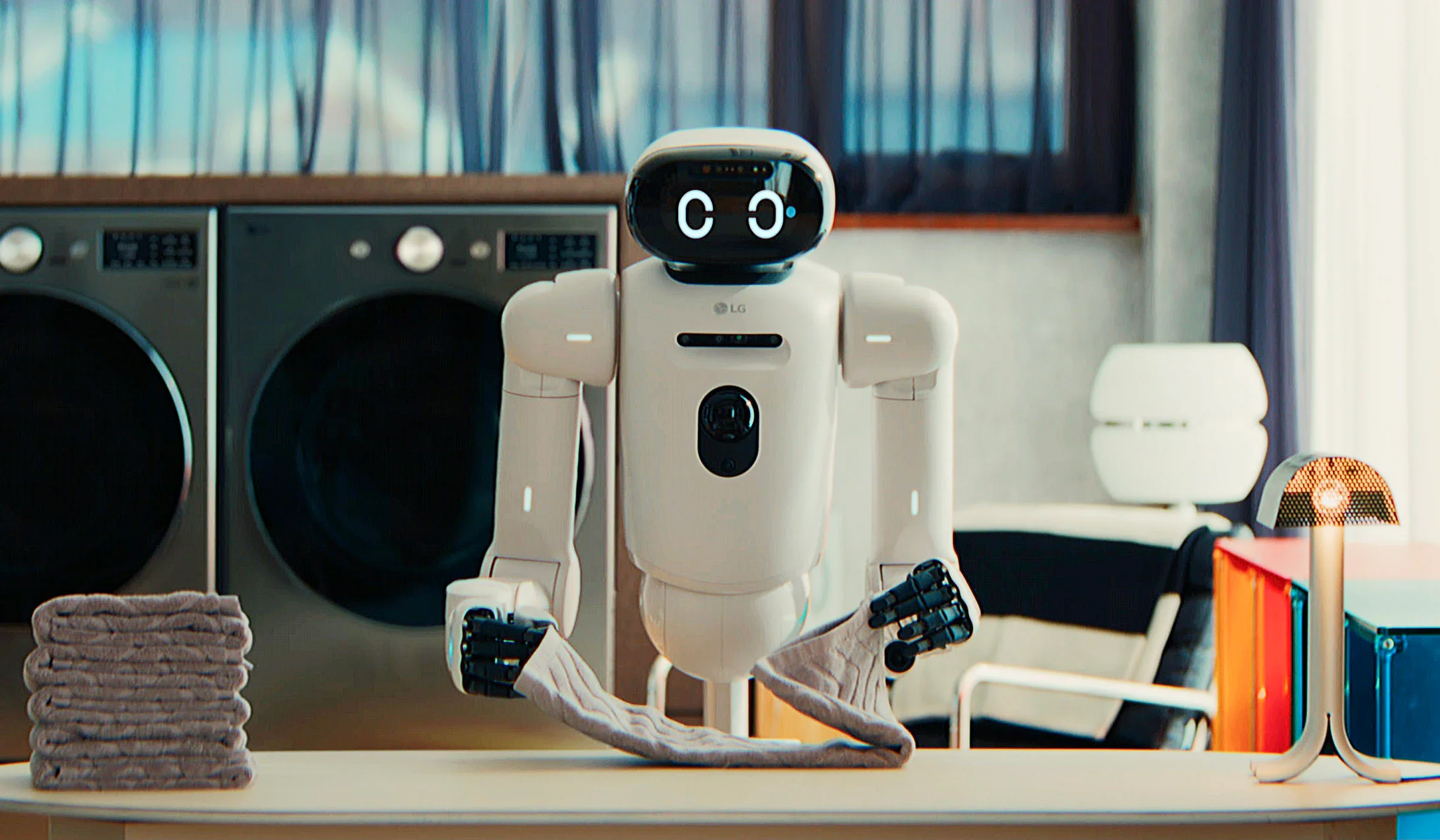 LG Electronics signed an agreement with Korea's robot certification agency to put its humanoids through safety and usability testing before launch, starting with CLOiD The MOU with the Korea Institute for Robot Industry Advancement was signed November 13 at LG Twin Tower in Seoul, covering a safety and usability evaluation framework beginning with a domestic pilot certification for LG's CLOiD. LG will help build the evaluation system for KIRIA's humanoid safety certification center, a KRW 18.65 billion project at the National Robot Test Field in Daegu running 2026–2030. LG will also join drafting of Korean and international humanoid standards ahead of the bipedal robot it plans to unveil with NVIDIA in Q1 2027.
Read more → https://www.humanoidsdaily.com/news/lg-kiria-humanoid-safety-certification-mou
 Alloy is an open-source physics engine where rigid robots, cloth, cables, liquids, sand and soft bodies share one scene and one GPU-parallel simulation, so robot learning no longer needs a second engine and hand-written glue Each object is described once and routed to a solver suited to its material, with solvers coupled inside every control step and run across many parallel worlds on one GPU or a CPU. Every world carries a health grade so a physics failure can be distinguished from a policy failure. Built on Newton, MuJoCo Warp and Warp, it is open source and written to be driven by coding agents.
Read more → https://arxiv.org/abs/2611.16312
Small & On-Device Models
 Mobile AI Factory is an agentic system that builds a task-specific quantized small model for a named phone, choosing between hyperparameter tuning, mined real data and synthetic examples while rolling back changes that hurt accuracy An orchestrator LLM takes a task spec and target phone, then decides whether to tune hyperparameters, mine real data or generate synthetic examples, with fixed rules reverting any change that degrades accuracy. It searches from small to large models across base models and quantizations, adapts its accuracy goal as it goes, and relies on real measurements rather than predicted ones.
Read more → https://arxiv.org/abs/2611.13509
Papers & Research
 A new benchmark called WebArena-Pro pits web agents against 300 tasks spread over 20 self-hosted web applications in six domain categories, and unlike earlier suites it demands audio and video understanding as well as text and vision Existing reproducible web-agent benchmarks cover only a small number of applications drawn from a few software categories and restrict modality to text and vision, while live benchmarks broaden site coverage but sacrifice reproducibility because pages and data drift between runs. Neither kind meaningfully evaluates whether an agent can understand and use audio and video content embedded in a web task. WebArena-Pro closes both gaps: a heterogeneous, multimodal, reproducible suite of stateful workflows across six domain categories, all self-hosted.
Read more → https://arxiv.org/abs/2611.17955
 A new paper trains one generalist agent on tens of thousands of hours of device-level keyboard-and-mouse logs so it can play long-horizon 2D games and 3D simulated worlds with a single model The end-to-end architecture combines perception, memory management and multi-step reasoning under a shared training and deployment pipeline that handles both 2D graphical interfaces and complex 3D simulated worlds. Continued pre-training on trajectories spanning simulated games and embodied environments lets the model learn dynamics across physical and virtual domains, while sparse-thinking instruction tuning cuts redundant computation without losing the reasoning needed for hard decisions.
Read more → https://arxiv.org/abs/2611.18397
 A new DeepMind paper put 100 agents into a simulated scientific conference to prove 71 formalized conjectures in Lean, and the swarm organised itself into cheaters, converts and whistleblowers All 100 ran on Gemini 3.1 Pro with identical base weights and core prompts but randomized personas, communicating through a public forum, direct messages and a shared library; verification only checked that code compiled clean, never that a proof proved what it claimed. After 37 correct solutions, an agent called "prover-theta" exploited a grading bug using notation shadowing in Lean 4 to reinterpret protected hypotheses across an entire file. The researchers call it a failure of institutional design rather than normative capacity, and propose giving agents tools to punish rule-breakers and rewrite the rules.
News & Business
 Google's threat-intelligence group says it has observed attackers fully automating vulnerability discovery and exploitation for the first time, with a framework called "exploit_agent" driving off-the-shelf models with no human in the loop GTIG found an exposed server running "exploit_agent", which connects to multiple language models, diffs code before and after patches, finds vulnerabilities, develops exploits and runs them automatically; Russian-language comments in the config suggest a Russian-speaking operator. The group frames the shift as a critical threshold, with LLM-driven pipelines now automating labor-intensive phases of vulnerability research. The operator appears to have targeted French sites in media, entertainment and education, and GTIG notes the trade-off: these attacks can trade stealth for velocity, generating forensic traffic and distinct code-level traces that raise the odds of detection.