In this edition
- Frontier & Text Models (3)
- Video & World Models (2)
- Audio, Voice & Music (2)
- Robots & Embodied AI (4)
- Small & On-Device Models (2)
- Papers & Research (2)
- News & Business (3)
Eighteen stories this morning: OpenAI ships a cheaper pair of frontier models that lands second on the intelligence index, Moonshot redirects Kimi from code to chemistry, and Shanghai AI Lab releases an open scientific model that checks its own work. Further down the stack, a 35-billion-parameter mixture-of-experts model activates 3 billion parameters per token at 256K context, Figure's chief executive puts household chores inside six months, and a long-video method learns to stop subjects drifting between shots.
Frontier & Text Models
 OpenAI released two frontier language models, GPT-6.2 Astra and GPT-6.2 Sol, cutting API prices while closing the gap to Anthropic's best. Astra is pitched at demanding scientific, legal and financial work, Sol at quick everyday tasks, and both are available to Plus, Pro, Enterprise and Edu users in ChatGPT Work and Codex. On the Artificial Analysis Intelligence Index Astra ranks second, just behind Claude Fable 5.2, while sitting on the cost-performance frontier. Astra costs $8 per million input tokens, $0.40 for cached input and $40 per million output, 20 percent below its predecessor; Sol holds GPT-6.1 Sol's $2, $0.10 and $10. OpenAI says Astra takes first place on the AA-3D benchmark with 1,318 Elo points, ahead of Claude Fable 5.2 at 1,271 and GPT-6.2 Sol at 1,259.
 Moonshot is redirecting its Kimi language models from coding toward biology, chemistry and pharmaceutical research. International director Giacomo Ficari said at Web Summit in Lisbon that science demands smarter models than law, finance or code, and that coding gains are flattening. Beijing startup DP Technology has integrated Kimi K3.1 Pro into its research assistant BioMaster; in one test the model analysed gene data from 3,696 mouse pancreatic cells and flagged 100 candidate genes in 90 minutes, against an estimated four hours of human work. Fully independent breakthroughs remain distant — on the 100-problem TCSExam benchmark, leading models produced verifiable proofs but cracked no open conjectures.
Read more → https://the-decoder.com/moonshot-ai-pivots-kimi-models-from-coding-to-science-as-benchmark-gains-flatten/
 Shanghai AI Lab released Sage S2.1 Flash, an open scientific language model built to check its analyses against intermediate output and visual feedback. Through the Sage SciPerception architecture it accepts more than ten kinds of scientific input, including molecular graphs, crystal structures and protein sequences, projecting each into a shared representation space. Across 15 benchmarks and six models it placed first on four and second on seven: it took MLE-bench Lite with 90.3, ahead of DeepSeek-V4.1-Flash-1017 at 89.2, and led OfficeQA Pro at 72.2, Harvey LAB at 25.0 and SpreadsheetBench 2 at 37.1.
Read more → https://huggingface.co/internlm/Sage-S2.1-Flash
Video & World Models
Découpage is a screenplay-driven video model that generates long, multi-shot cinematic video with dialogue and silence timed separately. In cinema, sound and picture transitions do not move in lockstep — dialogue bridges cuts and deliberate silences set pace — yet joint audio-video generators couple modality boundaries by default. Découpage uncouples generation into independently bounded visual and acoustic tracks governed by the script, which lets it hold long-range dialogue pacing instead of hallucinating speech during intended silences or driving mouth movement on a silent listener. The work was submitted to arXiv on 13 November 2026.
Read more → https://arxiv.org/abs/2611.18866
 Reference Forcing is a long video generation method that anchors every new frame to the opening frames so subjects and backgrounds stop drifting. Autoregressive video models are typically distilled with distribution-matching distillation over short windows, which does not teach them to hold consistency over long ranges, so the subject and background slowly drift. Reference Forcing builds a teacher video model that uses attention masks to force each region of a new frame to attend to the same region in the initial frames, finds those regions with off-the-shelf segmentation models, and distils the behaviour into a separate attention path of the student so no external model is needed at inference. A value-correction step then pulls drifted values in the KV cache back toward the matching drift-free initial frames. The work was submitted to arXiv on 16 November 2026.
Read more → https://arxiv.org/abs/2611.21559
Audio, Voice & Music
A new audio model called Think2Listen teaches a speech model to ask for the acoustic evidence it needs before committing to an answer. Large audio-language models can recognise what is audible but often cannot say which cue resolves an uncertain judgment, and tool-based agents only invoke predefined audio tools. Think2Listen couples iterative reasoning with targeted model interaction, learning what to ask, how to weigh the observation returned and when to stop, with training credit assigned by how much each observation shifts the candidate answer. The work was submitted to arXiv on 16 November 2026.
Read more → https://arxiv.org/abs/2611.21083
ProSing converts one singing technique into another inside an existing recording while keeping lyrics, melody, timing and the singer's identity intact. The system adapts a pretrained flow-matching acoustic model with frame-level technique conditioning, so a technique can be applied to selected regions rather than a whole track. To stop the model learning shortcuts from its conditioning signal, the authors use a paired training strategy that forces generalisable technique representations. It targets zero-shot use in a setting where technique-annotated singing data is scarce.
Read more → https://arxiv.org/abs/2611.19223
Robots & Embodied AI
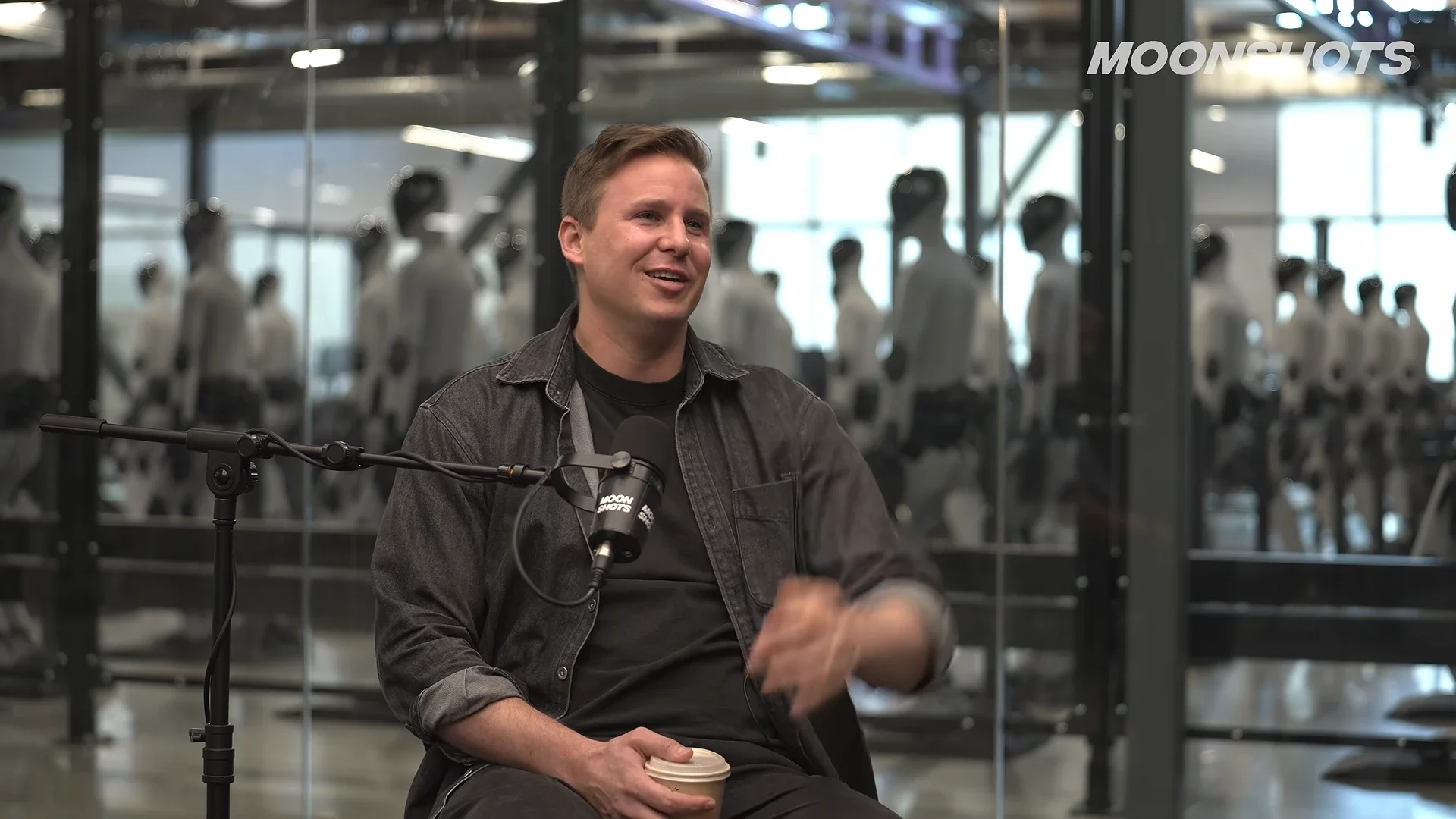 Figure's chief executive says a humanoid robot could handle multi-hour household chores in an unfamiliar home within six months. Brett Adcock gave the estimate on the Moonshots podcast after hosts were shown an early Helix 3 build in the closed test lab Figure calls Blackbox. He said Figure has well over a thousand robots on a campus of 700 to 800 employees, and that its BotQ factory can build about 40,000 robots a year at full rate across four lines. Single tasks such as making a bed or unloading a dishwasher already work from open-ended prompts; chaining them into hours of work is the next step, with consumer sales gated on proving safety and reliability and a lease of roughly $300 to $500 a month as the target.
Read more → https://www.humanoidsdaily.com/news/brett-adcock-moonshots-helix-3-homes-six-months
 Google published robotics results for Gemini 4 Hydrogen and shipped an open-source robotics plugin for its Antigravity coding environment. On 15 embodied-reasoning tests Hydrogen averages 84.8, against 75.5 for Gemini Robotics ER 2, and Google reports 58 on Artificial Analysis's AA-Robotics arm benchmark versus 55.3 for Gemini 4 Argon and 69.4 for GPT-6 Astra. The plugin handles arm bring-up over USB, builds MuJoCo simulations from chat and runs the same controller code in simulation and on hardware, with support for the I2RT YAM, LeRobot SO-101 and Franka FR3 Duo. Hydrogen costs $1.50 per million input tokens and $7.50 per million output in the Gemini API.
Read more → https://www.humanoidsdaily.com/news/gemini-4-hydrogen-robotics-antigravity-plugin
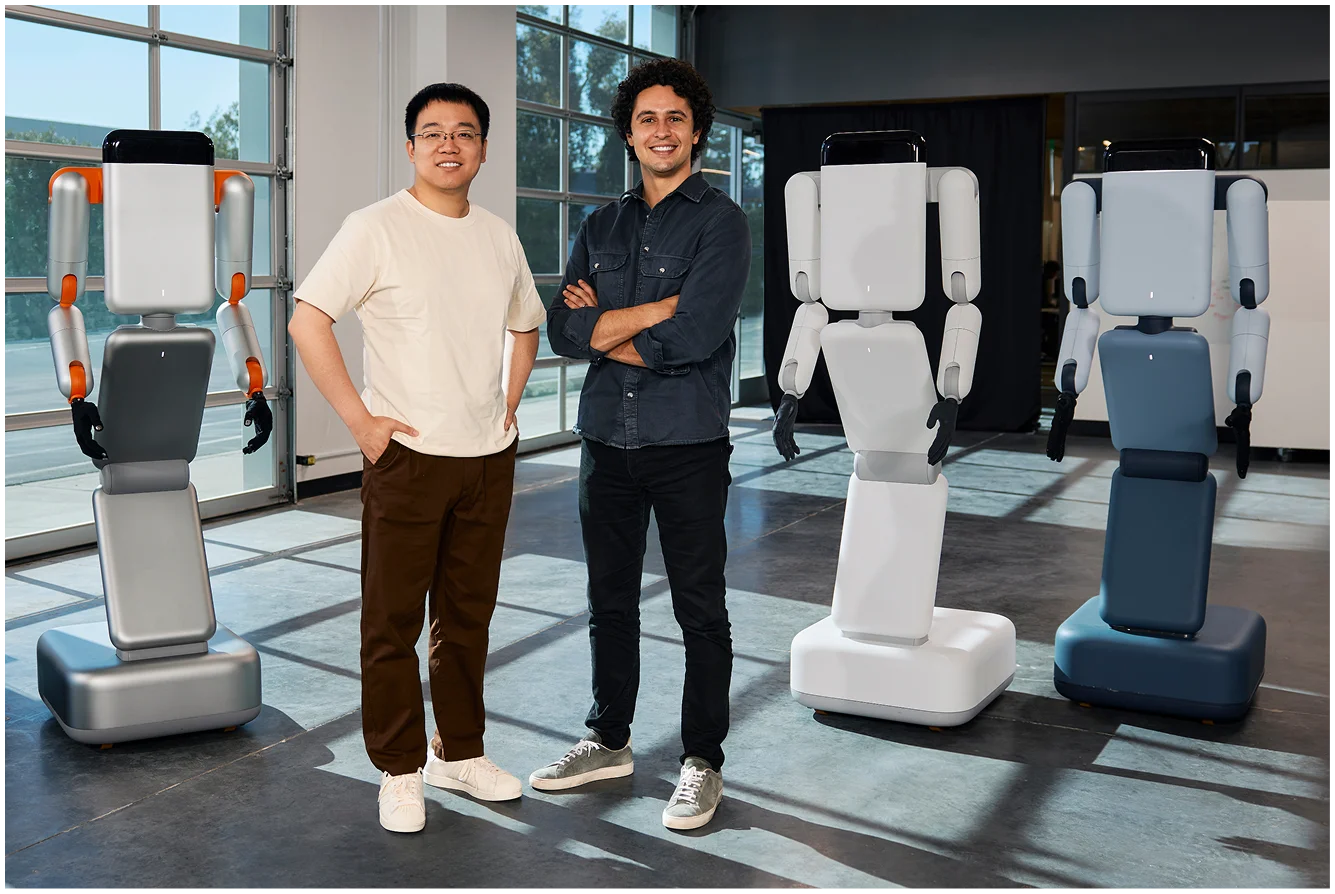 Genesis AI raised a $500 million Series A at a $3.5 billion post-money valuation to put its wheeled two-armed robot Eno into production. The round brings disclosed funding to about $605 million including a $105 million seed and was co-led by Premji Invest, Khosla Ventures and Eclipse, with NVIDIA, AMD Ventures, Samsung Next, Ericsson, Zoom and Bpifrance taking part. The Paris- and San Carlos-based company says it is ramping Eno production and will deploy first in manufacturing, logistics and laboratories, then hospitality and healthcare. It builds the whole stack in-house, from hardware and controls to the GENE model and the Genesis World simulator.
Read more → https://www.humanoidsdaily.com/news/genesis-ai-raises-500m-series-a-at-3-5b-valuation
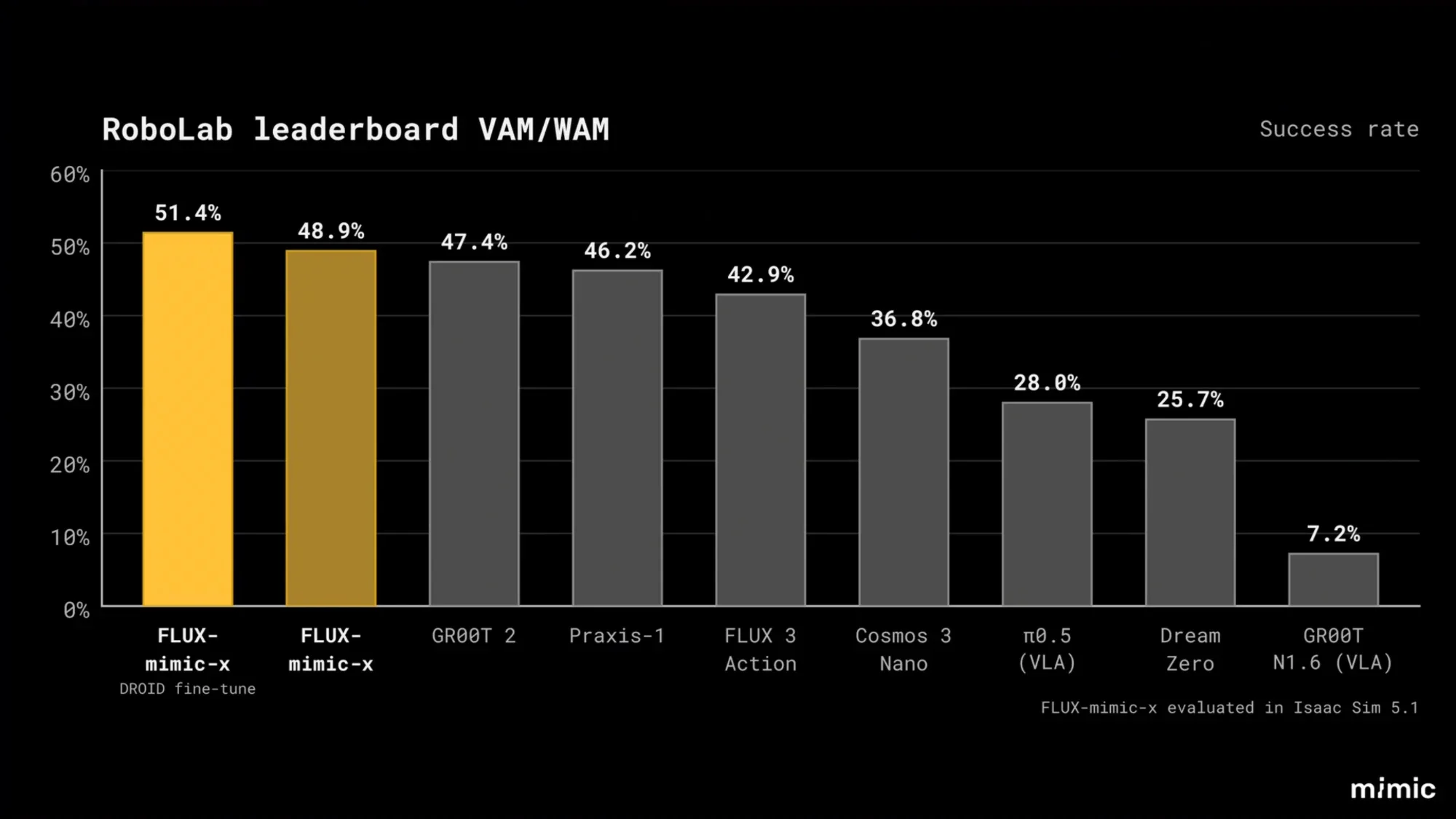 Mimic Robotics previewed FLUX-mimic-x, a 7-billion-parameter robot policy built on Black Forest Labs' FLUX 3 video model. Mimic reports a 51.4 percent success rate on NVIDIA's RoboLab simulation benchmark, which it says is the highest among real-time "system 1" controllers, ahead of NVIDIA's GR00T 2 at 47.4 percent, Runway's Praxis-1 at 46.2 and FLUX 3 Action at 42.9. About 37 percent of training data comes from bimanual robots with dexterous hands and a quarter is human video without action labels; no simulation data was used. The caveat is thin evidence — the announcement is a post on X and three slides, with no paper, blog or weights published yet.
Read more → https://www.humanoidsdaily.com/news/mimic-robotics-flux-mimic-x-robolab
Small & On-Device Models
 Maxwell-V1.0-Flash is a 35-billion-parameter mixture-of-experts small model that activates just 3 billion parameters per token. It ships under Apache-2.0 with a 256K-token context window after roughly 26 trillion training tokens. Its block-sparse attention caps main attention at 4,096 tokens per KV group while the full-history cache stays available, and the team reports the kernel runs 6.7 times faster than dense grouped-query attention at 256K. The pitch is long-context, agentic work at a practical inference cost rather than leaderboard bragging.
Read more → https://huggingface.co/maxwell-model/Maxwell-V1-Flash
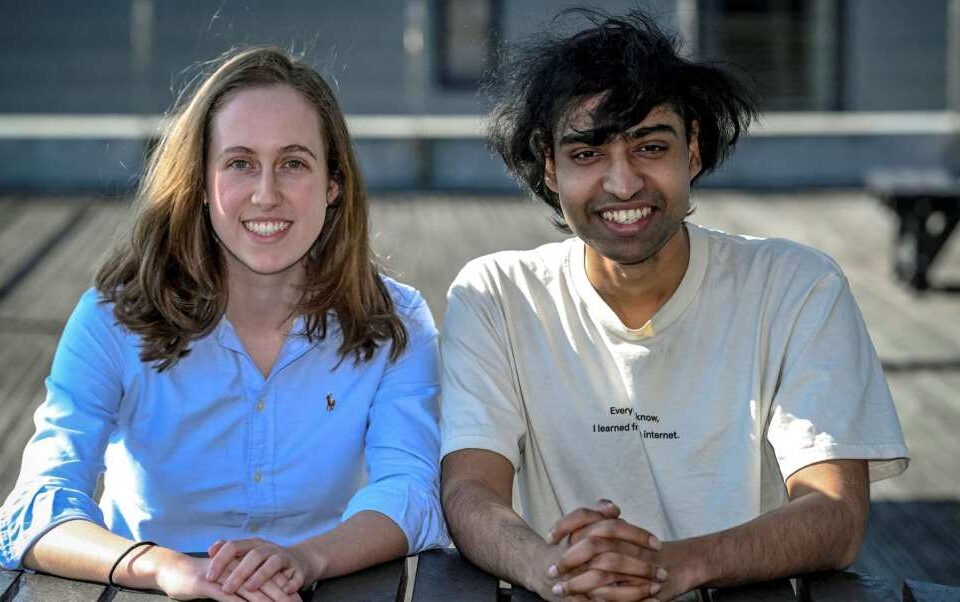 An eight-person Cambridge startup raised $3 million after its small model family beat larger systems from major labs in head-to-head tests. Sqwish Labs builds the kettei family, which returns structured answers and confidence scores instead of paragraphs of text — aimed at agents making thousands of decisions without a human in the loop. Cambridge Enterprise Ventures led the pre-seed, with Parkwalk participating and Innovate UK backing the company. Sqwish says its largest model, kettei fat, ranked first for capability among hosted decision models on the independent JevBench platform in its October 29 results.
Papers & Research
 A research paper called ScaleVLA connects a 552-billion-parameter language model to a trainable action head and finds that scale buys real dexterity. The researchers compared vision-language backbones from 2 billion to 552 billion parameters under one training setup, pairing each with an action diffusion transformer. With the largest backbone, ten demonstrations beat a 2-billion-parameter model trained on 50 (87.8 against 85.6 percent), LIBERO-PRO success reached 45.1 percent versus at most 31.3 for smaller backbones, and a real-world charger-insertion task improved from 4 of 10 successes to 9 of 10. Median latency stayed at 216 milliseconds.
Read more → https://arxiv.org/abs/2611.21607
QTOP improves humanoid whole-body motion tracking by treating it as a distributional reinforcement-learning problem. The authors argue that motion tracking is compute-bound because training on diverse motions introduces learning interference, similar to multi-task reinforcement learning. QTOP adds a distributional advantage estimate conditioned on state and reference pairs, and beats on- and off-policy baselines by up to 10 percent in simulation and in real-world tracking across multiple datasets. It also establishes a scaling law for the method and finds dataset size has minimal impact on performance at moderate GPU-hour budgets.
Read more → https://arxiv.org/abs/2611.20791
News & Business
 Isomorphic Labs raised $5 billion in its second mega-round in six months to push its drug-design engine toward clinical trials. Greenoaks and Sequoia Capital co-led, with Andreessen Horowitz joining alongside Alphabet and all existing investors, after a $2.1 billion round in May 2026. The money goes to IsoDDE, the company's drug design engine, which it says goes beyond AlphaFold 3 in predicting binding and docking sites. Isomorphic works with Novartis, Eli Lilly and Johnson & Johnson but has no approved drug; it is led by Demis Hassabis, who moved from day-to-day leadership of Google DeepMind to Alphabet chief scientist in August 2026.
Read more → https://the-decoder.com/isomorphic-labs-raises-5-billion-in-its-second-mega-round-within-six-months/
 An AI-assisted researcher found a critical OpenJDK vulnerability in about an hour and had a working exploit two hours later for under $200 in model tokens. The flaw, tracked as CVE-2026-114938 and nicknamed Java4Shell, carries a critical 9.2 severity score under CVSS 4.0 and could allow unauthenticated remote code execution under certain conditions, according to the security firm Calif. Java underpins roughly 90 percent of Fortune 500 companies, an IBM figure the firm cites, though that does not mean every deployment is exposed. Technical details were held until Oracle shipped a patch.
 US export regulators moved to close the cloud loophole that let Chinese firms rent advanced AI chips in third countries. The Bureau of Industry and Security's interim rule aligns remote-access rules with existing physical export bans: data centre operators in Singapore, Malaysia, Thailand, Indonesia and Brazil will need a US licence to buy advanced AI chips, with applications reviewed case by case. Subsidiaries of US-headquartered companies, and centres running only commercial recommendation systems for retailers or social platforms, are exempt. Nvidia's stock fell as much as 2.9 percent after the announcement and the Philadelphia Semiconductor Index dropped up to 5.5 percent.