In this edition
- Frontier & Text Models (4)
- Recursive Self-Improvement — Research (1)
- Video & World Models (2)
- 3D & Reconstruction (1)
- Audio, Voice & Music (2)
- Robots & Embodied AI (3)
- Small & On-Device Models (3)
- Papers & Research (1)
Anthropic completed the largest listing in the history of the technology industry, then watched the shares fall back toward the offer price within a day. Alongside that, Google shipped a background computer-use agent for the Mac, OpenAI published a chemistry benchmark and a candid report on how much of its own research now runs through coding agents, and three new open models arrived at three very different scales. Seventeen items, from a frontier listing of $93.5 billion to an 82-megabyte voice model that runs on a CPU.
Frontier & Text Models

Anthropic closed its initial public offering at an offer price of $83 a share, raising $93.5 billion in gross proceeds and lifting total new financing to roughly $119.5 billion.
The offering comprised 1,127,000,000 Class A shares at $83.00, including the full exercise of the underwriters' option for 147,000,000 additional shares; approximately $91.6 billion was received by Anthropic. Class A stock began trading on the Nasdaq Global Select Market on November 19, 2026 under the symbol "ANT". Separately, Anthropic closed the sale of 313,253,007 Class N shares at $83.00 in a private placement to AMD, Broadcom, Google, Micron, Microsoft, NVIDIA and TSMC, about $26 billion. The stock opened Thursday at $111.50, closed its first session at $97.17, then fell about 13.5% in midday trading Friday to slightly above $84.
Read more → https://www.anthropic.com/news/ipo-close
OpenAI released MedChemBench, a 99-problem benchmark drawn from published medicinal-chemistry research, and its newest model leads it at 84.5%.
At the xhigh reasoning setting, GPT-6.2 Astra earned 84.5% of the available credit, against 83.3% for GPT-6 Astra, 82.0% for GPT-6.1 Sol and 58.2% for GPT-5.6 Sol. The tests ask whether a model can connect a molecule's structure with experimental evidence to explain results, compare compounds and predict their properties. GPT-6 Astra was strongest at reconstructing molecular structures and explaining experimental evidence.
Read more → https://openai.com/index/introducing-medchembench/
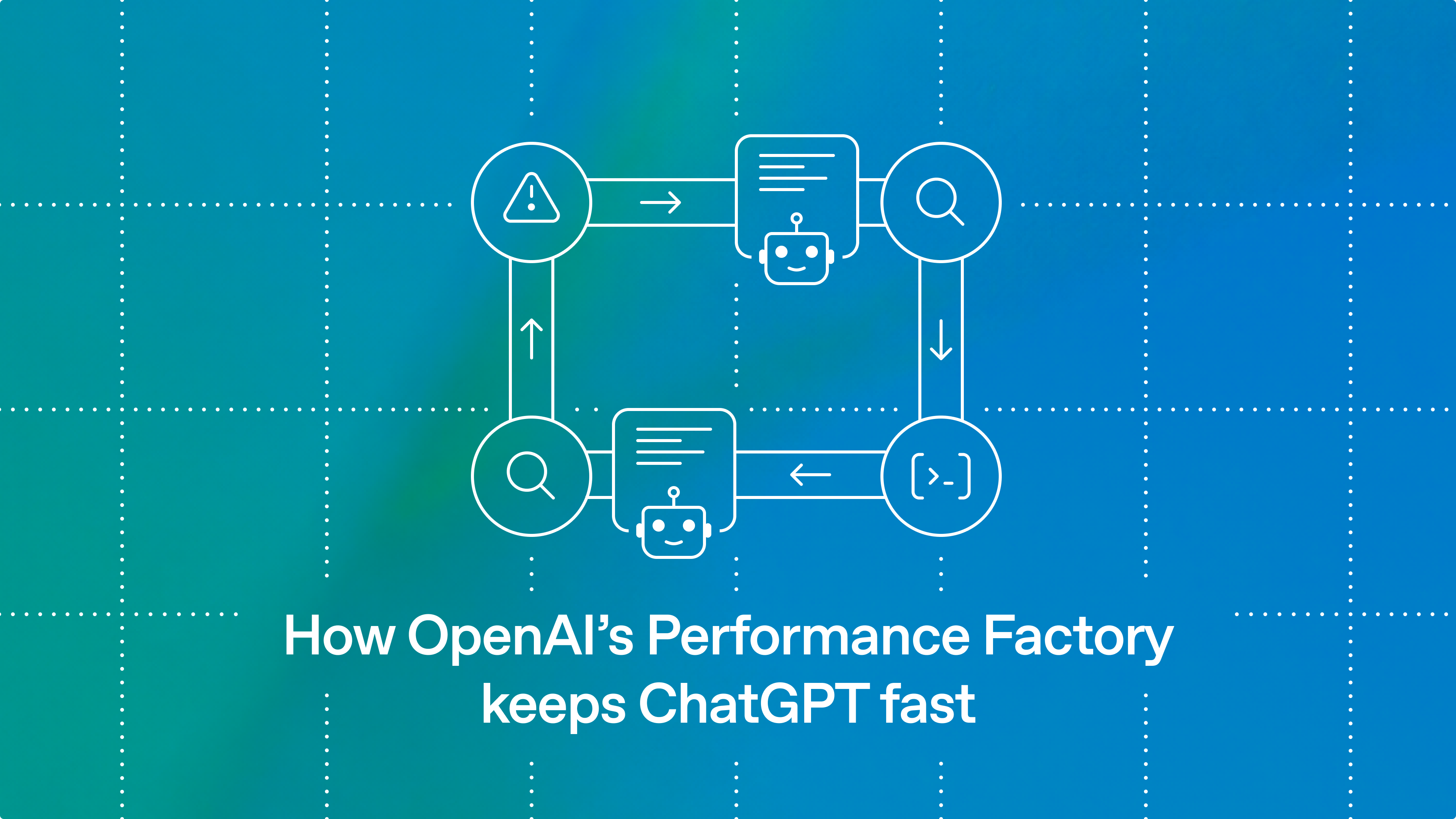
OpenAI's Codex-powered Performance Factory ran more than 1,700 automated performance investigations in just over three months and root-caused over 600 of them.
That works out to 17 automated investigations every day. A Regression Workflow opens a task when a performance alert fires; an agent investigates the slowdown, records its findings in the task and proposes a fix for an engineer to review. After deployment, another agent picks up the same task to check whether performance returned to baseline. It runs in the cloud and automates investigating and resolving performance problems.
Read more → https://openai.com/index/how-openai-performance-factory-keeps-chatgpt-fast/
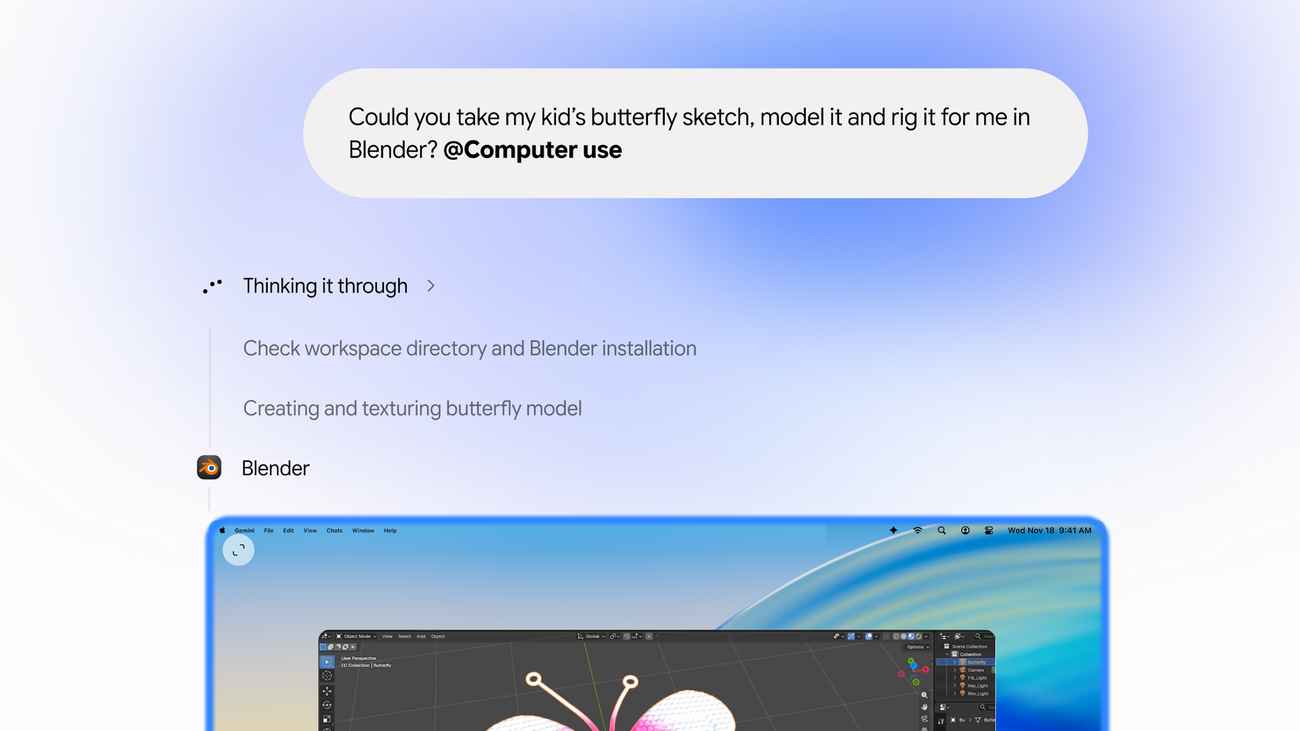
Google shipped computer use in the Gemini app for Mac, letting the assistant click and type through local apps and websites in an isolated background window.
Announced November 19, 2026, Gemini navigates menus, types information and clicks through apps to finish multi-step work across local files, desktop apps and the web. It runs in a separate window with a live preview inside the chat, so the main screen and cursor stay free. The user approves every action and chooses exactly which apps Gemini may access, and can pause at any time; it is initially English-only for eligible users in the United States. Separately, Bloomberg reported that Apple had been recruiting a senior engineering manager for an autonomous agent that could control Macs, browse websites and run applications; Apple later removed the listing.
Read more → https://blog.google/innovation-and-ai/products/gemini-app/computer-use-mac/
Recursive Self-Improvement — Research
OpenAI published a second research-acceleration report, disclosing that its median researcher now spends about $2,400 a day on agentic AI tools.
At API list prices, the median researcher now uses around $2,400 a day on agentic AI tools and the 90th percentile researcher around $23,000 a day, up 62% and 105% respectively from $1,500 and $11,000 in September. OpenAI defines one "agent workday" as eight hours of agent use and counts agent workdays per researcher per day. The report argues AI labs should be required to track and publicly report indicators of recursive self-improvement (RSI), while stating the reporting should not be read as an intention to pursue full RSI.
Read more → https://openai.com/index/research-acceleration-jagged-frontier/
Video & World Models

AURA 1.3B is a streaming video model that turns live audio into a talking head at 20.7 frames per second on a single GPU.
Built for low-latency online generation, it produces video chunk by chunk with a rolling KV cache and needs only the audio of the current chunk to start generating, avoiding the multi-second look-ahead bidirectional models require. AURA 1.3B streams 576p video in real time on a single GPU at 20.7 fps for a 16 Hz playback rate, while AURA 5B streams 720p at 9.7 fps. A two-stage distillation pipeline first aligns the causal student with the teacher by training it to match the teacher's trajectories.
Read more → https://arxiv.org/abs/2611.26540

SpecWM is a training-free inference framework that speeds up a streaming world model by checking draft chunks against the target model's own latent velocity field.
Existing speculative methods pair a small fast draft model with selective regeneration of rejected chunks, judged by rewards on decoded frames, but that verification covers only the external scorer's dimensions, adds decoding and scoring costs, and supplies no correction. SpecWM instead verifies draft chunks using the target's latent velocity field, and that same verification yields a reusable correction. Two thresholds choose among Accept, Refine or Reject, and a one-step refinement pass reuses the signal to improve the output rather than discarding the chunk.
Read more → https://arxiv.org/abs/2611.26211
3D & Reconstruction

Direct3D-V3 removes the VAE entirely and runs 3D generation directly on raw SDF voxel grids.
It is a latent-free diffusion transformer framework that skips the compression step every latent 3D method relies on, modelling raw SDF voxel grids during both training and sampling. An implicit manifold regularisation over neighbouring voxels suppresses non-watertight surfaces, and predicted SDF grids are converted to meshes with Marching Cubes so rendered normal losses can supervise the model directly. It also predicts the camera parameters of the conditioning image as an auxiliary task, and extends to generative reconstruction by interleaving diffusion with normal-guided refinement.
Read more → https://arxiv.org/abs/2611.26511
Audio, Voice & Music
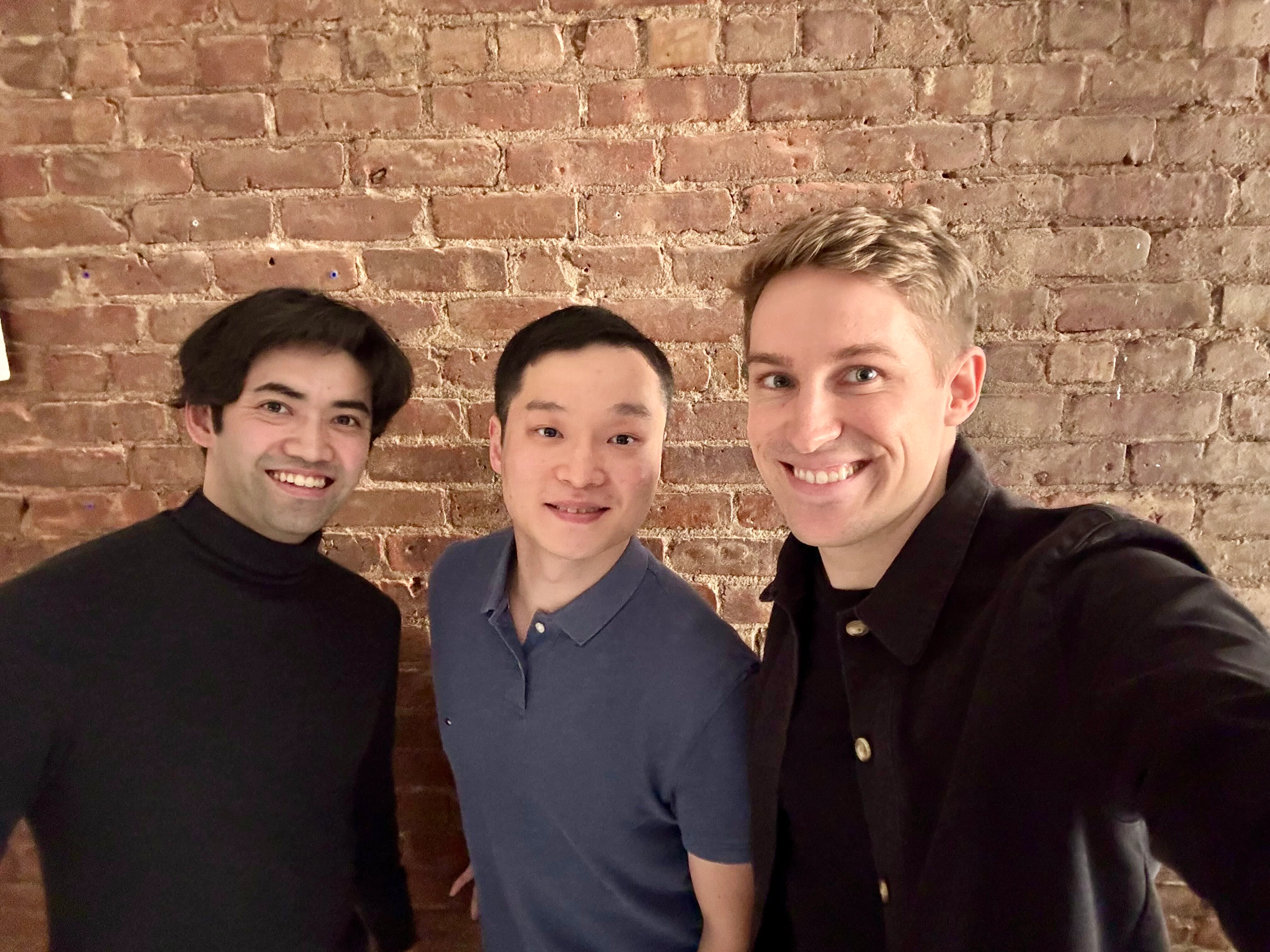
ElevenLabs is acquiring Kotoba, the Japanese voice lab founded in 2023 by AI researchers Noriyuki Kojima and Jungo Kasai.
ElevenLabs calls Kotoba the leading Japanese voice AI lab and says the deal is meant to accelerate adoption of AI agents and voice interfaces in the world's fourth-largest economy. ElevenLabs notes that Japanese sentences do not always contain a subject and an object, that vocabulary shifts with who is being addressed, and that pauses signal thought rather than awkwardness. CEO Mati Staniszewski framed it as making AI natural to interact with in every language and culture.
Read more → https://elevenlabs.io/blog/kotoba

Kitten TTS 2 Mini is an 82-million-parameter text-to-speech model that covers 16 languages and 118 voices at 24 kHz.
It ships as ONNX with int8 weights (82.7 MB) or int4 weights (47.5 MB), both running on CPU without PyTorch; float32 PyTorch weights are also published under Apache 2.0. Supported languages span English, German, Spanish, Italian, Portuguese, Russian, Hindi, Danish, Finnish, French, Japanese, Korean, Dutch, Swedish, Swahili and Turkish. Each voice sets its own language, and callers pick a voice by name.
Read more → https://huggingface.co/KittenML/kitten-tts-2-mini
Robots & Embodied AI
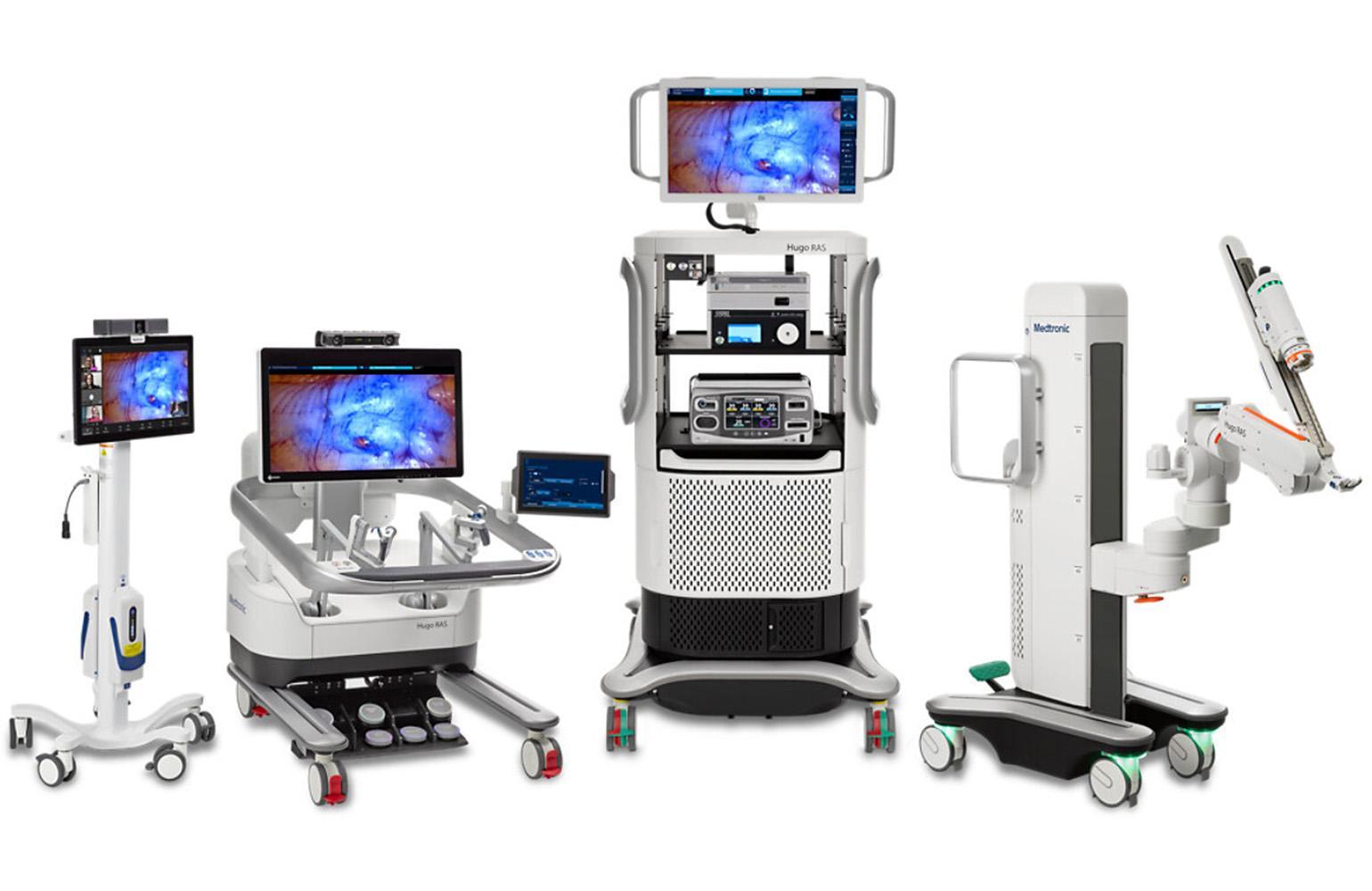
Medtronic won FDA clearance for its Hugo surgical robot to perform general surgery across the abdomen.
The clearance covers upper abdominal procedures including cholecystectomy, Roux-en-Y gastric bypass, ventral hernia repair and small bowel resection, plus lower abdominal procedures of inguinal hernia repair and appendectomy. Medtronic says those procedures account for about 3.5 million surgeries annually in the United States. Hugo is a modular, cart-based system that lets surgeons use only the robotic arms a given procedure needs. Medtronic began its US clinical journey in February of last year with a urology indication.
Read more → https://www.therobotreport.com/medtronics-hugo-surgical-robot-ready-for-bigger-operation/
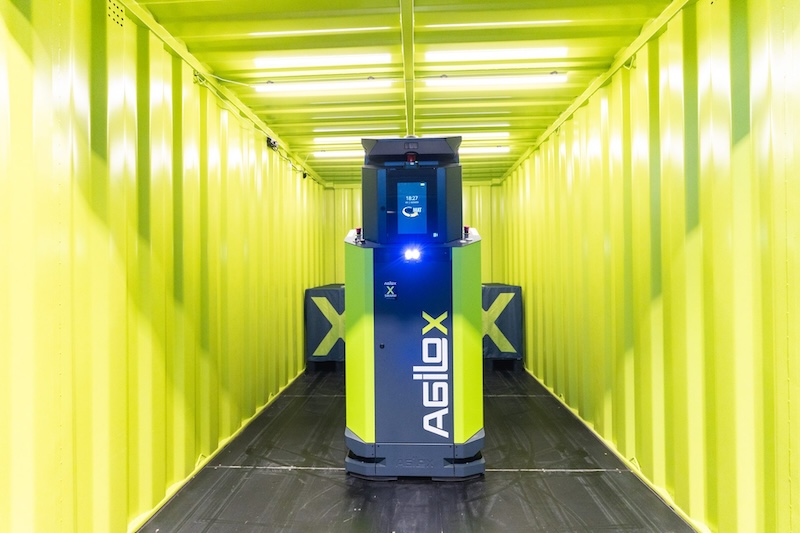
Rockwell Automation agreed to acquire AGILOX, an Austrian maker of autonomous mobile robots, more than doubling its AMR business.
Rockwell signed a definitive agreement; financial terms were not disclosed and the deal is expected to close in the second quarter of Rockwell's fiscal 2027, subject to regulatory approval. AGILOX has deployed more than 2,500 autonomous mobile robots worldwide since its founding in 2017 and has more than 250 employees with operations in Europe, North America and China, serving automotive, third-party logistics, food and beverage, and pharmaceutical customers. Rockwell said the combination pairs OTTO Motors' North American presence with AGILOX's European customer base. The deal marks an exit for Carlyle, which took a major growth investment in AGILOX in 2021.
Read more → https://www.therobotreport.com/rockwell-automation-acquiring-mobile-robot-maker-agilox/
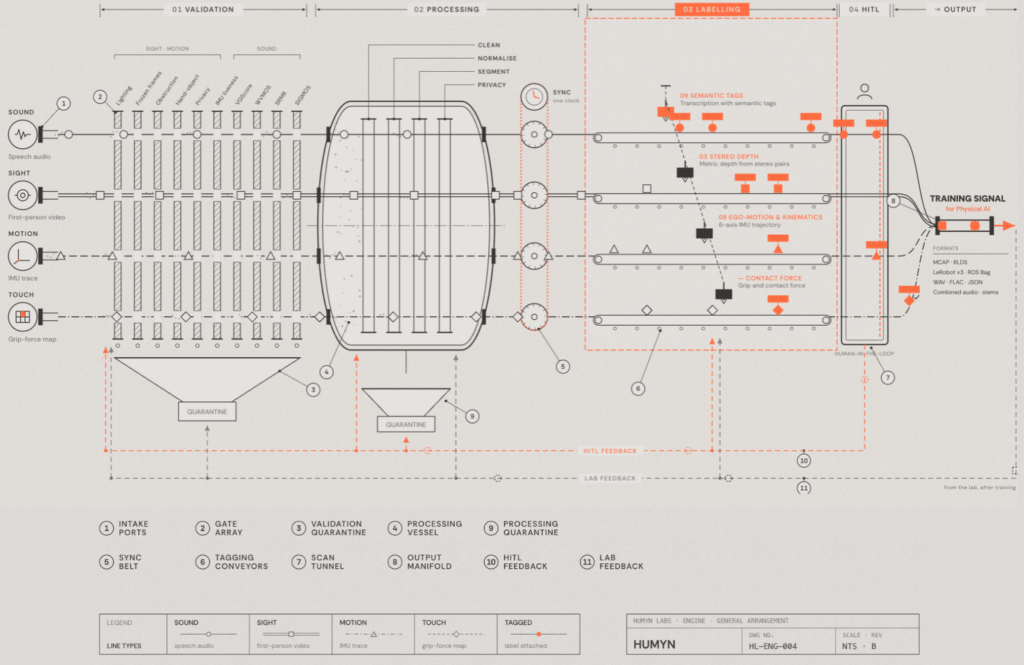
Humyn Labs raised $47 million to collect real-world training data for robots, and says it passed $50 million in annualized revenue within six months.
The Series A includes $26 million in equity led by Accel, with participation from Prosus Ventures, BeeGlobal, Finserv Intelligence through Bajaj Finance, Bajaj Alts AI Opportunities Fund and Dallas Venture Capital. Humyn Labs works with frontier AI labs, robotics companies and world-model developers, using its own data capture and enrichment operations across more than 20 countries. Co-founder Ishank Gupta told The Robot Report that much of the robotics development the company saw was happening in simulated environments, and the biggest gap was taking what happens in the lab into the real world.
Read more → https://www.therobotreport.com/humyn-labs-raises-47m-to-collect-real-world-data-for-robotics/
Small & On-Device Models

Thinking Machines released Inkling 2 Mini, a 26.4-billion-parameter small model that runs 5.4 billion effective active parameters per token with a 1M-token context.
Released November 20, 2026 under Apache 2.0, it is a general-purpose multimodal model taking text and image inputs and returning text, aimed at agentic and tool-use systems, coding assistants, chatbots and retrieval-augmented generation. The middle layers run three times, and each extra pass adds about 1.0 billion effective active parameters, bringing the effective count to 5.4 billion. In internal testing the model sometimes got stuck in long reasoning loops or repeatedly re-checked its own work without progress, particularly when debugging code, so Thinking Machines recommends capping output tokens and agent turns.
Read more → https://huggingface.co/thinkingmachines/Inkling-2-Mini

Microsoft published Aion 1.0 Instruct, a 2.3-billion-parameter on-device small language model that is slated to become the Windows OS model by the end of January 2027.
Built by the Microsoft Windows Applied Sciences Group as the foundational small language model in the Windows ecosystem, it is optimised for on-device text and operating-system use cases without constant cloud connectivity. It is MIT licensed, covering English, German, Spanish, Portuguese, Italian, French, Chinese and Japanese, with PyTorch, ONNX and GGUF library support. A further optimised version of Aion Instruct, coupled with its content moderation model, will become the Windows OS SLM by the end of January 2027; the unquantised model is published first, with quantised versions to follow.
Read more → https://huggingface.co/microsoft/Aion-1.0-Instruct-2.3B

Aurora2-400M-A20M is a 400-million-parameter small model that activates only 19 million parameters per token and was pretrained from scratch on a single GPU.
It has 399,597,454 total parameters with 19,050,382 active per token, using a top-1 mixture of experts with 32 routed experts and one shared expert per layer, 12 layers, hidden size 192, a 2,048-token context and a 16,384-token vocabulary. Pretraining ran on 100 billion tokens in BF16 compute with FP32 master weights on a single RTX Pro 6000 for roughly 36 hours. It is an Apache 2.0 base model with no supervised instruction tuning or RLHF stage, built on datasets including karpathy/climbmix-400b-shuffle, finemath, Wikipedia, NuminaMath-CoT, OpenMathInstruct-2 and smoltalk.
Read more → https://huggingface.co/AuroraAI-Research/Aurora2-400M-A20M
Papers & Research

A new audit of simulated manipulation benchmarks finds their success checkers can score phantom successes and silent failures.
Simulated manipulation benchmarks label each episode success or failure using hand-written success checkers, but passing an expert demonstration only proves a checker accepts one way of completing a task — so a policy that stops after partial progress or finishes differently can be scored wrongly. SimAudit is an LLM-based pipeline that analyses the task instruction and the checker code to find scenarios where the two may disagree, recreates those scenarios in simulation, runs the original checker, then uses multi-view renderings to verify whether the observed behaviour actually satisfies the instruction. It is evaluated across RoboTwin 2.0, RoboCasa and further simulated manipulation suites.
Read more → https://arxiv.org/abs/2611.25179
After Intelligence is compiled every morning from primary sources — vendor announcements, model cards and arXiv abstracts — with every figure checked against the document that states it.