In this edition
- Frontier & Text Models (4)
- Image & Vision (1)
- Video & World Models (1)
- Audio, Voice & Music (2)
- Robots & Embodied AI (4)
- Small & On-Device Models (2)
- Papers & Research (3)
- News & Business (1)
An Anthropic mathematician says Claude helped him crack math's most famous open problem, OpenAI's chief scientist argues a compression metric should pace the whole industry, and a Seoul conglomerate prepares to rescue a humanoid startup that cannot make payroll. Also this week: Tencent's new omni-modal video family sets an open-source record, 1X commits to shipping NEO in December, and an open 27B model learns to repair a damaged copy of itself by rewriting its own weights.
Frontier & Text Models

Anthropic mathematician Levent Alpöge says he proved the Riemann Hypothesis with Claude, and hours later Stanford released an all-human competing draft.
Alpöge's method chains special mathematical transformations to mimic derivatives, with Claude determining that a number sequence of length X requires roughly the square root of X transformations. The proof, which would exceed 250,000 printed pages, was released only in Lean across 14 data packages. Hours later, Stanford's Ravi Vakil posted an independent draft of the Generalized Riemann Hypothesis by Alessandro Masullo, reviewed for months by Brian Conrad and described as entirely human. About eight hours after that, Vakil reported that several people had found problems in Masullo's draft, identified with help from other AI models. Neither proof is accepted, and the community must verify both.
OpenAI's chief scientist argues pre-training progress, measured in perplexity, should become a shared safety standard across frontier labs.
Pachocki disclosed GPT-3.5 at roughly 0.99 log-perplexity, GPT-4 at about 0.91, and current models below 0.8, the threshold where transformative capabilities in cybersecurity and mathematics emerged. He expects further transformative capabilities as models enter the 0.68-0.7 window, though he does not know what those will be. He proposes common limits, based on perplexity and other measurements, that developers commit not to cross until monitoring reaches a concrete milestone such as a successor to CoT monitors. He acknowledges that publishing the numbers gives competitors a clearer view of OpenAI's position but says that concern is outweighed by the urgency of shared safety measures.
Read more → https://openai.com/index/perplexity-and-intelligence/

NVIDIA researchers argue that a language model rarely needs an ever-larger context window, and that summaries plus lookups work about as well.
GPT-4 launched in March 2023 with 8,192 tokens; GPT 5.6 Sol now handles roughly one million, about 120 times as much and enough for Tolstoy's "War and Peace." The Nvidia team found that in many tests, periodic summaries and targeted lookups performed about as well as stuffing full documents into the window, at far lower cost.
Read more → https://the-decoder.com/nvidia-researchers-argue-huge-ai-context-windows-are-a-dead-end/

InclusionAI's LingSante-3.1-flash is a 560-billion-parameter medical mixture-of-experts language model with a 1-million-token context.
Built on Ling-3.1-flash, the model activates 25 billion parameters per token. It is trained for complex medical reasoning, healthcare communication, evidence-based deep research, and long-horizon medical tasks through native medical-mixed pretraining, mid-training, supervised fine-tuning, task-specific reinforcement learning, and multi-teacher on-policy distillation. It is released for research and evaluation and is not a medical device.
Read more → https://huggingface.co/inclusionAI/LingSante-3.1-flash
Image & Vision

Apple's Depth Pro 2 is an image model for metric monocular depth, estimating every pixel from a single photo, a whole video, or a live feed.
Depth stays sharp at object edges and stable across frames, at full input resolution. The family ships in four sizes: S (24M parameters, 97 MB), B (97M, 386 MB), L (334M, 1.3 GB), and H+ (872M, 3.5 GB). All sizes share DepthPro2-focal, a 23.5M-parameter focal-length estimator that predicts focal length when unknown. The video path processes 16 frames at a time, emitting one prediction per frame in order.
Read more → https://huggingface.co/apple/DepthPro2
Video & World Models

Tencent's WeMM-Video family sets a new open-source state of the art in omni-modal video understanding, a video model with world model grade audio-visual reasoning.
The family spans 2B, 4B, 9B and 35B-A3B variants, bilingual in Chinese and English, built for joint audio-visual perception and reasoning in a hybrid-thinking design with a fast instruct mode and a thinking mode. Training used about 1.2 trillion tokens, multi-teacher OPD, anti-repetition MrDPO and specialist RL, evaluated across more than 120 benchmarks. The flagship 35B-A3B substantially outperforms proprietary models such as Qwen3.5-Omni-Flash and Seed2.0-Mini-0428 while narrowing the gap with Gemini-3.0-Flash, and the compact 9B surpasses the larger open-source Qwen3-Omni-30B-A3B-Instruct. The family and its evaluation pipeline are public.
Read more → https://arxiv.org/abs/2611.26409
Audio, Voice & Music
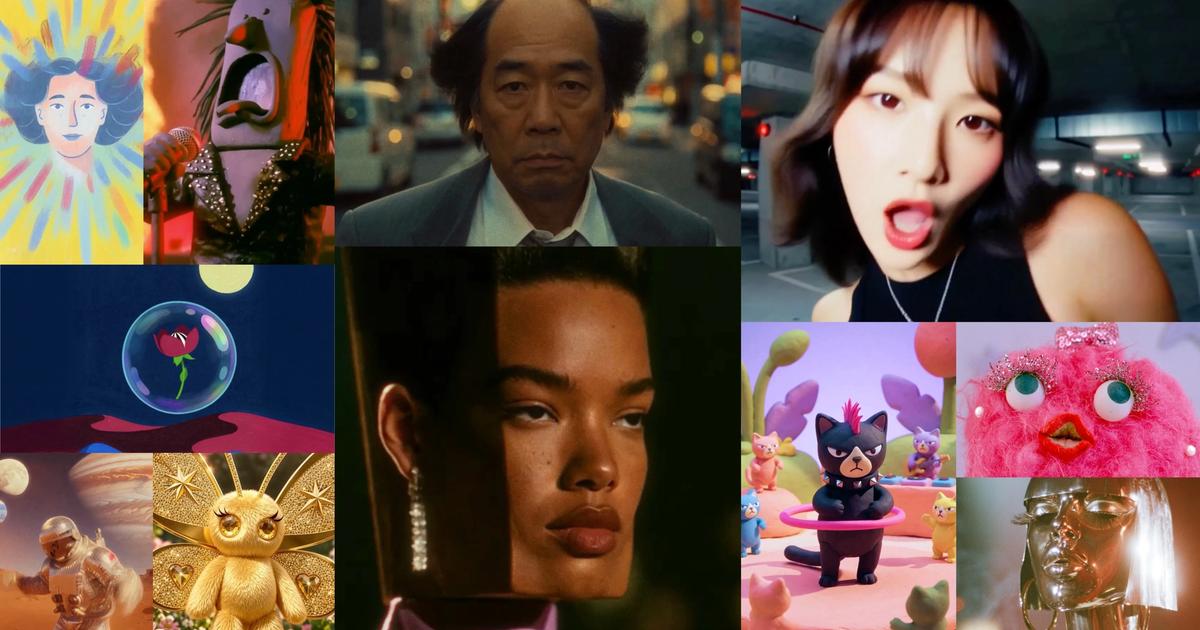
Suno's new Visuals tool turns any song into images and videos, with lip sync that follows the lyrics.
The model is optimized to complement the music, with video clips following the song's structure, picking up on the lyrics and lip syncing along with them. Users drag any song from the library into the Visuals tab to make clips up to 15 seconds long, then extend, edit and re-prompt with text. It launches on web, iOS and Android, with visual credits purchased separately from song credits. Suno added safeguards to protect artists from unauthorized use of their likenesses or works.
Read more → https://suno.com/blog/introducing-visuals

Adventists AI's Sophon-Realtime-4B-Flash runs a full-duplex voice model on a single 24 GB GPU.
The 4B member of the Sophon-Realtime family keeps the same full-duplex design as the 32B builds and uses about 21 GB of memory. It listens while you talk, decides from your voice when you have finished, writes a reply with sound tags such as [laughter] [cough] [sigh], and a lighter, faster speech model speaks the tagged reply with one forward pass per 80 ms frame. It is served as one vLLM-Omni model with /v1/realtime and /v1/chat/completions endpoints, scores 87.7 on the Full-Duplex-Bench v1.0 four-task average (94.3 for the Tag build), and reaches first audio in 0.21 s on an RTX PRO 6000. An MLX variant runs the same build locally on Apple silicon Macs with 16 GB or more.
Read more → https://huggingface.co/adventists-ai/Sophon-Realtime-4B-Flash
Robots & Embodied AI
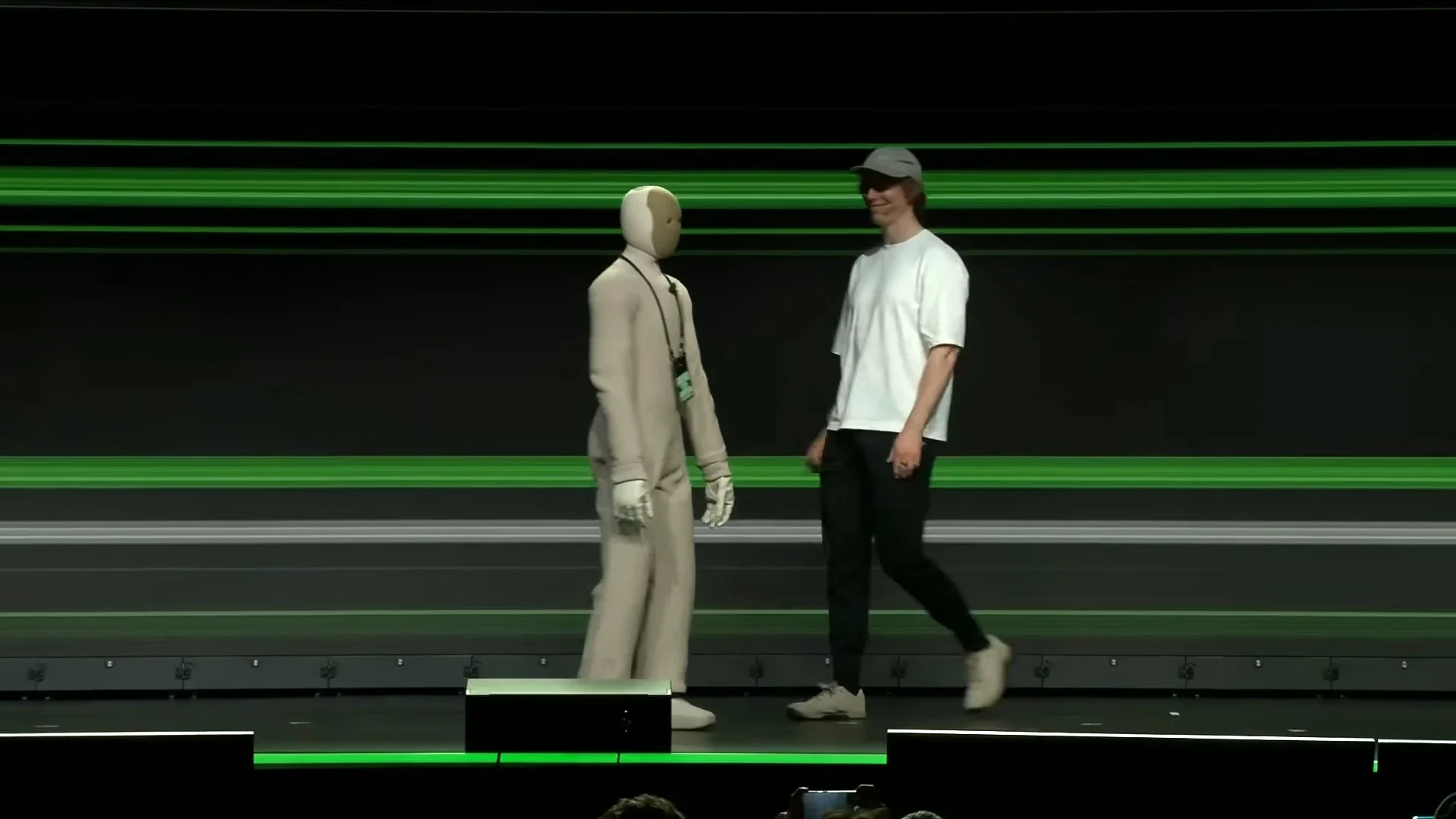
1X will ship its NEO humanoid to developers in December, recasting the home robot as a development platform.
Børnich made the commitment on stage at Runtime 2026, the San Francisco conference organized by AI cloud company Modal, saying NEO is shipping in December to developers and to some consumers. He also plans a weekly leaderboard and live robot runs, framing NEO as a development platform as much as a home robot.
Read more → https://www.humanoidsdaily.com/news/1x-neo-developers-december-runtime-2026-bornich

XPeng says its IRON humanoid will step onto the stage at AI Day on November 25 and interact live with the audience.
The event runs in Guangzhou two days before the Guangzhou Auto Show opens on November 27, with NIO holding its own technology day in the city the same date. Founder He Xiaopeng said in a Weibo post relayed by CnEVPost that XPeng will also demonstrate how its Turing AI changes the in-car experience. The current IRON was introduced at the 2025 AI Day on November 5 with the VLT model behind it, and XPeng set a 2026 target for mass production. XPeng Robotics has since raised more than US$900 million at a US$6.3 billion valuation and commissioned IRON's production line.
Read more → https://www.humanoidsdaily.com/news/xpeng-ai-day-2026-november-25-guangzhou
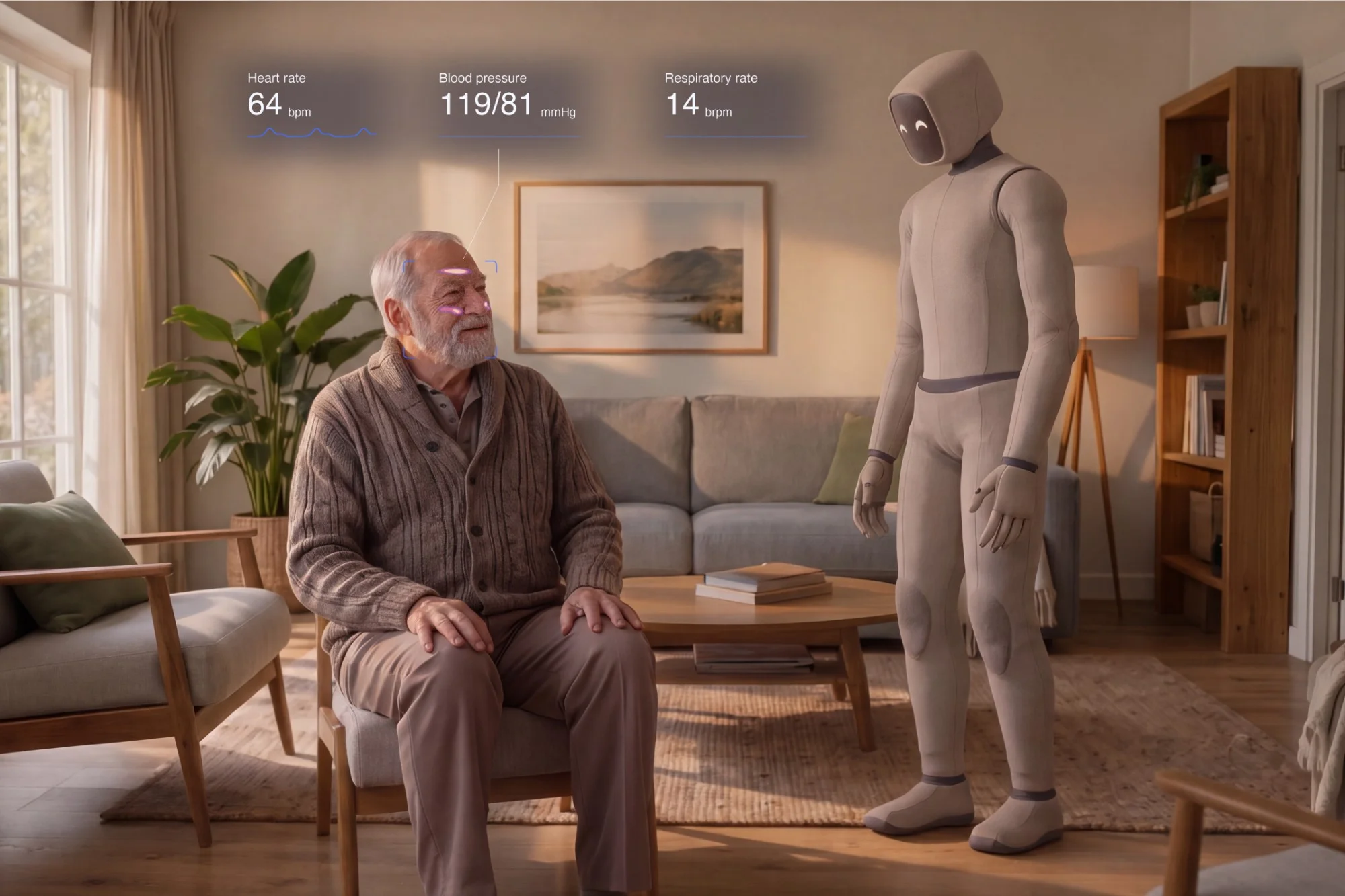
Belgian startup IntelliProve raised €2.7 million to put camera-based vital-signs reading into humanoid robots.
The Ghent-based company, founded in 2021, announced the round on November 19; it was led by Miles Ahead, a Belgian early-stage deep tech fund, with home-nursing organization Wit-Gele Kruis, the imec.istart fund and business angels participating. The software reads heart rate, heart-rate variability, respiratory rate, blood pressure and resonant breathing from a 30-second scan of a person's face with an ordinary camera, with no cuff or wearable. It is already embedded in apps of care providers, health insurers and wellbeing platforms in more than 50 countries. The company says the scan is already live on robots with partners it cannot name under NDA.
Read more → https://www.humanoidsdaily.com/news/intelliprove-2-7m-seed-camera-vital-signs-humanoid-robots
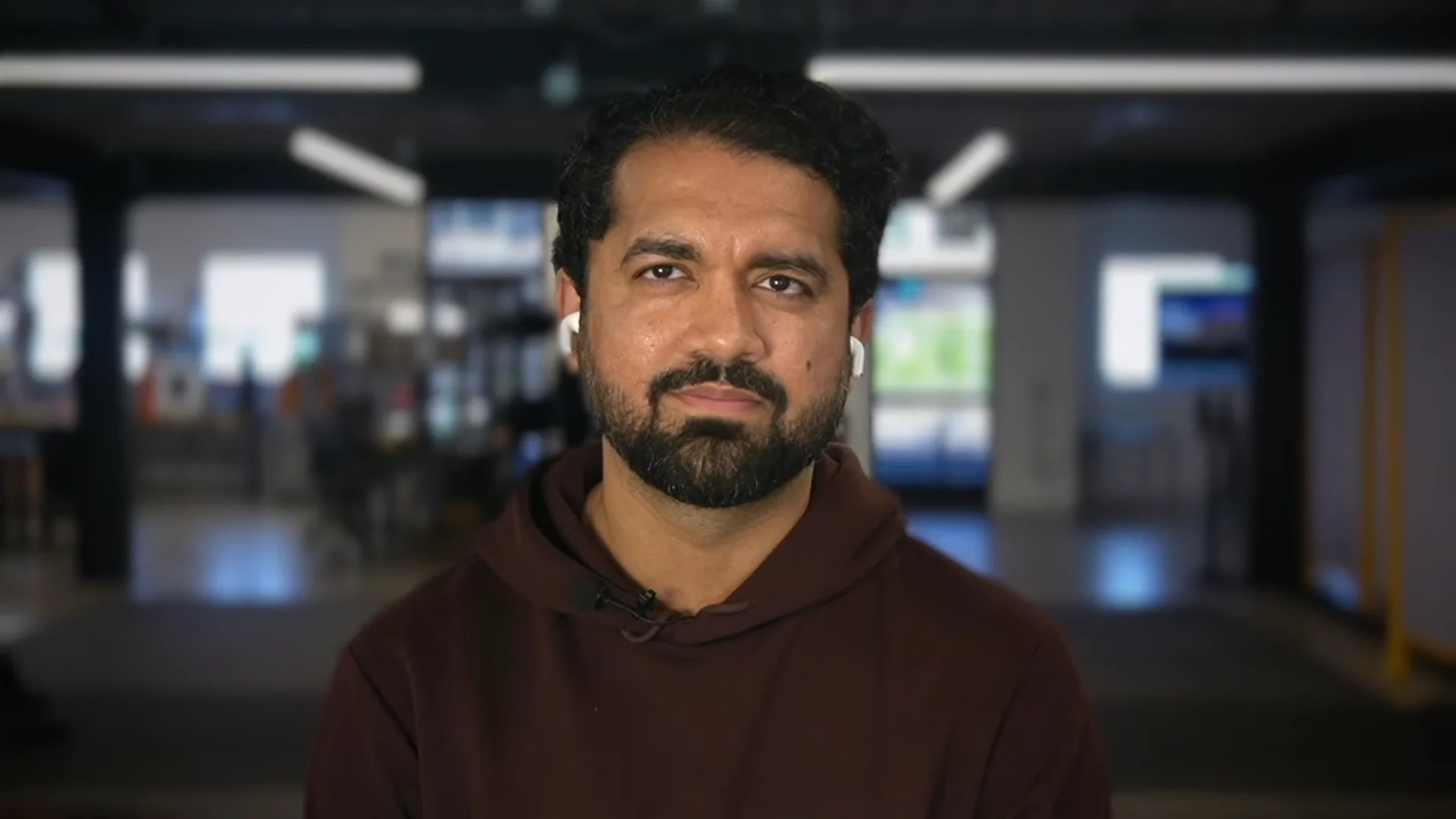
A Seoul conglomerate is preparing a $150 million lifeline for Foundation, the humanoid maker whose employees have gone unpaid since October 30.
Base Group, a conglomerate based in Seoul, is preparing to invest $150 million in Foundation Future Industries, the San Francisco maker of the military-focused Phantom humanoid, Reuters reported on November 19, citing internal emails from CEO Sankaet Pathak to employees. A Base Group spokesperson confirmed the company was considering an investment, recognizing the long-term value and growth potential of humanoid robotics. Pathak told employees in a November 8 email that the missed payroll was "a timing issue, not an existential one." The deal would include a joint venture in which Base supplies aluminum for Foundation's robots.
Read more → https://www.humanoidsdaily.com/news/foundation-base-group-150-million-investment
Small & On-Device Models
Pipecat's Sidechat is a distilled 325 MB small model that tells a voice agent when to speak, wait, or stay quiet.
It is a small experimental text classifier for a voice agent in a conversation with several people; for each line it says whether the agent should speak now, wait to see if anyone else does, or stay quiet. It runs on the CPU and speakers can be anonymous ("Speaker 1"). On the Duplex-MPE dataset of 52,336 lines, requests that name the agent are answered 99.6 percent of the time, people's lines are answered by mistake 0.2 percent of the time, and real spoken requests without the name are held for a pause 91 percent of the time. The int8 build takes 303 ms per line on one vCPU and downloads at 325 MB.
Read more → https://huggingface.co/pipecat-ai/sidechat

RadixArk's DaisyRose-27B is a distilled small-model post-train of Qwen3.8-27B, built with reinforcement learning only — no supervised fine-tuning, no distillation from a teacher.
It is RadixArk's first model: a multimodal reasoning model trained on about 1,200 curated long-horizon agent tasks, with sessions of up to 1 million tokens, for 18 days on 144 H200 GPUs. Terminal Bench 4.1 pass@1 rises from 5.6 on the base model to 12.0. It keeps the base model's architecture, tokenizer and chat template, image understanding and 256K-token context, making it a drop-in replacement for Qwen3.8-27B. Weights are released under Apache-2.0 in BF16, FP8 and NVFP4.
Read more → https://huggingface.co/RadixArk/DaisyRose-27B
Papers & Research

A paper shows an open 27B language model rewriting its own weights by its own reasoning, with no gradients and no training.
Given its weights, graded answers, and the ability to run itself, the model diagnoses its own failures and rewrites the weights behind them. A single self-edit yields 6.6 points more accuracy on unseen problems, and across eight consecutive sessions accuracy only rises as the model tests edits on practice problems and submits only what works. It repairs a damaged copy that solves almost nothing, restoring over 80 percent of original accuracy on unseen image tasks with no retraining and without reading the original weights. The ability emerges with scale: smaller models in one family make no edit or break themselves, and only the largest improves and repairs.
Read more → https://arxiv.org/abs/2611.21885

A research paper puts coding agents in charge of training optical neural networks in situ, from camera images alone.
The method, called "optics as code," has a coding agent train an optical neural network from measurements alone through a harness that returns camera images of probes and requires a hypothesis per request. The agent forms a physical understanding of the optics and reparametrizes the network with interpretable optical elements tuned on the hardware. It outperforms gradient-free methods in classification and image encoding, approaching backpropagation through a calibrated model at a fraction of the cost, and improves with more capable models.
Read more → https://arxiv.org/abs/2611.23875

A new paper finds RL post-training in diffusion transformers is mostly activation steering with a fixed set of vectors.
A fixed set of steering vectors added to the block outputs of the frozen base model recovers 90.0 to 96.3 percent of the reward gains of six RL-tuned image models, and 89.8 and 111.9 percent on two RL-tuned video models. The vectors hold 65x fewer parameters than the RL-tuned LoRA on SD3.5-M (0.29M against 18.8M), are identical for every prompt, token, and sampling seed, and were fit to match velocity predictions with no reward in the objective. Initialized at zero and trained with online RL, the vectors alone exceed the reward gains of weight-based RL on text rendering (OCR) and human preference (PickScore).
Read more → https://arxiv.org/abs/2611.26627
News & Business

Perplexity's new Monitor API turns web search from a one-off query into a nonstop watchdog with confidence scores.
The API watches the web on a schedule and sends updates via webhook in two modes: web monitors run a search query on a regular schedule, and page monitors track up to 10 pages, storing a baseline on the first run and returning a text diff afterwards. Perplexity's decision model evaluates results against a developer-defined natural-language goal: web results must clear checks for relevance, source credibility, novelty, and timeliness, while page changes are judged on whether they matter to the goal. An update with a confidence score is sent only when every threshold is met; thresholds are adjustable per check and the goal can change without recreating the monitor.
As always: numbers are quoted from the primary sources linked above. Corrections run in the next edition.